Electronic Circuits Schematics Projects


Oscillator Circuits


Few basic things about electronic oscillator circuits.


An electronic oscillator is an electronic circuit that produces a repetitive electronic signal, often a sine wave or a square wave. The basic form of a harmonic oscillator is an electronic amplifier connected in a feedback loop, with its output fed back into its input through a filter. When the power supply to the amplifier is first switched on, the amplifier's output consists only of noise. The noise travels around the loop, being filtered and re-amplified until it increasingly resembles the desired signal. Very quickly the signal in the loop becomes a sine wave at a single frequency. A piezoelectric crystal (commonly quartz) may take the place of the filter to stabilise the frequency of oscillation, this is called a crystal oscillator. These kinds of oscillators contain quartz crystals that mechanically vibrate as resonators, and their vibration determines the oscillation frequency.

Oscillators are important in many different types of electronic equipment. For example, a quartz watch uses a quartz oscillator to keep track of what time it is. An AM radio transmitter uses an oscillator to create the carrier wave for the station, and an AM radio receiver uses a special form of oscillator called a resonator to tune in a station. Every oscillator has at least one active device (smarties don't complicate matters for me - just read on) be it a transistor or even the old valve. This active device and, for this tutorial we'll stick to the humble transistor, acts as an amplifier. There is nothing flash about that. For this first part of the discussion we will confine ourselves to LC Oscillators and I'll keep the maths to an absolute minimum. A sinusoidal oscillator produces a sine-wave output signal. Ideally, the output signal is of constant amplitude with no variation in frequency. Actually, something less than this is usually obtained. The degree to which the ideal is approached depends upon such factors as class of amplifier operation, amplifier characteristics, frequency stability, and amplitude stability.

A clapp oscillator is in effect a series tuned version of the colpitts oscillator. Perhaps the simplest Colpitts oscillator to construct and get running is the "series tuned" version, more often referred to as the "Clapp Oscillator". Because there is no load on the inductor a high "Q" circuit results with a high L/C ratio and of course much less circulating current. This aids drift reduction. Because larger inductances are required, stray inductances do not have as much impact as perhaps in other circuits.

Crystals have very high Q-factor and also better temperature stability than tuned circuits, so crystal oscillators have much better frequency stability than LC or RC oscillators. They are used to stabilize the frequency of most radio transmitters, and to generate the clock signal in computers. The Pierce oscillator circuit is often used for crystal oscillators. Because the crystal is an off-chip component, it adds some cost and complexity to the system design, but the crystal itself is generally quite inexpensive. Frequency or phase stability of an oscillator is customarily considered in the long term stability case where frequency changes are measured over minutes, hours, days even years. Of interest here are the effects of the components changes, with ambient conditions, on the frequency of oscillation. These might be caused by changes in the input voltage, variations in temperature, humidity and ageing of our components.

Sine-wave generators produce signals ranging from low audio frequencies to ultrahigh radio and microwave frequencies. Many low-frequency generators use resistors and capacitors to form their frequency-determining networks and are referred to as RC OSCILLATORS. They are widely used in the audio-frequency range. Colpitts oscillators are somewhat similar to the shunt fed Hartley circuit except the Colpitts oscillator, instead of having a tapped inductor, utilises two series capacitors in its LC circuit. With the Colpitts oscillator the connection between these two capacitors is used as the centre tap for the circuit. The Hartley oscillator is an electronic oscillator circuit that uses an inductor and a capacitor in parallel to determine the frequency. Invented in 1915 by American engineer Ralph Hartley, the distinguishing feature of the Hartley circuit is that the feedback needed for oscillation is taken from a tap on the coil, or the junction of two coils in series.

A crystal oscillator is an electronic oscillator circuit that uses the mechanical resonance of a vibrating crystal of piezoelectric material to create an electrical signal with a very precise frequency. This frequency is commonly used to keep track of time (as in quartz wristwatches), to provide a stable clock signal for digital integrated circuits, and to stabilize frequencies for radio transmitters and receivers. The most common type of piezoelectric resonator used is the quartz crystal, so oscillator circuits designed around them became known as "crystal oscillators." An oscillator can be thought of as an amplifier that provides itself (through feedback) with an input signal. By definition, it is a nonrotating device for producing alternating current, the output frequency of which is determined by the characteristics of the device. The primary purpose of an oscillator is to generate a given waveform at a constant peak amplitude and specific frequency and to maintain this waveform within certain limits of amplitude and frequency.

Crystal oscillators are oscillators where the primary frequency determining element is a quartz crystal. Because of the inherent characteristics of the quartz crystal the crystal oscillator may be held to extreme accuracy of frequency stability. Temperature compensation may be applied to crystal oscillators to improve thermal stability of the crystal oscillator.

A relaxation oscillator produces a non-sinusoidal output, such as a square, sawtooth or triangle wave. It contains an energy-storing element (a capacitor or, more rarely, an inductor) and a nonlinear trigger circuit (a latch, Schmitt trigger, or negative resistance element) that periodically charges and discharges the energy stored in the storage element thus causing abrupt changes in the output waveform. Square-wave relaxation oscillators are used to provide the clock signal for sequential logic circuits such as timers and counters, although crystal oscillators are often preferred for their greater stability. Triangle wave or sawtooth oscillators are used in the timebase circuits that generate the horizontal deflection signals for cathode ray tubes in analogue oscilloscopes and television sets. In function generators, this triangle wave may then be further shaped into a close approximation of a sine wave. Ring oscillators are built of a ring of active delay stages. Generally the ring has an odd number of inverting stages, so that there is no single stable state for the internal ring voltages. Instead, a single transition propagates endlessly around the ring.

A voltage controlled oscillator or as more commonly known, a vco, is an oscillator where the principal variable or tuning element is a varactor diode. The voltage controlled oscillator is tuned across its band by a "clean" dc voltage applied to the varactor diode to vary the net capacitance applied to the tuned circuit. Virtually every piece of equipment that uses an oscillator has two stability requirements, AMPLITUDE STABILITY and FREQUENCY STABILITY. Amplitude stability refers to the ability of the oscillator to maintain a constant amplitude in the output waveform. The more constant the amplitude of the output waveform, the better the amplitude stability. Frequency stability refers to the ability of the oscillator to maintain its operating frequency. The less the oscillator varies from its operating frequency, the better the frequency stability.

Colpitts oscillators, Crystal oscillators, Hartley oscillators, Voltage Controlled Oscillators (VCO), Your oscillator or any electronic project should be as state-of-the-art as is possible, consistent with your design goals. Some circuits might be frequency synthesisers with phase locked loops, automatic fine tuning circuitry AFT or, AFC in AM Receivers and automatic temperature compensation built into an oscillator circuit. 100s of circuits for every hobbyist, technician, student, and design professional. A nice reference tool which includes lots of Oscillator circuits. look at these circuit ideas, some of them may need some modification if they are to work as advertised. Ideas along with pretty good descriptions for each circuit.

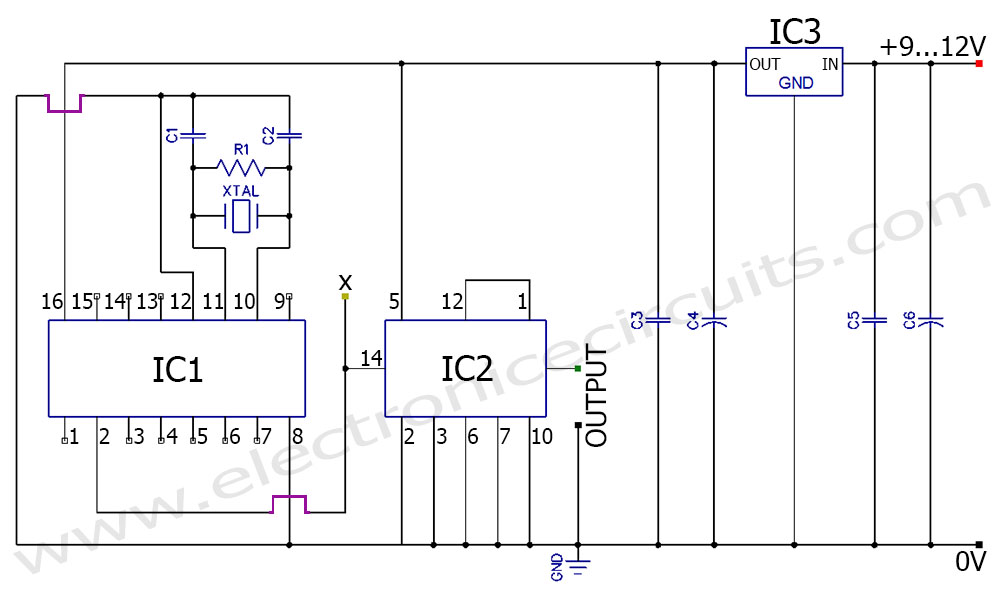
2MHz square-wave generator

With the values shown the circuit generates a 2-MHz symmetrical square wave. Changing capacitors Cl and C2 to 0.01 µ¥ results in a frequency of 500 Hz. ..


Views: 3546 | Votes: 77 | Comments: 0 | Rating: 5 | Rank: 6 | Added: Mar 31, 2013 |
Simple triangle-square wave oscillator

By making Rt variable it is possible to alter the operating frequency over a 100 to 1 range..


Views: 137 | Votes: 92 | Comments: 0 | Rating: 0 | Rank: 5 | Added: Mar 31, 2013 |
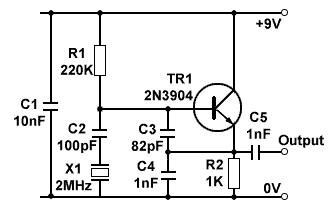
Crystal-controlled-reflection-oscillator

This unit is easily tunable and stable, consumes little power, and costs less than other types of oscillators tlmt operate at the same frequencies. This unusual combination of features is made possible by a design concept that includes operation of the transistor well beyond the 3 dB frequency of its currentversus- frequency curve. The concept takes advantage of newly available crystals that resonate at frequencies up to about 1 GHz. ..


Views: 27 | Votes: 22 | Comments: 0 | Rating: 9 | Rank: 5 | Added: Mar 31, 2013 |
International crystal oscillator

International Crystal OF-1 HI oscillator circuit for third-overtone crystals..


Views: 1298 | Votes: 4 | Comments: 0 | Rating: 8 | Rank: 5 | Added: Mar 30, 2013 |
Multiplying pulse widths circuit

A circuit for multiplying the width of incoming pulses by a factor greater or less than unity is simple to build and has the feature that the multiplying factor can be selected by adjusting one potentiometer only. The multiplying factor is determined by setting the potentiometer in the feedback of a 741 amplifier. The input pulses of width r and repetition period is used to trigger a sawtooth generator at its rising edges to produce the waveform e2 having a peak value of.....


Views: 465 | Votes: 93 | Comments: 0 | Rating: 4 | Rank: 5 | Added: Mar 27, 2013 |
Discrete-sequence-oscillator

The swept-frequency oscillator offers an inexpensive source of discrete frequencies for use in testing digital circuits. In this configuration, the circuit generates an 80-second seguence of eight frequencies, dwelling for 10 seconds on each frequency. You can change the dwell time or the number of frequencies. Frequencies can range from 0.005 Hz to 1 MHz. The programmable crystal oscillators, PXOs, IC2 and IC4 can each generate 57 frequencies in response to an 8-bit.....


Views: 13 | Votes: 37 | Comments: 0 | Rating: 7 | Rank: 5 | Added: Mar 26, 2013 |
Precise wave generator

The positive and negative peak amplitude is controllable to an accuracy of about ± 0.01 V by a dc input. Also, the output frequency and symmetry are easily adjustable. The oscillator consists of an integrator and two comparators—one comparator sets the positive peak and the other the negative peak of the triangle wave. If R1 is replaced by a potentiometer, the frequency can be varied over at least a 10 to 1 range without affecting amplitude. Symmetry is also.....


Views: 1516 | Votes: 102 | Comments: 0 | Rating: 3 | Rank: 5 | Added: Mar 25, 2013 |
Stable Start-Stop Oscillator

Oscillators that generate a predetermined number of pulses are often required in applications such as video wo..


Views: 12 | Votes: 93 | Comments: 0 | Rating: 4 | Rank: 5 | Added: Mar 25, 2013 |
Improved Cmos Multivibrator Circuit

This circuit uses a protective resistor R2 in conjunction with feedback resistor Rl. Together, they form a voltage divider to reduce the input voltage amplitude for ICl-a so that the protective diodes never conduct. ..


Views: 13 | Votes: 24 | Comments: 0 | Rating: 0 | Rank: 5 | Added: Mar 25, 2013 |
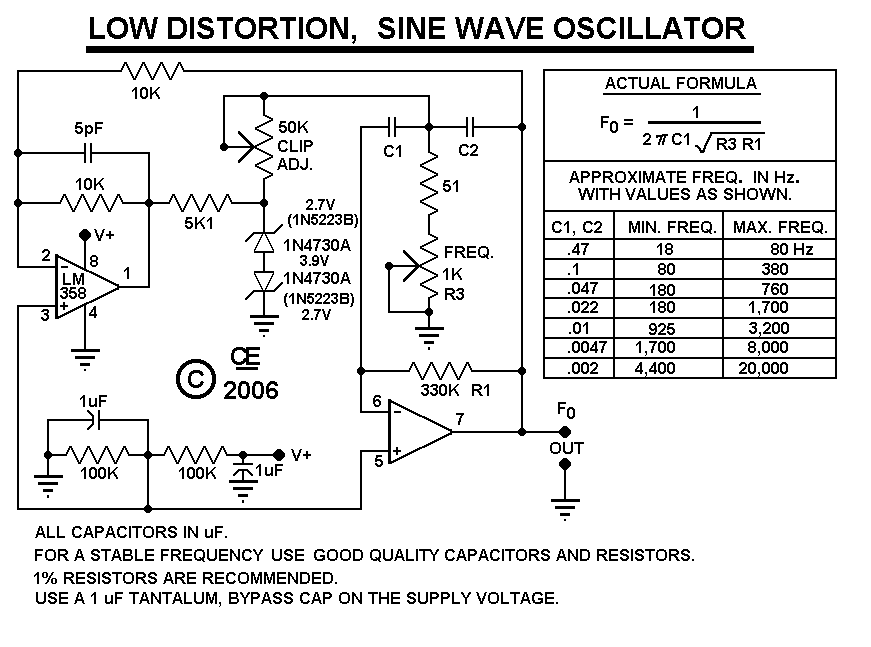
Wien Bridge Sine Wave Oscillator Circuit

This Wien-bridge sine-wave oscillator uses a 2N3819 as an amplitude stabilizer...


Views: 64 | Votes: 69 | Comments: 0 | Rating: 2 | Rank: 5 | Added: Mar 23, 2013 |
RF-powered sidetone oscillator

A sidetone oscillator is a special audio astable multivibrator. Keying is accomplished oscillator that is turned on and off with the by applying a positive dc potential, developed transmitter. The oscillator is rf-driven and bat- from the rf signal, to the reset terminal of the tery operated..


Views: 3410 | Votes: 49 | Comments: 0 | Rating: 3 | Rank: 5 | Added: Mar 17, 2013 |
Jfet pierce crystal oscillator

The JFET Pierce crystal oscillator allows a wide frequency range of crystals to be used without circuit modification..


Views: 2380 | Votes: 73 | Comments: 0 | Rating: 3 | Rank: 5 | Added: Mar 17, 2013 |
Astable multivibrator IIV

The circuit with independent control of "ON" and "OFF" periods uses the CA3130 BiMOS op amp for filters, oscillators, and long-duration timers...


Views: 5239 | Votes: 43 | Comments: 0 | Rating: 6 | Rank: 5 | Added: Mar 14, 2013 |
Function Generator With Lt1016 Circuit

This function generator, based on an LT1016 high-speed comparator, will generate from a single +5-V supply...


Views: 12 | Votes: 18 | Comments: 0 | Rating: 7 | Rank: 5 | Added: Mar 14, 2013 |
Non-integer programmable pulse divider

In applications where the period of the input pulses is uneven and the divider is required to cover a wide range of frequencies, the non-integer programmable pulse divider shown can be used. The purpose of the D-type flip-flop (IC2) is to synchronize the input signal with the clock pulse. When the clock pulse changes from low to high and the input is high, IC2 output goes high. Subsequently, IC3 resets to zero and starts counting up...


Views: 2257 | Votes: 44 | Comments: 0 | Rating: 0 | Rank: 3 | Added: Mar 13, 2013 |
S/R Flip-Flop

This circuit combines the characteristics of an asynchronous S/R flip-flop and an edge-triggered JK flip-flop. It changes sta..


Views: 4 | Votes: 101 | Comments: 0 | Rating: 3 | Rank: 5 | Added: Mar 11, 2013 |
Crystal controlled butler oscillator

A typical Butler oscillator (20-100 MHz) uses an FET in the second stage; the circuit is not reliable with two bipolars. Sometimes two FETs are used..


Views: 4763 | Votes: 17 | Comments: 0 | Rating: 7 | Rank: 5 | Added: Mar 10, 2013 |
Rf-genie

A variable oscillator covers 3.2 to 22 MHz in two bands—providing coverage of 80 through 15 meters plus most crystal-filter frequencies. Optional 455 kHz and 10.7 MHz crystal oscillators can be switched on-line for precise if alignment. Generator output is on the order of 4 volts p-p into a 500 ohm load...


Views: 3159 | Votes: 10 | Comments: 0 | Rating: 1 | Rank: 5 | Added: Mar 9, 2013 |
Astable multivibrator

The capacitor C will charge through Ra and Rb, and then discharge through Rb only..


Views: 593 | Votes: 5 | Comments: 0 | Rating: 3 | Rank: 5 | Added: Mar 8, 2013 |
Simple Rf Test Oscillator Circuit

A simple oscillator for IF alignment (455 kHz) can prove useful in field testing or where a standard signal generator is available...


Views: 14 | Votes: 65 | Comments: 0 | Rating: 0 | Rank: 5 | Added: Mar 8, 2013 |