


9V Power Supply For Garage Shed Alarm
#9V power supply
#garage alarm
#burglar alarm
#single-zone alarm
#security circuit
#power supply
#alarm system
#shed security
#circuit diagram
#DIY alarm
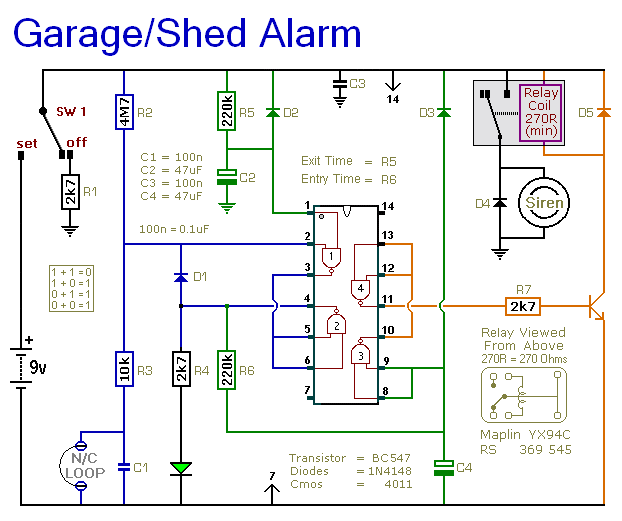
Description: The following circuit illustrates a 9V power supply for a garage shed alarm circuit diagram. Features include a single-zone burglar alarm circuit that is used with the system.
The 9V power supply circuit for the garage shed alarm is designed to provide a stable voltage source for the operation of the alarm system. This circuit typically consists of a transformer, a rectifier, and a voltage regulator to ensure that the output voltage remains constant at 9 volts, even with variations in input voltage or load conditions.
The transformer steps down the AC mains voltage to a lower AC voltage suitable for the rectification process. Following this, the rectifier converts the AC voltage to pulsating DC voltage. A smoothing capacitor is often included in the circuit to reduce the ripple in the DC output, providing a more stable voltage level.
To ensure the output voltage does not exceed 9V, a voltage regulator is integrated into the circuit. This component maintains the output voltage at a fixed level, regardless of fluctuations in input voltage or load current. The regulator may be a linear type, such as the 7809 voltage regulator, which is commonly used for such applications.
The alarm circuit itself is designed as a single-zone burglar alarm, meaning it monitors a single area for unauthorized entry. It typically includes a motion detector or door/window sensors that trigger the alarm when an intruder is detected. The alarm may be an audible siren or a visual indicator, such as flashing lights, to alert the owner of a breach.
In summary, this circuit combines a reliable 9V power supply with a single-zone burglar alarm system, making it suitable for use in a garage shed or similar environments, ensuring both security and functionality.The following circuit shows about 9V Power Supply For Garage Shed Alarm Circuit Diagram. Features:single-zone burglar alarm circuit, used with the ..
The 9V power supply circuit for the garage shed alarm is designed to provide a stable voltage source for the operation of the alarm system. This circuit typically consists of a transformer, a rectifier, and a voltage regulator to ensure that the output voltage remains constant at 9 volts, even with variations in input voltage or load conditions.
The transformer steps down the AC mains voltage to a lower AC voltage suitable for the rectification process. Following this, the rectifier converts the AC voltage to pulsating DC voltage. A smoothing capacitor is often included in the circuit to reduce the ripple in the DC output, providing a more stable voltage level.
To ensure the output voltage does not exceed 9V, a voltage regulator is integrated into the circuit. This component maintains the output voltage at a fixed level, regardless of fluctuations in input voltage or load current. The regulator may be a linear type, such as the 7809 voltage regulator, which is commonly used for such applications.
The alarm circuit itself is designed as a single-zone burglar alarm, meaning it monitors a single area for unauthorized entry. It typically includes a motion detector or door/window sensors that trigger the alarm when an intruder is detected. The alarm may be an audible siren or a visual indicator, such as flashing lights, to alert the owner of a breach.
In summary, this circuit combines a reliable 9V power supply with a single-zone burglar alarm system, making it suitable for use in a garage shed or similar environments, ensuring both security and functionality.The following circuit shows about 9V Power Supply For Garage Shed Alarm Circuit Diagram. Features:single-zone burglar alarm circuit, used with the ..
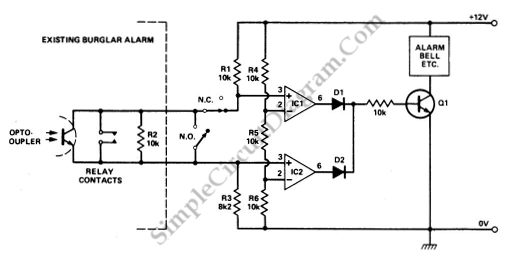
Burglar Alarm Works for Both N.O and N.C Contacts
Unlike other alarm circuits that provide only normally-open or normally-closed configurations, this alarm circuit works for both configurations. The circuit is designed to enhance flexibility in alarm systems.
This dual-configuration alarm circuit utilizes a versatile relay that can be set to...
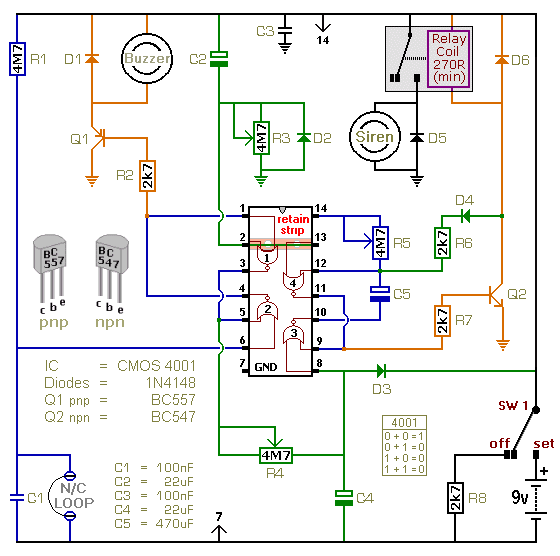
A Battery Powered Burglar Alarm With A Timed Siren Cut-Off
This is a single-zone alarm system featuring independently adjustable Exit, Entry, and Siren Cut-Off timers. It is compatible with standard normally-closed input devices such as magnetic-reed contacts, foil tape, and passive infrared sensors (PIRs). A mains power supply can be...
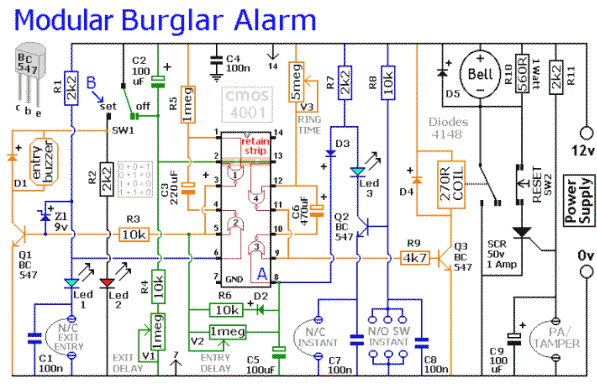
Modular Burglar Alarm Project
This circuit includes automatic exit and entry delays along with a timed bell cut-off feature. It accommodates both normally-closed and normally-open contacts, and it has a 24-hour personal attack/tamper zone. The circuit is permanently connected to a 12-volt supply and...
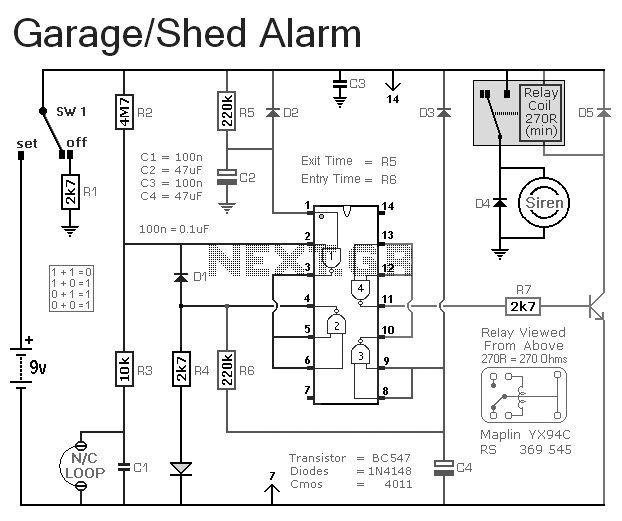
Shed/Garage Alarm
This is a simple single-zone burglar alarm circuit. Its features include automatic exit and entry delays. It is designed to be used with the usual types of normally-closed input devices such as magnetic reed contacts, micro switches, foil tape, and...
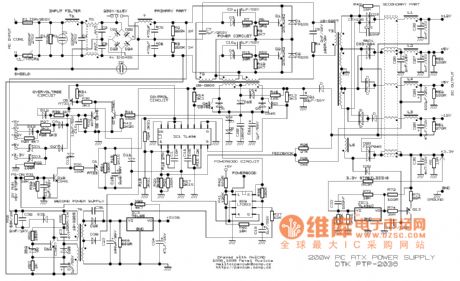
Switching Regulator Circuit
This example presents a switch DC regulated power supply circuit designed for buck-mode +5V applications. It consists of a power supply circuit, an impulsator, a voltage sampling or pulse width modulation circuit, and a buffering driver circuit, as illustrated in...
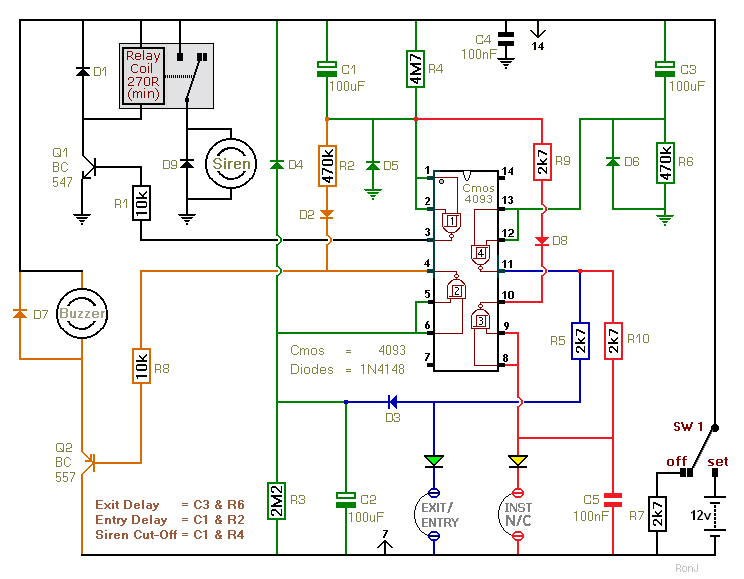
Two-Zone Alarm
This is a two-zone alarm system featuring automatic exit, entry, and siren cut-off timers. It can be activated by standard normally-closed input devices such as magnetic reed contacts, foil tape, and passive infrared sensors (PIRs). The circuit is designed to...
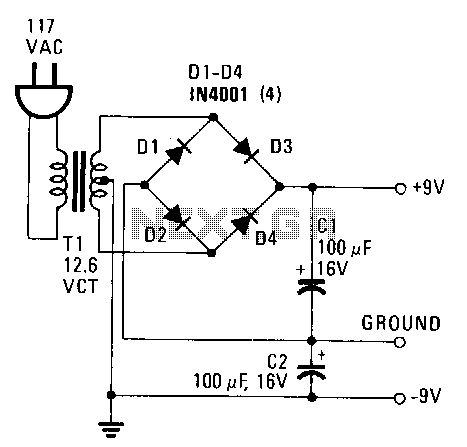
Simple-power-supply
This power supply provides both +9 V and -9 V outputs to replace two 9-V batteries. The rectifier circuit consists of two separate full-wave rectifiers, each connected to the secondary winding of the transformer. The first full-wave rectifier, made up...
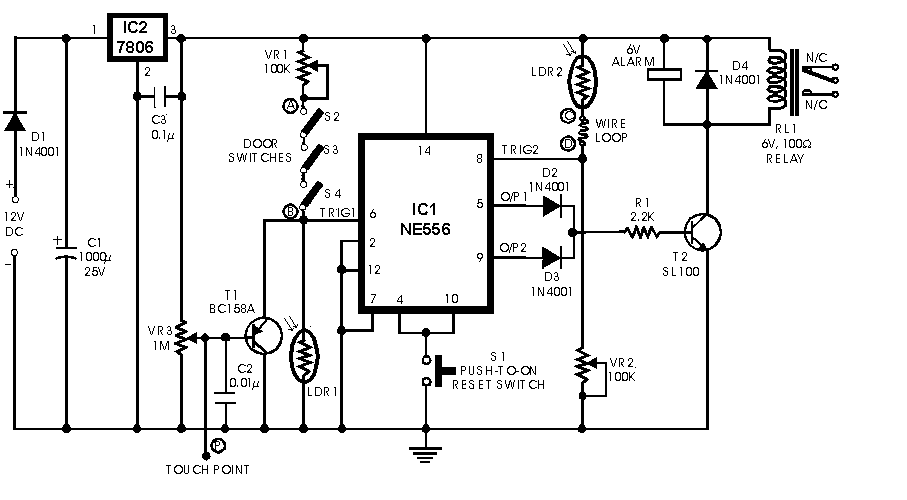
4 i n 1 burglar alarm circuit diagram
In this circuit, the alarm is activated under four different conditions: 1. When light falls on LDR1 (located at the entry to the premises). 2. When light falling on LDR2 is obstructed. 3. When door switches are opened or a...
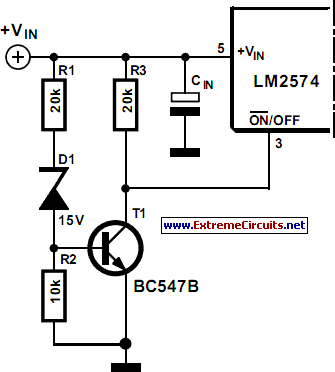
Soft Start For Switching Power Supply
A switching power supply that has an output voltage significantly lower than its input voltage exhibits a unique characteristic: the current drawn from the supply is less than the output current. However, the input power (UI) is, naturally, greater than...