


Car Park Aid Circuit
#infrared
#distance sensor
#LED indicator
#parking aid
#automotive
#safety
#proximity sensor
#circuit design
#resistors
#indoor use
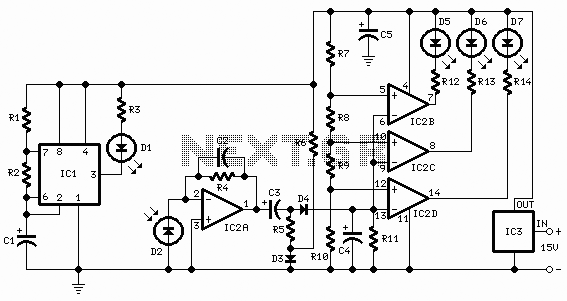
Description: The Park Aid system utilizes three LEDs to indicate the distance of a bumper barrier through infrared operation, designed for indoor use. The circuit diagram includes the following components: R1 (10K 1/4W resistor), R2, R5, R6, R9 (1K 1/4W resistors), R3 (33R 1/4W resistor), R4, R11 (1M 1/4W resistors), R7 (4K7 1/4W resistor), and R8 (1K5 1/4W resistor).
The Park Aid system is designed to assist users in parking by providing visual feedback on the proximity of obstacles. The circuit operates using infrared (IR) technology, which is effective for indoor applications where direct line-of-sight is often available.
The three LEDs serve as indicators, illuminating in response to varying distances detected by the IR sensor. The resistors included in the circuit are essential for controlling the current flowing through the LEDs and other components, ensuring that they operate within safe limits.
Resistor R1, with a value of 10K ohms, is likely used for biasing purposes, while the 1K ohm resistors (R2, R5, R6, R9) may be used in various parts of the circuit to stabilize the voltage levels. R3, a 33 ohm resistor, may be used to limit the current in specific sections of the circuit, preventing damage to sensitive components. The 1M ohm resistors (R4, R11) can serve as pull-down or pull-up resistors, ensuring that the inputs to the circuit are at a defined state when not actively driven. R7, with a resistance of 4.7K ohms, and R8, at 1.5K ohms, also play roles in current limiting and voltage division as necessary.
In summary, this Park Aid circuit is a straightforward yet effective design that leverages infrared technology and LED indicators to provide users with a visual representation of distance to obstacles, enhancing safety and convenience during parking maneuvers.Park Aid Three LEDs signal bumper-barrier distance Infra-red operation, indoor use Circuit diagram: Parts: R1 10K 1/4W Resistor R2,R5,R6,R9 1K 1/4W Resistors R3 33R 1/4W Resistor R4,R11 1M 1/4W Resistors R7 4K7 1/4W Resistor R8 1K5 1/4W Res..
The Park Aid system is designed to assist users in parking by providing visual feedback on the proximity of obstacles. The circuit operates using infrared (IR) technology, which is effective for indoor applications where direct line-of-sight is often available.
The three LEDs serve as indicators, illuminating in response to varying distances detected by the IR sensor. The resistors included in the circuit are essential for controlling the current flowing through the LEDs and other components, ensuring that they operate within safe limits.
Resistor R1, with a value of 10K ohms, is likely used for biasing purposes, while the 1K ohm resistors (R2, R5, R6, R9) may be used in various parts of the circuit to stabilize the voltage levels. R3, a 33 ohm resistor, may be used to limit the current in specific sections of the circuit, preventing damage to sensitive components. The 1M ohm resistors (R4, R11) can serve as pull-down or pull-up resistors, ensuring that the inputs to the circuit are at a defined state when not actively driven. R7, with a resistance of 4.7K ohms, and R8, at 1.5K ohms, also play roles in current limiting and voltage division as necessary.
In summary, this Park Aid circuit is a straightforward yet effective design that leverages infrared technology and LED indicators to provide users with a visual representation of distance to obstacles, enhancing safety and convenience during parking maneuvers.Park Aid Three LEDs signal bumper-barrier distance Infra-red operation, indoor use Circuit diagram: Parts: R1 10K 1/4W Resistor R2,R5,R6,R9 1K 1/4W Resistors R3 33R 1/4W Resistor R4,R11 1M 1/4W Resistors R7 4K7 1/4W Resistor R8 1K5 1/4W Res..
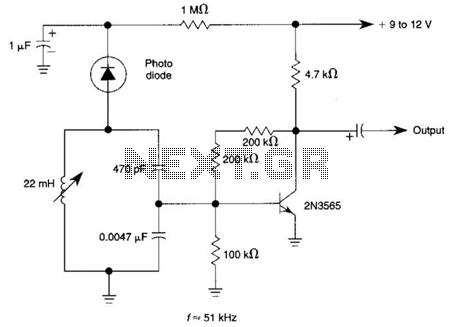
Selective Preamplifier For Infrared Photodiode Circuit
The circuit utilizes a tuned circuit for frequency selection, designed to operate at approximately 51 kHz. The 2N3565 transistor amplifies the output generated by the tuned circuit.
The described circuit operates on the principle of resonance, where the tuned circuit is...
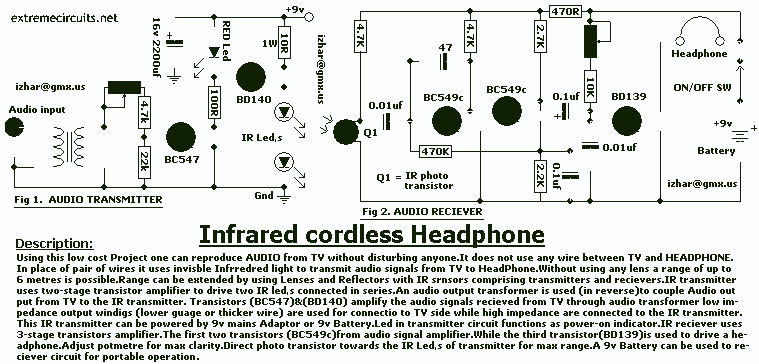
Infrared cordless Headphone Amplifier
Using this low cost project, one can reproduce audio from a TV without disturbing anyone. It does not use any wire between the TV and headphones. Instead of a pair of wires, it uses invisible infrared light to transmit audio...
Circuits
To prevent soldering errors, students were instructed to place all their resistors on the board first. Once their placements were verified, they could proceed with soldering. Capacitors were next, followed by LEDs and other components. The middle school class demonstrated...
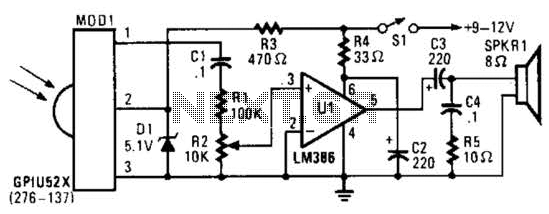
Ir Pulse To Audio Converter Circuit
This circuit utilizes an infrared pulse-to-audio converter to assist in troubleshooting infrared remote controls, making it an effective tool for detecting infrared light sources. It employs a photo cell module (Radio Shack P/N 276-137) to detect IR radiation and drive...
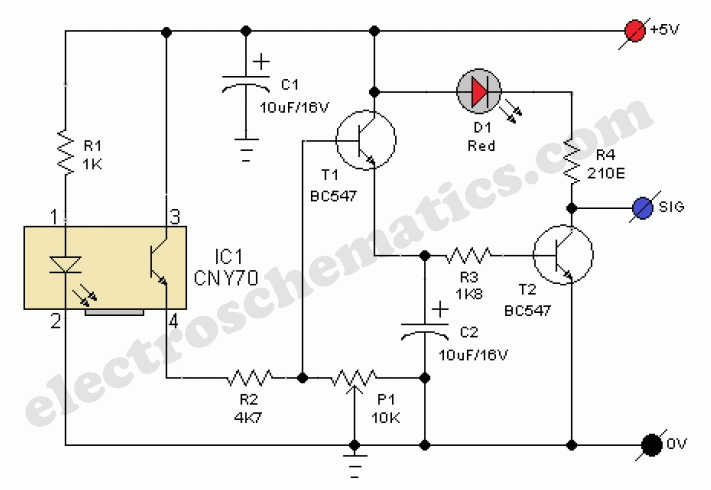
Proximity Sensor Circuit
This presence detector or proximity sensor circuit responds to the presence of any conductive object, including humans. The sensitivity can be adjusted with potentiometer P1, which is positioned at a considerable distance from the rest of the circuit. This circuit...
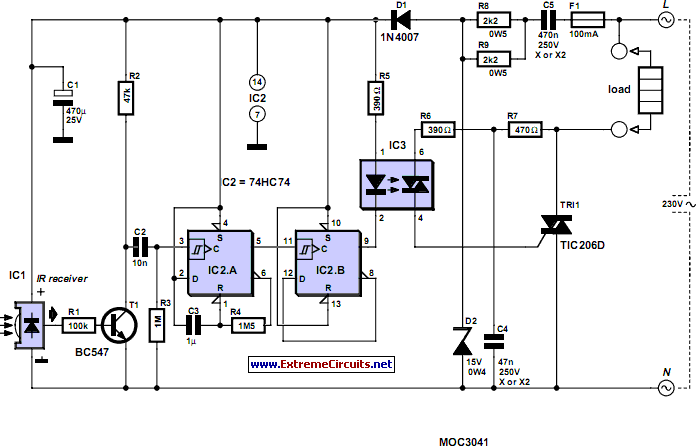
On-off Infrared Remote Control circuit
Most homes today have at least a few infrared remote controls, whether for the television, video recorder, stereo, or other devices. Despite this, many individuals have experienced frustration when a light remains on after settling into a comfortable chair to...
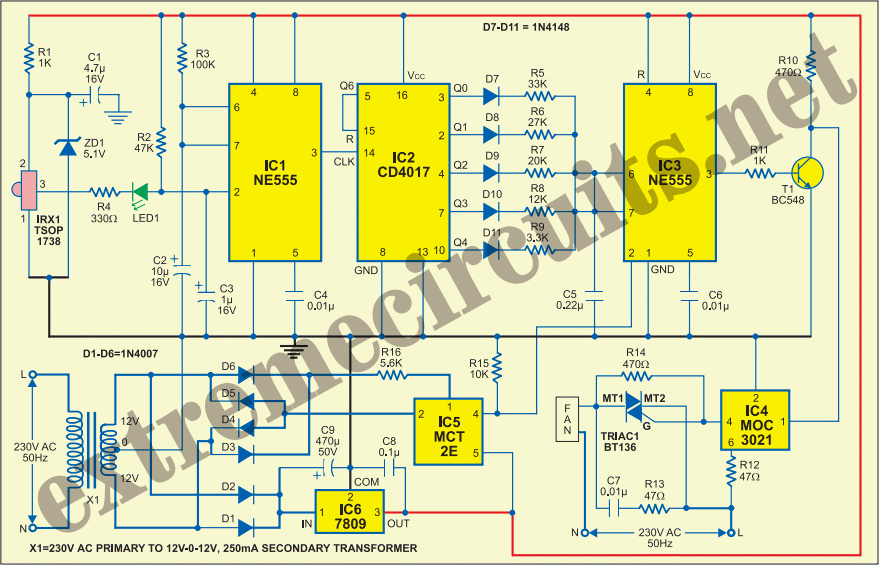
Remote-Controlled Fan Regulator
This circuit allows for the adjustment of a fan's speed from a distance, such as from a couch or bed. It utilizes an infrared receiver module TSOP1738 to capture the infrared signals sent by a remote control. The circuit operates...
Infrared light trap circuit
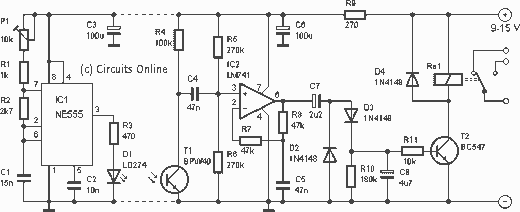
This infrared light valve has more parts, so it works better and more reliable for alarms. The circuit responds less ambient light. The light valve consists of a transmitter and a receiver. The transmitter consists of a NE 555 which...
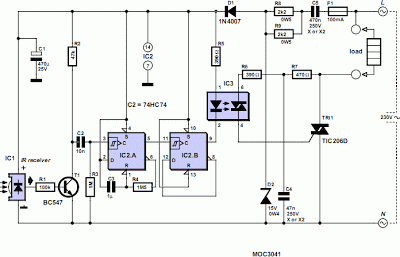
On-off Infrared Remote Control
Most homes today have several infrared remote controls, such as those for televisions, video recorders, and stereos. However, many individuals have experienced frustration when lights remain illuminated after settling into a comfortable chair to watch a movie. This project aims...