


DOOR AJAR MONITOR
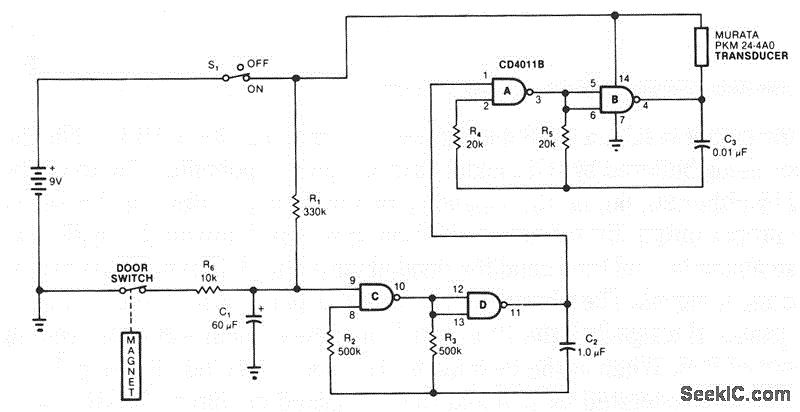
Description: The monitor detects an open door, and if the condition is not rectified within 20 seconds, it triggers a beeping alarm. The circuit operates using a magnetic reed switch and a magnet positioned on the door. When the door is closed, the switch remains closed, and the alarm is disabled. Upon opening the door, the switch opens, allowing capacitor C1 to charge through resistor R1. Approximately 20 seconds later, the alarm activates.
The circuit design involves a magnetic reed switch (SW1) that is mounted on the door frame, aligned with a magnet (M1) attached to the door itself. When the door is closed, the magnet holds the reed switch in a closed position, preventing current from flowing to the alarm (A1). In this state, the capacitor (C1) remains discharged, and the alarm is inactive.
When the door is opened, the magnetic field is disrupted, causing the reed switch to open. This action initiates the charging of capacitor C1 through resistor R1, which is connected in series with the switch. The time constant of the RC circuit formed by R1 and C1 determines the delay before the alarm activates. The time constant (τ) can be calculated using the formula τ = R1 × C1, where R1 is the resistance in ohms and C1 is the capacitance in farads.
After approximately 20 seconds, once the voltage across C1 reaches a threshold level, it triggers the alarm circuit, causing the beeping sound to alert individuals nearby. The alarm will continue to sound until the door is closed again, which will reset the circuit by closing the reed switch and discharging the capacitor.
This design offers a simple yet effective solution for monitoring door status and ensuring security by providing an audible alert in the event of unauthorized access. The components used in this circuit should be selected based on the required voltage and current ratings to ensure reliable operation. Additionally, the circuit can be powered using a low-voltage DC supply, making it suitable for battery-operated applications.The monitor senses an ajar door and, if the situation isn`t corrected within 20 seconds, sounds a beeping alarm. The circuit is controlled by a magnetic reed switch and magnet on the door. With the door closed, the switch is closed and the alarm is disarmed. Opening the door opens switch, C1 starts charging up through R1. Approximately 20 seconds later, th..
The circuit design involves a magnetic reed switch (SW1) that is mounted on the door frame, aligned with a magnet (M1) attached to the door itself. When the door is closed, the magnet holds the reed switch in a closed position, preventing current from flowing to the alarm (A1). In this state, the capacitor (C1) remains discharged, and the alarm is inactive.
When the door is opened, the magnetic field is disrupted, causing the reed switch to open. This action initiates the charging of capacitor C1 through resistor R1, which is connected in series with the switch. The time constant of the RC circuit formed by R1 and C1 determines the delay before the alarm activates. The time constant (τ) can be calculated using the formula τ = R1 × C1, where R1 is the resistance in ohms and C1 is the capacitance in farads.
After approximately 20 seconds, once the voltage across C1 reaches a threshold level, it triggers the alarm circuit, causing the beeping sound to alert individuals nearby. The alarm will continue to sound until the door is closed again, which will reset the circuit by closing the reed switch and discharging the capacitor.
This design offers a simple yet effective solution for monitoring door status and ensuring security by providing an audible alert in the event of unauthorized access. The components used in this circuit should be selected based on the required voltage and current ratings to ensure reliable operation. Additionally, the circuit can be powered using a low-voltage DC supply, making it suitable for battery-operated applications.The monitor senses an ajar door and, if the situation isn`t corrected within 20 seconds, sounds a beeping alarm. The circuit is controlled by a magnetic reed switch and magnet on the door. With the door closed, the switch is closed and the alarm is disarmed. Opening the door opens switch, C1 starts charging up through R1. Approximately 20 seconds later, th..
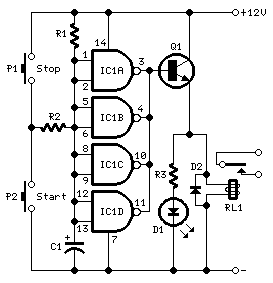
long delay timer schematics
This timer is designed to automatically switch off a portable radio after a set period, allowing users to relax without worrying about battery drain. Resistor R1 and capacitor C1 create a long time constant. When switch P2 is momentarily closed,...
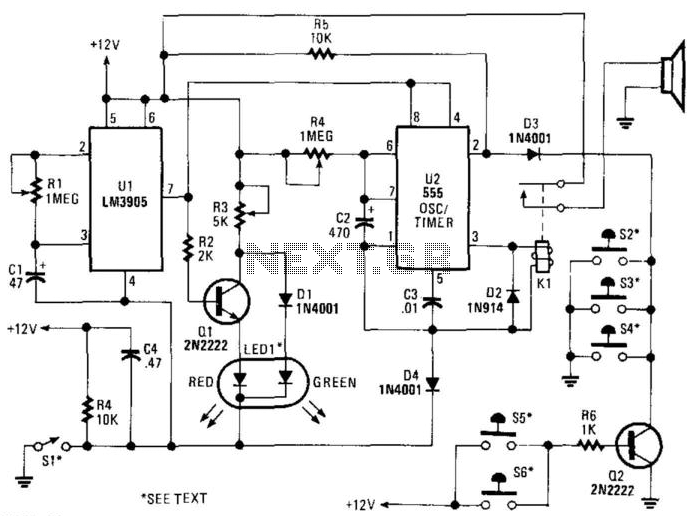
Auto Alarm
SI is an external key switch. The alarm allows a delay of 0 to 45 seconds after SI is operated before the circuit is armed. During this period, LED1 lights up green. After this delay, LED1 lights red, indicating that...
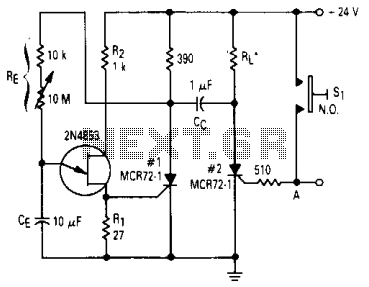
Timer circuit
After one cycle of operation, SCR1 will be activated, resulting in a low voltage being applied to the UJT emitter circuit, which interrupts the tuning function. When pushbutton SI is pressed, or a positive pulse is applied at point A,...
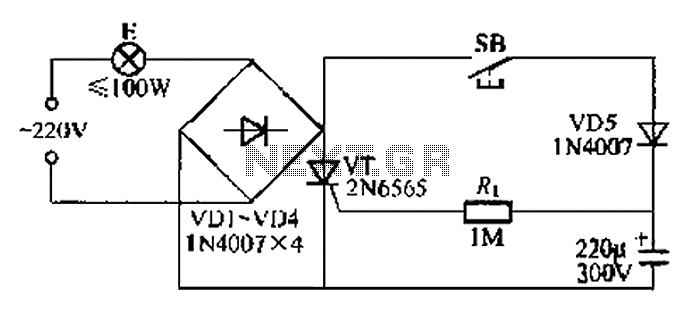
Simple light delay circuit 3
This circuit is a simple connection delay lamp circuit. When the lights are turned on and the switch is pressed, the power supply is activated. The capacitor charges rapidly, causing the thyristor (VT) to open, which in turn lights up...
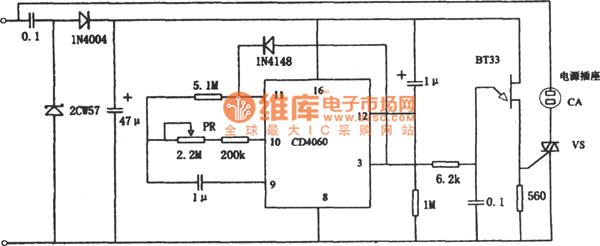
Preset Outage Timer of Electric Cooker Remote_Control
The figure illustrates a preset outage timer circuit designed for an electric cooker. The timing range of the circuit extends from 1 hour to 12 hours, adjustable via a potentiometer (PR). The timing mode operates on a counting basis, and...
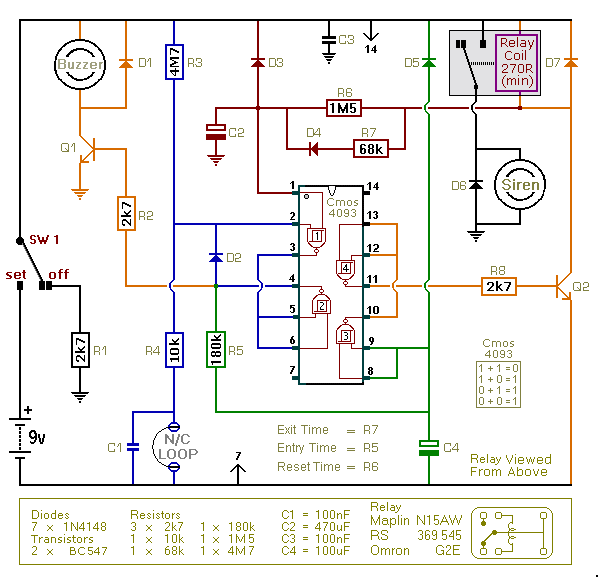
Enhanced Alarm
This is an enhanced version of the simple Garage/Shed Alarm. The entry and exit delays have been increased to approximately 30 seconds, and a timed siren cut-off and automatic reset have been added. The LED has been replaced with an...
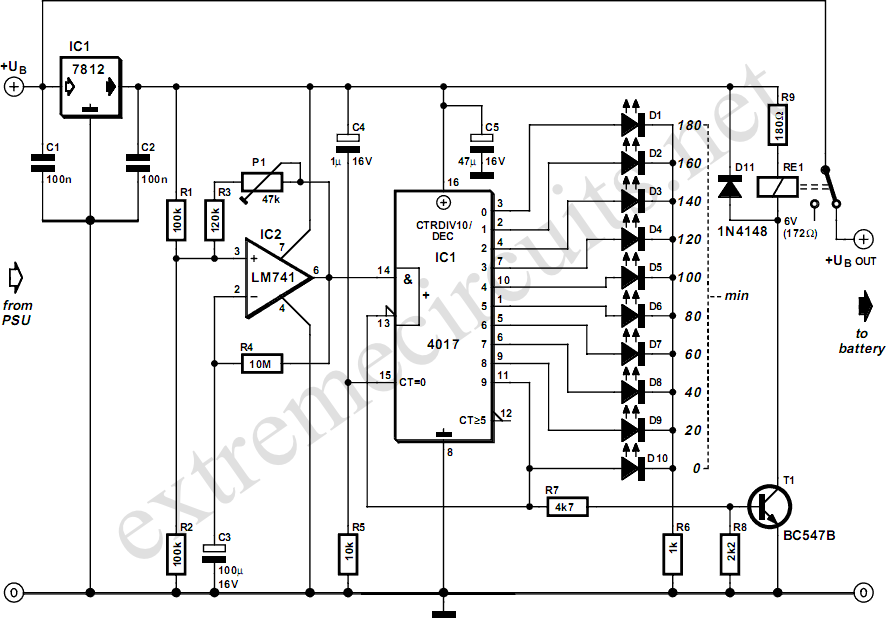
Three Hour Timer
Manufacturers of cordless drills typically recommend a battery charging time of three hours. After this time, the battery should be disconnected from the charger to prevent the risk of overcharging. The following circuit is designed to prevent this scenario by...
Magic Wand Conjuring Trick.s
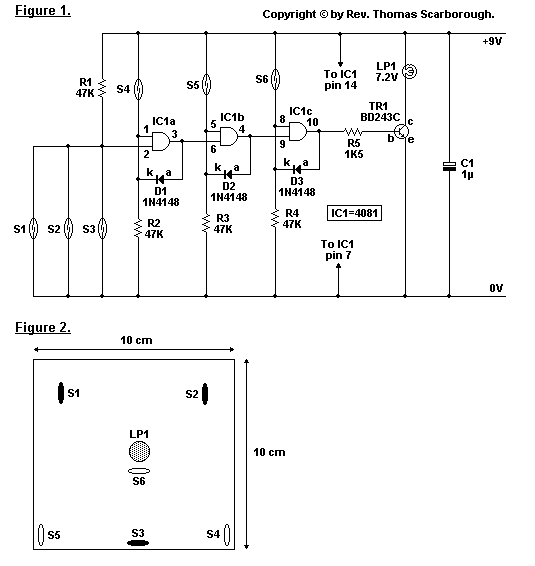
The simple conjuring trick illustrated is designed to provide enjoyment for beginners in electronics or magic, and it should take only one to two hours to construct. The trick operates as follows: a wand, equipped with a magnet at one...
Delay On Circuit
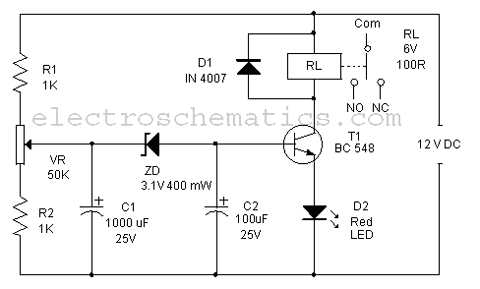
Protect your LCD or Plasma TV with this small delay-on circuit. The SMPS-based power supply of these modern electronic devices is susceptible to voltage spikes.
This delay-on circuit is designed to enhance the protection of LCD and Plasma TVs by mitigating...