


Drinking Water Alarm
#water alarm
#sensor
#alert system
#home automation
#water supply
#notification
#buzzer
#timer
#public utility
#safety
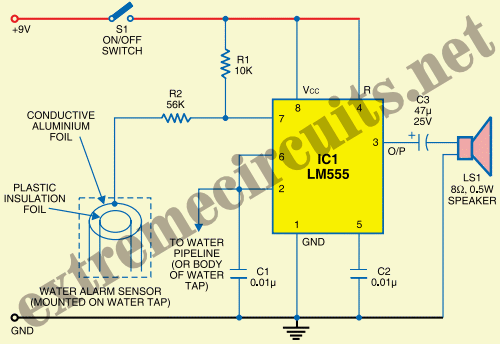
Description: The State Jal Boards provide water for a limited duration each day. The timing of water supply is determined by the management, and the public is not informed of this schedule.
The operation of State Jal Boards typically involves a network of pumps, valves, and reservoirs designed to manage water distribution efficiently. The system is controlled by a central management unit that schedules the water supply based on various factors, including demand, reservoir levels, and maintenance requirements.
To optimize the water supply process, a programmable logic controller (PLC) can be employed. This PLC can be programmed to automate the scheduling of water distribution, ensuring that supply times are consistent and that any changes in demand can be accommodated. Sensors can be integrated into the system to monitor water levels in reservoirs and detect any leaks or faults in the distribution network.
Additionally, the use of flow meters can help in tracking the amount of water supplied to different areas, allowing for better management of resources and identification of any discrepancies in water distribution. Communication systems, such as GSM modules, can be utilized to send alerts to the management team regarding supply status, enabling timely responses to any issues that may arise.
Overall, the design of the State Jal Boards' water supply system requires careful consideration of both hardware components and software algorithms to ensure reliable and efficient service to the public.The State Jal Boards supply water for limited duration in a day. Time of water supply is decided by the management and the public does not know the same
The operation of State Jal Boards typically involves a network of pumps, valves, and reservoirs designed to manage water distribution efficiently. The system is controlled by a central management unit that schedules the water supply based on various factors, including demand, reservoir levels, and maintenance requirements.
To optimize the water supply process, a programmable logic controller (PLC) can be employed. This PLC can be programmed to automate the scheduling of water distribution, ensuring that supply times are consistent and that any changes in demand can be accommodated. Sensors can be integrated into the system to monitor water levels in reservoirs and detect any leaks or faults in the distribution network.
Additionally, the use of flow meters can help in tracking the amount of water supplied to different areas, allowing for better management of resources and identification of any discrepancies in water distribution. Communication systems, such as GSM modules, can be utilized to send alerts to the management team regarding supply status, enabling timely responses to any issues that may arise.
Overall, the design of the State Jal Boards' water supply system requires careful consideration of both hardware components and software algorithms to ensure reliable and efficient service to the public.The State Jal Boards supply water for limited duration in a day. Time of water supply is decided by the management and the public does not know the same
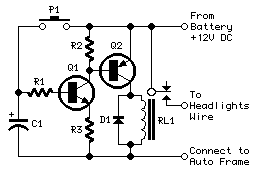
headlights timer
This device is a simple timer that keeps the headlights of a vehicle illuminated for approximately 1 minute and 30 seconds. This feature is particularly useful when accessing dark areas, eliminating the need to return to manually switch off the...
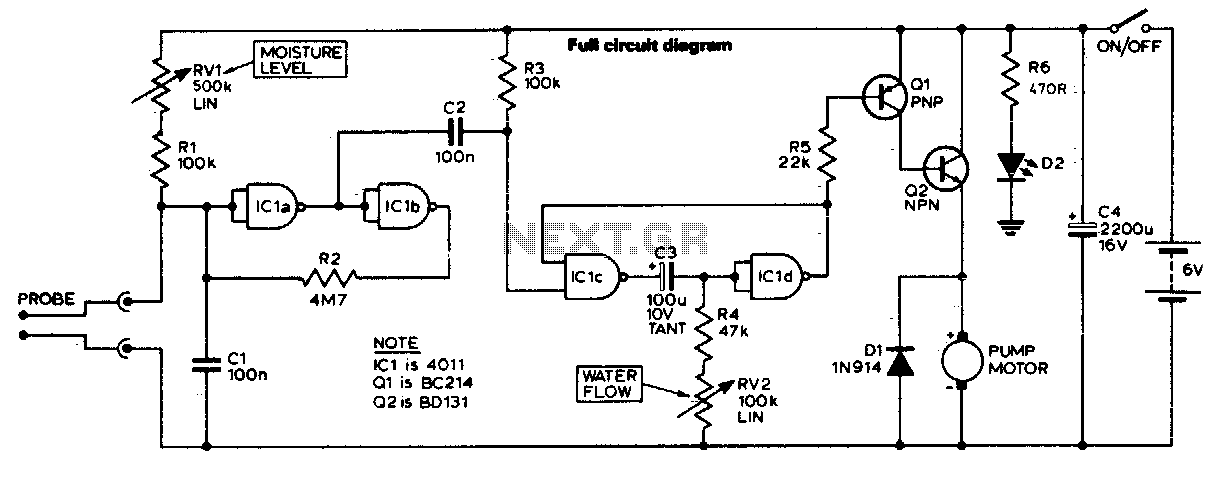
Automatic plant waterer
The unit consists of a sensor, timer, and electric water pump. The sensor is embedded in the soil, and when dry, the electronics operate the water pump for a preset time. The circuit is composed of a level-sensitive Schmitt trigger,...
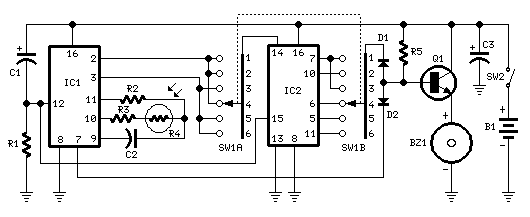
Tan Timer
This timer was designed for people wanting to get tanned but at the same time wishing to avoid an excessive exposure to sunlight. A Rotary Switch sets the timer according to six classified Photo-types (see table). A Photo resistor extends...
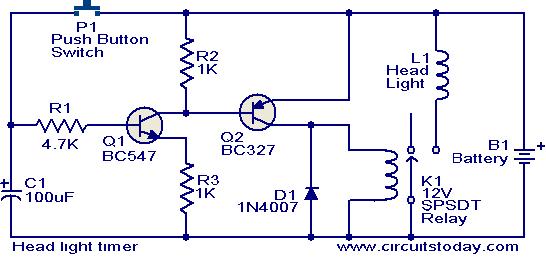
Head light timer circuit
This circuit is a compact timer that keeps the headlights of a car on for approximately 1.5 minutes before turning them off. Incorporating this circuit into a vehicle allows access to dark areas without the need to return and manually...
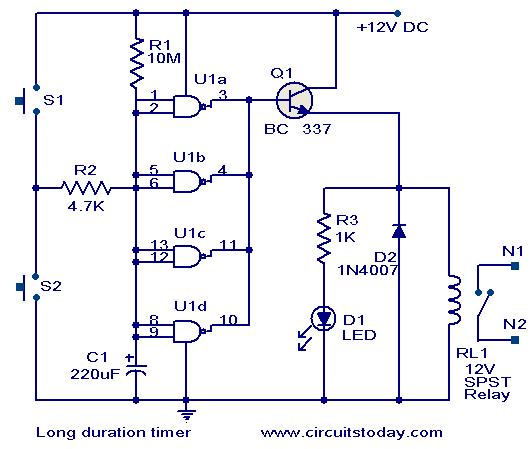
Long duration timer circuit
This timer circuit is designed to turn off a specific device after approximately 35 minutes. It can be utilized to switch off appliances such as radios, TVs, fans, and pumps after a predetermined duration of 35 minutes, contributing to significant...
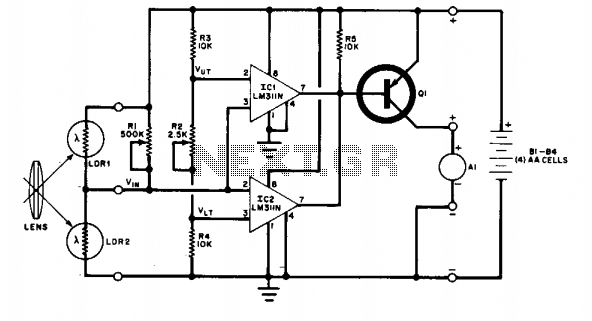
Field disturbance sensor-alarm
The change in ambient light triggers the alarm by changing the resistance of LDR1 and LDR2.
The circuit utilizes two light-dependent resistors (LDR1 and LDR2) to detect variations in ambient light levels. LDRs are passive components that exhibit a change in...
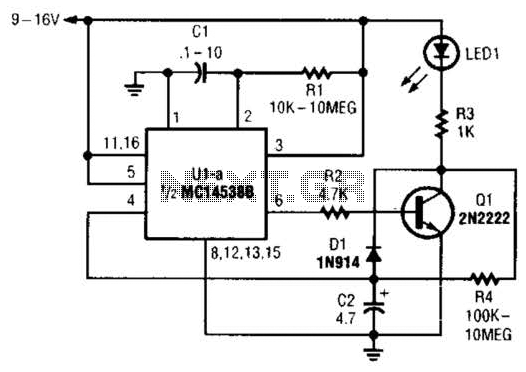
Self Retriggering Timed Generator Circuit
When power is first applied to the circuit, capacitor C2 begins to charge through LED1, resistor R3, and resistor R4. When the voltage across C2 reaches the input trigger level of operational amplifier U1, the output at pin 6 of...
Counters and Timer Circuits
AN79 Linear Technology AN79 modifies methods presented in AN74, allowing for the verification of 30 nanosecond amplifier settling times with 0.1% resolution. The sampling-based technique used is detailed, and results are presented. Appendices cover oscilloscope overdrive issues, the construction of...
A Very Useful Timed Beeper Circuit Schematic
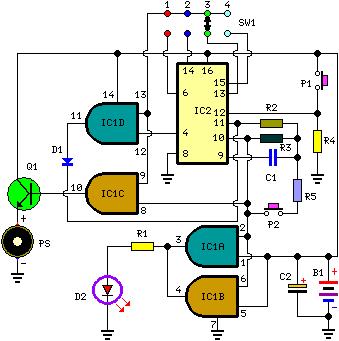
This circuit is designed to provide alerts after a predetermined time interval. It is ideal for tabletop games that necessitate a fixed duration for answering questions or moving pieces. In this context, it serves as a contemporary alternative to the...