


Electronic watchdog circuit
#Doppler effect sensor
#LM358
#KD5608
#barking sound
#security
#sensor circuit
#operational amplifier
#sound imitation
#electronic watchdog
#motion detection
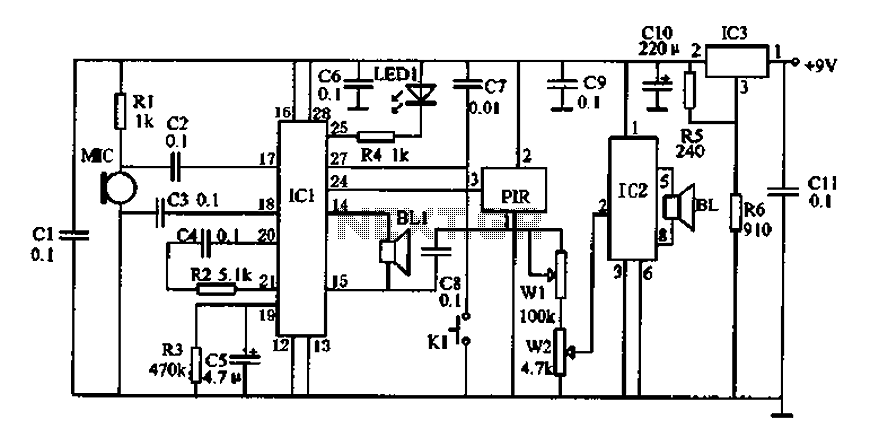
Description: Doppler effect sensor N1 (RD627), operational amplifier N2 (LM358), and a special integrated circuit for imitating dog barking (N3, KD5608) are utilized along with other components. When there is no activity detected in the monitoring area by N1, the output pin of N2 remains at a low potential, causing the transistor (VT) to be in a cutoff state, which keeps the output of N3 at a low potential, preventing it from operating. Conversely, when activity is detected in the monitoring area by N1, it outputs a low-frequency signal. This signal is amplified by N2, which causes the transistor (VT) to conduct, resulting in a positive trigger signal at the output of N3 that emulates barking. This mechanism serves to alert the owner when someone enters the monitored area, effectively functioning as an alarm system. The resistance of potentiometer RP connected to N1 can be adjusted to modify the monitoring distance.
The described circuit employs a Doppler effect sensor (N1) to detect motion within a specified area. The RD627 sensor is sensitive to changes in frequency caused by motion, allowing it to detect the presence of individuals or objects. When no motion is detected, the output remains low, ensuring that the operational amplifier (N2) remains inactive. The LM358 is configured to amplify the low-frequency signal generated by N1 when movement is detected.
The output from N2 drives a transistor (VT), which acts as a switch. In the absence of a signal, the transistor remains off, preventing current flow to the barking imitation circuit (N3). However, once the Doppler sensor detects motion, it produces a low-frequency signal that is amplified by N2. The amplified signal turns on the transistor, allowing current to flow to the KD5608 integrated circuit, which generates a barking sound to deter potential intruders.
The circuit's effectiveness can be fine-tuned by adjusting the potentiometer (RP) connected to the sensor. This adjustment alters the sensitivity of the Doppler sensor, allowing the user to set the desired monitoring distance according to the specific application requirements. The entire arrangement is designed to provide a reliable and efficient solution for security monitoring, utilizing sound as a deterrent for unauthorized entry into a designated area.Doppler effect sensor Nl (RD627), operational amplifier N2 (LM358), the sound of dogs barking imitation special integrated circuit N3 (KD5608) and other components. When nobody in Nl Monitoring area of activity, Nl of feet without signal output, O pin output N2 is low potential, VT cutoff, N3 feet of low potential instead of working. When Nl Monitoring area was activity, which pin outputs a low frequency signal, the signal amplification by N2 after making VT conduction, thus, N3s feet to get a positive trigger signal issued barking.
This activity in the region to promote sound Nl Lin as the man to leave the area, and the master alarm. Adjust RP. Nl can change the Monitor distance.
The described circuit employs a Doppler effect sensor (N1) to detect motion within a specified area. The RD627 sensor is sensitive to changes in frequency caused by motion, allowing it to detect the presence of individuals or objects. When no motion is detected, the output remains low, ensuring that the operational amplifier (N2) remains inactive. The LM358 is configured to amplify the low-frequency signal generated by N1 when movement is detected.
The output from N2 drives a transistor (VT), which acts as a switch. In the absence of a signal, the transistor remains off, preventing current flow to the barking imitation circuit (N3). However, once the Doppler sensor detects motion, it produces a low-frequency signal that is amplified by N2. The amplified signal turns on the transistor, allowing current to flow to the KD5608 integrated circuit, which generates a barking sound to deter potential intruders.
The circuit's effectiveness can be fine-tuned by adjusting the potentiometer (RP) connected to the sensor. This adjustment alters the sensitivity of the Doppler sensor, allowing the user to set the desired monitoring distance according to the specific application requirements. The entire arrangement is designed to provide a reliable and efficient solution for security monitoring, utilizing sound as a deterrent for unauthorized entry into a designated area.Doppler effect sensor Nl (RD627), operational amplifier N2 (LM358), the sound of dogs barking imitation special integrated circuit N3 (KD5608) and other components. When nobody in Nl Monitoring area of activity, Nl of feet without signal output, O pin output N2 is low potential, VT cutoff, N3 feet of low potential instead of working. When Nl Monitoring area was activity, which pin outputs a low frequency signal, the signal amplification by N2 after making VT conduction, thus, N3s feet to get a positive trigger signal issued barking.
This activity in the region to promote sound Nl Lin as the man to leave the area, and the master alarm. Adjust RP. Nl can change the Monitor distance.
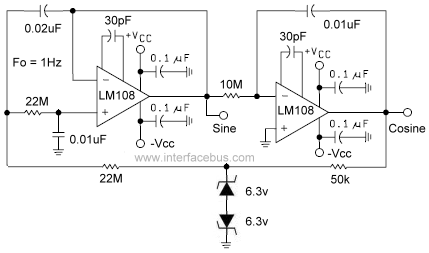
Cosine wave Oscillator
This circuit is designed to output both a sine wave and a cosine wave. The design utilizes an operational amplifier, with the output frequency determined by component values set to 1Hz. The first operational amplifier generates a 1Hz sine wave,...
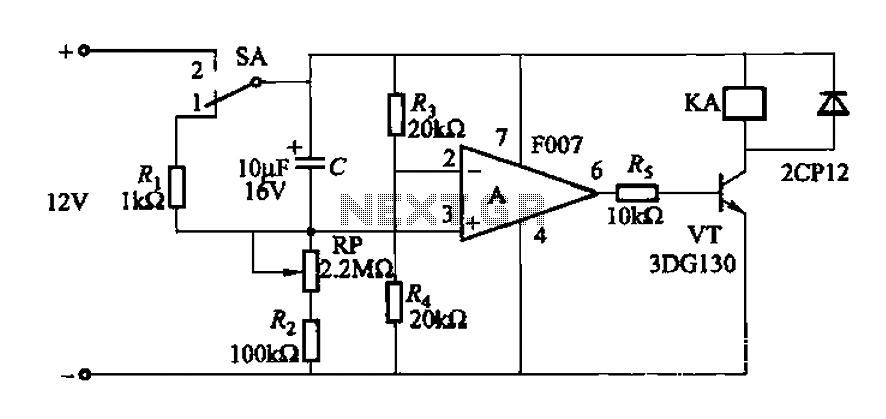
A delay circuit using an operational amplifier
A delay circuit utilizing an operational amplifier functions as a comparator, providing high timing accuracy. The timer's delay range is from 1 to 30 seconds. The delay time is determined by resistors Ri, RP, and capacitor C. By adjusting RP,...
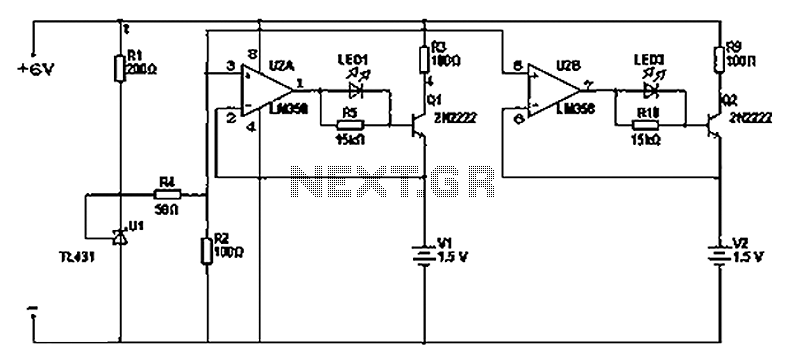
lm358 alkaline battery charger circuit
There are two differing opinions regarding the charging of alkaline batteries. Some assert that charging is effective, while others caution against it due to the risk of explosion. It is acknowledged that rechargeable alkaline batteries can typically endure 30 to...
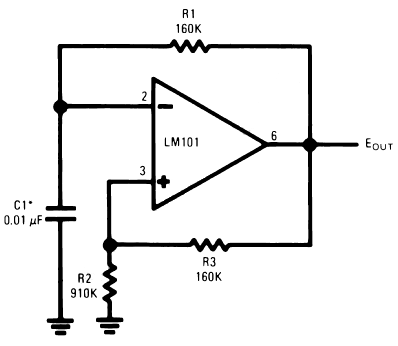
operational amplifier op amp oscillator
The timing capacitor (C1) generates multiple time constants, facilitating substantial voltage fluctuations at the input, attributable to the LM101's extensive input voltage range. It is advisable to decrease the value of resistor R2 and to increase the capacitance of C1...
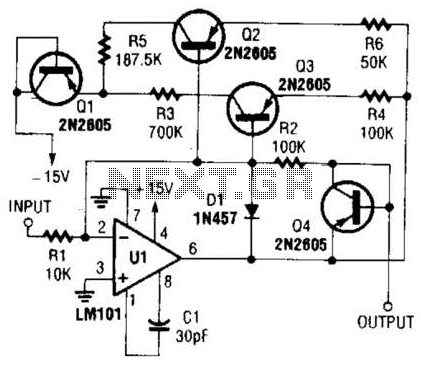
Nonlinear Operational Amplifier Circuit
This operational amplifier circuit utilizes resistor and transistor feedback elements to function as a nonlinear amplifier. The resistors R4 and R6 can be adjusted to modify the breakpoints as needed.
This operational amplifier circuit is designed to operate within the nonlinear...
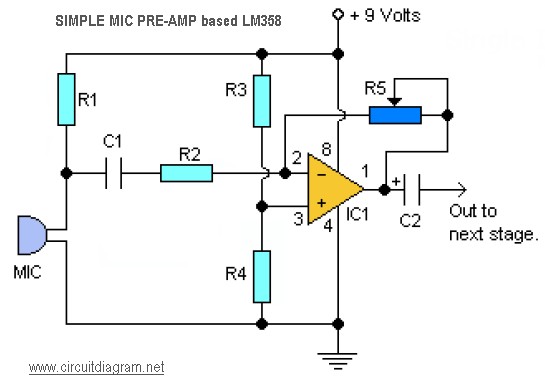
simple mic pre-amp based LM358
This is a simple audio microphone preamplifier circuit based on a single LM358 IC. The circuit is straightforward, cost-effective, and easy to construct. The component parts list includes: R1, R3, R4 = 10K; R2 = 1K; R5 = 100K-1M potentiometer;...
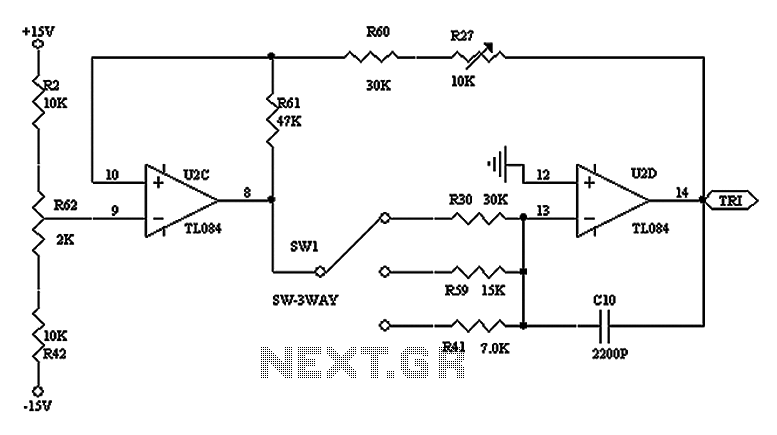
The triangular wave carrier generator circuit diagram
The triangular wave circuit consists of two operational amplifiers (OPs). R62 serves as the offset adjustment, while R27 is utilized for peak adjustment. A switch is included to select different resistances, allowing for the generation of triangular waves at varying...
Security Monitor
This circuit can be utilized in a garden setting to detect unusual sounds or wildlife noises. It can also monitor sounds around a car parked in a remote location. The cable used for the setup can either be visible or...

electronic hotel door vulnerability using stealth lock circuit
The term "pentester" refers to a penetration tester, individuals who assess security vulnerabilities. Many high-end hotels globally depend on keycard locks for securing hotel rooms. However, recent incidents of theft have shown that these locks may not be as secure...