


One infrared burglar alarm circuit
#infrared
#LED
#burglar alarm
#security system
#IR sensor
#reception circuit
#light emitting circuit
#intrusion detection
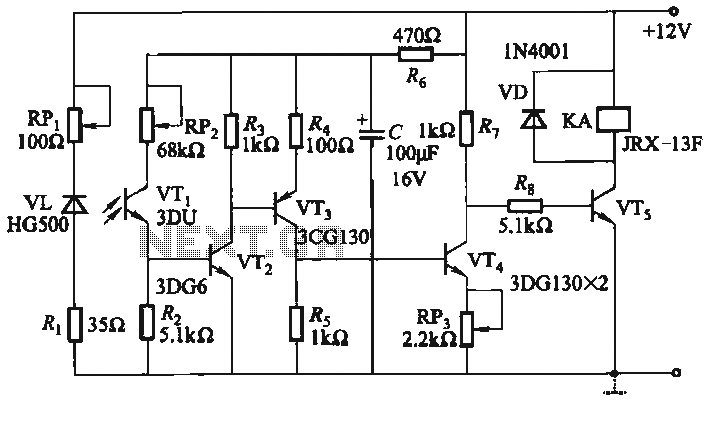
Description: The infrared alarm system utilizes an infrared LED that emits invisible light. When this light is obstructed by an object, it triggers an alarm. The system comprises an infrared light-emitting circuit and a receiving circuit. The light-emitting diode (LED) is represented by VL, and the sensitive component is a three-pole tube denoted as VTi. The switch circuit is constructed using transistors VT2 and VTs, while the actuators are represented by relay KA.
The infrared alarm system operates on the principle of detecting interruptions in a beam of infrared light. The infrared LED (VL) emits a continuous stream of infrared light that is not visible to the human eye. This light travels toward a photodetector or a sensitive three-pole tube (VTi), which is designed to detect the presence of this infrared light.
When an object, such as a person, passes through the path of the emitted infrared light, it blocks the light from reaching the photodetector. This interruption is sensed by the receiving circuit, which includes the three-pole tube (VTi). The tube is configured to respond to the absence of light by sending a signal to the switching circuit.
The switching circuit is formed by two transistors, VT2 and VTs, which work in tandem to amplify the signal generated by the photodetector. When the beam is interrupted, the transistors are activated, allowing current to flow through the circuit. This action triggers the relay (KA), which serves as the actuator for the alarm system. The relay is responsible for closing or opening a circuit, thereby activating an alarm sound, visual indicator, or any other alert mechanism linked to the system.
Overall, the infrared alarm system is a reliable and efficient method for detecting unauthorized access or movement within a designated area. Its design is compact and can be easily integrated into various applications, such as security systems for homes, offices, and restricted areas. The simplicity of the components used, along with the effectiveness of infrared technology, makes this alarm system a popular choice for enhancing security measures.Infrared alarm system is the use of infrared LED emits invisible light, when the light is blocked by the body, namely the police. It consists of an infrared light emitting circuit and reception circuit (by the infrared light-emitting diode VL, sensitive three-pole tube VTi composition), the switch circuit (composed by the transistor VT2-VTs) and actuators - relay KA composition.
The infrared alarm system operates on the principle of detecting interruptions in a beam of infrared light. The infrared LED (VL) emits a continuous stream of infrared light that is not visible to the human eye. This light travels toward a photodetector or a sensitive three-pole tube (VTi), which is designed to detect the presence of this infrared light.
When an object, such as a person, passes through the path of the emitted infrared light, it blocks the light from reaching the photodetector. This interruption is sensed by the receiving circuit, which includes the three-pole tube (VTi). The tube is configured to respond to the absence of light by sending a signal to the switching circuit.
The switching circuit is formed by two transistors, VT2 and VTs, which work in tandem to amplify the signal generated by the photodetector. When the beam is interrupted, the transistors are activated, allowing current to flow through the circuit. This action triggers the relay (KA), which serves as the actuator for the alarm system. The relay is responsible for closing or opening a circuit, thereby activating an alarm sound, visual indicator, or any other alert mechanism linked to the system.
Overall, the infrared alarm system is a reliable and efficient method for detecting unauthorized access or movement within a designated area. Its design is compact and can be easily integrated into various applications, such as security systems for homes, offices, and restricted areas. The simplicity of the components used, along with the effectiveness of infrared technology, makes this alarm system a popular choice for enhancing security measures.Infrared alarm system is the use of infrared LED emits invisible light, when the light is blocked by the body, namely the police. It consists of an infrared light emitting circuit and reception circuit (by the infrared light-emitting diode VL, sensitive three-pole tube VTi composition), the switch circuit (composed by the transistor VT2-VTs) and actuators - relay KA composition.
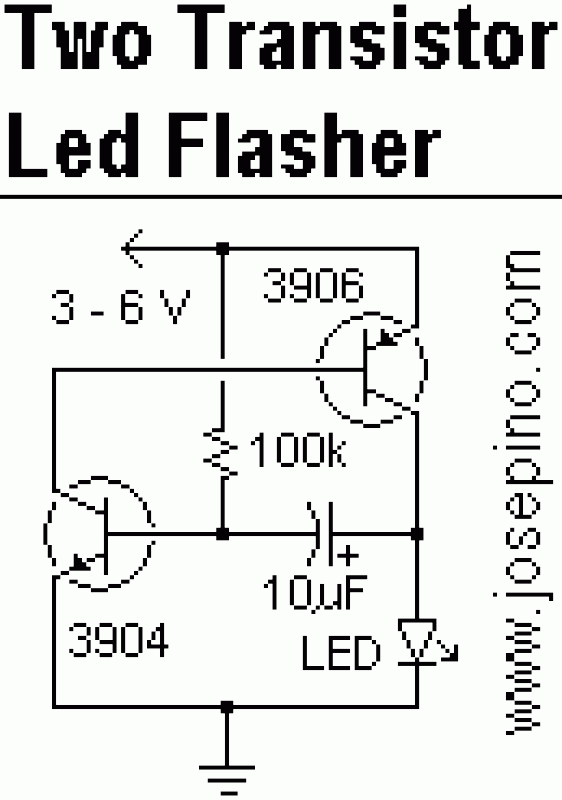
Simple 3-6V LED Flasher
If you are familiar with LED flashers using transistor, you may know the basic one uses two transistor, one capacitor and three resistors. There is other kind of oscillator called "flip-flop". As I'm starting to develop some basic circuits, I...
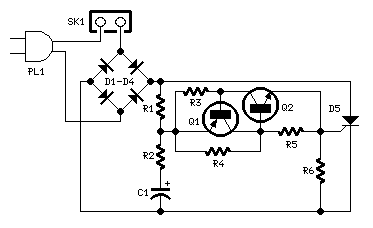
220V LED Flasher
This is a 200W lamp flasher circuit diagram. The frequency of the lamp flashing can be adjusted within a range of 1Hz to 5Hz using the PR1 variable resistor (trimpot). The duty cycle of the lamp flashing can be adjusted...

Lamp pulser circuit
This circuit is designed to gradually pulse an LED or a low-power filament lamp, creating a visual effect where the light transitions from an OFF state to full brightness and then back down to OFF. Such a circuit is particularly...

Modular Burglar Alarm Project
This circuit includes automatic exit and entry delays along with a timed bell cut-off feature. It accommodates both normally-closed and normally-open contacts, and it has a 24-hour personal attack/tamper zone. The circuit is permanently connected to a 12-volt supply and...

Infrared Remote Control Tester Circuit
Infrared Remote Control Tester Circuit. This is a simple circuit that can be built to test infrared remote controls. The circuit utilizes an...
This infrared remote control tester circuit is designed to verify the functionality of infrared remote controls commonly used...
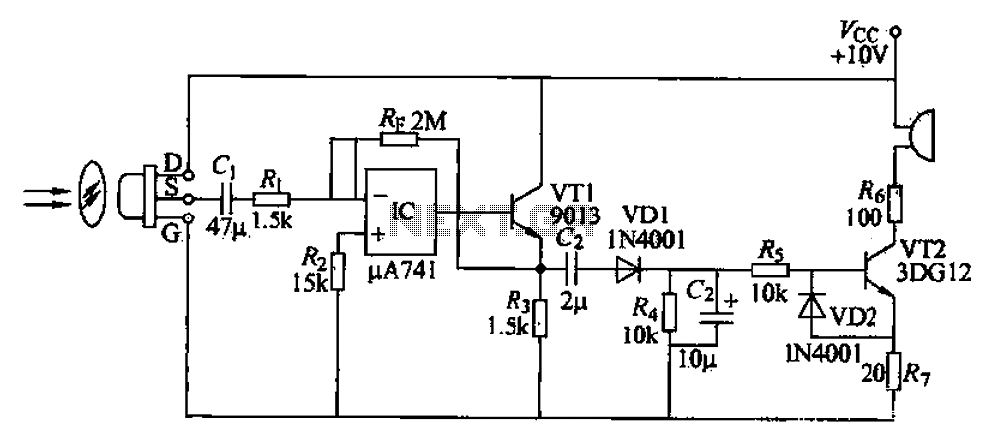
Burglar alarm circuit
A simple burglar alarm circuit utilizes a pyroelectric sensor (IRA-E100SZI). When human movement is detected, it triggers an electric buzzer alarm. The sensor receives signals through an AC amplifier, which is then converted by a rectifier circuit into a DC...
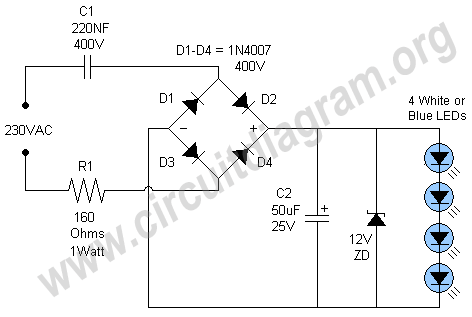
led night light lamp circuit
This is a simple LED night light circuit that can serve as a room night lamp. The circuit is straightforward and can be constructed with a few components. It employs four LEDs to function as a night lamp. Users can...

Human infrared remote sensing lamp circuit
The diagram illustrates a human infrared remote sensing lamp circuit. It utilizes the trace infrared heat emitted by humans to control the lamp's operation, allowing it to turn on or off remotely. This human infrared remote sensing lamp features high...

Remote Infrared Switch Circuit
The SFH505A, manufactured by Siemens, integrates an infrared diode receiver, amplifier, demodulator, and a band-pass filter to minimize interferences. This circuit operates effectively in various applications.
The SFH505A is a versatile optical receiver module designed for infrared communication systems. It is...