


Over-Temperature Alarm Circuit Uses Common Inexpensive Components
#thermistor
#temperature sensor
#alarm circuit
#NTC
#IC
#over-temperature
#safety
#monitoring
#warning system
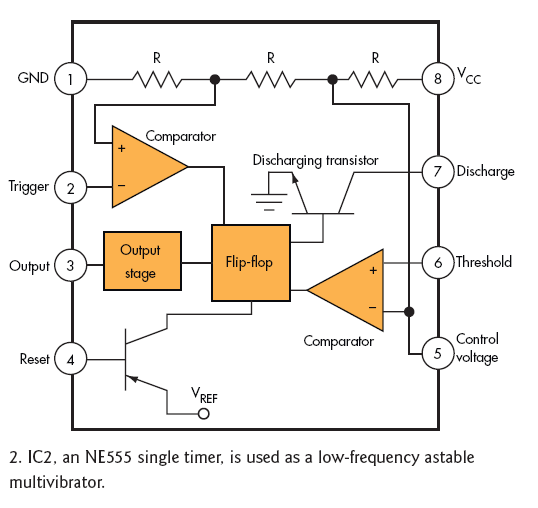
Description: Over-Temperature Alarm Circuit Uses Common, Inexpensive Components | Negative-temperature-coefficient (NTC) thermistor, ICs.
The Over-Temperature Alarm Circuit is designed to detect excessive temperatures and provide an alert using readily available and cost-effective components. The core sensing element of this circuit is a Negative Temperature Coefficient (NTC) thermistor, which exhibits a decrease in resistance as the temperature increases. This property allows the thermistor to serve as an effective temperature sensor.
The circuit typically includes an operational amplifier (op-amp) configured as a comparator. The NTC thermistor is connected in a voltage divider configuration with a fixed resistor, creating a reference voltage that varies with the temperature. As the temperature rises and the thermistor's resistance drops, the voltage at the op-amp's non-inverting input increases. When this voltage exceeds the reference voltage at the inverting input, the op-amp output switches states, triggering an alarm signal.
Additional components may include a relay or transistor to drive an alarm or indicator LED, providing a visual or audible alert when the temperature surpasses a predetermined threshold. The design can be further enhanced with hysteresis to prevent rapid switching of the alarm during fluctuating temperatures, ensuring stability in the alarm state.
This circuit is suitable for various applications, including temperature monitoring in industrial equipment, home appliances, and HVAC systems, where maintaining safe operating temperatures is critical. Its simplicity and reliance on inexpensive components make it an attractive solution for temperature alarm systems.Over-Temperature Alarm Circuit Uses Common, Inexpensive Components | Negative-temperature-coefficient (NTC) thermistor, ICs.
The Over-Temperature Alarm Circuit is designed to detect excessive temperatures and provide an alert using readily available and cost-effective components. The core sensing element of this circuit is a Negative Temperature Coefficient (NTC) thermistor, which exhibits a decrease in resistance as the temperature increases. This property allows the thermistor to serve as an effective temperature sensor.
The circuit typically includes an operational amplifier (op-amp) configured as a comparator. The NTC thermistor is connected in a voltage divider configuration with a fixed resistor, creating a reference voltage that varies with the temperature. As the temperature rises and the thermistor's resistance drops, the voltage at the op-amp's non-inverting input increases. When this voltage exceeds the reference voltage at the inverting input, the op-amp output switches states, triggering an alarm signal.
Additional components may include a relay or transistor to drive an alarm or indicator LED, providing a visual or audible alert when the temperature surpasses a predetermined threshold. The design can be further enhanced with hysteresis to prevent rapid switching of the alarm during fluctuating temperatures, ensuring stability in the alarm state.
This circuit is suitable for various applications, including temperature monitoring in industrial equipment, home appliances, and HVAC systems, where maintaining safe operating temperatures is critical. Its simplicity and reliance on inexpensive components make it an attractive solution for temperature alarm systems.Over-Temperature Alarm Circuit Uses Common, Inexpensive Components | Negative-temperature-coefficient (NTC) thermistor, ICs.
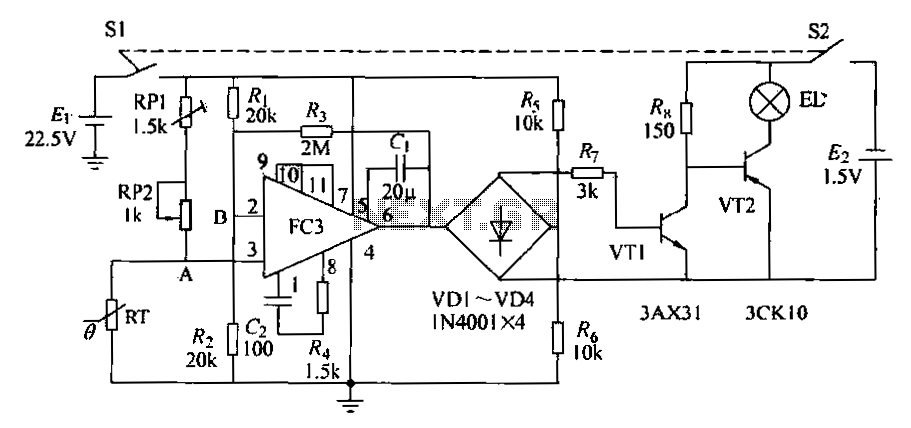
Electronic thermometer circuit
The circuit diagram illustrates an electronic thermometer. RT represents the thermistor, while A denotes an integrated operational amplifier. The diodes VD1 to VD4 provide a unidirectional output signal. The transistors VT1 and VT2 form a switching circuit. When the resistance...
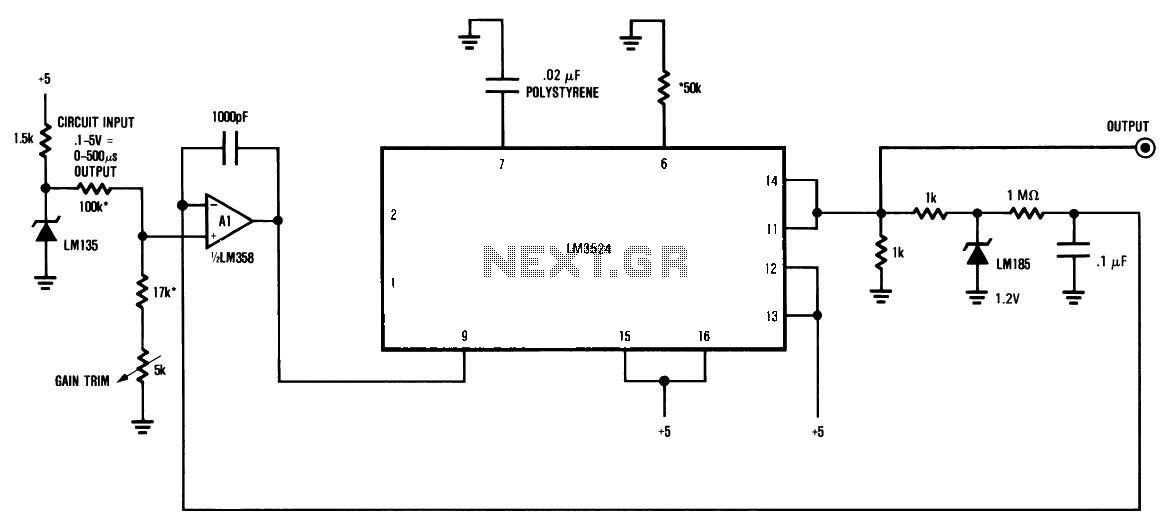
Temperature To Pulse Width Converter Circuit Using LM3524
The circuit is a temperature-to-pulse-width converter. The LM3524 is used to convert the output of an LM135 temperature transducer into a pulse width that can be measured by a digital system, such as a microprocessor-controlled data acquisition system. In this...
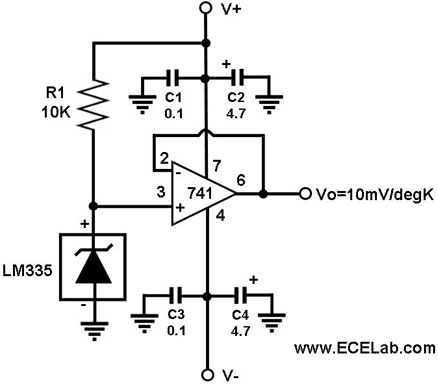
Temperature Sensor Circuit With LM335 IC
In this circuit, the LM335 is utilized as a temperature sensor, an integrated circuit that converts ambient temperature into an equivalent output voltage.
The LM335 is a precision temperature sensor that provides a linear output voltage proportional to the absolute temperature...
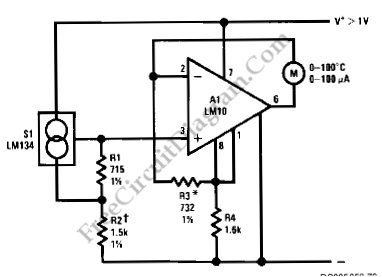
LM134-LM10 Thermometer/Temperature Sensor
Using LM134 and LM10 integrated circuits, a thermometer can be constructed with a sensing range of -55 to 150 °C. The ideal meter for this circuit is a 0-200 µA.
The proposed thermometer circuit utilizes the LM134, a current source IC,...
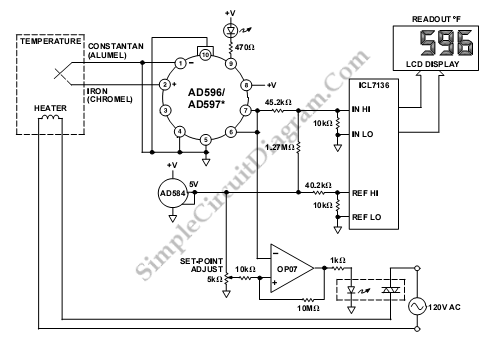
Temperature Sensing and Control
This is a temperature indication and control system utilizing the AD596/AD597. In this system, the AD596/AD597 functions as a closed-loop thermocouple signal conditioner.
The temperature indication and control system based on the AD596/AD597 integrates a thermocouple sensor to measure temperature variations...

thermometer circuit
When the system is placed in a shop or mall, logos and product advertisements serve as an ideal complement to temperature information. For home use, photographs of children at the beach or, should the temperature drop, images of making a...
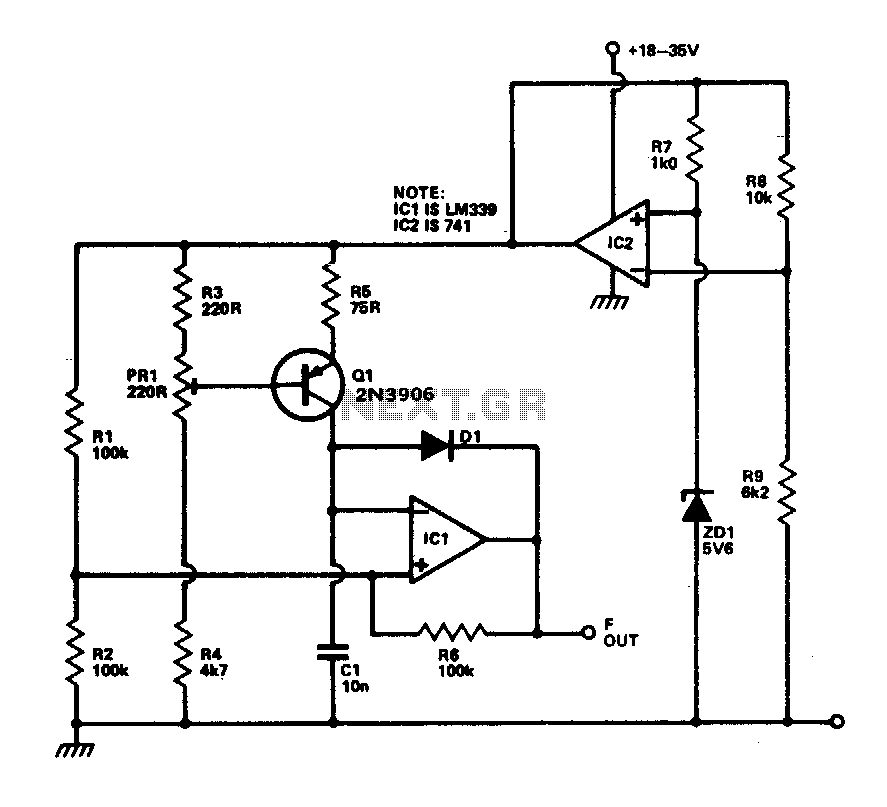
Linear temperature-to-frequency
This circuit provides a linear frequency increase of 10 Hz per °C over a temperature range of 0 to 100 °C and can be utilized with logic systems, including microprocessors. The temperature probe Q1, utilizing the Vbe characteristic, changes by...
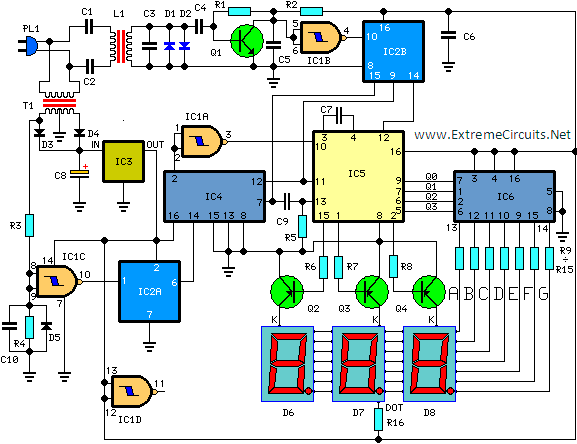
digital remote thermometer
This circuit is designed for precise measurement of temperature in degrees Celsius. It includes a transmitter section that converts the output voltage from the sensor, which is proportional to the temperature being measured, into a frequency signal. This frequency signal...
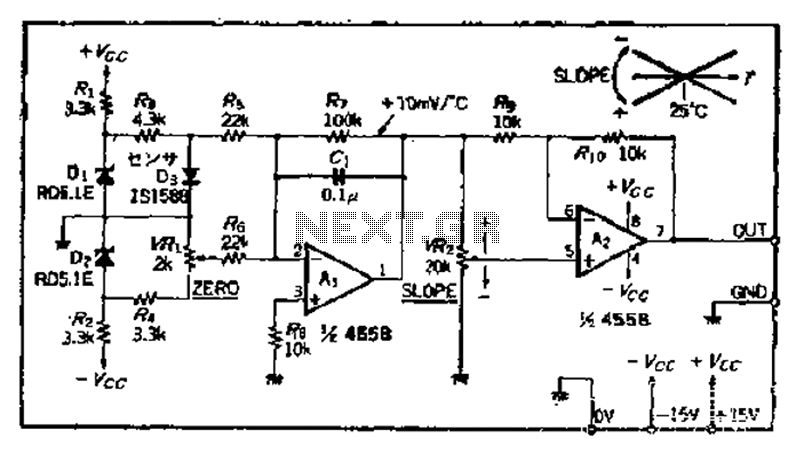
It can produce 10mV- compensation voltage temperature compensation voltage generating circuit
A temperature sensor can be created using a standard silicon diode, which produces approximately 2.2 mV per degree Celsius variation. An operational amplifier (OP amplifier) is utilized with a positive reference temperature (room temperature). The output signal is amplified about...