


simple home alarm system pcb
#home alarm
#shock sensor
#rolling code
#security system
#PCB
#variable sensitivity
#wireless
#DIY
#low cost
#easy assembly

Description: This home alarm system is simple, secure, fast, and cost-effective. It consists of only a few components while providing maximum security through the use of a Rolling Code transmitter and a shock sensor with variable sensitivity. The alarm module can be assembled in just two hours without requiring manual presetting. This home alarm system is one of the most affordable options available, and the total cost can be further reduced by utilizing a standard external sounder (excluding AG8). A GSM module will be added in the future for remote control capabilities. A blue LED connected to pin RA3 of the microcontroller serves as a memory indicator to show if the home alarm system has been activated by an event, and it resets after reactivation. A red LED connected to the power supply before the 1N5406 diode is used to verify the power supply connection. Additionally, three red micro LEDs near the relays indicate the output state.
The home alarm system is designed to provide reliable security for residential environments while maintaining ease of use and affordability. The core components include a microcontroller, a shock sensor, and a transmitter that utilizes a Rolling Code algorithm to enhance security by preventing replay attacks. The shock sensor's variable sensitivity allows customization based on the specific needs of the installation site, making it adaptable to various environments.
Assembly of the alarm module is straightforward, taking approximately two hours to complete. This quick assembly time is facilitated by the minimal number of components and the effective design of the circuit. The absence of manual presetting further simplifies the installation process, making it accessible to users without extensive technical knowledge.
The integration of a GSM module is planned for future enhancements, providing users with remote control capabilities to monitor and manage the alarm system from a distance. This feature is particularly beneficial for users who wish to receive alerts or control the system while away from home.
The blue LED indicator connected to the microcontroller pin RA3 serves a critical function. It provides a visual cue indicating whether the alarm system has been activated, allowing users to quickly assess the system's status. The reset functionality after reactivation ensures that the indicator accurately reflects the current state of the system.
In terms of power management, the red LED connected before the 1N5406 diode acts as a power supply verification tool. This ensures that users can easily check the power connection, which is vital for the reliable operation of the alarm system. The additional three red micro LEDs located near the relays serve to indicate the output states of the system, providing further assurance to the user regarding the operational status of the alarm.
Overall, this home alarm system combines simplicity, security, and cost-effectiveness, making it an excellent choice for residential security applications.This Home Alarm System is simple, secure, fast and cheap. It`s only few components with maximum security with Rolling Code TX and Shock Sensor with variable sensitivity. The alarm module can be assembled in only 2 hours and it don`t need manual preset. Home Alarm System with this characteristics is the most cheap system and the total cost could be reduced using a normal external sounder (escl. AG8). GSM module will be add in the future for a remote control. The blue led connected to the pin RA3 of micro controller is used like a memory to know if the home alarm system has been activated by an event and its reset after a reactivation. The red led connected to the power supply before the 1N5406 diode is used to check the power supply connection.
Of course the other 3 micro led red near the relays are used to check the output state.
The home alarm system is designed to provide reliable security for residential environments while maintaining ease of use and affordability. The core components include a microcontroller, a shock sensor, and a transmitter that utilizes a Rolling Code algorithm to enhance security by preventing replay attacks. The shock sensor's variable sensitivity allows customization based on the specific needs of the installation site, making it adaptable to various environments.
Assembly of the alarm module is straightforward, taking approximately two hours to complete. This quick assembly time is facilitated by the minimal number of components and the effective design of the circuit. The absence of manual presetting further simplifies the installation process, making it accessible to users without extensive technical knowledge.
The integration of a GSM module is planned for future enhancements, providing users with remote control capabilities to monitor and manage the alarm system from a distance. This feature is particularly beneficial for users who wish to receive alerts or control the system while away from home.
The blue LED indicator connected to the microcontroller pin RA3 serves a critical function. It provides a visual cue indicating whether the alarm system has been activated, allowing users to quickly assess the system's status. The reset functionality after reactivation ensures that the indicator accurately reflects the current state of the system.
In terms of power management, the red LED connected before the 1N5406 diode acts as a power supply verification tool. This ensures that users can easily check the power connection, which is vital for the reliable operation of the alarm system. The additional three red micro LEDs located near the relays serve to indicate the output states of the system, providing further assurance to the user regarding the operational status of the alarm.
Overall, this home alarm system combines simplicity, security, and cost-effectiveness, making it an excellent choice for residential security applications.This Home Alarm System is simple, secure, fast and cheap. It`s only few components with maximum security with Rolling Code TX and Shock Sensor with variable sensitivity. The alarm module can be assembled in only 2 hours and it don`t need manual preset. Home Alarm System with this characteristics is the most cheap system and the total cost could be reduced using a normal external sounder (escl. AG8). GSM module will be add in the future for a remote control. The blue led connected to the pin RA3 of micro controller is used like a memory to know if the home alarm system has been activated by an event and its reset after a reactivation. The red led connected to the power supply before the 1N5406 diode is used to check the power supply connection.
Of course the other 3 micro led red near the relays are used to check the output state.
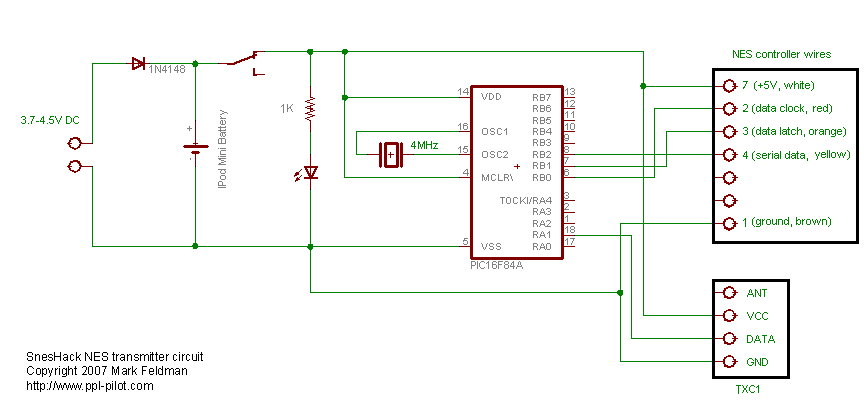
Wireless/Wii Hack for SNES and NES Controllers
The NES version of this modification closely resembles the SNES version, and it is advisable to review that article first for a general understanding of the assembly of these controllers. The primary component required is an original NES controller, which...
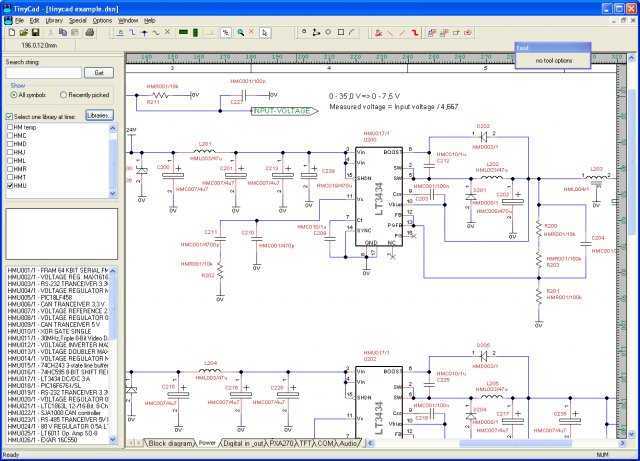
Free-PCB
FreePCB is a free, open-source printed circuit board layout editor for Microsoft Windows, released under the GNU General Public License. It was designed to be easy to learn and easy to use, yet capable of professional-quality work. More: It does...
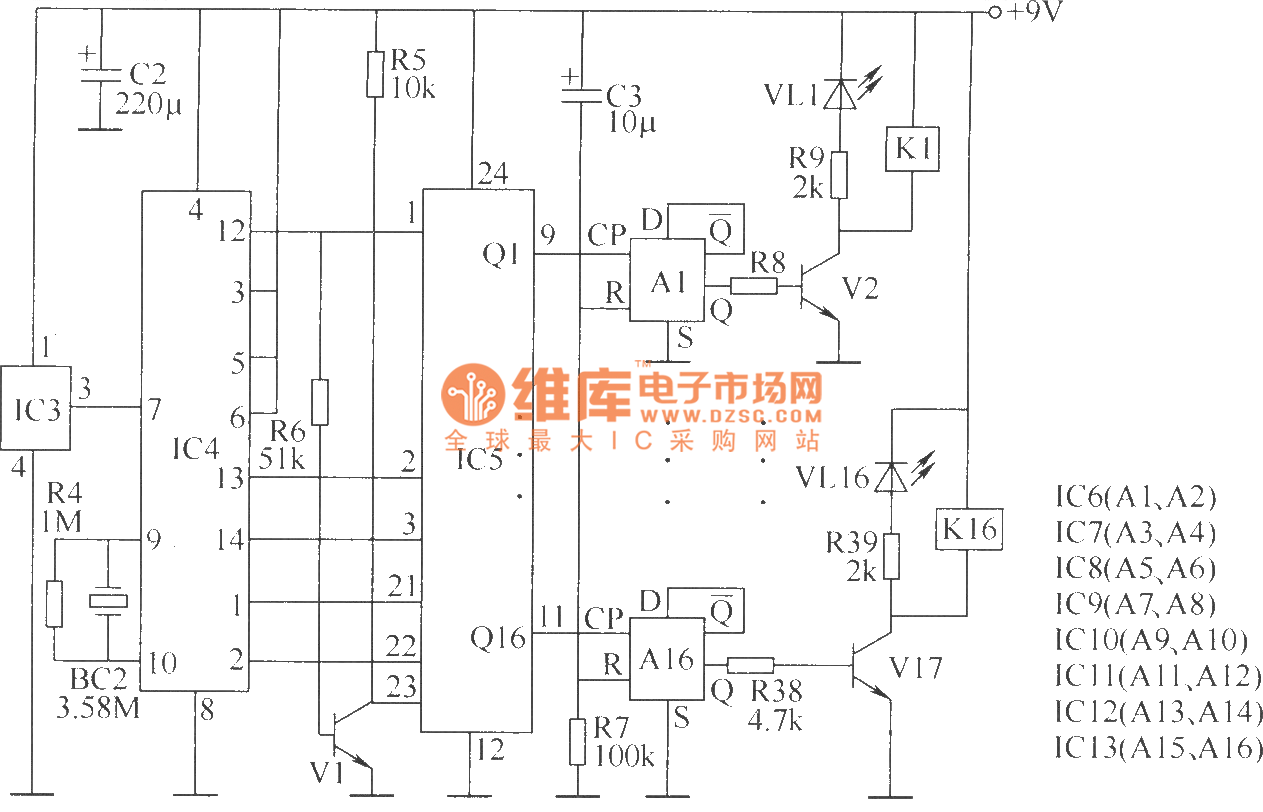
Wireless remote control switch circuit 5
The wireless remote control transmitter circuit consists of control buttons S1 to S16, resistors R1 to R3, a capacitor C1, a regulator diode VS, a crystal oscillator BC1, and DTMF encoder integrated circuits IC1 and IC2. The circuit components are...
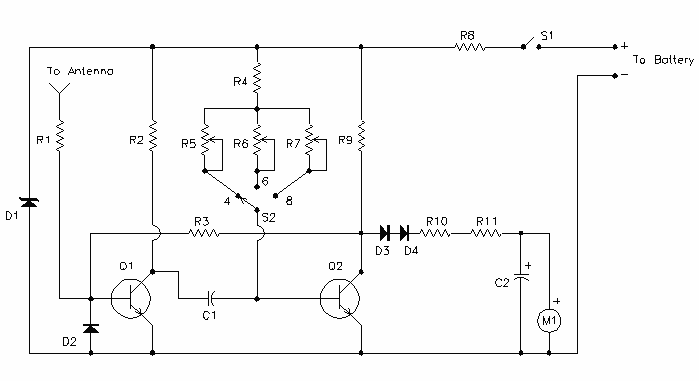
Wireless Auto Tachometer
Anyone performing their own automobile tune-ups knows how important it is to know your engine's speed. With this tachometer, you can measure your engine's speed without any connections or annoying timing lights.
The described tachometer is a non-invasive device designed for...
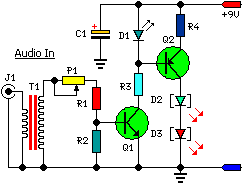
A Low Power Wireless Audio Power Amplifier
A battery-powered portable unit suitable for all types of televisions. This low-cost project allows audio reproduction from a TV without disturbing others.
This battery-powered portable audio unit is designed to provide a convenient solution for reproducing television audio discreetly. The unit...
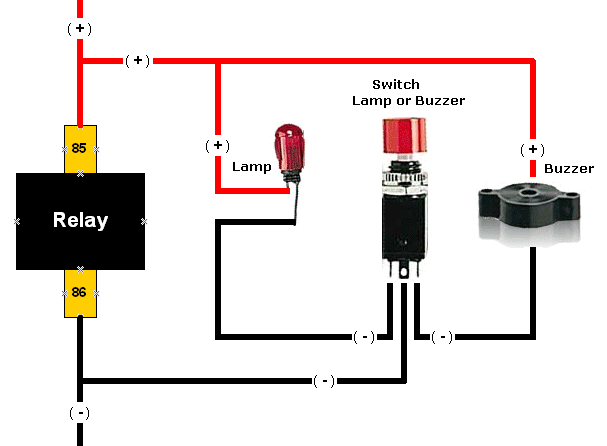
Wireless Lock Tone
Upon acquiring the car, it was appreciated that it did not emit a "chirp" or sound the horn each time the doors were locked or unlocked. There are occasions when discreetness is preferred regarding entering or exiting the vehicle. However,...
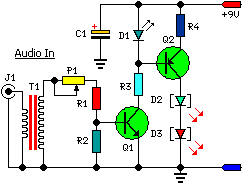
A Low Power Wireless Audio Power Amplifier circuit
This low-cost project enables audio reproduction from a television without disturbing others. It eliminates the need for wired connections between the TV and loudspeakers. Instead, it utilizes invisible infrared light to transmit audio signals from the TV to the loudspeakers....
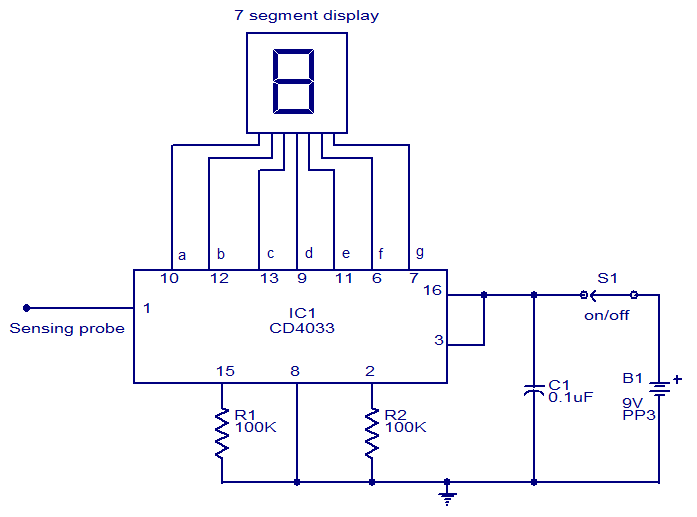
Wireless mains voltage tester
This circuit is designed to test the presence of mains voltage without direct electrical contact with the mains line. The core component of this circuit is the CMOS IC CD4033, which features a five-stage decade Johnson counter and an output...

Low Cost Universal Battery Charger Schematic
This is a simple and low-cost NiCd and NiMH battery charger. The schematic diagram indicates that the charging current (I) should be set to 1/10 of the battery's rated capacity. For instance, if the battery has a rated capacity of...