


Simple Proximity Detector & Alarm Circuit
#proximity sensor
#IC 4049
#oscillator
#metal detection
#alarm circuit
#feedback resistor
#sensing
#security
#bipolar IC
#resonant tank circuit
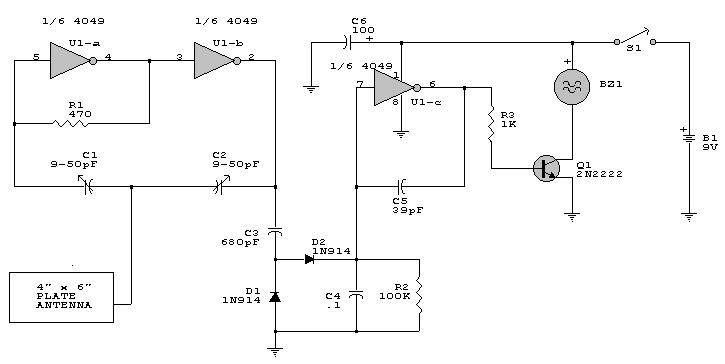
Description: This is a simple proximity switch utilizing the IC 4049. The IC 4049 is a bipolar monolithic integrated circuit designed for metal detection systems and proximity sensing applications. It includes an oscillator formed by an external parallel resonant tank circuit and a feedback resistor connected to pins 2 and 5. The internal oscillator operates near the resonant frequency of the tank circuit. As a metal object approaches the coil, it causes a decrease in the amplitude of the voltage across the tank circuit. If the oscillation envelope reaches a certain level, the resistance increases, which extends the detection range. The maximum possible range can be achieved with a high Q coil, extending up to 1 inch. The tuning circuit must be adjusted to maintain the desired detection range. To facilitate the detection of a metal object at a distance of 1 inch, the resistance and capacitors C1 and C2 should be adjusted, with one of the outputs from pins 2 or 5 changing state.
The proximity switch circuit based on the IC 4049 operates by utilizing the characteristics of an oscillator integrated with a resonant tank circuit. The tank circuit consists of an inductor (coil) and capacitors (C1 and C2), which are tuned to resonate at a specific frequency. The IC 4049's oscillator generates an alternating current (AC) signal that is influenced by the presence of nearby metallic objects.
When a metal object approaches the coil, it alters the electromagnetic field around the coil, thereby affecting the resonant frequency of the tank circuit. This interaction leads to a reduction in the voltage amplitude across the tank circuit. The oscillator's output is monitored through the feedback resistor connected to pins 2 and 5. As the voltage amplitude diminishes, the circuit's feedback mechanism responds by increasing the resistance. This adjustment effectively increases the detection range of the circuit.
The circuit can achieve a maximum detection range of approximately 1 inch when a high Q coil is employed, which is essential for maintaining sensitivity and accuracy in metal detection applications. To optimize the circuit for different detection distances, the values of the capacitors C1 and C2 can be adjusted. This tuning allows the user to set the circuit for specific operational distances, ensuring reliable detection of metal objects.
In summary, the IC 4049-based proximity switch circuit is a versatile solution for metal detection and proximity sensing, leveraging an oscillator and resonant tank circuit to provide adjustable and reliable performance. The careful selection of components and tuning of the circuit parameters are critical for achieving the desired detection range and sensitivity.This is a simple proximity switches with IC 4049th The IC4049 is a bipolar monolithic integrated circuit for use in metal-detection system / proximity sensing applications IC4049 includes an oscillator constituted by an external parallel resonant tank circuit and a feedback resistor connected 2-5 The internal oscillator operates near the resonant frequency of the tank is brought circuit. As a metal object near the coil begins to decrease the amplitude of the voltage across the tank gradually. If the envelope of the oscillation a certain level, the greater the resistance the greater the travel distance.
Detection-point range with a high Q coil. Maximum possible range can be achieved with a well extended to 1-inch drive circuit. Only So this circuit, the tuning circuit to a certain range. For making it easy to a metal coil at the desired distance (1 inch) square and adjust the resistance, C1 and C2 (make Pin2 or 5) one of the outputs in the state change.
The proximity switch circuit based on the IC 4049 operates by utilizing the characteristics of an oscillator integrated with a resonant tank circuit. The tank circuit consists of an inductor (coil) and capacitors (C1 and C2), which are tuned to resonate at a specific frequency. The IC 4049's oscillator generates an alternating current (AC) signal that is influenced by the presence of nearby metallic objects.
When a metal object approaches the coil, it alters the electromagnetic field around the coil, thereby affecting the resonant frequency of the tank circuit. This interaction leads to a reduction in the voltage amplitude across the tank circuit. The oscillator's output is monitored through the feedback resistor connected to pins 2 and 5. As the voltage amplitude diminishes, the circuit's feedback mechanism responds by increasing the resistance. This adjustment effectively increases the detection range of the circuit.
The circuit can achieve a maximum detection range of approximately 1 inch when a high Q coil is employed, which is essential for maintaining sensitivity and accuracy in metal detection applications. To optimize the circuit for different detection distances, the values of the capacitors C1 and C2 can be adjusted. This tuning allows the user to set the circuit for specific operational distances, ensuring reliable detection of metal objects.
In summary, the IC 4049-based proximity switch circuit is a versatile solution for metal detection and proximity sensing, leveraging an oscillator and resonant tank circuit to provide adjustable and reliable performance. The careful selection of components and tuning of the circuit parameters are critical for achieving the desired detection range and sensitivity.This is a simple proximity switches with IC 4049th The IC4049 is a bipolar monolithic integrated circuit for use in metal-detection system / proximity sensing applications IC4049 includes an oscillator constituted by an external parallel resonant tank circuit and a feedback resistor connected 2-5 The internal oscillator operates near the resonant frequency of the tank is brought circuit. As a metal object near the coil begins to decrease the amplitude of the voltage across the tank gradually. If the envelope of the oscillation a certain level, the greater the resistance the greater the travel distance.
Detection-point range with a high Q coil. Maximum possible range can be achieved with a well extended to 1-inch drive circuit. Only So this circuit, the tuning circuit to a certain range. For making it easy to a metal coil at the desired distance (1 inch) square and adjust the resistance, C1 and C2 (make Pin2 or 5) one of the outputs in the state change.
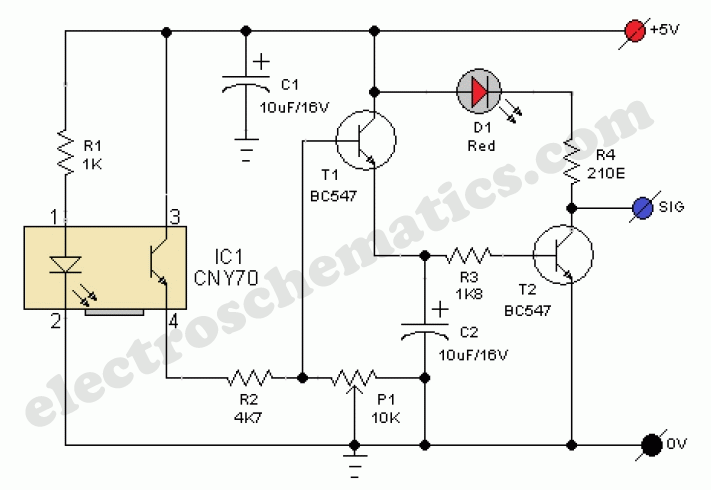
Proximity Sensor Circuit
This presence detector or proximity sensor circuit responds to the presence of any conductive object, including humans. The sensitivity can be adjusted with potentiometer P1, which is positioned at a considerable distance from the rest of the circuit. This circuit...
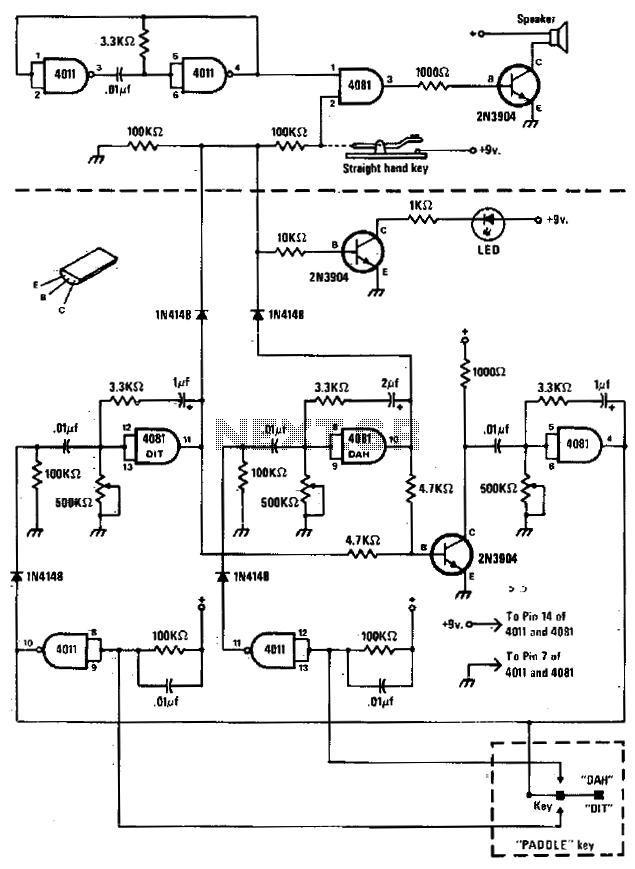
Code practice oscillator
The circuit comprises a basic oscillator (above the dashed line) and an automatic keyer (below the dashed line). The unit can be utilized with either a straight hand key or a paddle key for automatic operation.
The described circuit integrates two...
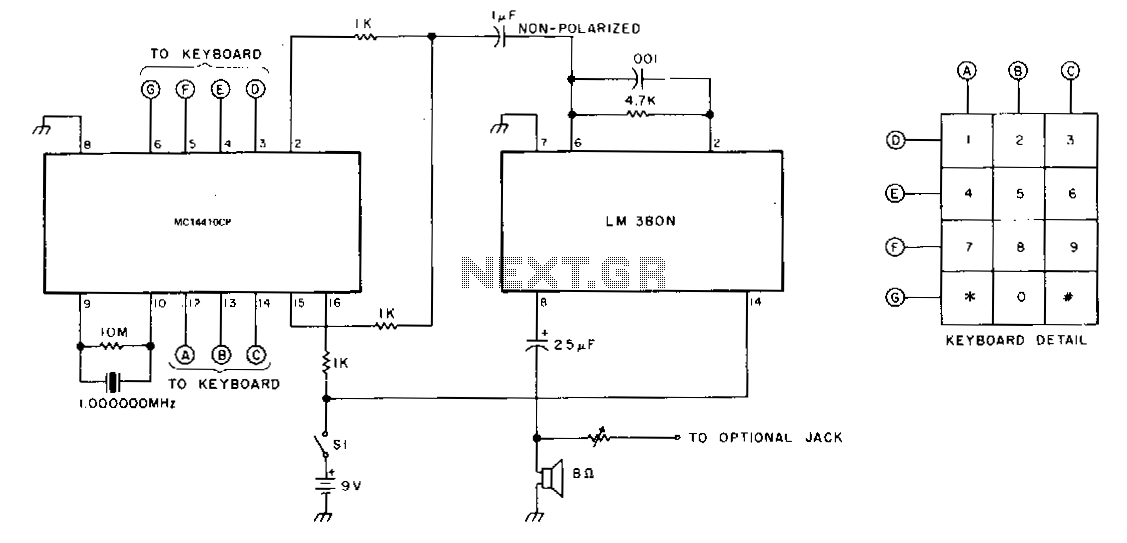
Simple-touchtonetm-generator
The oscillator utilizes a Motorola MC14410CP chip paired with a 1-MHz crystal. This configuration generates both high and low audio tones, which are then transmitted to the amplifier through 1 kΩ resistors and a 1 µF capacitor. The output resistors...

Electronic Gong Circuit
The electronic gong consists of an oscillator utilizing half of a 74C00 quad 2-input NAND gate, an active twin-T filter based on a TL081 operational amplifier, and an audio amplifier integrated circuit, such as the LM386N. Pulses generated by an...

The door bell circuit
Figure 1 illustrates an economical and straightforward Gate Alarm designed to operate using a small universal AC-DC power supply. IC1a functions as a fast oscillator, while IC1b serves as a slow oscillator. These two oscillators are integrated through IC1c to...
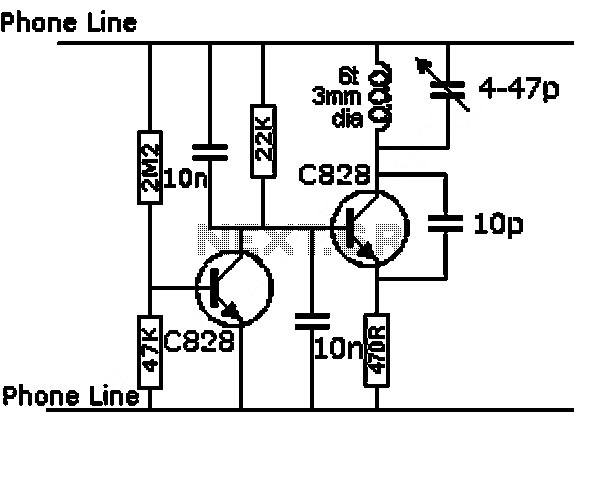
proximity alarm circuit
Inverters U1a and U1b are connected in a simple RC oscillator circuit. The frequency is determined by the values of R1, C1, C2, and the internal characteristics of the integrated circuit. As long as the circuit is oscillating, a positive...
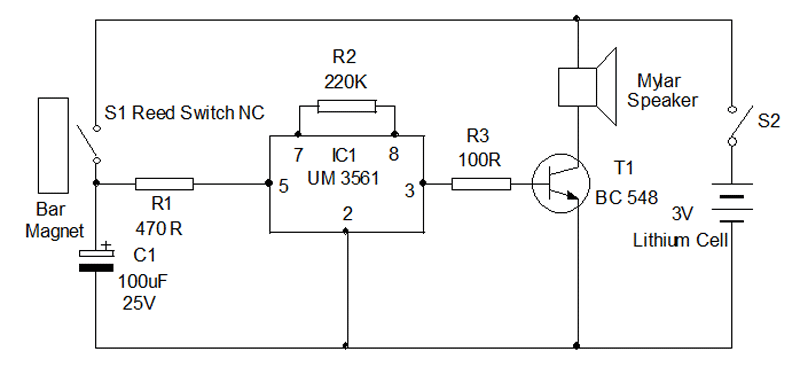
Locker Guard Locker Security Alarm Circuit Anti Theft
Locker Guard Circuit Diagram. This compact circuit is designed to protect a locker or almirah from burglary. If the locker is opened while in the armed state, the circuit triggers a loud police siren to deter the burglary attempt.
The Locker...
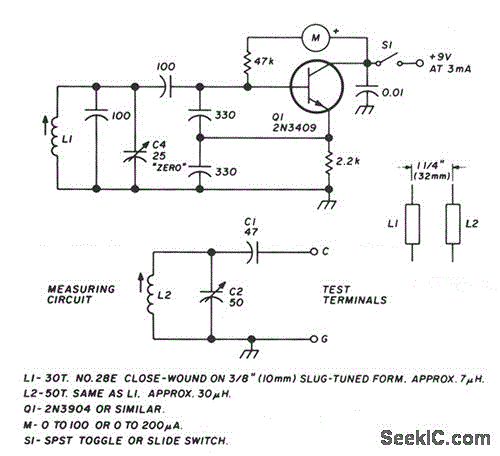
LC CHECKER
The circuit operates on the principle of the grid-dip or absorption effect, which takes place when a parallel resonant circuit is coupled to an oscillator operating at the same frequency. Transistor Q1 functions within a standard Colpitts oscillator circuit, maintaining...
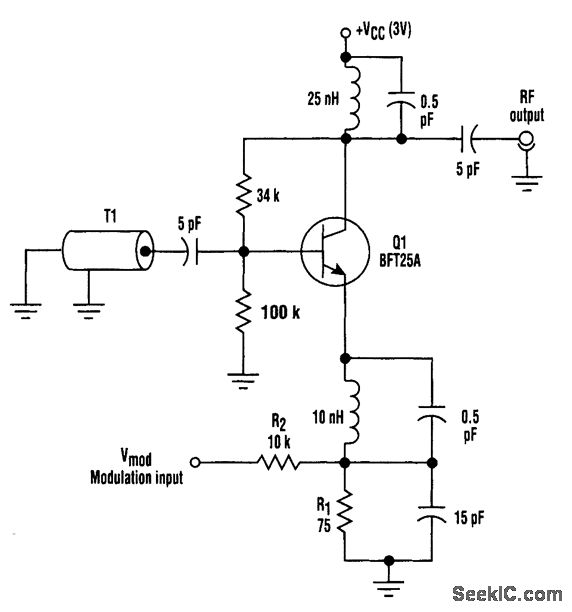
FM HF OSCILLATOR WITH NO VARACTOR
This circuit utilizes base-charging capacitance modulation instead of a varactor to frequency-modulate a high-frequency oscillator. This approach eliminates the significant voltage change required by a varactor, which can pose challenges in battery-powered systems with limited supply voltages. T1 serves as...