


300B tube single-ended Class A amplifier circuit diagram
#300B tube
#single-ended
#Class A
#vacuum tube
#audio amplifier
#high fidelity
#tube amplifier
#low distortion
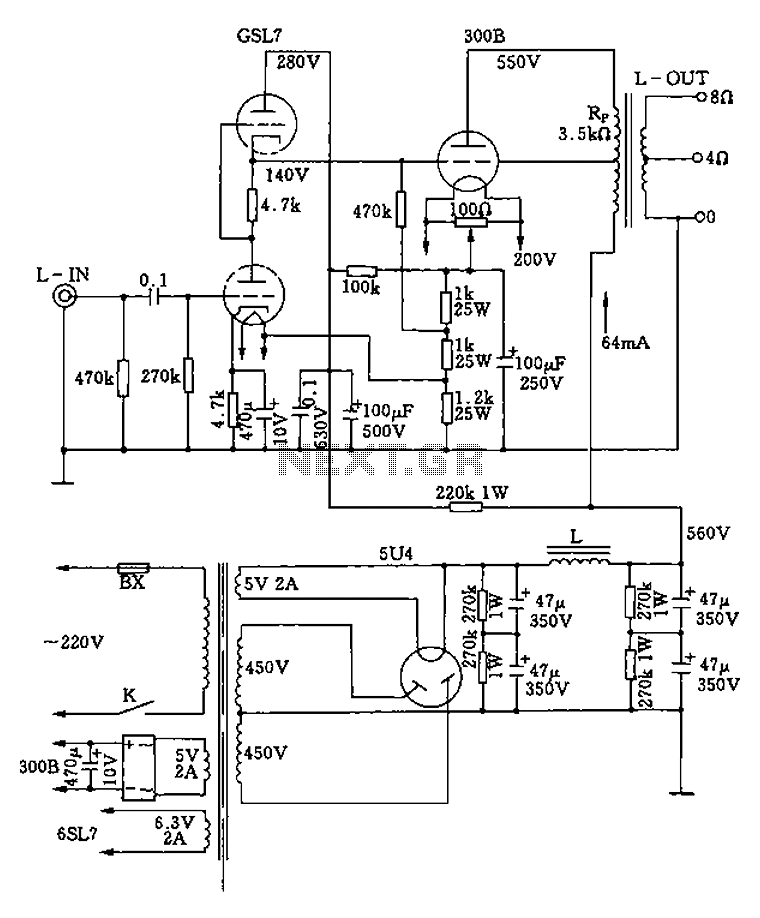
Description: The 300B tube single-ended Class A amplifier circuit is as follows:
The 300B tube single-ended Class A amplifier is a high-fidelity audio amplification circuit that utilizes a 300B vacuum tube as the primary amplification element. This design is characterized by its simplicity and the warm, rich sound quality it produces, which is highly sought after in audiophile circles.
The circuit typically consists of a power supply, an input stage, a driver stage, and the output stage, which employs the 300B tube. The power supply is designed to provide the necessary high voltage, usually around 300V, and a filament voltage of approximately 5V to power the 300B tube.
In the input stage, a low-noise tube, such as the 6SN7 or 12AX7, is often used to amplify the audio signal before it reaches the driver stage. The driver stage may include another tube that prepares the signal for the output stage, ensuring that the 300B tube operates within its optimal parameters.
The output stage features the 300B tube in a single-ended configuration, meaning that it amplifies the audio signal using only one tube per channel. This configuration results in lower distortion and a more natural sound reproduction. The output transformer is crucial in this stage, as it matches the high impedance of the tube to the lower impedance of the speakers, allowing for efficient power transfer.
Additional components, such as coupling capacitors, resistors, and feedback networks, are included to ensure stability and to tailor the frequency response of the amplifier. The overall design emphasizes minimalism and high-quality components to maintain signal integrity and enhance audio performance.
The 300B tube single-ended Class A amplifier circuit is revered for its ability to deliver a warm and dynamic sound, making it a popular choice for high-end audio systems.300B tube single-ended Class A amplifier circuit is as follows:
The 300B tube single-ended Class A amplifier is a high-fidelity audio amplification circuit that utilizes a 300B vacuum tube as the primary amplification element. This design is characterized by its simplicity and the warm, rich sound quality it produces, which is highly sought after in audiophile circles.
The circuit typically consists of a power supply, an input stage, a driver stage, and the output stage, which employs the 300B tube. The power supply is designed to provide the necessary high voltage, usually around 300V, and a filament voltage of approximately 5V to power the 300B tube.
In the input stage, a low-noise tube, such as the 6SN7 or 12AX7, is often used to amplify the audio signal before it reaches the driver stage. The driver stage may include another tube that prepares the signal for the output stage, ensuring that the 300B tube operates within its optimal parameters.
The output stage features the 300B tube in a single-ended configuration, meaning that it amplifies the audio signal using only one tube per channel. This configuration results in lower distortion and a more natural sound reproduction. The output transformer is crucial in this stage, as it matches the high impedance of the tube to the lower impedance of the speakers, allowing for efficient power transfer.
Additional components, such as coupling capacitors, resistors, and feedback networks, are included to ensure stability and to tailor the frequency response of the amplifier. The overall design emphasizes minimalism and high-quality components to maintain signal integrity and enhance audio performance.
The 300B tube single-ended Class A amplifier circuit is revered for its ability to deliver a warm and dynamic sound, making it a popular choice for high-end audio systems.300B tube single-ended Class A amplifier circuit is as follows:
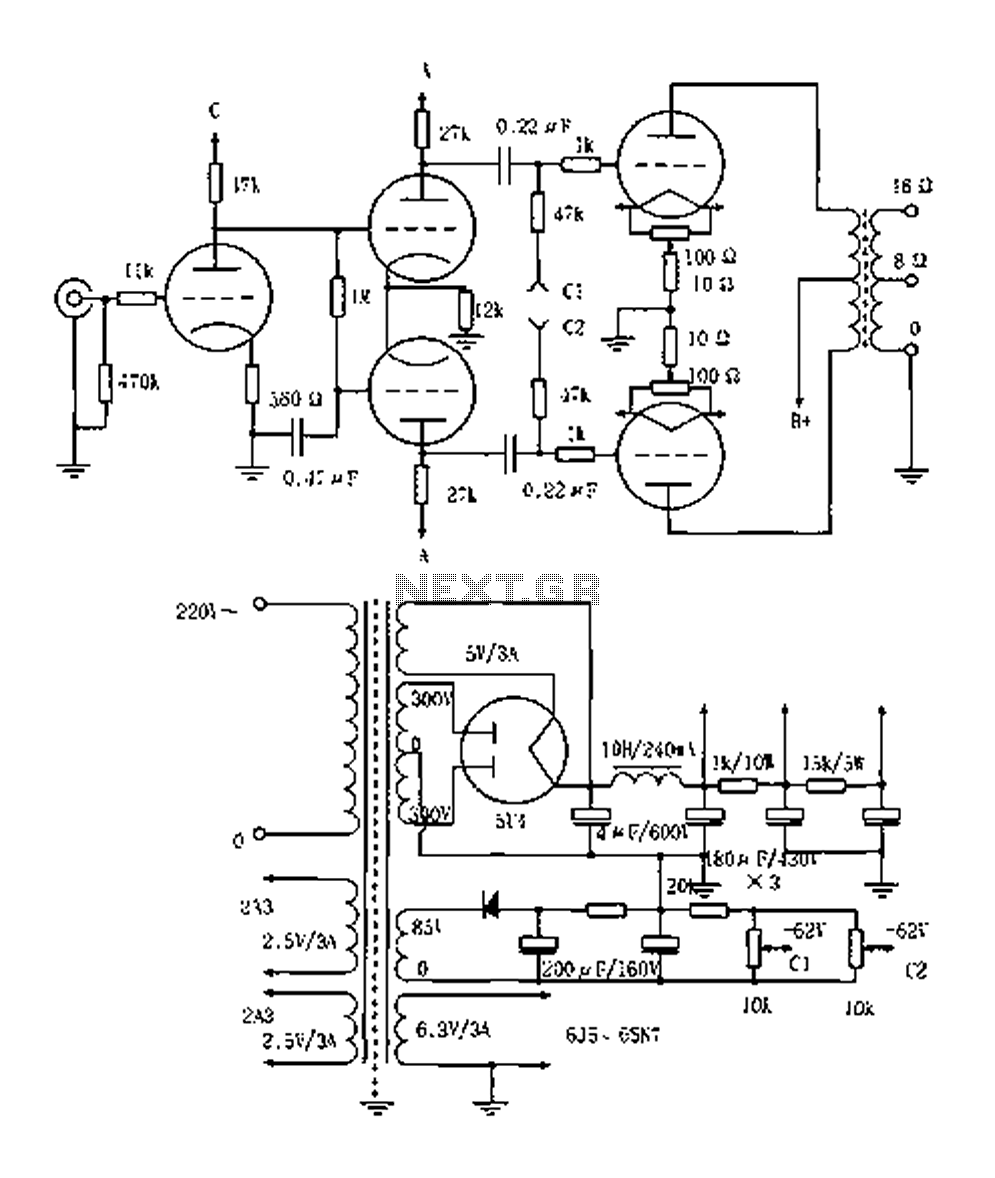
Vented 2a3p 2a3pp-15w Tube Amplifier circuit diagram
The Elliot 2A3PP line amplifier is a straightforward design, emphasizing the quality of the output transformer. It utilizes a 3KPP output transformer with a fixed bias of 62V, delivering an output power of 15W. The 2A3PP is well-suited for speakers...
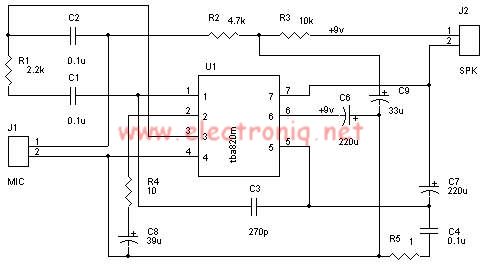
TBA820M high gain audio amplifier circuit design electronic project
A very simple audio amplifier circuit can be designed using the TBA820M audio amplifier integrated circuit with just a few electronic components. This audio amplifier project features a high gain that allows for the detection of sounds underwater. The TBA820M...
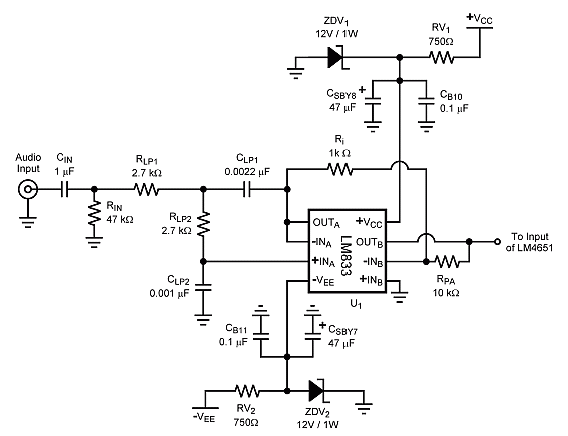
amplifier electronic circuits audio amp schematics 170w lm4651 lm4652
The ICs LM4651 and LM4652 are types of MOSFET integrated circuits and power amplifiers that include high-efficiency amplifiers, making them suitable for self-powered speakers, subwoofers, and high-quality car audio systems. The LM4651 is a fully integrated conventional pulse width modulation...
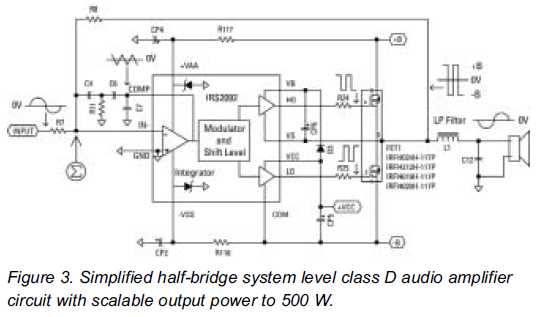
Class D Audio Amplifier Matches Class AB With Higher Efficiency
Class D audio amplifiers are now prepared to replace Class AB amplifiers. An integrated high-voltage audio driver simplifies the design and construction of high-power audio systems.
Class D audio amplifiers, also known as switching amplifiers, utilize pulse-width modulation (PWM) to convert...
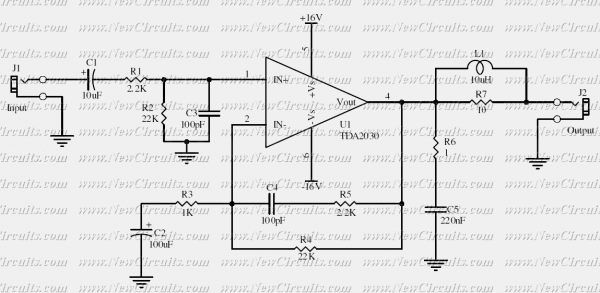
10 Watt Power Amplifier (TDA2030)
This simple 10 watts audio power amplifier is designed for home-brewed purpose. It is based on an Audio Power Amplifier IC that is called TDA2030. It is a monolithic integrated circuit in Pentawatt package, intended for use as a low...
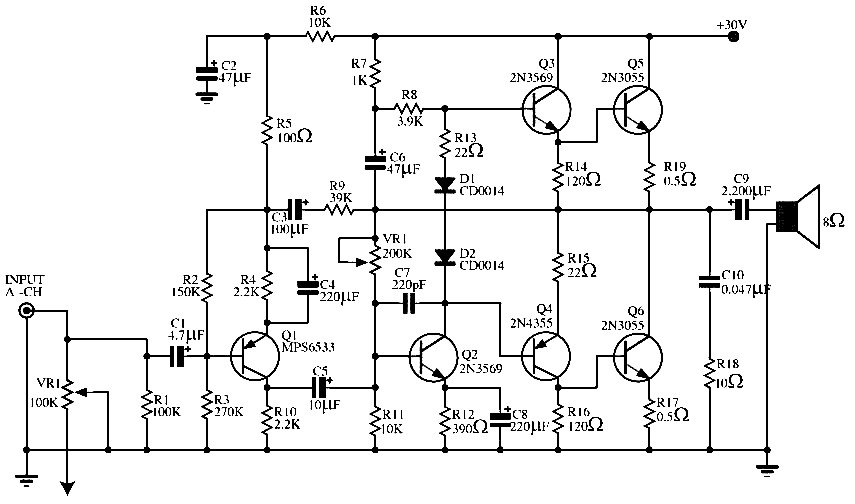
audio power amplifier circuit 140 w
More:
The input data lacks specific content, providing only placeholders without any detailed information.
In the context of electronic schematics, a comprehensive description typically involves detailing the components, their interconnections, and the overall functionality of the circuit. Each component,...
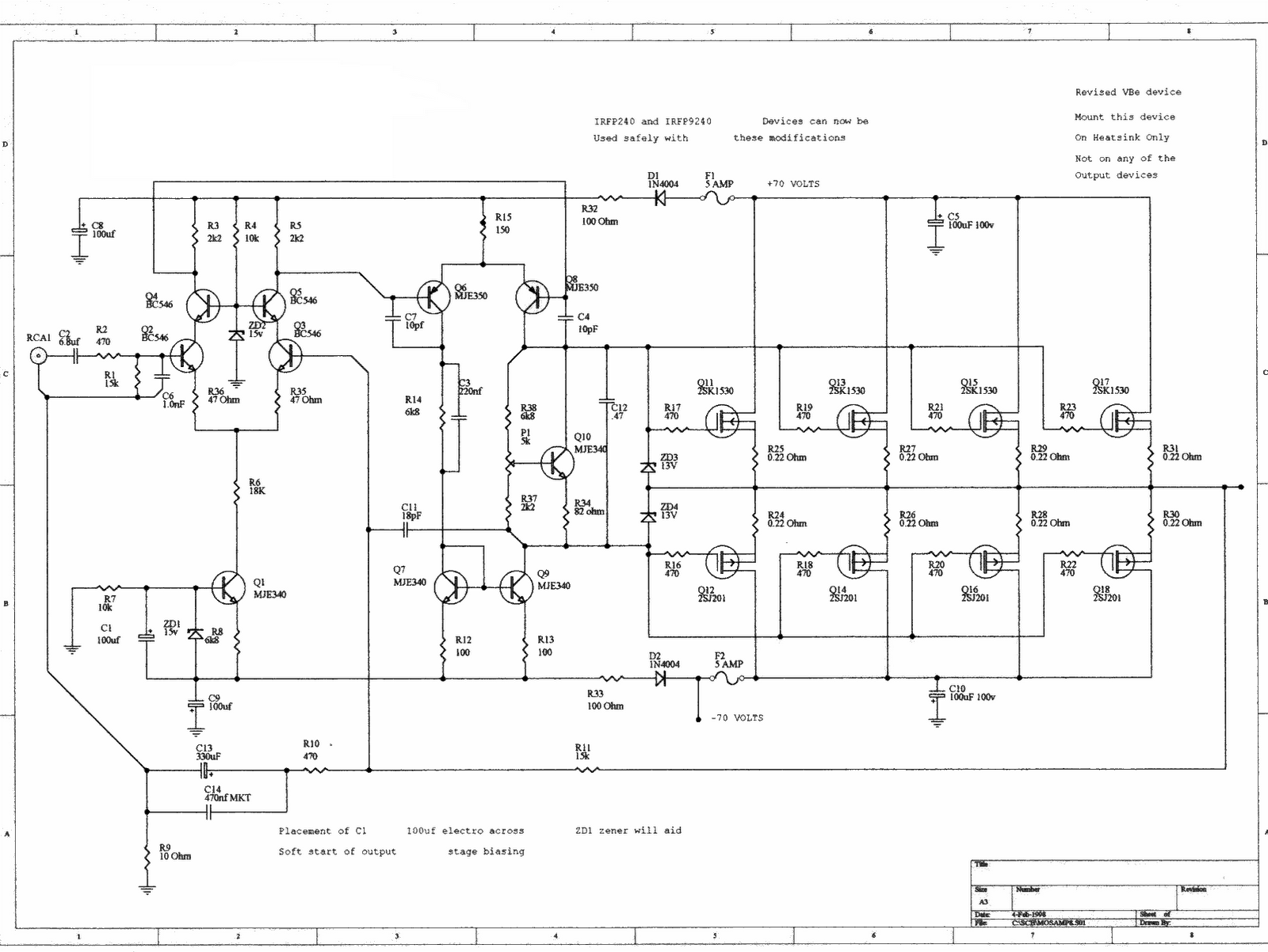
Audio Amplifer Circuit 230W With MOSFET IRFP2409240
This is a simple LED-powered audio amplifier circuit utilizing a MOSFET amplifier with the TL071C operational amplifier. It can deliver up to 45 W into an 8-ohm load. The circuit incorporates the MOSFETs IRFP240 and IRFP9240, which are recommended for...
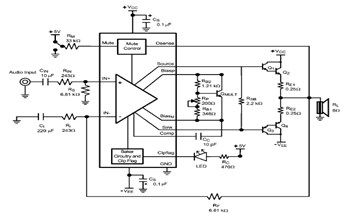
LME49810 Audio Amplifier Circuit Schematic and Datasheet
The LME49810 audio amplifier schematic is depicted in the accompanying circuit diagram. Based on the LME49810 datasheet, this component is a high-fidelity audio power amplifier driver intended for use in applications such as audio-video receivers, guitar amplifiers, powered studio monitors,...
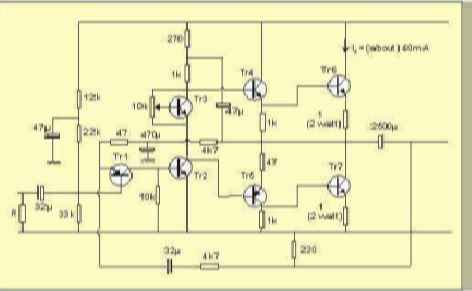
10w audio amplifier
The table below illustrates the expected voltages when utilizing a 24V supply, with the variable resistor adjusted to provide an output current of approximately 40mA.
The circuit operates with a 24V DC power supply, where a variable resistor (also known as...