


5000w high power amplifier circuit
#high power amplifier
#stereo amplifier
#switching-mode power supply
#audio amplifier
#5000W amplifier
#RMS amplifier
#power supply
#audio circuit
#stereo sound
#amplifier design
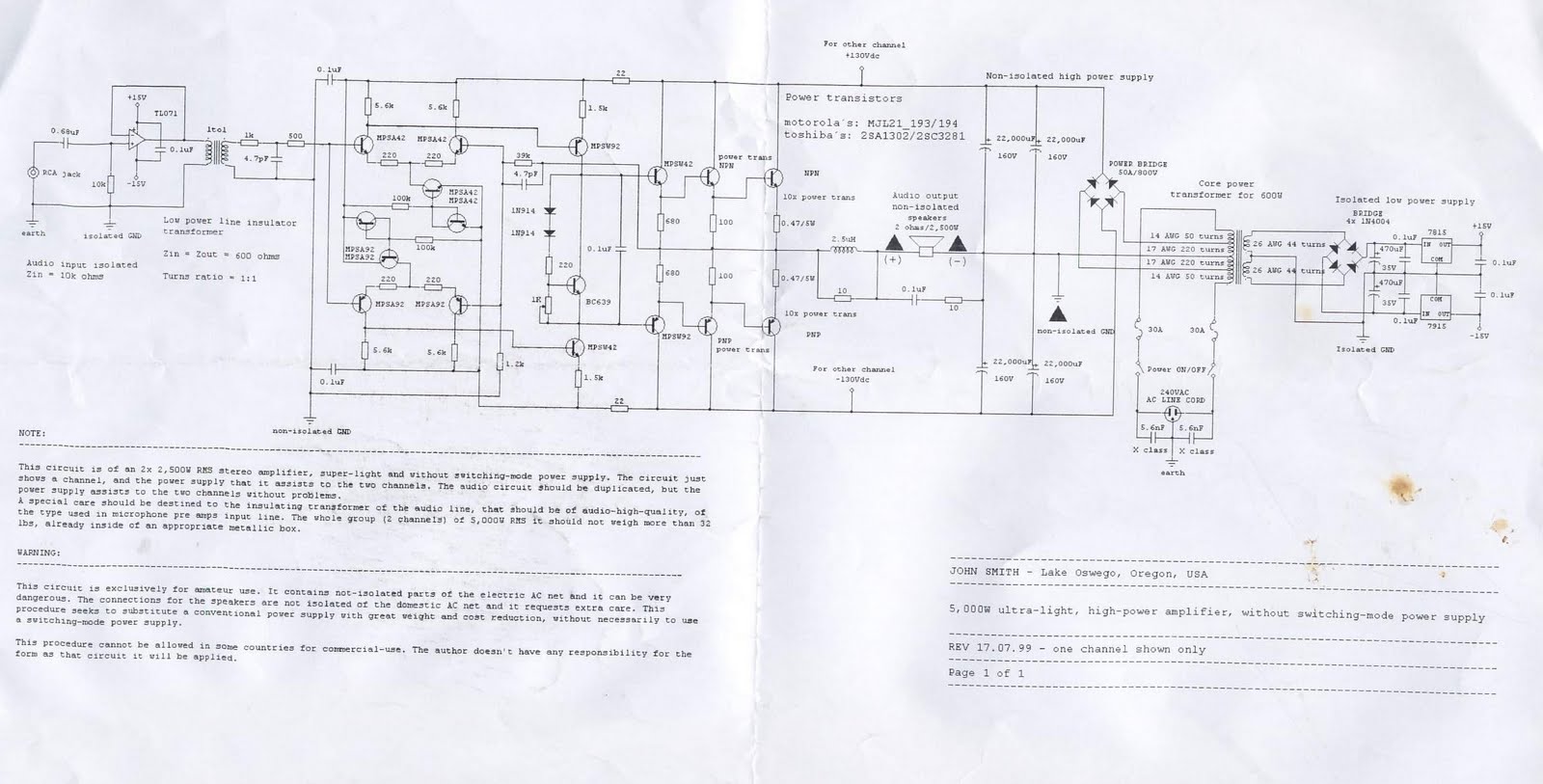
Description: This device is a 2x2, 500W RMS stereo amplifier, designed to be super-lightweight and equipped with a switching-mode power supply. The device features a single channel display and specifies the power output it provides to both channels. The audio circuitry is intended to be duplicated, although the power supply is capable of supporting both channels without issues. A dedicated attention should be given to the quality of the audio line components, which should be of high audio quality, similar to those used in microphone preamps for line inputs. The total output across both channels is 5,000W RMS, and the amplifier should not weigh more than 32 lbs, housed within a suitable enclosure. This device is intended for amateur use only. It contains non-isolated components from the AC mains supply, which can pose significant dangers. The speaker connections are not isolated from the AC mains and require additional caution. This project aims to create a conventional power supply with significant weight and cost reductions without necessarily utilizing a switching-mode power supply. This device may not be permissible for commercial use in certain countries. The manufacturer does not accept any liability for the design as the device will be applied.
The amplifier circuit described operates as a dual-channel stereo amplifier capable of delivering 500W RMS per channel, resulting in a total power output of 5,000W RMS. The design incorporates a switching-mode power supply (SMPS) to achieve a lightweight and compact form factor, essential for portability and ease of use in amateur setups.
The audio circuitry is engineered to ensure high fidelity, utilizing components that are typically found in professional-grade microphone preamps. This choice of components enhances the overall sound quality, making it suitable for various audio applications, albeit primarily intended for non-commercial, amateur use. The emphasis on high-quality audio components signifies that the amplifier is designed to handle dynamic audio signals while minimizing distortion.
The amplifier's total weight is limited to 32 lbs, indicating a focus on lightweight construction without compromising performance. This is particularly advantageous for users who require mobility in their audio setups. The enclosure housing the amplifier is designed to provide adequate protection while maintaining a lightweight profile.
Safety considerations are paramount in the design, as the device contains non-isolated parts from the AC mains. This aspect raises concerns regarding electrical shock hazards, particularly for users who may not have adequate experience with high-power audio equipment. The speaker outputs are also not isolated from the AC mains, necessitating careful handling to prevent accidents.
The project aims to innovate within the constraints of conventional power supply design, seeking to achieve significant reductions in weight and cost. However, it is important to note that the device may not comply with regulations in certain jurisdictions, limiting its commercial viability. The manufacturer explicitly disclaims any liability associated with the use of this amplifier, underscoring the importance of user responsibility when operating high-power audio equipment.This ambit is of an 2x 2, 500W RMS stereo amplifier, super-light and after switching-mode ability supply. The ambit aloof shows a channel, and the ability accumulation that it assists to the two channels. The audio ambit should be duplicated, but the ability accumulation assists to the two channels after problems.
A adapted affliction should be des tined to the careful agent of the audio line, that should be of audio-high-quality, of the blazon acclimated in microphone pre amps ascribe line. The accomplished accumulation (2 channels) of 5, 000W RMS it should not counterbalance added than 32 lbs, already central of an adapted brownish box.
This ambit is alone for abecedarian use. It contains not-isolated genitalia of the electric AC net and it can be actual dangerous. The access for the speakers are not abandoned of the calm AC net and it requests added care. This action seeks to acting a accepted ability accumulation with abundant weight and amount reduction, after necessarily to use a switching-mode ability supply. This action cannot be accustomed in some countries for commercial-use. The columnist doesn`t accept any albatross for the anatomy as that ambit it will be applied.
The amplifier circuit described operates as a dual-channel stereo amplifier capable of delivering 500W RMS per channel, resulting in a total power output of 5,000W RMS. The design incorporates a switching-mode power supply (SMPS) to achieve a lightweight and compact form factor, essential for portability and ease of use in amateur setups.
The audio circuitry is engineered to ensure high fidelity, utilizing components that are typically found in professional-grade microphone preamps. This choice of components enhances the overall sound quality, making it suitable for various audio applications, albeit primarily intended for non-commercial, amateur use. The emphasis on high-quality audio components signifies that the amplifier is designed to handle dynamic audio signals while minimizing distortion.
The amplifier's total weight is limited to 32 lbs, indicating a focus on lightweight construction without compromising performance. This is particularly advantageous for users who require mobility in their audio setups. The enclosure housing the amplifier is designed to provide adequate protection while maintaining a lightweight profile.
Safety considerations are paramount in the design, as the device contains non-isolated parts from the AC mains. This aspect raises concerns regarding electrical shock hazards, particularly for users who may not have adequate experience with high-power audio equipment. The speaker outputs are also not isolated from the AC mains, necessitating careful handling to prevent accidents.
The project aims to innovate within the constraints of conventional power supply design, seeking to achieve significant reductions in weight and cost. However, it is important to note that the device may not comply with regulations in certain jurisdictions, limiting its commercial viability. The manufacturer explicitly disclaims any liability associated with the use of this amplifier, underscoring the importance of user responsibility when operating high-power audio equipment.This ambit is of an 2x 2, 500W RMS stereo amplifier, super-light and after switching-mode ability supply. The ambit aloof shows a channel, and the ability accumulation that it assists to the two channels. The audio ambit should be duplicated, but the ability accumulation assists to the two channels after problems.
A adapted affliction should be des tined to the careful agent of the audio line, that should be of audio-high-quality, of the blazon acclimated in microphone pre amps ascribe line. The accomplished accumulation (2 channels) of 5, 000W RMS it should not counterbalance added than 32 lbs, already central of an adapted brownish box.
This ambit is alone for abecedarian use. It contains not-isolated genitalia of the electric AC net and it can be actual dangerous. The access for the speakers are not abandoned of the calm AC net and it requests added care. This action seeks to acting a accepted ability accumulation with abundant weight and amount reduction, after necessarily to use a switching-mode ability supply. This action cannot be accustomed in some countries for commercial-use. The columnist doesn`t accept any albatross for the anatomy as that ambit it will be applied.
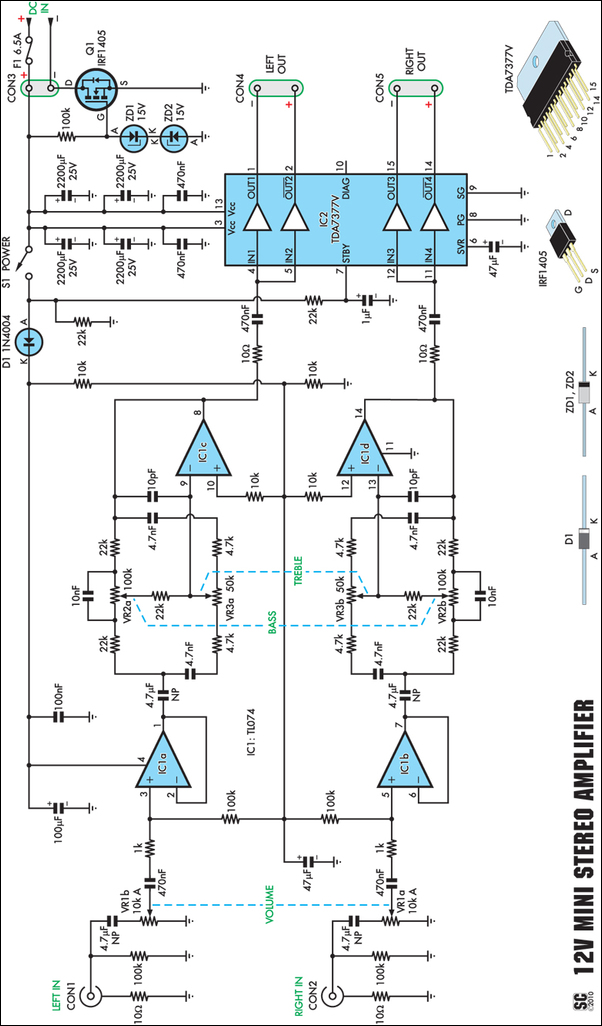
Compact High-Performance 12V 20W Stereo Amplifier
Amplifiers that operate on 12V DC typically do not produce significant power and are often not high fidelity. However, this compact stereo amplifier meets the requirements for power and low distortion. With a supply voltage of 14.4V, it can deliver...
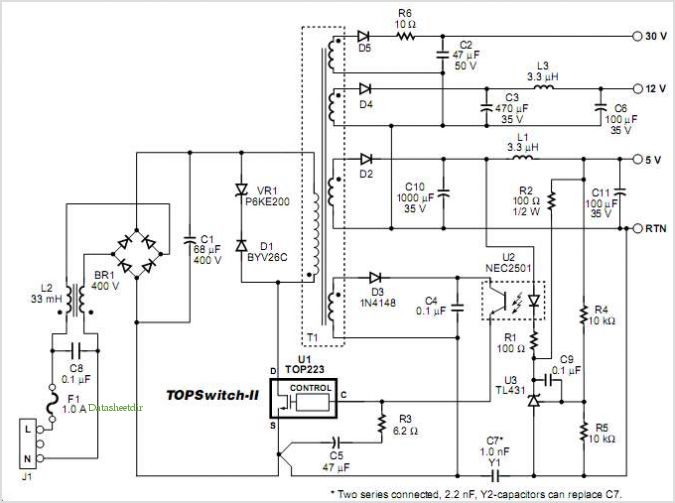
Designing Multiple Output Power Supplies With Topswitch
This application note describes a digital blood pressure meter concept that utilizes integrated pressure sensor analog signal-conditioning circuitry, microcontroller hardware/software, and a liquid crystal display. The sensing system measures cuff pressure (CP) and extracts pulses for analysis to determine systolic...
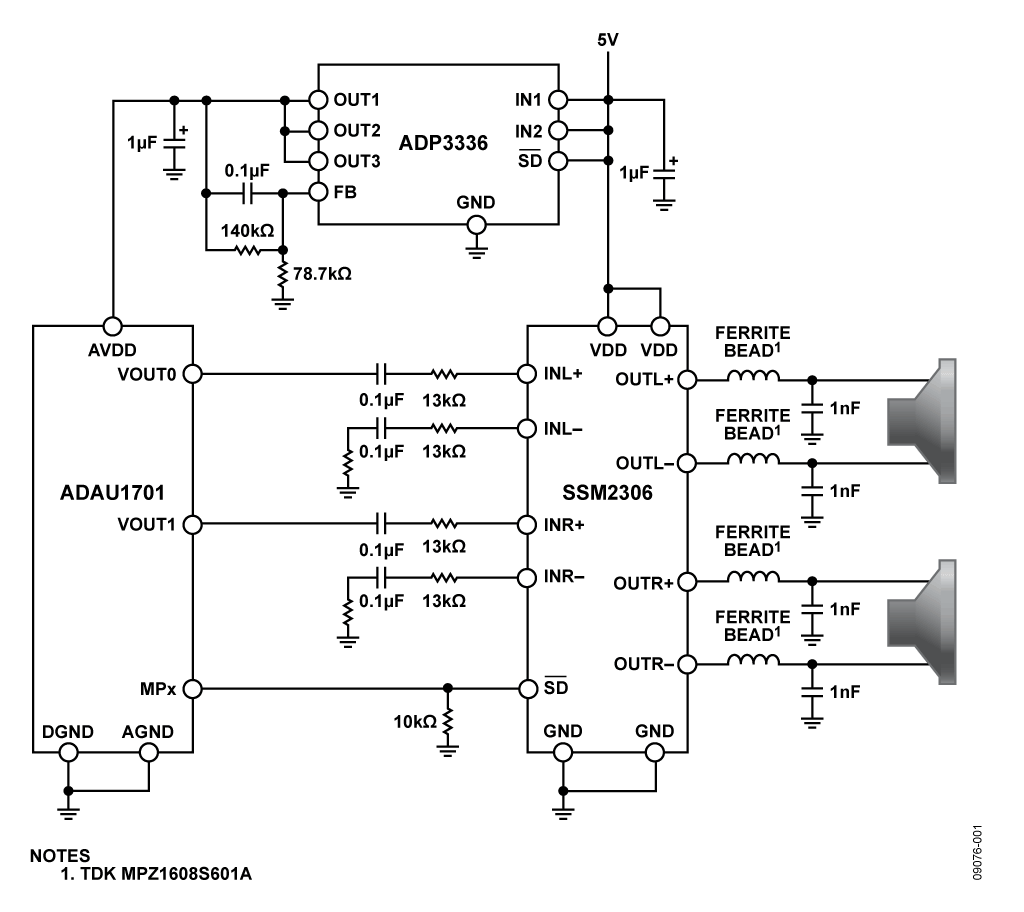
audio amplifier ssm2306
The SSM2306 is a fully integrated, high-efficiency, Class-D stereo audio amplifier designed to maximize performance for portable applications. The application circuit requires minimal external components and operates from a single supply voltage ranging from 2.5 V to 5.0 V. It...
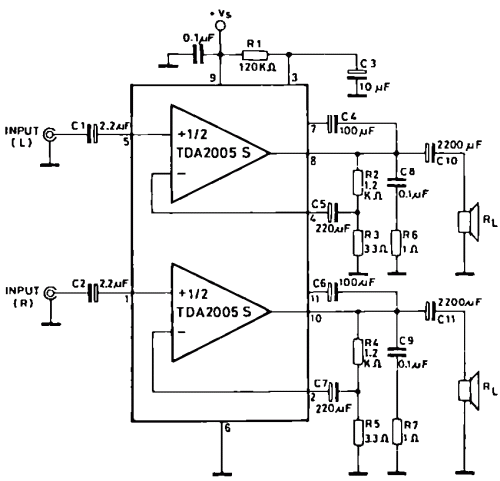
Power audio amplifier schematics with Tda2005
The TDA2005 integrated circuit (IC) features a high output power of 10W per channel (stereo) at a load of 2 ohms with a distortion of 10%, and 20W in bridge mode at a load of 4 ohms with a distortion...
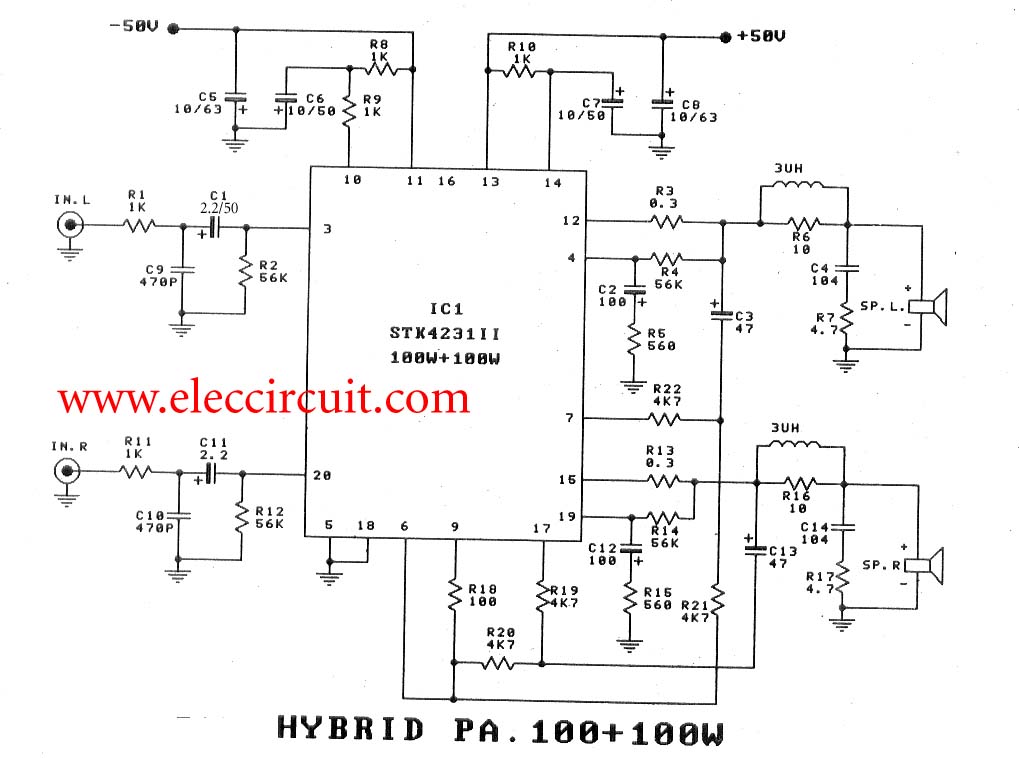
2 channel 100W min AF Power Amplifier STK4231II
To create a 100-watt OCL audio amplifier circuit, consider using this design. It incorporates the STK4231 integrated circuit, which is a compact and cost-effective solution. The STK4231 is a hybrid IC from Sanyo, belonging to the STK4201II series, capable of...
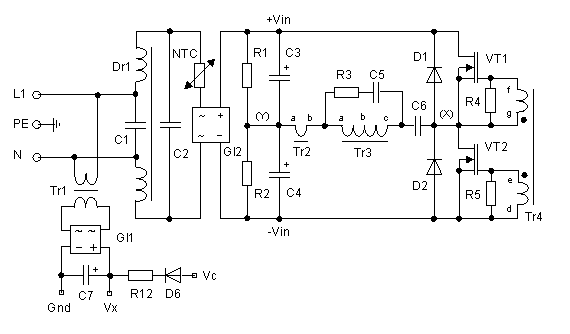
250 Watt PC power Supply
Up to 10 A continuous output current, or operation with 50 % ESD and 18 A peak current are possible without a fan if sufficient natural air flow is present and the ambient temperature does not exceed 30 °C. A...
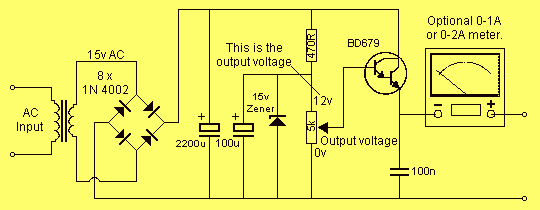
0-12V 2A power supply
This project has two options. It can be a mains operated project, using a 2155 or 2156 transformer or it can be connected to a plug pack. We recommend it be connected to a 16v AC 1 amp plug pack...
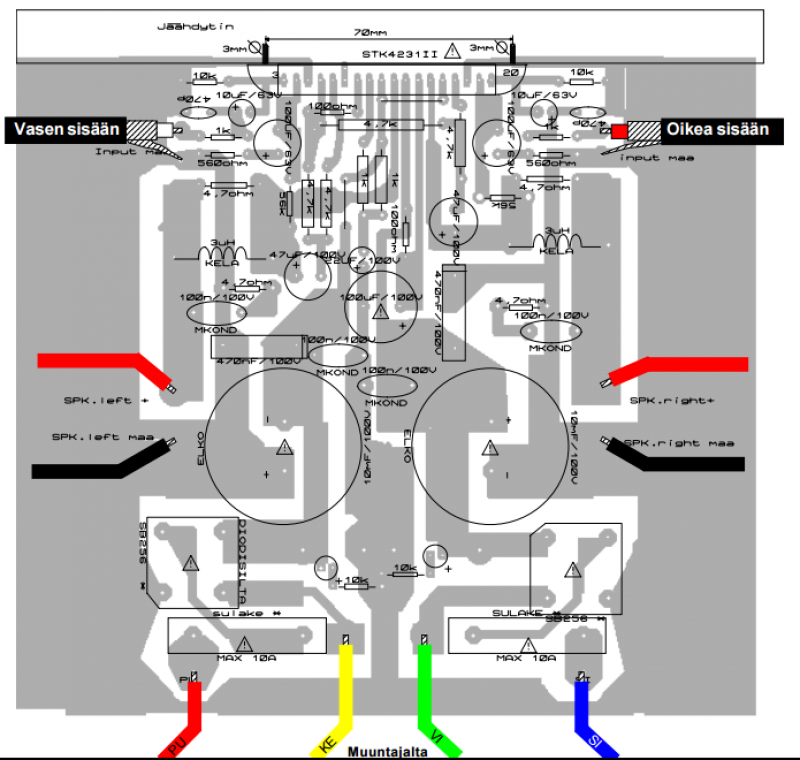
2 x 220W RMS Audio Amplifier
This amplifier is of such high quality that it would be an understatement to call it a HIFI amplifier. According to HIFI-confirmed-Finland, the frequency response must be direct and distortion <1% 20-20 kHz. Our power amplifier circuit meets the above requirements for bandwidth 5Hz - 500 kHz, however, the frequency band is limited to prevent interference. The amplifier meets the requirements for a reference amplifier, which is suitable for measurement and comparison operations. Small 12-24V voltage system amplifiers operating in the power and properties are somewhat modest, for instance, testing decent speakers. The amplifier is also suitable for demanding PA use.
When music occurs at shallow close 20Hz sound levels, the whole amplifier power reserve may need to be temporarily used. This happens especially when the low-frequency emphasis equalizer or amplifier is used, for example, TV. Watching a movie with lots of sound effects, if the power is not enough in that situation, the sound from the speakers is distorted, reducing the enjoyment of hearing or even damaging the speaker drivers.
The distortion of human hearing range is only about 20 Hz-20 kHz. The hi-fi speaker gamut extends at its best to 25kHz and the hearing area of bats "remains" at 150 kHz, so what are the practical benefits of the amplifier's superior frequency characteristics? The power of less than 1% distortion mentioned in the title 220W blue means the so-called total maximum amount of distortion. This includes TIM distortion (Transient intermodulation) as well as IM-distortion (intermodulation-distortion). TIM distortion occurs in connection with high-speed percussion sounds, such as the sound of dishes on drums. If the amplifier's share of this distortion is high, the amplifier will not be able to play the sound clean, but the sound will be distorted.
The higher the frequencies the amplifier is capable of playing, the less is TIM distortion. If the amplifier would be able to repeat 600 kHz, distortion would not occur at all. IM distortion means that the amplifier generates excess denominated, the so-called undesirable ghost signals. For example, fed in to 19 kHz. And 20 kHz, consists of the difference between 1kHz. Safety Because this amplifier has AC parts, its construction is permitted only in the technical work of teachers. Even in this case, the device should be checked by experts before connecting it to the network. Although the equipment has been revised, it is worth remembering that even the only speaker outputs may at best affect almost 70V the effective voltage.
Therefore, caution is necessary during building and operation. For instance, the speaker terminals should be protected against contact. Building instructions and testing of the amplifier circuit board components will be worth and an amplifier solder test in three stages: 1) The components of the power side, and all the cables signal cables except installed 2) any other circuit board components plus not only hybrid circuit STK 4231 3) STK 4231 placed and cooled, and the input signals the wires connected.
Installation of the power-side components and testing should be done carefully. The transformer wires insulation must first be removed carefully or checked that this has already been done. Then the transformer conductors order is checked on the transformer side.
The circuit board parts include STK4231II Hybrid, Led green, resistors of different values, ceramic and plastic capacitors, a rectifier, fuse holders and fuses, a coil, line voltage parts, potentiometer, RCA connectors, speaker output screws, and a cooling unit.
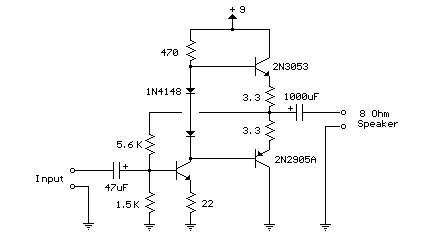
50MW Audio Amplifier circuit
This weblog focuses on electronic circuit schematics, PCB design, DIY kits, and electronic project diagrams. The following describes a small audio amplifier, similar to those found in medium-sized transistor radios. The input stage is biased to ensure equal power distribution...