


adjusting Williamson amp
#Williamson amp
#pentode
#Mullard 5-10
#audio amplifier
#vacuum tube
#circuit adjustment
#optimum performance
#electronics
#DIY audio
#tube amplifier
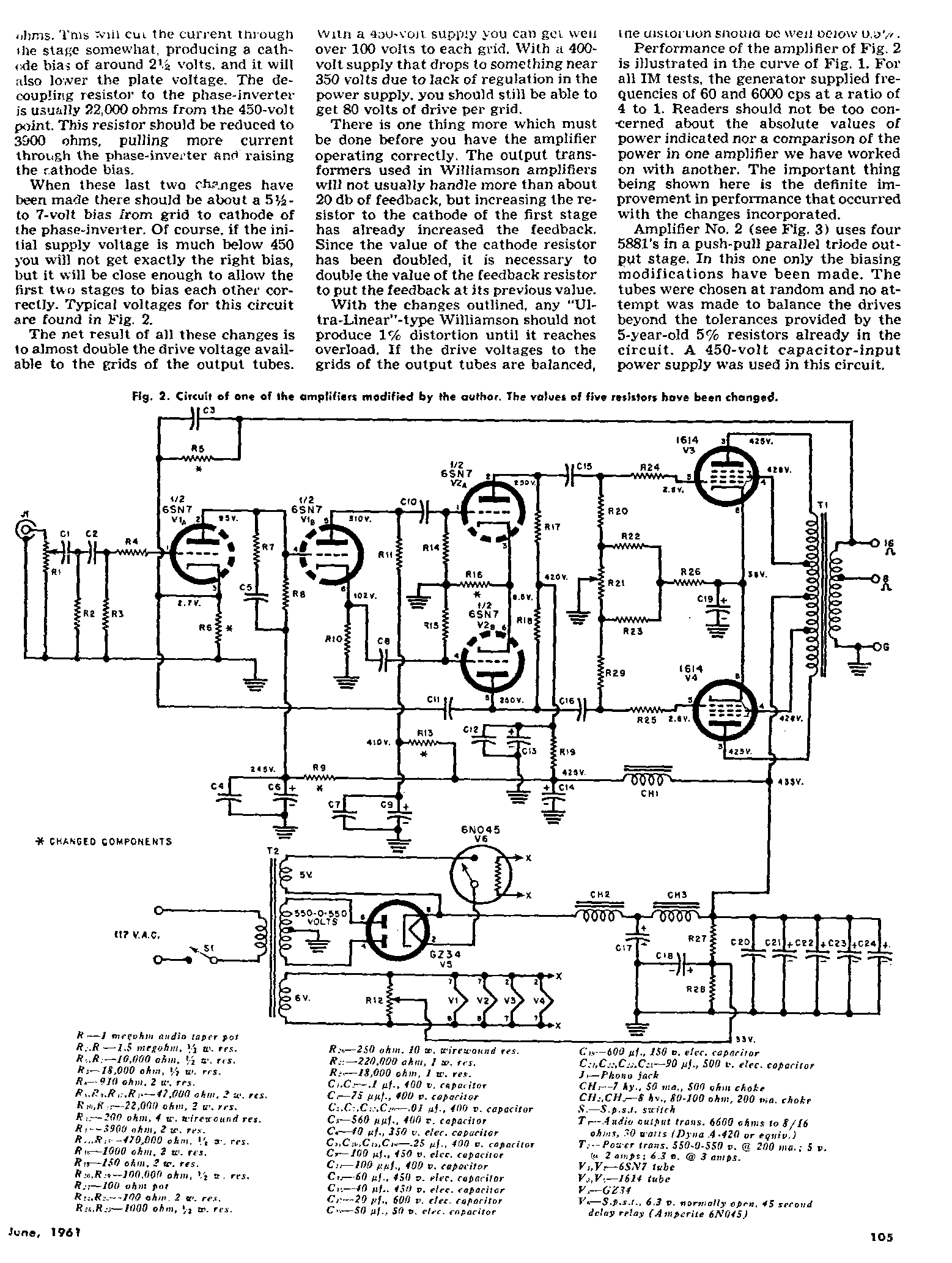
Description: The original claim indicated that a pentode-connected version is not optimal. However, it was stated that the Mullard 5-10 is not considered optimal.
The discussion revolves around the performance evaluation of different amplifier configurations, particularly focusing on the pentode connection and the Mullard 5-10 circuit. The Mullard 5-10 is a well-known audio amplifier design that utilizes a push-pull configuration with a pair of EL84 output tubes in a class AB operation. This design is often praised for its warm sound and efficient power output, but it may not deliver the highest fidelity compared to other configurations.
In a pentode-connected amplifier, the pentode tube offers higher gain and better linearity compared to a triode. However, the trade-off can include increased distortion levels and a more complex feedback network to maintain sound quality. The Mullard 5-10, while not optimal in every aspect, provides a balanced performance that appeals to many audio enthusiasts.
To analyze the circuit, it is essential to consider the input stage, which typically consists of a low-noise transistor or a triode, followed by a phase splitter that drives the output stage. The output stage, featuring the EL84 tubes, is coupled to the speaker through output transformers, which are crucial for impedance matching and ensuring efficient power transfer. The feedback loop in the Mullard design is implemented to reduce distortion and stabilize the gain, which is a critical aspect of achieving desired sound characteristics.
In summary, while the pentode connection may offer specific advantages in terms of gain and linearity, the Mullard 5-10 circuit design presents a well-rounded approach to audio amplification that balances performance with practicality, making it a popular choice among audiophiles.Originally Posted by artosalo My original claim was that pentode connected version is not optimum. NO! You wrote the Mullard 5-10 is not optimum. If..
The discussion revolves around the performance evaluation of different amplifier configurations, particularly focusing on the pentode connection and the Mullard 5-10 circuit. The Mullard 5-10 is a well-known audio amplifier design that utilizes a push-pull configuration with a pair of EL84 output tubes in a class AB operation. This design is often praised for its warm sound and efficient power output, but it may not deliver the highest fidelity compared to other configurations.
In a pentode-connected amplifier, the pentode tube offers higher gain and better linearity compared to a triode. However, the trade-off can include increased distortion levels and a more complex feedback network to maintain sound quality. The Mullard 5-10, while not optimal in every aspect, provides a balanced performance that appeals to many audio enthusiasts.
To analyze the circuit, it is essential to consider the input stage, which typically consists of a low-noise transistor or a triode, followed by a phase splitter that drives the output stage. The output stage, featuring the EL84 tubes, is coupled to the speaker through output transformers, which are crucial for impedance matching and ensuring efficient power transfer. The feedback loop in the Mullard design is implemented to reduce distortion and stabilize the gain, which is a critical aspect of achieving desired sound characteristics.
In summary, while the pentode connection may offer specific advantages in terms of gain and linearity, the Mullard 5-10 circuit design presents a well-rounded approach to audio amplification that balances performance with practicality, making it a popular choice among audiophiles.Originally Posted by artosalo My original claim was that pentode connected version is not optimum. NO! You wrote the Mullard 5-10 is not optimum. If..
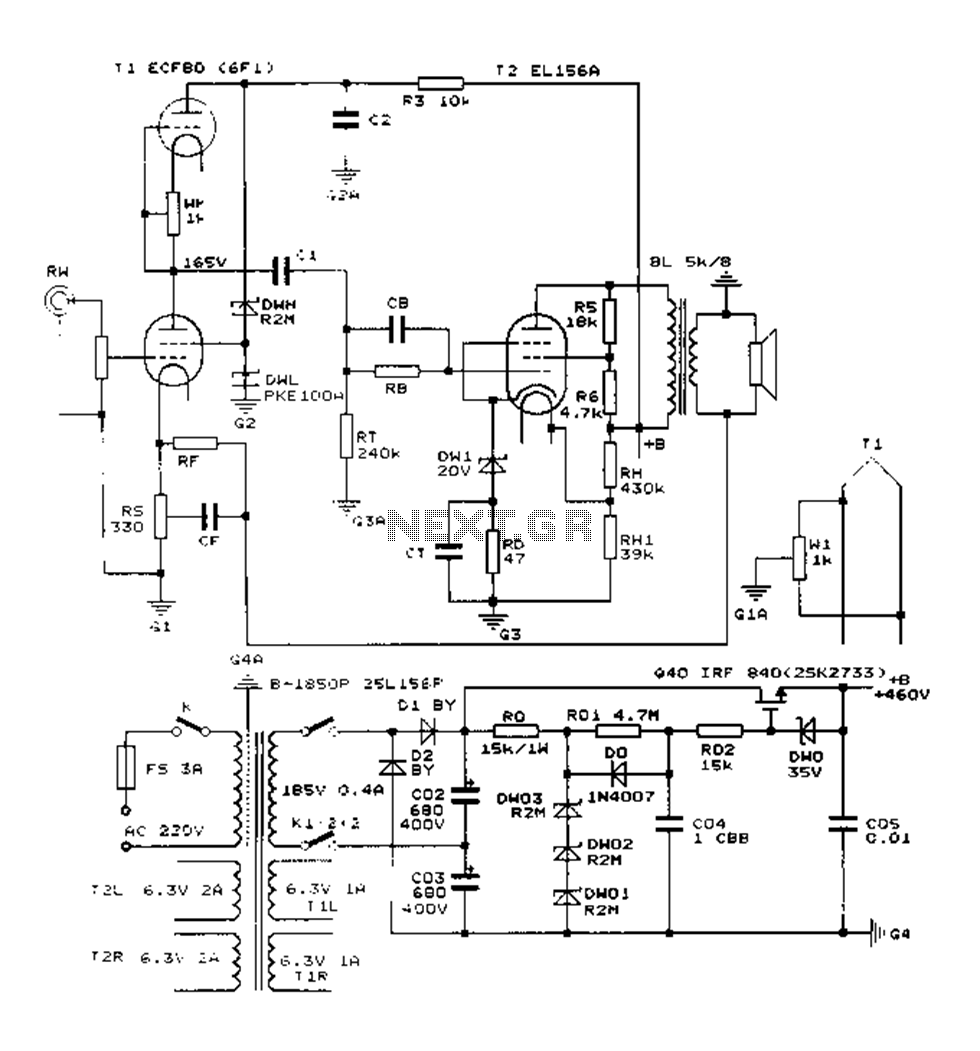
Construction 25W single-ended Class A tube amp circuit diagram EL156
The Danji mellow sound is characterized by its transparent and natural quality, offering a sweet and sincere listening experience that is tireless over long durations and rich in humane color. Tube amplifiers have become an audiophile's companion and are increasingly...
10w audio amplifier
The table below illustrates the expected voltages when utilizing a 24V supply, with the variable resistor adjusted to provide an output current of approximately 40mA.
The circuit operates with a 24V DC power supply, where a variable resistor (also known as...
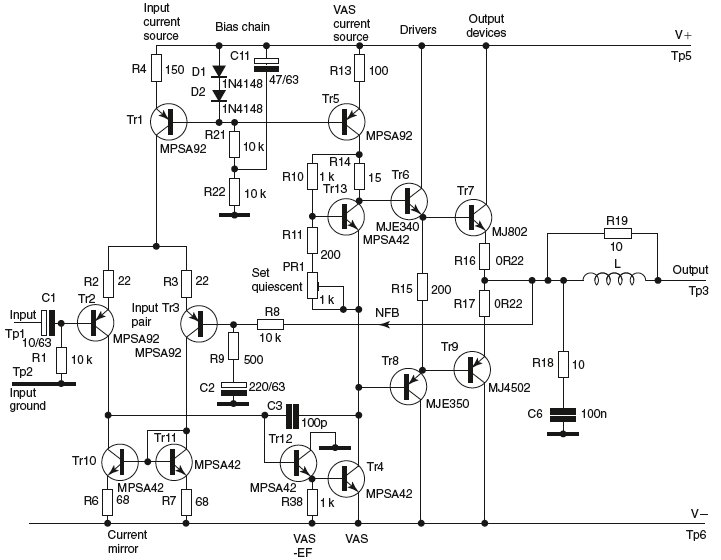
Audio amplifier power supply design
This document discusses the advantages and disadvantages of various power supply technologies, along with the design considerations necessary for selecting and evaluating a mains transformer. It covers the pros and cons of external supplies, inrush current control, RF emissions from...
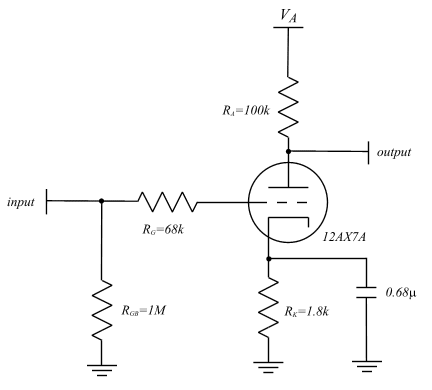
Vacuum Tube Preamplifier Analysis and SPICE Simulation
The concept of an AC model for the triode is presented, and the equivalent circuit technique is described. Theoretical calculations for amplifier gain and frequency response are derived and compared to simulation results in the SPICE3 environment, showing good agreement....
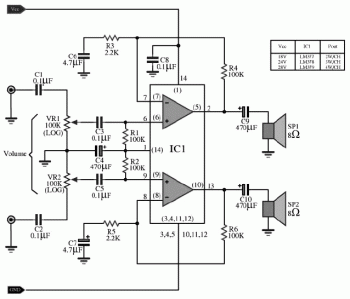
Stereo OTL Audio Amplifier
The following diagram illustrates the circuit of a Stereo OTL Audio Amplifier. It is based on an integrated circuit (IC), making the circuit design straightforward. The amplifier project can utilize ICs such as LM379, LM377, or LM378. According to the...
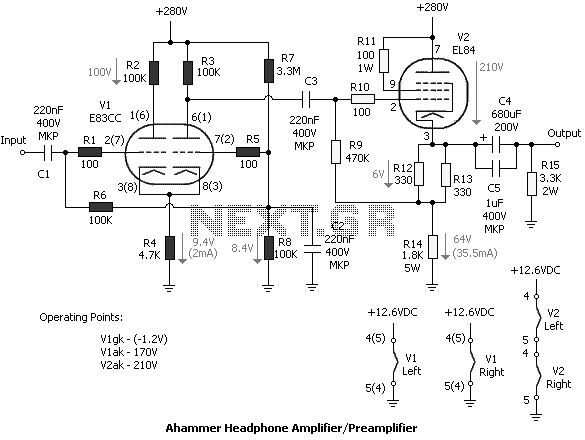
Tube Headphone Amplifier/Preamp
Tube amplifiers designed for headphones have the principal property that they can be used as preamplifiers too. In most cases, the output impedance of a tube headphone amplifier is (or should be) less than the output impedance of a tube...
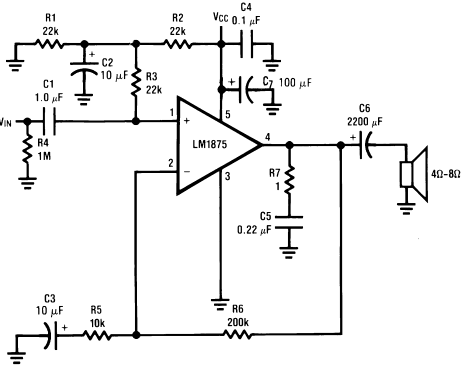
Circuit of power audio amplifier lm1875 20W
The LM1875 is a monolithic audio amplifier that provides very low distortion and high-quality performance for audio amplifier projects. The LM1875 delivers 20 watts into loads of 4 Ohms or 8 Ohms.
The LM1875 audio amplifier is designed for applications requiring...
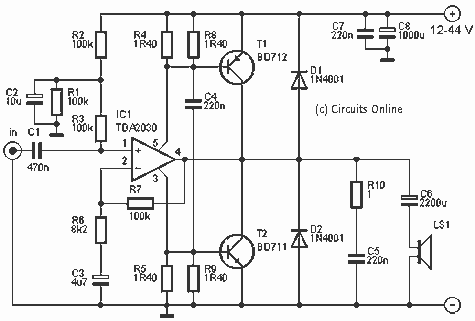
40W audio amplifier using TDA2030
This amp delivers a lot of power and uses 1 IC and two power transistors. The circuit consists of an amplifier IC (a TDA 2030A) and a power stage consists of two transistors. The amplifier can be powered with an...
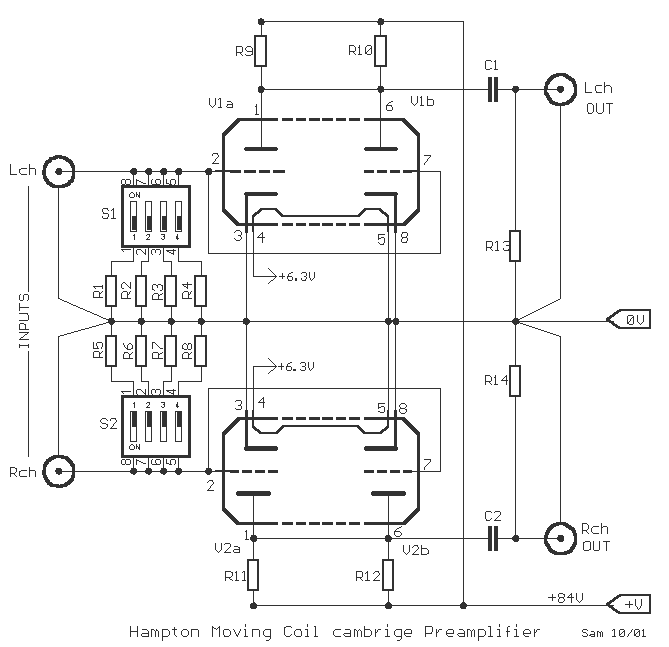
Tube Preamplifier with ECC88
A very good circuit of pre-preamplifier for amplification of signals from heads of Moving Coil. It uses the two departments of tube ECC88, association parallel, for reduction of produced noise. The circuit enters in line with existing circuit PHONO. Switches...