


Amplifier with Tone Controls and Soft Switching
#LM380
#tone control
#soft switching
#audio amplifier
#electronic switching
#power management
#sound control
#low voltage
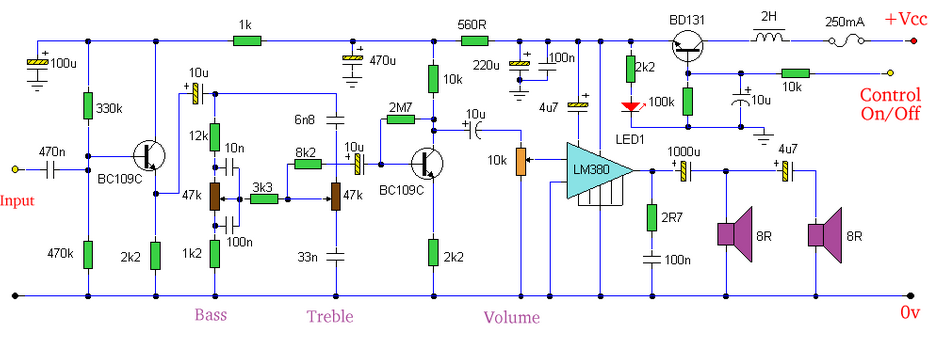
Description: Built around an LM380, this amplifier includes tone controls and electronic soft switching. The soft switching circuitry ensures power is balanced.
The LM380 is a power audio amplifier capable of delivering up to 14 watts of output power. It is designed to operate in a variety of applications, including consumer electronics and professional audio systems. The amplifier circuit typically consists of the LM380 integrated circuit, passive components such as resistors and capacitors for tone control, and additional circuitry for implementing the soft switching feature.
Tone controls in this amplifier allow users to adjust bass and treble frequencies, enhancing the listening experience by tailoring audio output to personal preferences or specific acoustic environments. The tone control circuit may utilize potentiometers to provide variable resistance, influencing the feedback network of the amplifier and altering the frequency response.
The electronic soft switching circuitry is crucial for minimizing audible switching noise and ensuring smooth transitions between power states. This feature is particularly beneficial in applications where the amplifier must operate quietly or in sensitive audio environments. Soft switching can be implemented using additional transistors or MOSFETs that gradually ramp up the power to the amplifier, reducing the likelihood of pops or clicks during power-up and power-down sequences.
Overall, this amplifier design combines the robust performance of the LM380 with user-friendly features like tone controls and soft switching, making it suitable for a wide range of audio applications. Proper layout and component selection are essential to achieve optimal performance, including considerations for heat dissipation, power supply decoupling, and signal integrity.Built around an LM380, this amplifier includes tone controls and electronic “soft switchingâ€. The soft switching circuitry ensures power is b..
The LM380 is a power audio amplifier capable of delivering up to 14 watts of output power. It is designed to operate in a variety of applications, including consumer electronics and professional audio systems. The amplifier circuit typically consists of the LM380 integrated circuit, passive components such as resistors and capacitors for tone control, and additional circuitry for implementing the soft switching feature.
Tone controls in this amplifier allow users to adjust bass and treble frequencies, enhancing the listening experience by tailoring audio output to personal preferences or specific acoustic environments. The tone control circuit may utilize potentiometers to provide variable resistance, influencing the feedback network of the amplifier and altering the frequency response.
The electronic soft switching circuitry is crucial for minimizing audible switching noise and ensuring smooth transitions between power states. This feature is particularly beneficial in applications where the amplifier must operate quietly or in sensitive audio environments. Soft switching can be implemented using additional transistors or MOSFETs that gradually ramp up the power to the amplifier, reducing the likelihood of pops or clicks during power-up and power-down sequences.
Overall, this amplifier design combines the robust performance of the LM380 with user-friendly features like tone controls and soft switching, making it suitable for a wide range of audio applications. Proper layout and component selection are essential to achieve optimal performance, including considerations for heat dissipation, power supply decoupling, and signal integrity.Built around an LM380, this amplifier includes tone controls and electronic “soft switchingâ€. The soft switching circuitry ensures power is b..
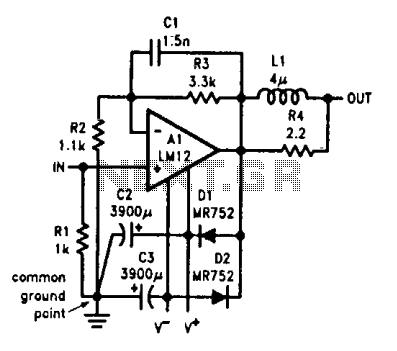
Audio power amplifier
Output-clamp diodes are essential due to the inductive nature of loudspeakers. Output LR isolation is employed as audio amplifiers are typically designed to manage load capacitance of up to 2 µF. Large supply-bypass capacitors placed near the integrated circuit (IC)...
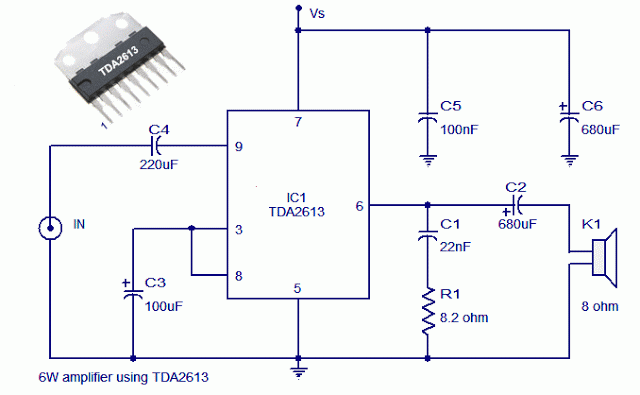
Reliable 6 Watt Hi Fi Audio Amplifier Using TDA2613
A 6-watt audio amplifier circuit utilizing the TDA2613 integrated circuit is presented. The TDA2613, produced by Philips Semiconductors, is a high-fidelity audio amplifier IC. This component is designed to be click-proof when switched on or off, resistant to short circuits,...
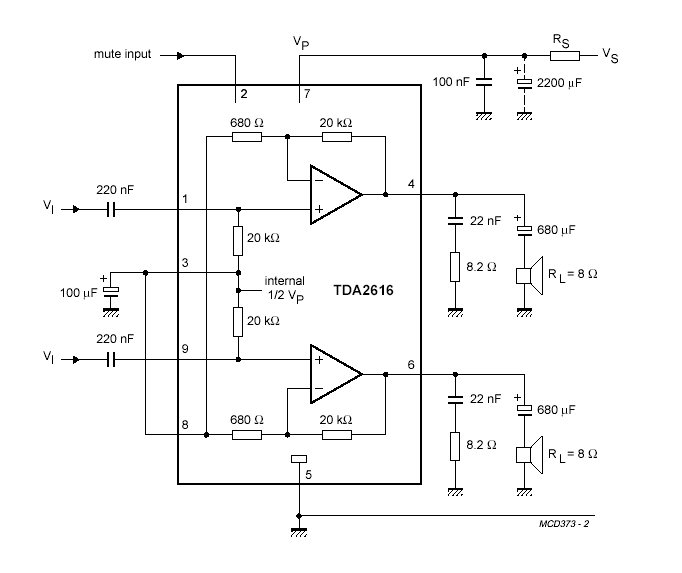
Stereo Audio Amplifier with TDA2616
A power amplifier was constructed during secondary school using transistors. The circuit offered limited power and featured a poorly designed PCB. Concurrently, access to the TDA1524 datasheet, a tone and volume control circuit, led to the decision to create a...
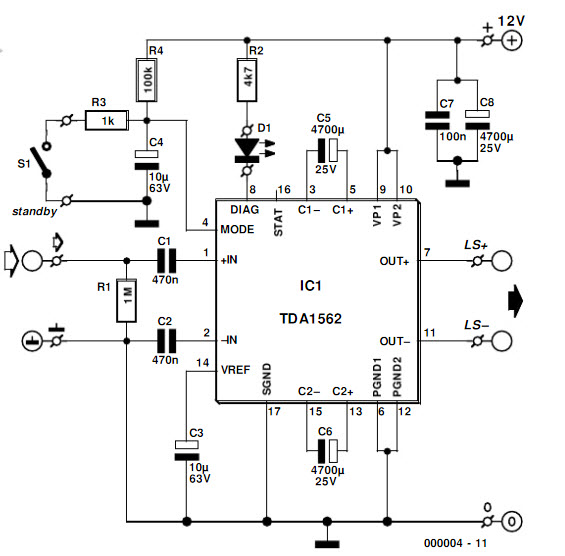
50w audio amplifier using ic tda1562
The integrated output amplifier presented in this article consists primarily of a single integrated circuit. It is specifically designed for application in motor vehicles and other battery-operated devices. Despite its seemingly simple design, the amplifier is capable of delivering significant...
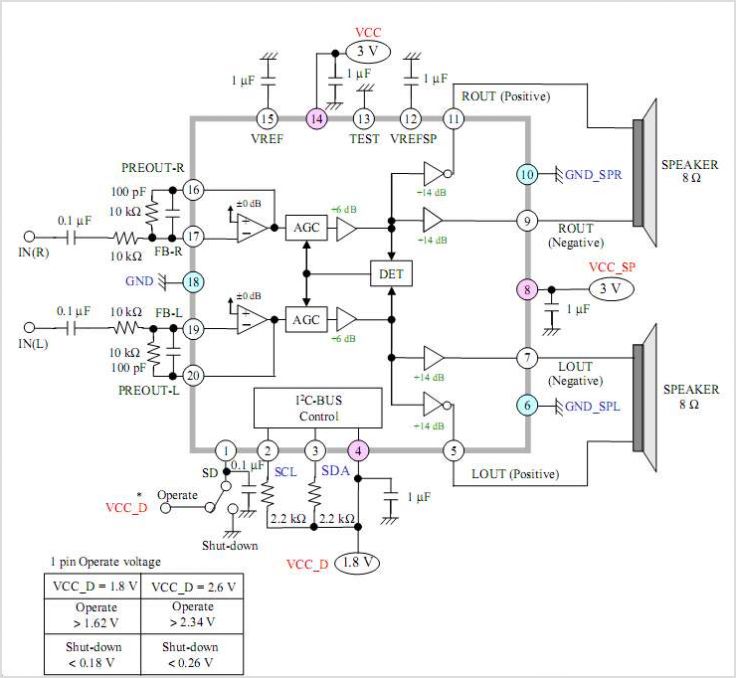
AN12979A Audio Power Amplifier
The AN41240A is a single-chip integrated circuit (IC) designed for audio applications. It employs a single-hall-sensor drive on the input side of the spindle motor drive block and utilizes a low-noise direct PWM drive of sine wave on the output...
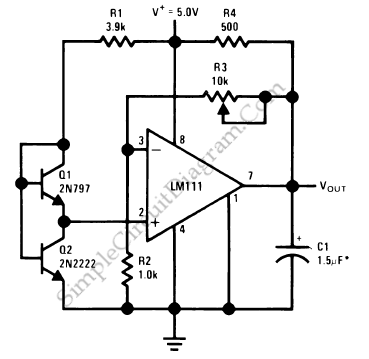
Low Voltage Adjustable Reference Supply
A low voltage reference is essential for providing an offset source or biasing, or simply serving as a reference for a comparator. Its adjustable feature should be compatible with this circuit.
A low voltage reference circuit is designed to deliver a...
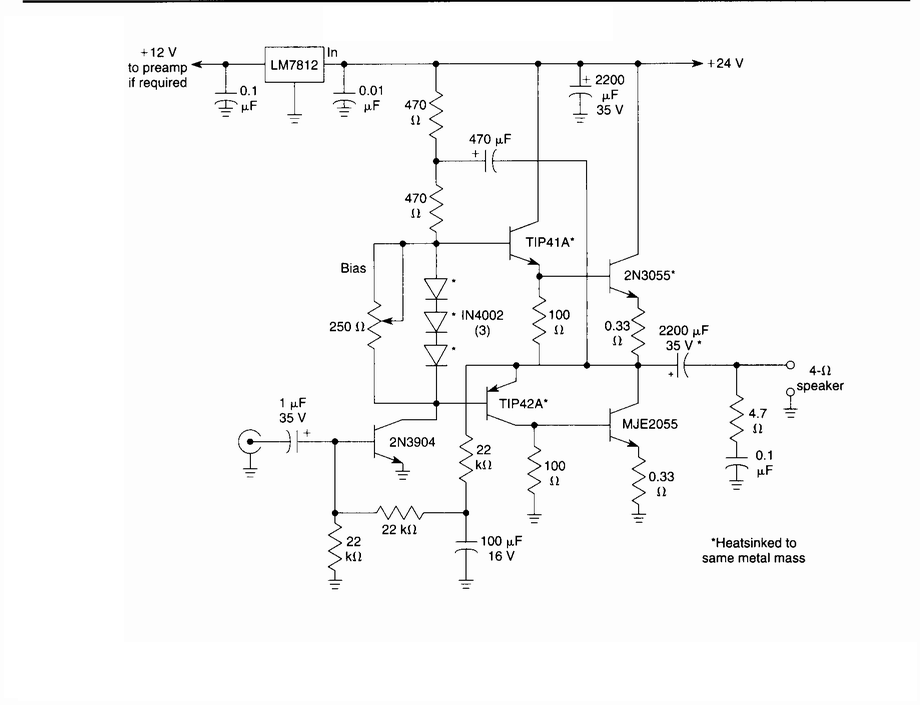
10 W Audio Amplifier
This circuit is a general-purpose 10-W audio amplifier designed for moderate-power public address (PA) systems or as a modulator in an AM transmitter. By applying higher voltages and adjusting the bias resistors, it is possible to achieve output power levels...
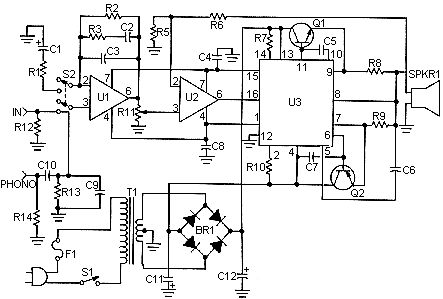
50 Watt Amplifier
This is a convenient and straightforward general-purpose 50-watt amplifier. The amplifier features an input for connecting devices such as radios, TVs, or stereo equipment. Additionally, it includes a phono input suitable for connecting record players, guitars, microphones, or other unamplified...
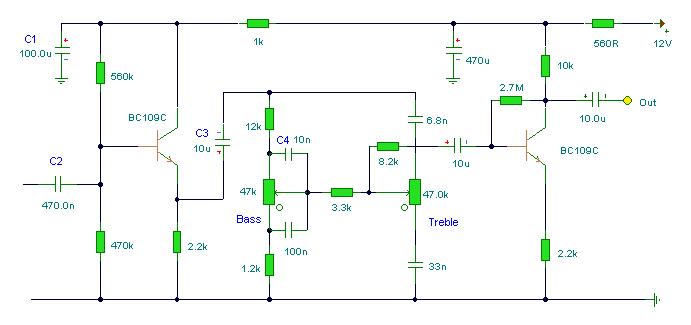
Tone Control Circuit
The first BC109C transistor (on the left side) functions as a buffer, offering the circuit a high input impedance of approximately 250k ohms and a voltage gain slightly less than unity. As the Baxandall tone control circuit is a passive...