


Audio amplifier with IC AN7522 AN7523 and TDA2616
#audio amplifier
#BTL
#IC AN7522
#IC AN7523
#TDA2616
#bridge transformer less
#coupling capacitors
#coupling transformers
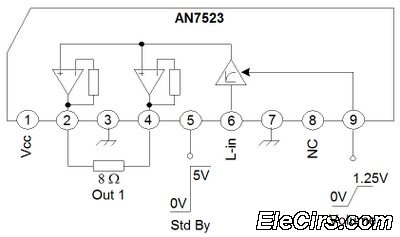
Description: The third series of the function utilizes the same system, specifically BTL (Bridge Transformer Less). This configuration offers several advantages, including the elimination of coupling capacitors and coupling transformers.
The BTL (Bridge Transformer Less) configuration is a significant advancement in audio amplification systems, particularly in applications where space and component count must be minimized. By employing a BTL design, the circuit achieves a more efficient power transfer to the load, which is often a speaker, without the need for traditional coupling components that can introduce distortion and reduce fidelity.
In a typical BTL setup, two amplifiers are used in a push-pull configuration to drive a load. Each amplifier outputs a signal that is 180 degrees out of phase with the other, effectively doubling the voltage across the load while maintaining a balanced output. This arrangement allows for higher output power levels and improved efficiency, as the amplifiers can directly drive the load without the need for transformers or capacitors that can limit frequency response and introduce phase shifts.
The absence of coupling capacitors is particularly beneficial in high-fidelity applications, as these components can filter out low-frequency signals and affect the overall sound quality. Additionally, the elimination of transformers reduces the size and weight of the overall system, making it more suitable for compact designs where space is at a premium.
Furthermore, BTL configurations can enhance thermal performance, as the heat generated by each amplifier can be more effectively managed when they are working together to drive the same load. This can lead to increased reliability and longevity of the components used in the circuit.
Overall, the BTL (Bridge Transformer Less) design represents a forward-thinking approach in the realm of audio amplification, providing clear advantages in terms of efficiency, size, and sound quality.Third series of the function with the same system, namely BTL (Bridge Transformer Less). By using such configuration we get several advantages, namely no use coupling capacitors or coupling transformers.
The BTL (Bridge Transformer Less) configuration is a significant advancement in audio amplification systems, particularly in applications where space and component count must be minimized. By employing a BTL design, the circuit achieves a more efficient power transfer to the load, which is often a speaker, without the need for traditional coupling components that can introduce distortion and reduce fidelity.
In a typical BTL setup, two amplifiers are used in a push-pull configuration to drive a load. Each amplifier outputs a signal that is 180 degrees out of phase with the other, effectively doubling the voltage across the load while maintaining a balanced output. This arrangement allows for higher output power levels and improved efficiency, as the amplifiers can directly drive the load without the need for transformers or capacitors that can limit frequency response and introduce phase shifts.
The absence of coupling capacitors is particularly beneficial in high-fidelity applications, as these components can filter out low-frequency signals and affect the overall sound quality. Additionally, the elimination of transformers reduces the size and weight of the overall system, making it more suitable for compact designs where space is at a premium.
Furthermore, BTL configurations can enhance thermal performance, as the heat generated by each amplifier can be more effectively managed when they are working together to drive the same load. This can lead to increased reliability and longevity of the components used in the circuit.
Overall, the BTL (Bridge Transformer Less) design represents a forward-thinking approach in the realm of audio amplification, providing clear advantages in terms of efficiency, size, and sound quality.Third series of the function with the same system, namely BTL (Bridge Transformer Less). By using such configuration we get several advantages, namely no use coupling capacitors or coupling transformers.
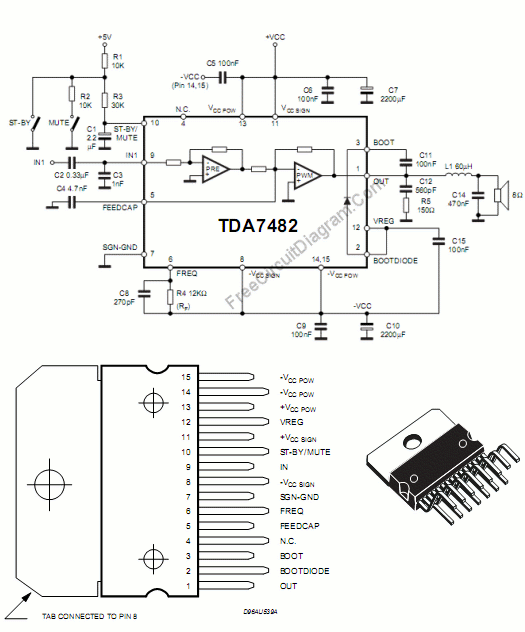
Audio Single Chip 25 Watt Mono Class-D Audio Power Amplifier Circuit
This class-D audio amplifier is suitable for TV and home stereo systems. The TDA7882 integrated circuit (IC) provides a class-D audio amplifier solution. Since this IC has a single channel output, two units are required for stereo applications. The power...
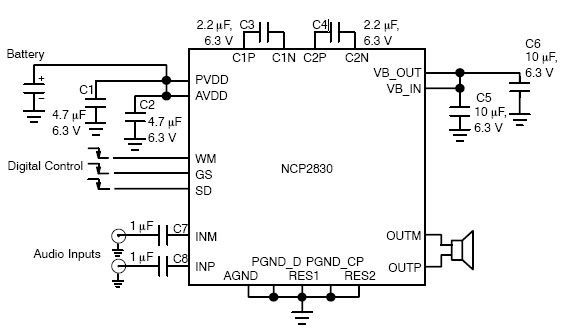
1w audio amplifier circuit using ncp2830
The NCP2830 audio power amplifier features high-quality audio performance with a total harmonic distortion plus noise (THD+N) of 0.04%. It offers low noise with a signal-to-noise ratio (SNR) of up to 100 dB and optimizes overall system efficiency, achieving up...
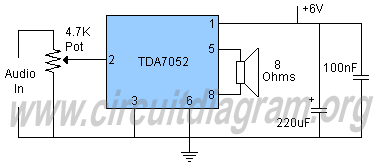
2 watt amplifier tda7052
Schematic diagram and description of a 2-watt audio amplifier circuit using the TDA7052 amplifier IC. This is a very simple audio amplifier circuit.
The 2-watt audio amplifier circuit utilizing the TDA7052 integrated circuit (IC) is designed for basic audio amplification applications....
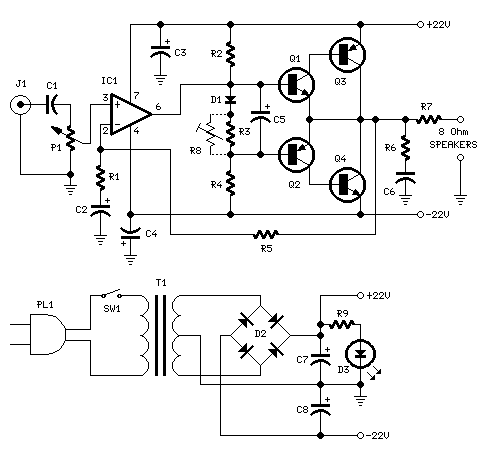
18W Audio Amplifier
High Quality very simple unit - No need for a preamplifier. Can be directly connected to CD players, tuners and tape recorders. Don't exceed 23 + 23V supply. Q3 and Q4 must be mounted on heatsink. D1 must be in...
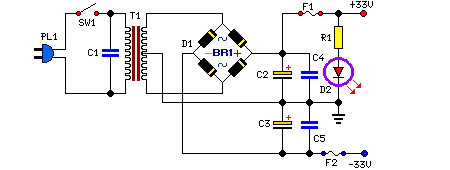
25 Watt Audio Amplifier
This is a 25 Watt basic power amplifier designed to be relatively easy to build at a reasonable cost. It offers better performance than standard STK module amplifiers commonly found in mass-market stereo receivers. The original design was created to...
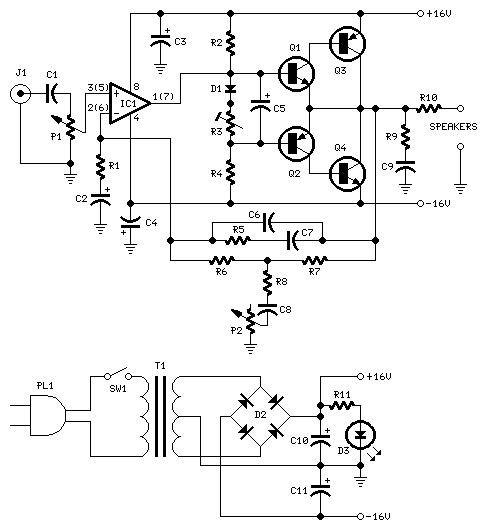
10W Audio Amplifier with Bass-boost
This design is based on an 18 Watt Audio Amplifier and was developed primarily to address the needs of users who have difficulty locating the TLE2141C chip. It utilizes the commonly available NE5532 Dual IC; however, its power output will...
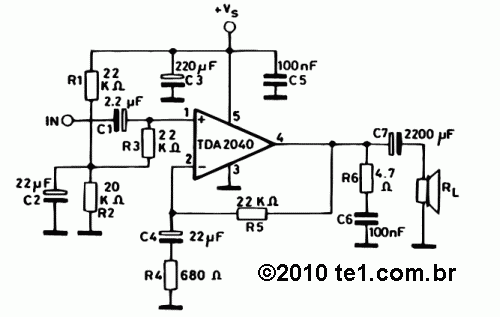
Circuit power audio amplifier TDA2040 20 watts integrate circuit with pcb and power supply circuit
The TDA2040 is a monolithic integrated circuit housed in a Pentawatt package, designed for use as an audio class AB amplifier. It typically delivers an output power of 22W (with a distortion factor of 0.5%) at a supply voltage of...
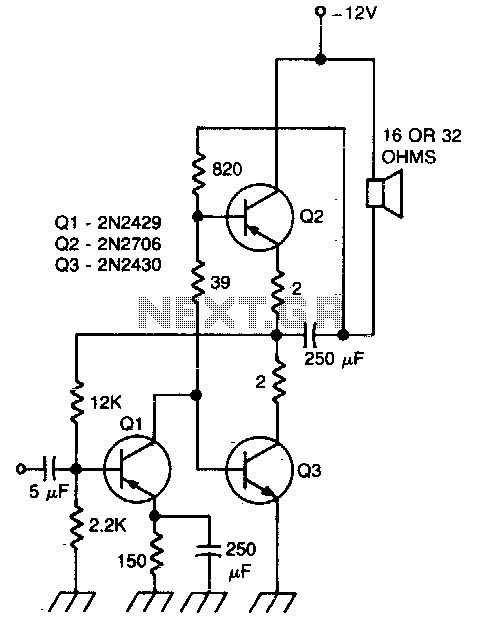
470 Mw complementary-symmetry audio amplifier
This circuit exhibits less than 2% distortion and maintains a flat response within 3 dB from 15 Hz to 130 kHz.
The described circuit is engineered to provide high fidelity audio performance, characterized by minimal distortion and a wide frequency response....
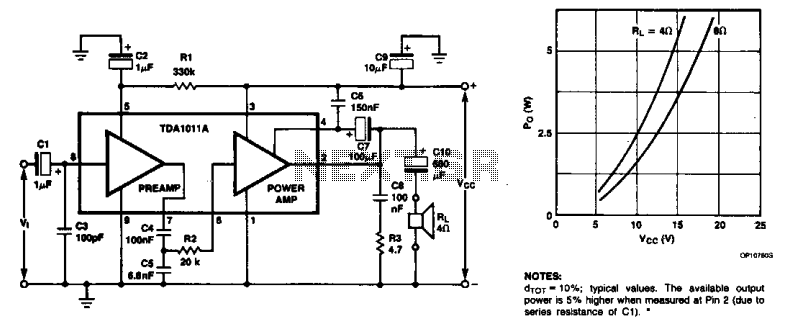
6w audio amplifier with preamplifier
The monolithic integrated audio amplifier circuit is specifically designed for portable radio and recorder applications, delivering up to 4 W into a 4-ohm load impedance. The power output is close to 6 watts RMS.
The monolithic integrated audio amplifier circuit is...