


HYDROPHONE PREAMPLIFIER
#hydrophone
#preamplifier
#cathode-follower
#Navy RBA-6
#low-frequency
#radio receiver
#underwater
#telemeter
#21-kc beam
#trawl net depth
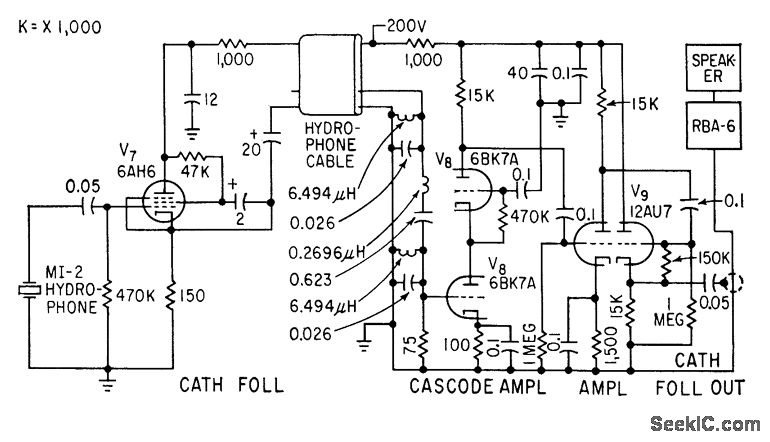
Description: A cathode-follower hydrophone isolation amplifier and high-gain preamplifier are used to feed the Navy RBA-6 low-frequency radio receiver on a trawler. This setup is designed to receive a modulated 21-kc beam that transmits data regarding trawl net depth.
The circuit employs a cathode-follower configuration to ensure high input impedance and low output impedance, which is essential for interfacing with hydrophones. The hydrophone captures underwater acoustic signals, which are then amplified by the isolation amplifier to prevent loading effects. The high-gain preamplifier further boosts the signal before it reaches the Navy RBA-6 receiver, which is optimized for low-frequency operations.
The design focuses on minimizing noise and distortion, ensuring that the depth data transmitted via the 21-kc beam is received with high fidelity. The use of a hydrophone isolation amplifier is crucial in underwater applications, where external noise can significantly affect signal quality. The entire system is designed to operate effectively in marine environments, providing reliable communication and data transmission for trawl fishing operations.
In summary, this circuit configuration is vital for accurately receiving and processing underwater signals, facilitating efficient trawl net depth monitoring for fishing vessels.Cathode-follower hydrophone isolation amplifier and high-gain preamplifier feed Navy RBA-6 low-frequency radio receiver on trawler, to receive modulated 21-kc beam that transmits trawl net depth data. -F. H. Stephens, Jr. , Underwater Telemeter for Trawl Fishing, Electronics, 32:13, p 66-68.
The circuit employs a cathode-follower configuration to ensure high input impedance and low output impedance, which is essential for interfacing with hydrophones. The hydrophone captures underwater acoustic signals, which are then amplified by the isolation amplifier to prevent loading effects. The high-gain preamplifier further boosts the signal before it reaches the Navy RBA-6 receiver, which is optimized for low-frequency operations.
The design focuses on minimizing noise and distortion, ensuring that the depth data transmitted via the 21-kc beam is received with high fidelity. The use of a hydrophone isolation amplifier is crucial in underwater applications, where external noise can significantly affect signal quality. The entire system is designed to operate effectively in marine environments, providing reliable communication and data transmission for trawl fishing operations.
In summary, this circuit configuration is vital for accurately receiving and processing underwater signals, facilitating efficient trawl net depth monitoring for fishing vessels.Cathode-follower hydrophone isolation amplifier and high-gain preamplifier feed Navy RBA-6 low-frequency radio receiver on trawler, to receive modulated 21-kc beam that transmits trawl net depth data. -F. H. Stephens, Jr. , Underwater Telemeter for Trawl Fishing, Electronics, 32:13, p 66-68.
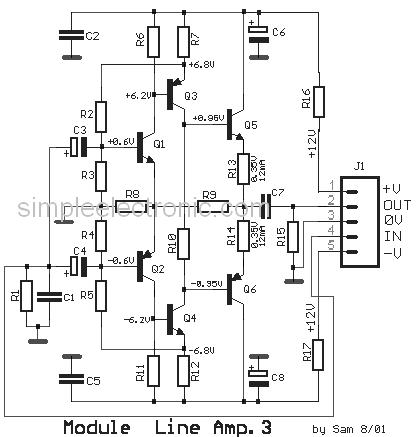
low impedance simple preamplifier
This is a simple low-impedance preamplifier circuit diagram used to amplify an audio signal. The circuit operates with a 12V DC power source and is straightforward due to its minimal component count.
The low-impedance preamplifier circuit is designed to enhance weak...

Mixer preamplifier with tone control
A general-purpose preamplifier/mixer accepts up to four inputs, has a gain of 1600, and provides bass and treble controls that can be varied ± 10 dB at 100 Hz and 10 kHz respectively. More: IC1 and IC2 = LM301A.
This circuit...
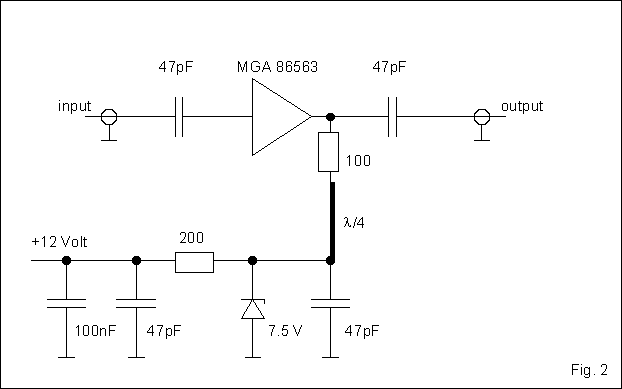
A receiving converter for 2320 MHz
The preamplifier is straightforward, utilizing a low-noise integrated circuit manufactured by Hewlett Packard, specifically the MGA86563. This device features a noise figure of approximately 2 dB and operates within a frequency range of 0.5 GHz to at least 6 GHz....
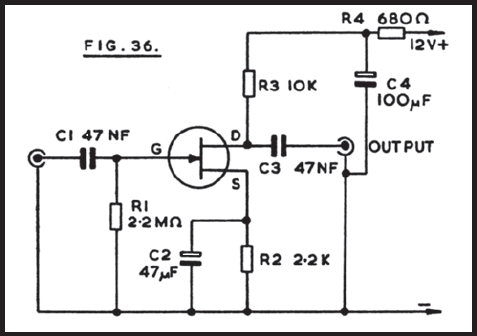
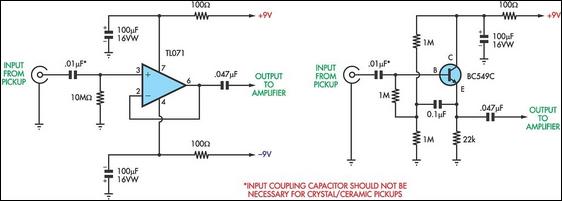
Crystal Microphone Preamplifier
Figure 36 illustrates the circuit of a preamplifier featuring a high impedance input and an output circuit designed for coupling to a main amplifier. This configuration is particularly advantageous for applications such as amplifying the signal from a crystal microphone....
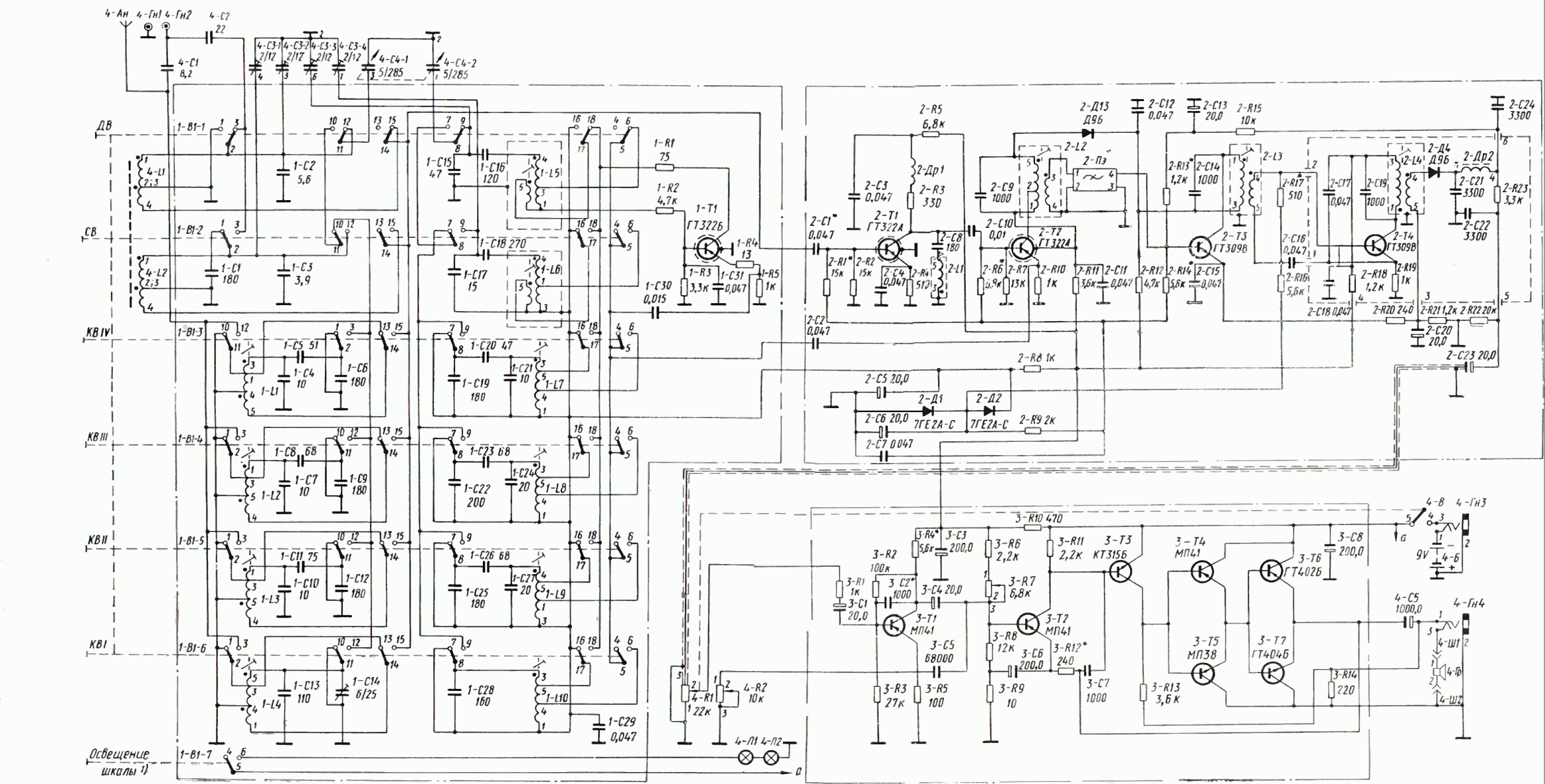
Radio receiver GEOLOG circuit diagram
To enhance usability during nighttime, the receiver features a scale with bias lighting, and the surface behind the scale is coated with a fluorescent material. To activate the scale illumination, press button 3. Radio programs can be listened to through...
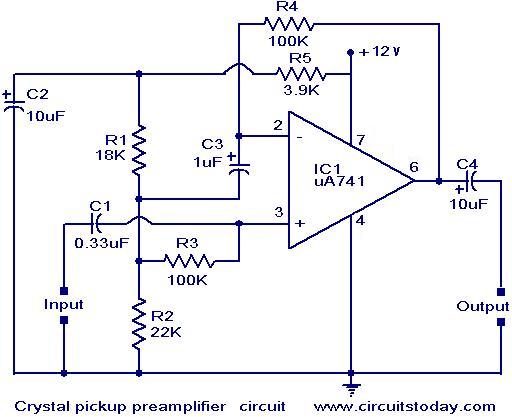
Crystal pickup pre-amplifier circuit
A preamplifier that operates on a single supply and is suitable for high-impedance crystal pickups is presented here. The circuit functions as a non-inverting AC amplifier, with the gain determined by the feedback resistor R4; a smaller R4 results in...
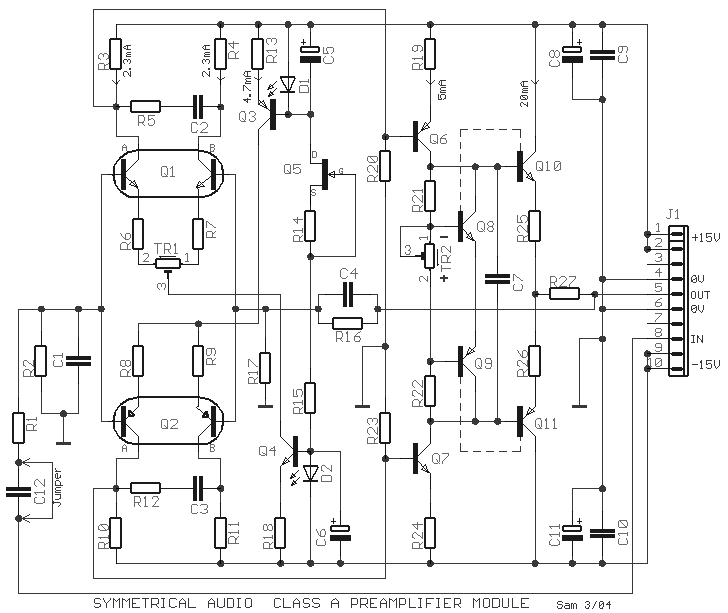
Class A-Designed Symmetrical Audio Preamplifier
The circuit was designed to produce a preamplifier with symmetrical audio input while the output operates in Class A type. Preamplifier (pre-amp) a device...
The circuit in question is a preamplifier designed to handle symmetrical audio inputs, which ensures that both...
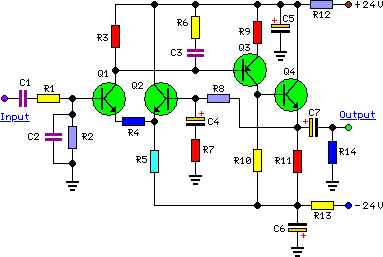
Moduler Preamplifier
To complement the 60 Watt MOSFET Audio Amplifier, a high-quality preamplifier design was necessary. A discrete component topology, utilizing ±24V supply rails, was chosen, maintaining a minimal transistor count while still achieving low noise, very low distortion, and a high...
preamplifier
This Hi-Fi stereo preamplifier circuit is designed with the TDA1054 IC from SGS. The TDA1054 is a 16-pin DIL integration that includes two separate preamplifier circuits. It is a low-noise preamp with minimal issues during the construction process. The first...