


Integrated OTL power amplifier circuit composed by the TDA2040
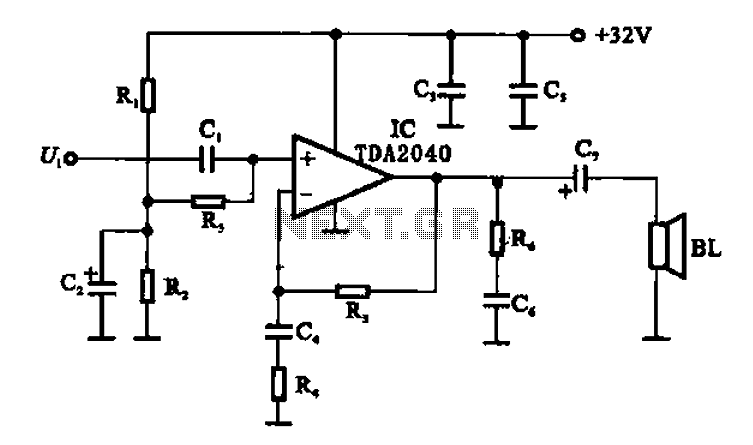
Description: An integrated power amplifier TDA2040 is used in an OTL (Output Transformer-Less) power amplifier circuit, which operates with a +3V single supply as the working voltage. This circuit has a voltage gain of 30 dB (approximately 32 times magnification), with a speaker impedance of 4 ohms and an output power of 5W, while the output power can reach up to 7.5W. In this circuit, the voltage signal is fed into the inverting input terminal of the integrated power amplifier IC through an input coupling capacitor. A bias resistor is connected to the inverting input terminal of the integrated circuit, set to half the power supply voltage (+1.5V). A resistor is included to prevent the bias resistor from reducing the input impedance. A feedback resistor, in conjunction with other components, forms a negative feedback network that determines the voltage amplification gain of the circuit. Additional capacitors and resistors are used to form an output terminal network that absorbs vibrations and prevents self-excitation within the circuit, while a power supply filter capacitor stabilizes the power supply.
The TDA2040 integrated power amplifier is designed for audio applications, providing high-quality amplification with a simple circuit configuration. The use of a +3V single supply allows for a compact design suitable for battery-operated devices. The circuit achieves a voltage gain of 30 dB, indicating significant amplification of the input audio signal, which is essential for driving speakers effectively.
The speaker impedance of 4 ohms is a standard value for many audio applications, ensuring compatibility with a wide range of speakers. The output power rating of 5W, with a potential peak of 7.5W, provides sufficient power for driving small to medium-sized speakers without distortion. The circuit's design incorporates an input coupling capacitor that isolates the amplifier from the source, preventing DC offset issues and ensuring that only the AC audio signal is amplified.
The biasing network, which includes a resistor connected to half the supply voltage, establishes the operating point of the amplifier, ensuring it functions within its linear range. This careful biasing is crucial for maintaining audio fidelity and preventing clipping during high signal peaks. The feedback network, composed of feedback resistors and capacitors, plays a vital role in stabilizing the gain and improving linearity, thereby enhancing the overall sound quality.
Vibration absorption at the output terminal is achieved through a combination of resistors and capacitors, which dampen any unwanted oscillations or ringing that may occur during operation. This feature is particularly important in audio applications where clarity and distortion-free sound reproduction are paramount. The power supply filter capacitor further ensures that any noise from the power supply does not interfere with the amplifier’s performance, providing a clean and stable voltage to the circuit.
Overall, the TDA2040 OTL power amplifier circuit is a well-engineered solution for audio amplification, balancing performance, simplicity, and component count, making it suitable for various audio applications. By an integrated power amplifier TDA2040 composed OTL power amplifier circuit is shown, which uses +3V single supply as the working voltage. This circuit voltage gain 30 dB (32 times magnification), the speaker impedance Z chaos 4 Q, output power I5W, speaker barrier anti ZBL: 80, the output power is 7.5W. In this circuit, the voltage signal by the integrated power amplifier IC-inverting input terminal of the input coupling capacitor .cl .RJ, bias resistor R2 to the inverting input terminal of the integrated circuit in the power supply voltage of i bias/2 (+16 V) .R3 role is to prevent the bias resistor R, Rz reduced input impedance .Rs feedback resistor, it C4, R4 together form the exchange of negative feedback network, the decision circuit a voltage amplification gain of the circuit RS/R4.C7 the coupling capacitor .R6, C6 form the output terminal network vibration absorption, prevent self-excited circuit .C, the power supply filter capacitor C5.
The TDA2040 integrated power amplifier is designed for audio applications, providing high-quality amplification with a simple circuit configuration. The use of a +3V single supply allows for a compact design suitable for battery-operated devices. The circuit achieves a voltage gain of 30 dB, indicating significant amplification of the input audio signal, which is essential for driving speakers effectively.
The speaker impedance of 4 ohms is a standard value for many audio applications, ensuring compatibility with a wide range of speakers. The output power rating of 5W, with a potential peak of 7.5W, provides sufficient power for driving small to medium-sized speakers without distortion. The circuit's design incorporates an input coupling capacitor that isolates the amplifier from the source, preventing DC offset issues and ensuring that only the AC audio signal is amplified.
The biasing network, which includes a resistor connected to half the supply voltage, establishes the operating point of the amplifier, ensuring it functions within its linear range. This careful biasing is crucial for maintaining audio fidelity and preventing clipping during high signal peaks. The feedback network, composed of feedback resistors and capacitors, plays a vital role in stabilizing the gain and improving linearity, thereby enhancing the overall sound quality.
Vibration absorption at the output terminal is achieved through a combination of resistors and capacitors, which dampen any unwanted oscillations or ringing that may occur during operation. This feature is particularly important in audio applications where clarity and distortion-free sound reproduction are paramount. The power supply filter capacitor further ensures that any noise from the power supply does not interfere with the amplifier’s performance, providing a clean and stable voltage to the circuit.
Overall, the TDA2040 OTL power amplifier circuit is a well-engineered solution for audio amplification, balancing performance, simplicity, and component count, making it suitable for various audio applications. By an integrated power amplifier TDA2040 composed OTL power amplifier circuit is shown, which uses +3V single supply as the working voltage. This circuit voltage gain 30 dB (32 times magnification), the speaker impedance Z chaos 4 Q, output power I5W, speaker barrier anti ZBL: 80, the output power is 7.5W. In this circuit, the voltage signal by the integrated power amplifier IC-inverting input terminal of the input coupling capacitor .cl .RJ, bias resistor R2 to the inverting input terminal of the integrated circuit in the power supply voltage of i bias/2 (+16 V) .R3 role is to prevent the bias resistor R, Rz reduced input impedance .Rs feedback resistor, it C4, R4 together form the exchange of negative feedback network, the decision circuit a voltage amplification gain of the circuit RS/R4.C7 the coupling capacitor .R6, C6 form the output terminal network vibration absorption, prevent self-excited circuit .C, the power supply filter capacitor C5.
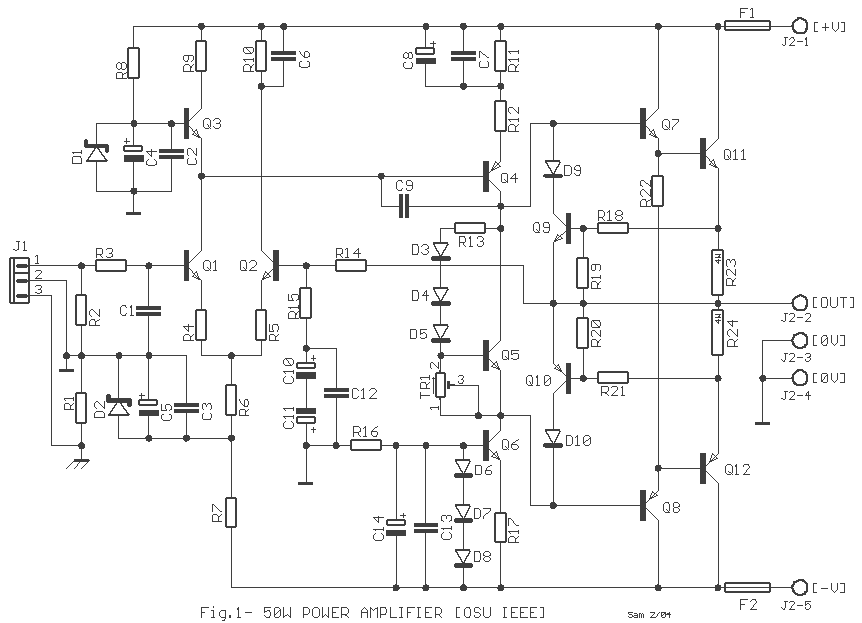
Power Amplifier 50W
Cleaned Input: This simple audio power amplifier was originally designed for a circuit board workshop, conducted by the OSU IEEE Student Group. At the workshop, 20 participants each constructed this amplifier, by etching and drilling the single sided circuit board,...
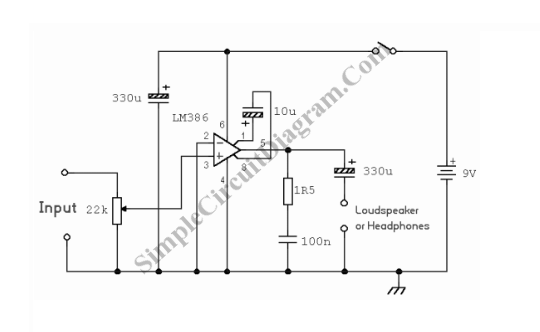
Small High Quality Audio Power Amplifier
This audio power amplifier is highly suitable for portable devices or as a headphone amplifier. The circuit design of this audio power amplifier is straightforward.
This audio power amplifier circuit is designed to enhance audio signals for portable devices and headphones,...
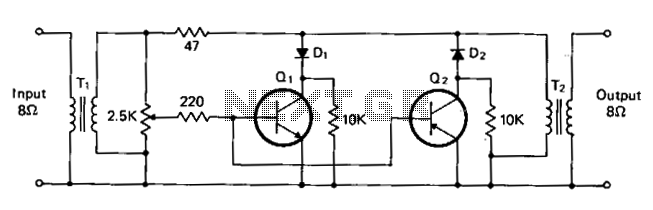
Audio-powered noise clipper
T1 and T2 are 600 to 8-ohm transformers (any transistor radio output transformers with 500 to 4-ohm impedance may be used). Q1 is a 2N2222 NPN transistor, and Q2 is a 2N2907 PNP transistor. D1 and D2 are 1N270 signal...

25W HiFi Audio Amplifier with MOSFET
This is a high-fidelity, high-quality audio amplifier circuit diagram. A pre-amplifier is not required. Component list: R1, R4 = 47K 1/4W resistors; R2 = 4.7K 1/4W resistor; R3 = 1.5K 1/4W resistor; R5 = 390Ω 1/4W resistor; R6 = 470Ω...
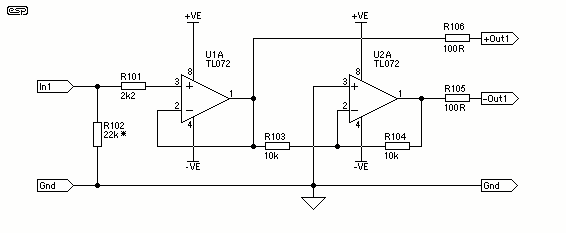
Bridging Adapter For Power Amplifiers
A stereo power amplifier is limited in its output power by two main factors - the impedance of the load and the internal power supply voltage. To obtain more power, one has very limited choices - other than the purchase...
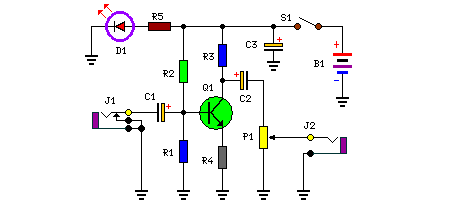
Audio Booster circuit
The amplifier's gain is nominally 20 dB. Its frequency response is primarily influenced by the values of a few components, mainly C1 and R1. The schematic diagram's component values yield a frequency response of ±3.0 dB from approximately 120 Hz...
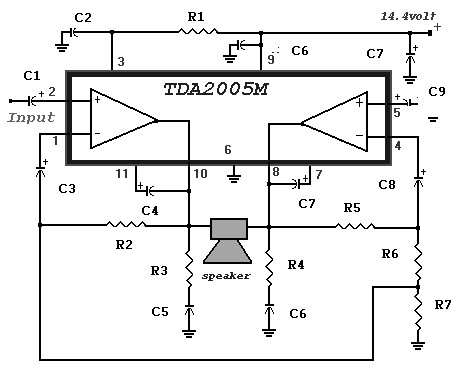
20 Watt Power Amplifier
A 20 Watt car power amplifier circuit diagram based on the TDA 2005. The TDA 2005 IC is specifically designed for power boosting applications in car audio systems. This IC includes protection against short circuits and overheating. The circuit utilizes...
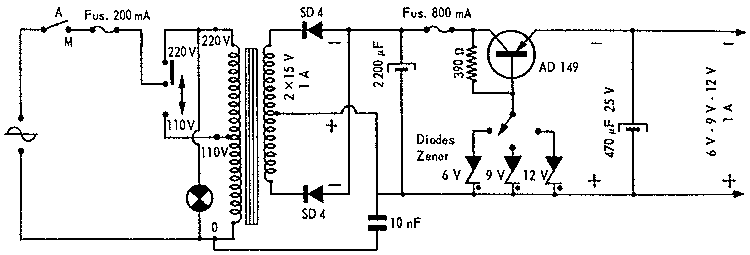
Low Voltage Supplies - Solid State - Tubes
Such supplies are often realised with dedicated integrated circuits nowadays but it's still interesting to give a look at old designs to understand the basics.
The description outlines the evolution of power supply designs in electronics, emphasizing the transition from traditional...

Irons intelligent control circuit
The intelligent control circuit for the iron is presented. This circuit utilizes the integrated circuit PT8A351X to manage functions such as direction detection, relay control, and LED indication. When the iron is positioned horizontally, it will power off after 30...