


LM3886 Gainclone 2x68 Watt Full Amplifier Project
#LM3886
#audio amplifier
#gainclone
#68W RMS
#THD 0.03%
#power amplifier
#stereo amplifier
#Hi-Fi
#audio circuit
#LM3875
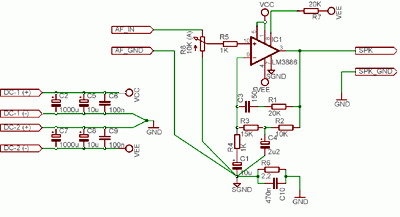
Description: The LM3886 is an improved version of the LM3875. Key features of the LM3886 include a maximum output power of 68W RMS and 108W peak, with a total harmonic distortion (THD) of 0.03% at 60W.
The LM3886 is a high-performance audio power amplifier designed for driving speakers in various applications, such as home audio systems, professional audio equipment, and automotive sound systems. The device operates with a supply voltage range of 10V to 30V and is capable of delivering a significant amount of power while maintaining low distortion levels.
The amplifier features a built-in thermal protection mechanism, which prevents overheating and ensures reliability during operation. Additionally, it has short-circuit protection that safeguards the amplifier and connected components from damage due to excessive current draw. The LM3886 also includes a mute function, allowing for noise-free power-up and power-down transitions, which enhances the overall user experience.
In terms of circuit implementation, the LM3886 can be configured in a variety of ways, including a simple non-inverting amplifier setup or a more complex bridge configuration to achieve higher power output. The device typically requires a few external components, such as resistors and capacitors, to set the gain and stabilize the operation. Proper layout and grounding techniques are essential to minimize noise and ensure optimal performance.
The LM3886's combination of high output power, low distortion, and protective features make it a popular choice for audio amplification applications, providing an excellent balance of performance and reliability.We are using LM3886 which is the revised version of its brother LM3875.Briefly features of LM3886 are; Maximum Output Power: 68W RMS 108W Peak THD: %0.03 at 60W S..
The LM3886 is a high-performance audio power amplifier designed for driving speakers in various applications, such as home audio systems, professional audio equipment, and automotive sound systems. The device operates with a supply voltage range of 10V to 30V and is capable of delivering a significant amount of power while maintaining low distortion levels.
The amplifier features a built-in thermal protection mechanism, which prevents overheating and ensures reliability during operation. Additionally, it has short-circuit protection that safeguards the amplifier and connected components from damage due to excessive current draw. The LM3886 also includes a mute function, allowing for noise-free power-up and power-down transitions, which enhances the overall user experience.
In terms of circuit implementation, the LM3886 can be configured in a variety of ways, including a simple non-inverting amplifier setup or a more complex bridge configuration to achieve higher power output. The device typically requires a few external components, such as resistors and capacitors, to set the gain and stabilize the operation. Proper layout and grounding techniques are essential to minimize noise and ensure optimal performance.
The LM3886's combination of high output power, low distortion, and protective features make it a popular choice for audio amplification applications, providing an excellent balance of performance and reliability.We are using LM3886 which is the revised version of its brother LM3875.Briefly features of LM3886 are; Maximum Output Power: 68W RMS 108W Peak THD: %0.03 at 60W S..
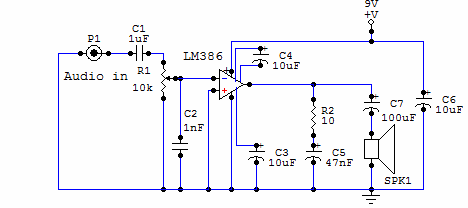
1Watt audio amplifier
Here is a simple audio amplifier circuit that is easy to build and has few components. This circuit is built around the LM386 audio amplifier integrated circuit, useful when you need to power medium-sized speakers from a music player that...
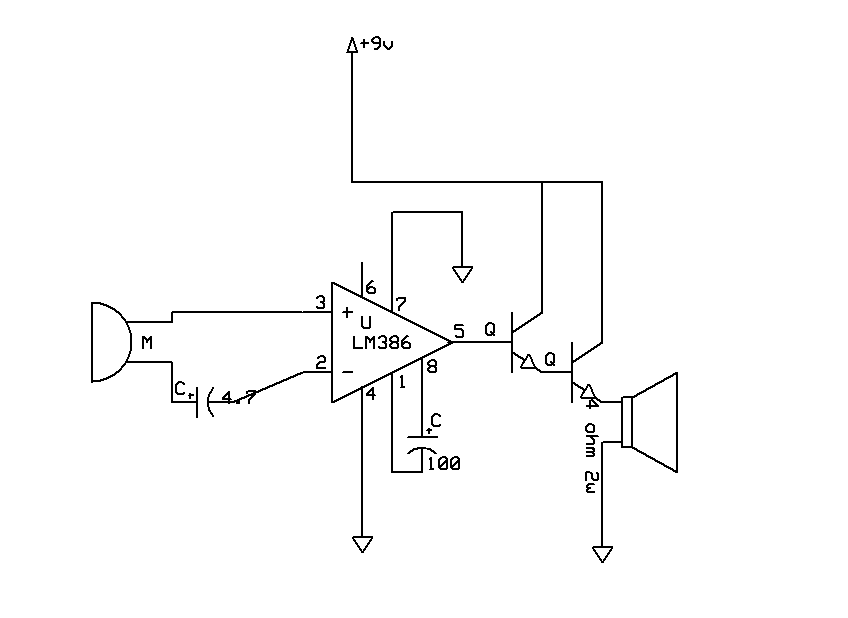
sound simple audio amplifier
The sound quality was poor, and then it stopped functioning. Can anyone explain which part of the circuit may have malfunctioned? Any suggestions to enhance the sound quality and restore functionality? The transistors used are both BC546, and the microphone...
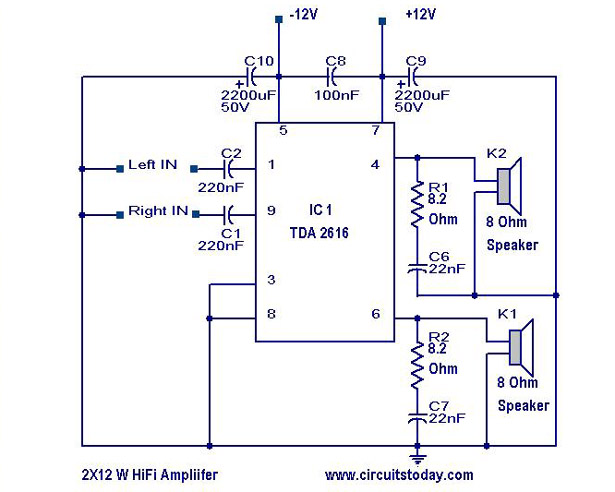
Hi Fi Amplifier Circuit 2X12 Watts
A simple Hi-Fi amplifier circuit diagram with a schematic for creating an audio amplifier, designed using the TDA 2616 integrated circuit (IC), which is a stereo power amplifier. It is suitable for use with radios, tape players, and televisions, delivering...

10w audio amplifier with bass
Proper grounding is essential for eliminating hum and ground loops. The ground connections for J1, P1, C2, C3, and C4 should all be connected to the same point. Additionally, connect C9 to the output ground.
In electronic circuits, grounding serves as...
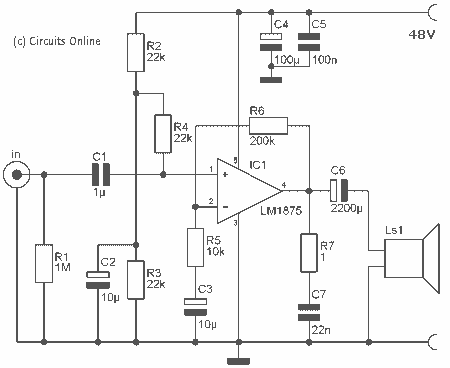
20 Watt audio Amplifier
This is a standard amplifier based on LM 1875. It can deliver 20 W, with an 8 Ω speaker and 60V power supply even 30 W.
The capacitors C4 and C5 should preferably be as close to the IC down. More:...
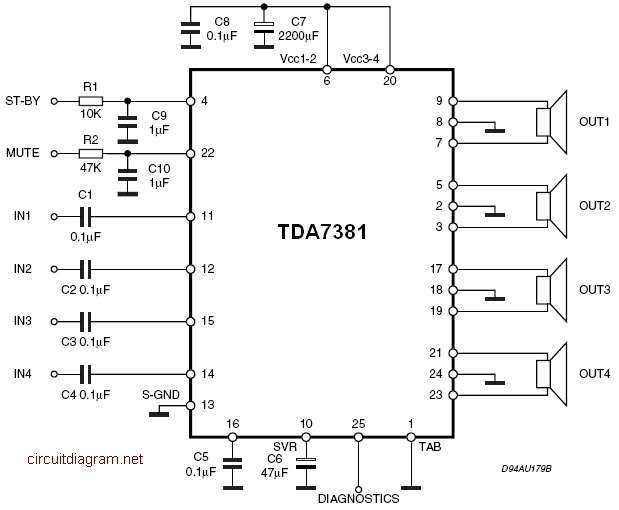
4 x 25 W Car Amplifier TDA7381 Circuit
The TDA7381 is a Class AB audio power amplifier housed in a Flexiwatt25 package, specifically intended for car radio applications. This circuit can also be utilized for various other purposes. The fully complementary PNP/NPN output configuration enables a rail-to-rail output...
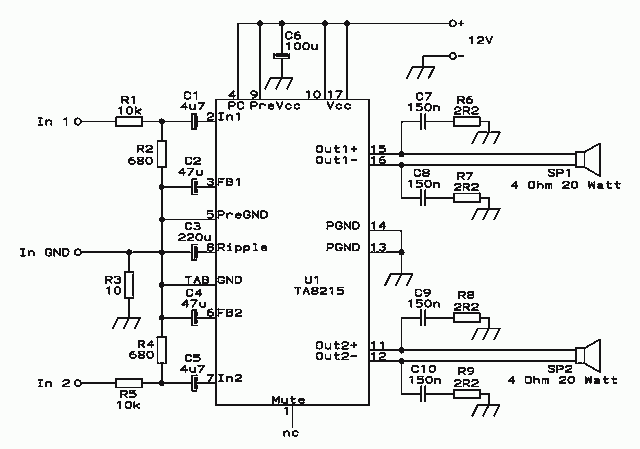
4x15Watt 12volt power audio amplifier
While I would have liked a 4 channel chip with about 20 Watt per channel, the local parts store didn't have any yet, so I opted for two TA8215AH stereo chips, selected by their low price in this particular store....
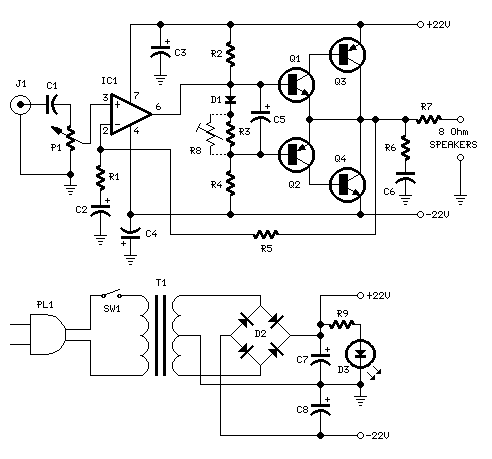
18W Audio Amplifier
High Quality very simple unit - No need for a preamplifier. Can be directly connected to CD players, tuners and tape recorders. Don't exceed 23 + 23V supply. Q3 and Q4 must be mounted on heatsink. D1 must be in...
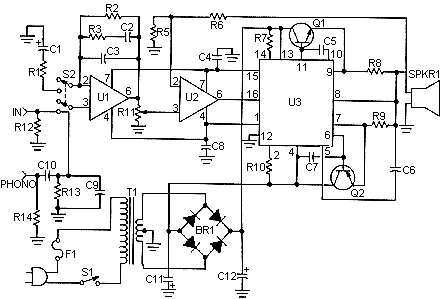
50 Watt Amplifier
This is a convenient and straightforward general-purpose 50-watt amplifier. The amplifier features an input for connecting devices such as radios, TVs, or stereo equipment. Additionally, it includes a phono input suitable for connecting record players, guitars, microphones, or other unamplified...