


LM4911 without an output capacitor OCL power circuit
#LM4911
#OCL
#power circuit
#audio amplifier
#no output capacitor
#squelch control
#shutdown
#amplification
#sound
#electronics
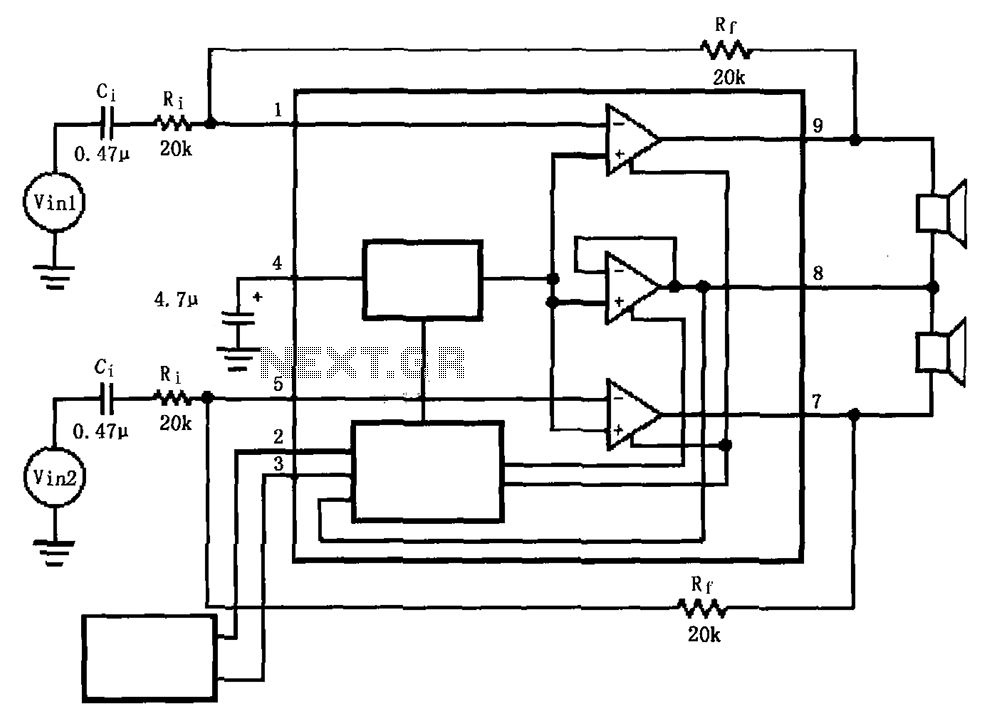
Description: The LM4911 is presented in a configuration that does not utilize an output capacitor (OCL) for its power circuit. This design eliminates the need for squelch control (Mute), as the shutdown control (SD) responds more rapidly than the squelch control, effectively turning off the circuit to mitigate any slight noise issues. The maximum power consumption for this circuit without an output capacitor is given by the formula PDMAX = 4VDD² / (2R).
The LM4911 is a low-power audio amplifier designed for applications requiring high efficiency and minimal component count. In configurations without an output capacitor, the circuit can achieve a more compact design, reducing the overall footprint of the system. The absence of an output capacitor in the power circuit allows for a direct connection between the amplifier output and the load, which can be advantageous in achieving better transient response and lower distortion.
The shutdown control (SD) feature is critical in this configuration, as it ensures that the amplifier can quickly turn off in response to control signals, thereby preventing any unwanted audible artifacts such as bashing noise during transitions. This rapid response is particularly useful in battery-operated devices, where power conservation is essential. The squelch control (Mute) is typically used to suppress noise during idle periods; however, in this design, the shutdown control serves as a more effective solution, providing a cleaner output without the need for additional components.
The power consumption of the circuit is an important factor to consider, especially in low-power applications. The maximum power consumption is calculated using the formula PDMAX = 4VDD² / (2R), where VDD represents the supply voltage and R is the load resistance. This equation highlights the relationship between supply voltage, load resistance, and power dissipation, which is crucial for designing efficient audio amplification systems.
Overall, the LM4911's configuration without an output capacitor presents a viable solution for applications that prioritize compactness and efficiency while maintaining audio quality. The design effectively balances the need for rapid shutdown capabilities with the goal of minimizing power consumption and noise. As shown for the LM4911 no output capacitor (OCL) power circuit. Without an output capacitor (OCL) power circuit without using squelch control (Mute), because then the shutdown control (SD) faster than the squelch control (Mute) comes and turns off to eliminate the slightly - bashing noise. The maximum power consumption without an output capacitor circuit PDMAX 4VDD2/2R.
The LM4911 is a low-power audio amplifier designed for applications requiring high efficiency and minimal component count. In configurations without an output capacitor, the circuit can achieve a more compact design, reducing the overall footprint of the system. The absence of an output capacitor in the power circuit allows for a direct connection between the amplifier output and the load, which can be advantageous in achieving better transient response and lower distortion.
The shutdown control (SD) feature is critical in this configuration, as it ensures that the amplifier can quickly turn off in response to control signals, thereby preventing any unwanted audible artifacts such as bashing noise during transitions. This rapid response is particularly useful in battery-operated devices, where power conservation is essential. The squelch control (Mute) is typically used to suppress noise during idle periods; however, in this design, the shutdown control serves as a more effective solution, providing a cleaner output without the need for additional components.
The power consumption of the circuit is an important factor to consider, especially in low-power applications. The maximum power consumption is calculated using the formula PDMAX = 4VDD² / (2R), where VDD represents the supply voltage and R is the load resistance. This equation highlights the relationship between supply voltage, load resistance, and power dissipation, which is crucial for designing efficient audio amplification systems.
Overall, the LM4911's configuration without an output capacitor presents a viable solution for applications that prioritize compactness and efficiency while maintaining audio quality. The design effectively balances the need for rapid shutdown capabilities with the goal of minimizing power consumption and noise. As shown for the LM4911 no output capacitor (OCL) power circuit. Without an output capacitor (OCL) power circuit without using squelch control (Mute), because then the shutdown control (SD) faster than the squelch control (Mute) comes and turns off to eliminate the slightly - bashing noise. The maximum power consumption without an output capacitor circuit PDMAX 4VDD2/2R.
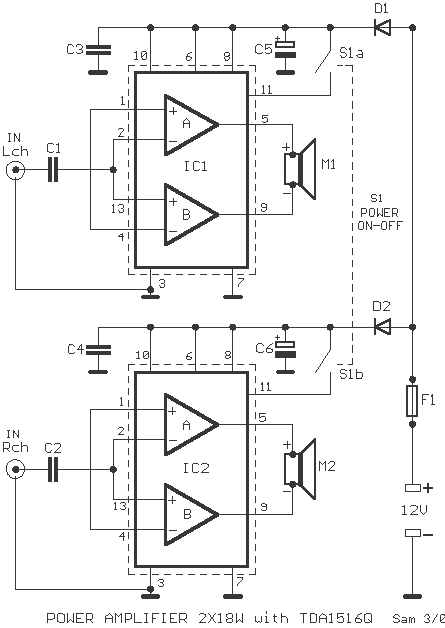
Audio amplifier 2X18W
In a lot of cars, the car radios use amplifiers that their output power does not exceed the 5W with enough distortion in the limits of power. The problem is tied with the utilization of external amplifiers, that will have...
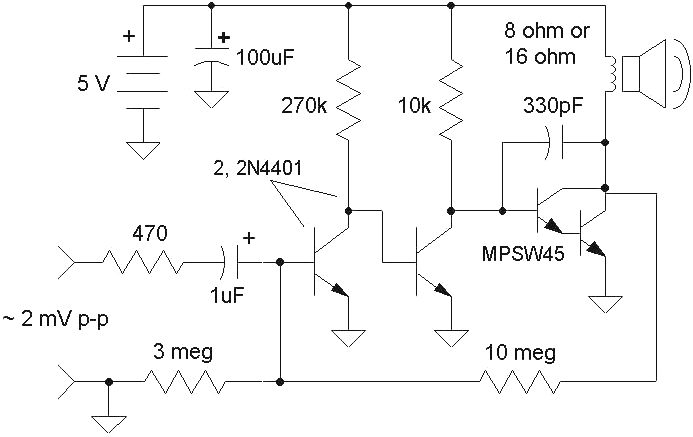
class audio amplifiers
A Class-A audio amplifier is known for its high power consumption; however, its simplicity is appealing when ample power is available. This circuit features a Darlington transistor designed for use with a 5-volt power supply. It is important to note...
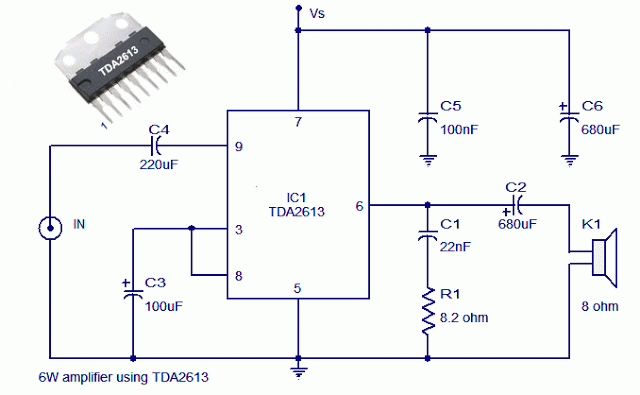
Reliable 6 Watt Hi Fi Audio Amplifier Using TDA2613
A 6-watt audio amplifier circuit utilizing the TDA2613 integrated circuit is presented. The TDA2613, produced by Philips Semiconductors, is a high-fidelity audio amplifier IC. This component is designed to be click-proof when switched on or off, resistant to short circuits,...
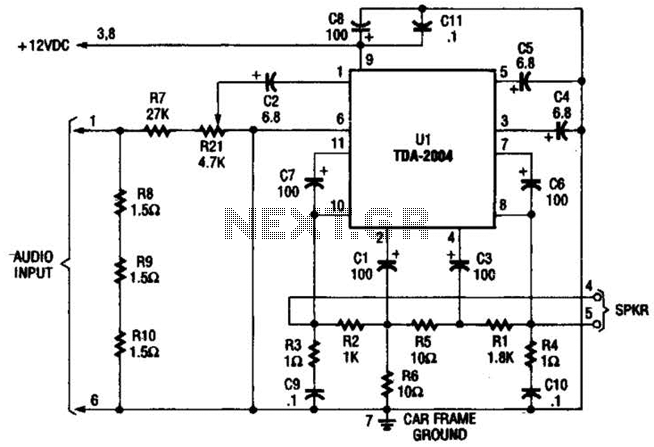
Booster Amplifier For Car Stereo Use Circuit
Only one channel of this circuit is shown. The other is practically identical. The input to the circuit, taken from the speaker output of a car radio, is divided into two paths. In one path, a high-power divider network (comprising...
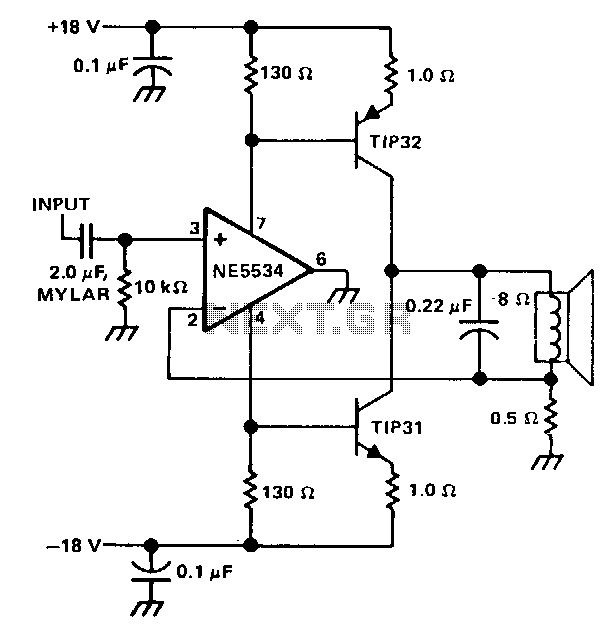
Audio-power-amplifier
The single speaker amplifier circuit utilizes current feedback instead of the more commonly used voltage feedback. The feedback loop originates from the junction of the speaker terminal and a 0.5-ohm resistor, connecting to the inverting input of the NE5534 operational...
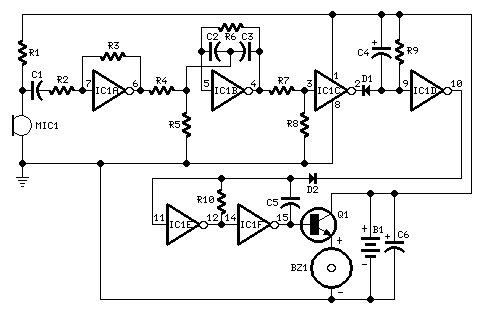
whistle responder
The first two inverters within IC1 function as audio amplifiers. IC1A consistently amplifies the signal received from a small electret microphone, while IC1B serves as a band-pass filter, centered around a frequency of approximately 1.8 kHz. This filter is essential...
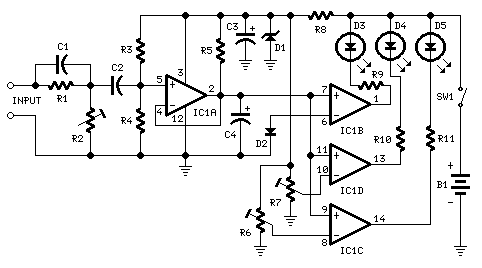
three level audio power indicator
This circuit is designed to indicate the power output level of any audio amplifier. It is simple, portable, and displays three power levels that can be adjusted to any desired value.
The circuit operates by measuring the output voltage from the...
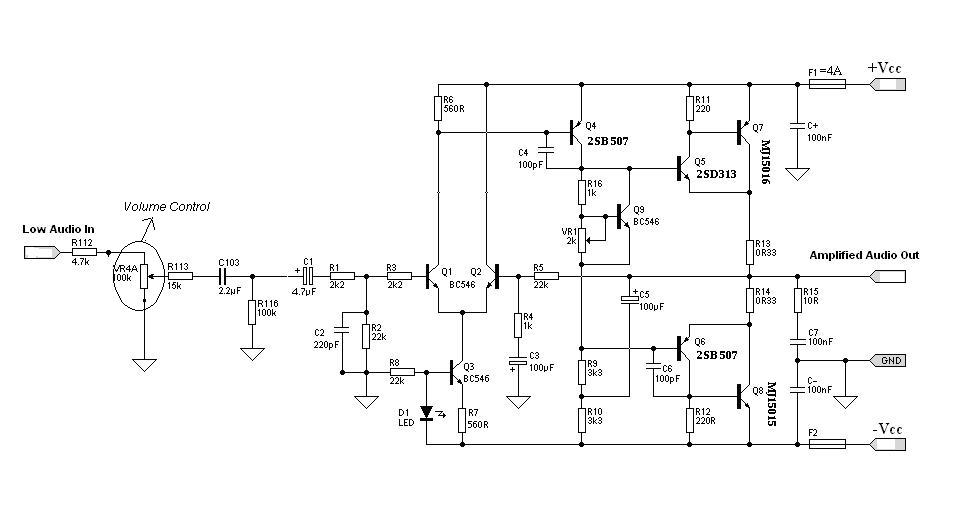
Hi-fi Audio Amplifier Circuit Design and implementation
Designing an audio amplifier from scratch using discrete components is an engaging task, as it enables users to create amplifiers that meet diverse requirements. Audio amplifiers can enhance low-level sounds from mobile devices, making them louder and more vibrant. Based...
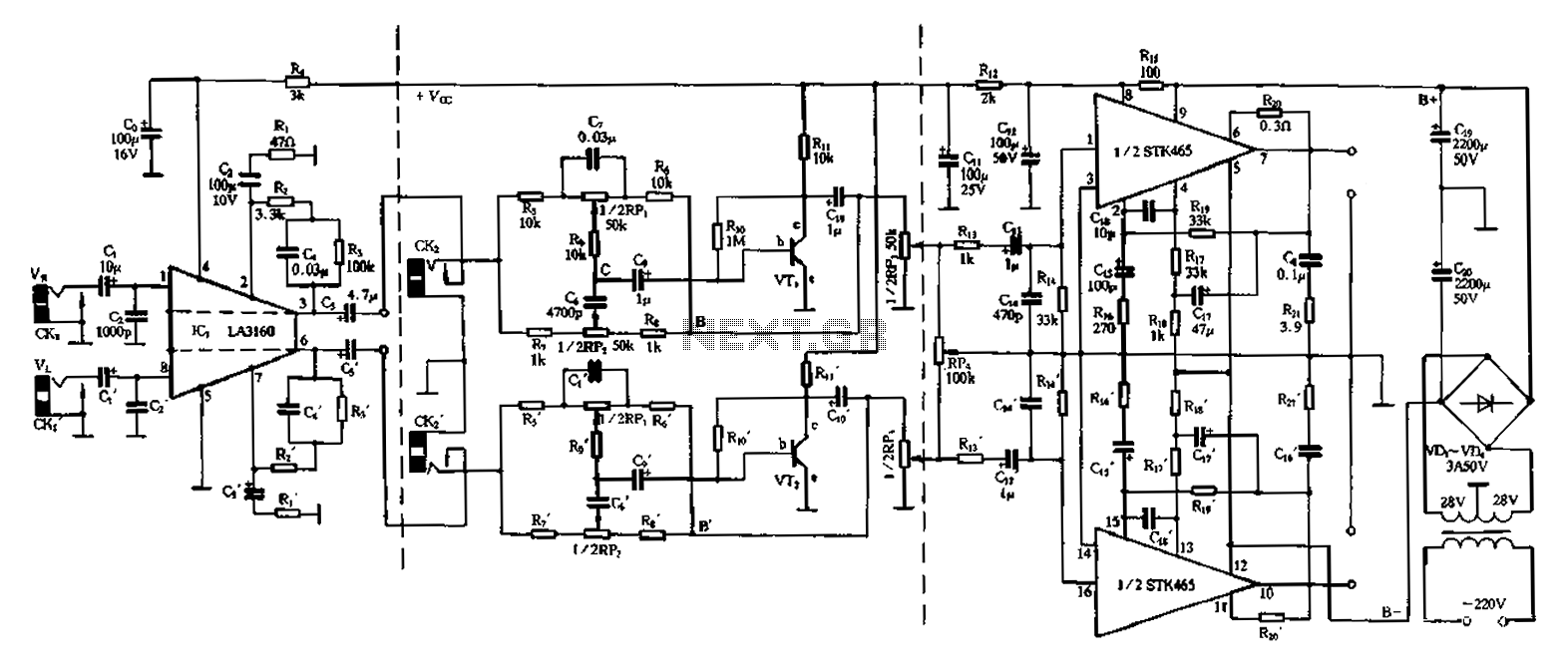
50Wx2 amplifier circuit
The 50W is a two-channel amplifier featuring a preamplifier and tone control based on the LA3160 integrated circuit. Its external components include the input preamplifier, with C1 serving as the input coupling capacitor. The circuit incorporates a high-frequency bypass capacitor...