


low power tia tunes gain 24 ghz
#transimpedance amplifier
#current-reuse stage
#cascade differential stage
#gain tuning
#low noise figure
#2.4 GHz
#RF amplifier
#signal amplification
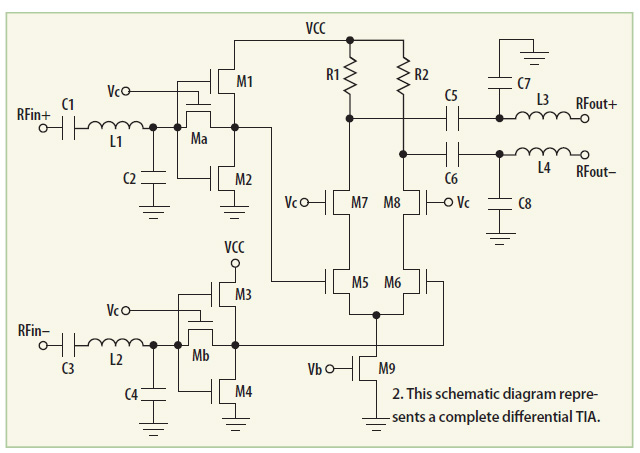
Description: This transimpedance amplifier utilizes a current-reuse stage and a cascaded differential stage to provide a continuous gain tuning range of 15 dB, along with a low noise figure of 1.061 dB at 2.4 GHz.
The transimpedance amplifier (TIA) is designed to convert input current signals into output voltage signals, making it particularly useful in applications such as photodetection and optical communication systems. The architecture incorporates a current-reuse stage, which enhances efficiency by allowing the same current to be used in multiple stages of amplification. This approach not only conserves power but also improves the overall gain performance of the amplifier.
The cascaded differential stage further contributes to the amplifier's performance by providing high linearity and better noise performance. This stage is crucial in maintaining signal integrity, especially in high-frequency applications such as 2.4 GHz, where signal degradation can occur due to various factors like thermal noise and flicker noise.
The continuous gain tuning range of 15 dB allows for flexibility in adjusting the amplifier's performance according to the specific requirements of the application. By fine-tuning the gain, the amplifier can accommodate different input signal levels while maintaining optimal noise performance.
The low noise figure of 1.061 dB is particularly noteworthy, as it indicates the amplifier's ability to minimize the addition of noise to the signal during amplification. This characteristic is essential in sensitive applications where signal fidelity is paramount.
Overall, this transimpedance amplifier design is well-suited for high-frequency applications, providing a combination of efficient power usage, adjustable gain, and low noise performance, which are critical for effective signal processing in modern electronic systems.This transimpedance amplifier employs a current-reuse stage and cascade differential stage to achieve a continuous gain tuning range of 15 dB and low noise figure of 1.061 dB at 2.4 GHz..
The transimpedance amplifier (TIA) is designed to convert input current signals into output voltage signals, making it particularly useful in applications such as photodetection and optical communication systems. The architecture incorporates a current-reuse stage, which enhances efficiency by allowing the same current to be used in multiple stages of amplification. This approach not only conserves power but also improves the overall gain performance of the amplifier.
The cascaded differential stage further contributes to the amplifier's performance by providing high linearity and better noise performance. This stage is crucial in maintaining signal integrity, especially in high-frequency applications such as 2.4 GHz, where signal degradation can occur due to various factors like thermal noise and flicker noise.
The continuous gain tuning range of 15 dB allows for flexibility in adjusting the amplifier's performance according to the specific requirements of the application. By fine-tuning the gain, the amplifier can accommodate different input signal levels while maintaining optimal noise performance.
The low noise figure of 1.061 dB is particularly noteworthy, as it indicates the amplifier's ability to minimize the addition of noise to the signal during amplification. This characteristic is essential in sensitive applications where signal fidelity is paramount.
Overall, this transimpedance amplifier design is well-suited for high-frequency applications, providing a combination of efficient power usage, adjustable gain, and low noise performance, which are critical for effective signal processing in modern electronic systems.This transimpedance amplifier employs a current-reuse stage and cascade differential stage to achieve a continuous gain tuning range of 15 dB and low noise figure of 1.061 dB at 2.4 GHz..
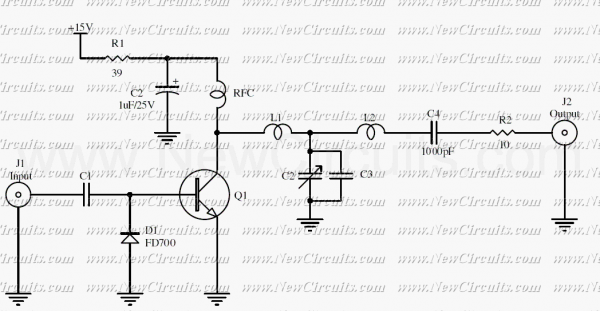
1 Watt Linear RF Amplifier
The RF circuit is a C-Class power amplifier. It is used in the last stage of transmitters. Its maximum power output is about 1 Watt. The circuit can be used in 3 frequency ranges: 30-100-200 MHz. More: The P-Out column...
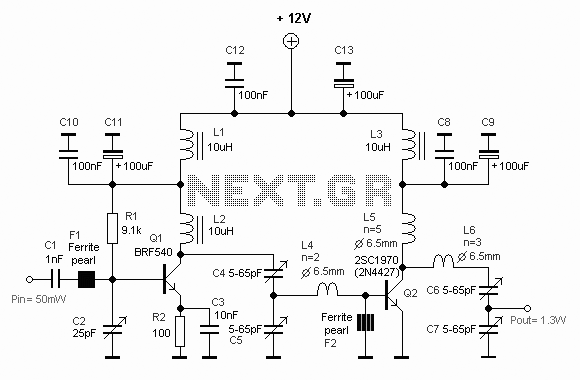
1.3W RF Amplifier
This diagram represents a schematic of an RF amplifier circuit. The circuit is designed to amplify an RF signal from approximately 100 mW input power to 1.3 W output power. It utilizes a general NPN RF transistor, specifically the 2SC1970....
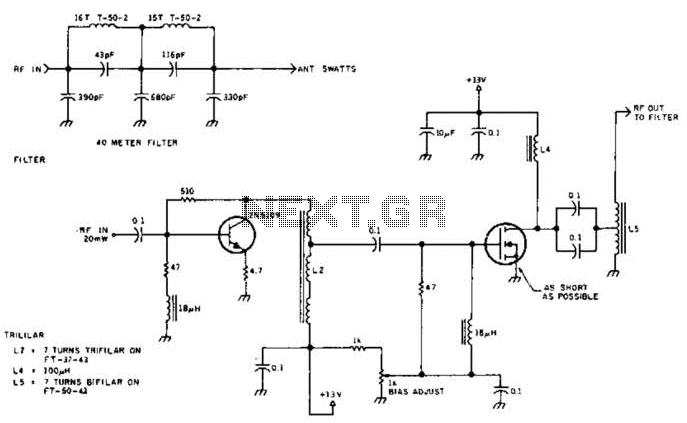
5W 7Mhz Rf Power Amplifier Circuit
The circuit illustrated is designed to generate up to 5 watts of RF output in the 40-meter (7 MHz) amateur band. The coils depicted are wound on toroidal cores from Armdon Associates Inc., with part numbers provided in the schematic....
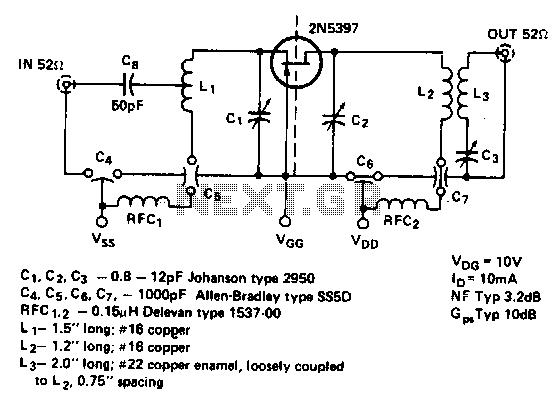
450Mhz-common-gate-amplifier
This is a low noise amplifier with a typical noise figure of 3 dB and approximately 10 dB of gain, operating within the frequency range of 450-470 MHz. It is designed for VHF two-way applications.
The described low noise amplifier (LNA)...
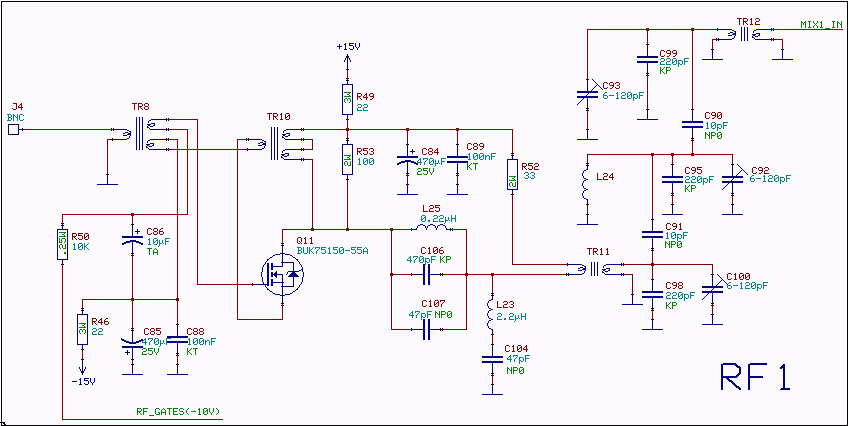
10.7 MHz RF Amplifier And Filter
The following circuit illustrates a 10.7 MHz RF amplifier and filter circuit diagram. Features include significant capacitances of a power MOSFET.
The 10.7 MHz RF amplifier and filter circuit is designed to amplify radio frequency signals while simultaneously filtering out unwanted...
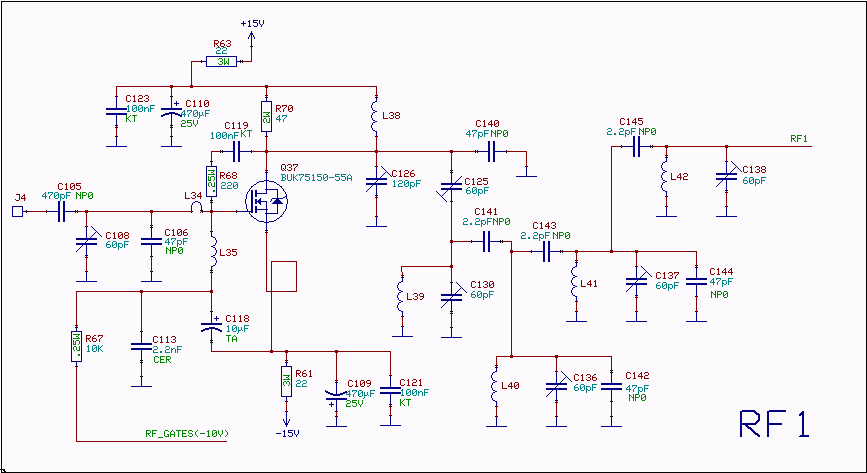
RF amplifier and filter for 70 MHz
The RF amplifier utilizes noiseless feedback via the drain-gate capacitance, incorporating an inductor in the source lead to achieve the required 90-degree phase shift between the gate voltage and channel current.
The RF amplifier is designed to enhance signal strength while...
RF Fm 88-108 MHz radio amplifier BLF 245
This FM 88-108 MHz radio amplifier is equipped with a BLF 245 and can be used with a heatsink from a processor and a cooler. The BLF 245 datasheet can be downloaded.
The FM 88-108 MHz radio amplifier utilizing the BLF...
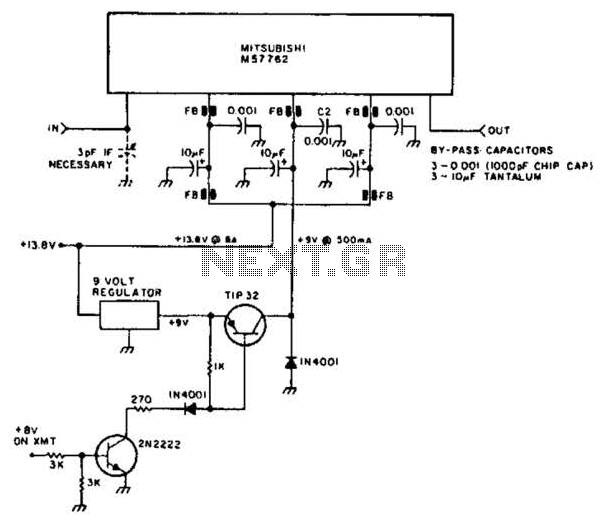
20W 1296Mhz Amplifier Module Circuit
Using a Mitsubishi M57762 amplifier module, this amplifier delivers 20 W output at 1296 MHz. A single 12 V nominal power supply can be used.
The Mitsubishi M57762 is a high-performance RF amplifier designed for applications requiring significant power output at...
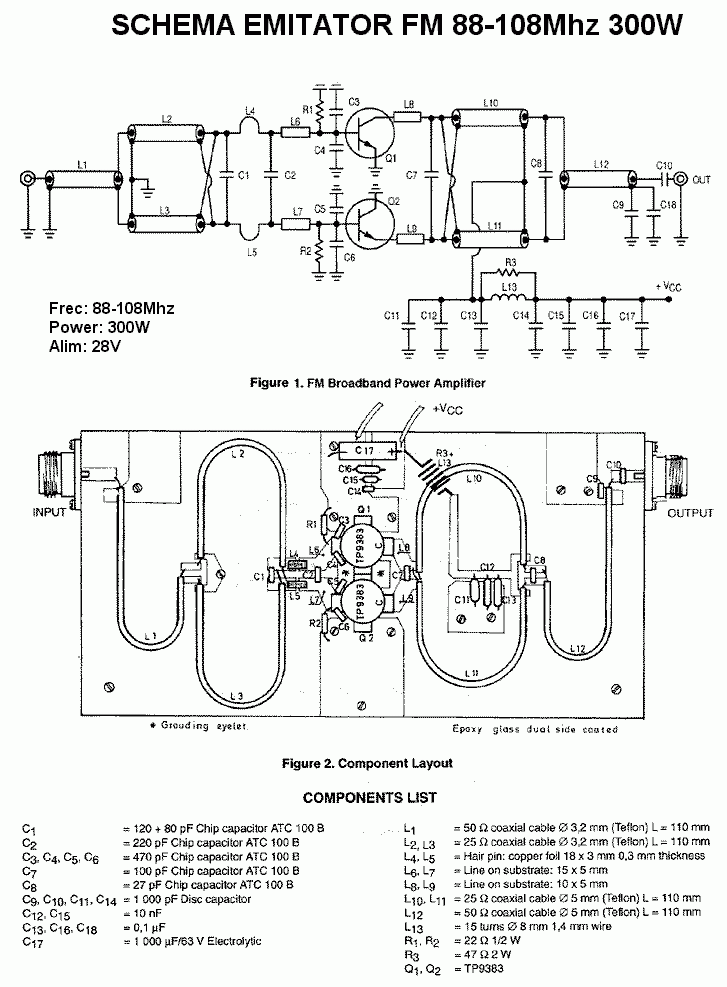
300w rf power amplifier circuit
This is a 300 W RF amplifier designed for FM transmission, capable of operating within the frequency range of 88 to 108 MHz. The amplifier utilizes two TP9383 transistors, enabling it to deliver up to 300 W of output power.
The...