


power amp 100w with v mosfet
#V-MOSFET
#100W
#audio amplifier
#high speed
#thermal stability
#low distortion
#power amplifier
#transistor
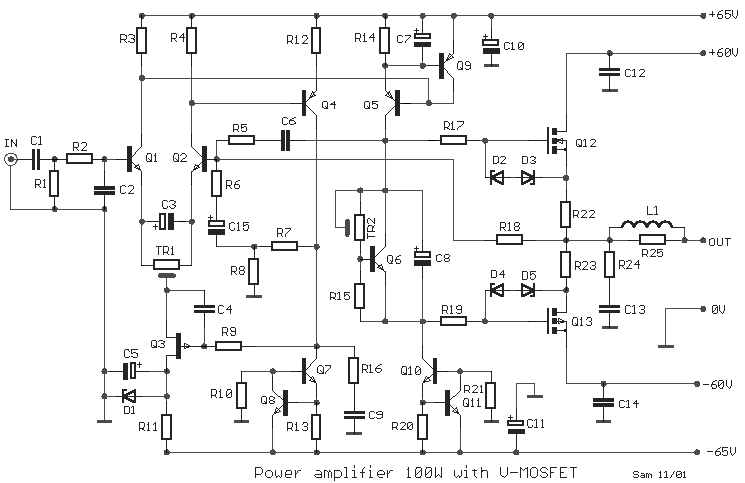
Description: One design employs the exit transistor technology of V-MOSFETs. These transistors provide numerous advantages over standard bipolar transistors, including high speed, thermal stability, and low distortion.
V-MOSFETs, or Vertical Metal-Oxide-Semiconductor Field-Effect Transistors, are a specific type of MOSFET that utilizes a vertical structure to enhance performance characteristics. In electronic circuit design, these components are often favored for their superior switching speeds, which are essential in high-frequency applications such as RF amplifiers and digital circuits.
The thermal stability of V-MOSFETs is another significant advantage, as they can operate effectively over a wider range of temperatures without the risk of thermal runaway, a common issue with bipolar transistors. This stability is critical in applications where the operating environment may vary significantly, ensuring consistent performance.
Low distortion is a key characteristic of V-MOSFETs, making them ideal for audio applications where signal fidelity is paramount. The reduced distortion levels contribute to cleaner sound reproduction in amplifiers, making them a preferred choice for high-fidelity audio systems.
In circuit design, the integration of V-MOSFETs can lead to more compact and efficient designs due to their smaller size compared to bipolar transistors. This compactness allows for higher density layouts, which is particularly beneficial in modern electronic devices where space is at a premium.
Overall, the use of V-MOSFET technology in circuit design enhances performance, reliability, and efficiency, making it a valuable choice for engineers looking to optimize their electronic systems.One still designing that it uses in the exit transistor of technology V-mosfet. This transistors to us offer a lot of virtues concerning the simple bipolar transistors, as high speeds, thermic stability, low distortion etc..
V-MOSFETs, or Vertical Metal-Oxide-Semiconductor Field-Effect Transistors, are a specific type of MOSFET that utilizes a vertical structure to enhance performance characteristics. In electronic circuit design, these components are often favored for their superior switching speeds, which are essential in high-frequency applications such as RF amplifiers and digital circuits.
The thermal stability of V-MOSFETs is another significant advantage, as they can operate effectively over a wider range of temperatures without the risk of thermal runaway, a common issue with bipolar transistors. This stability is critical in applications where the operating environment may vary significantly, ensuring consistent performance.
Low distortion is a key characteristic of V-MOSFETs, making them ideal for audio applications where signal fidelity is paramount. The reduced distortion levels contribute to cleaner sound reproduction in amplifiers, making them a preferred choice for high-fidelity audio systems.
In circuit design, the integration of V-MOSFETs can lead to more compact and efficient designs due to their smaller size compared to bipolar transistors. This compactness allows for higher density layouts, which is particularly beneficial in modern electronic devices where space is at a premium.
Overall, the use of V-MOSFET technology in circuit design enhances performance, reliability, and efficiency, making it a valuable choice for engineers looking to optimize their electronic systems.One still designing that it uses in the exit transistor of technology V-mosfet. This transistors to us offer a lot of virtues concerning the simple bipolar transistors, as high speeds, thermic stability, low distortion etc..
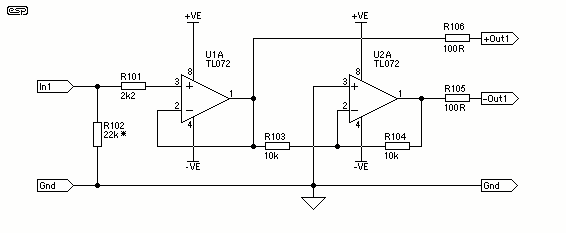
Bridging Adapter For Power Amplifiers
A stereo power amplifier is limited in its output power by two main factors - the impedance of the load and the internal power supply voltage. To obtain more power, one has very limited choices - other than the purchase...
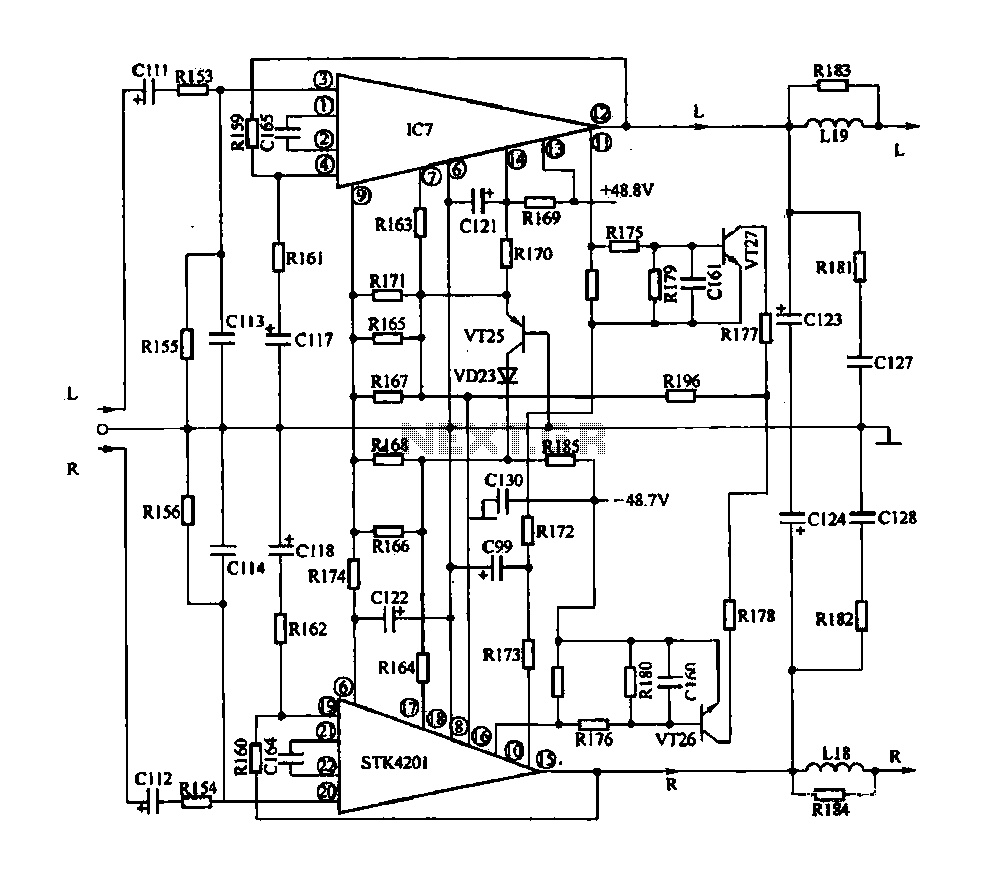
IC audio power amplifier circuit
The rapid advancement of integrated circuit technology has led to the widespread emergence of integrated circuit amplifiers. These amplifiers exhibit high levels of technology and performance indicators. Their advantages include compact size, simplified circuitry, exceptional performance, and comprehensive protection features....

10w audio amplifier with bass
Proper grounding is essential for eliminating hum and ground loops. The ground connections for J1, P1, C2, C3, and C4 should all be connected to the same point. Additionally, connect C9 to the output ground.
In electronic circuits, grounding serves as...
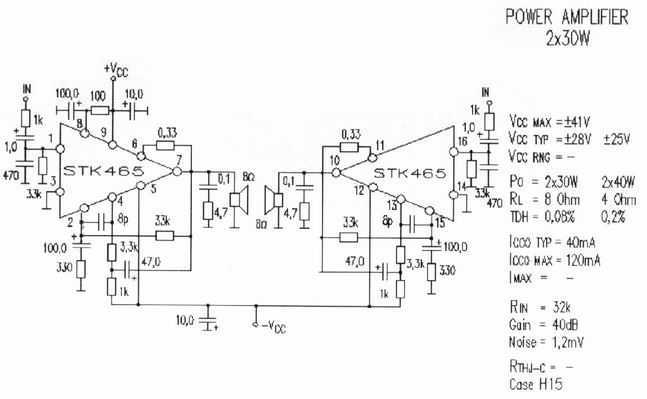
Power Amplifier 2x30W
Completed STK465 is an amplifier of acoustic frequencies that offers qualitative output, using minimal exterior elements. Substantially he is one of big completed force. Has a line pins and incorporated metal surface for adaptation in cooler. The provision pins in...
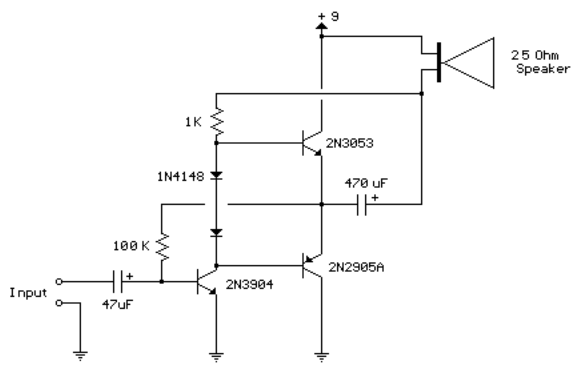
3 transistor audio amp 80 milliwatt
This circuit is similar to the previous one but employs positive feedback to enhance the amplitude delivered to the speaker. It was derived from a small 5-transistor radio utilizing a 25-ohm speaker. In the previous circuit, the load resistor for...
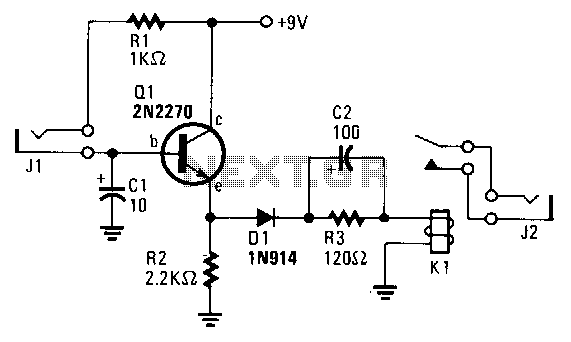
Camera-alarm-trigger
The transistor Q1 remains off until the magnetic switch connected to J1 closes. When this occurs, 9V is supplied through R1 to the base of Q1. As a result, Q1 turns on, which charges capacitor C2 through relay K1, causing...
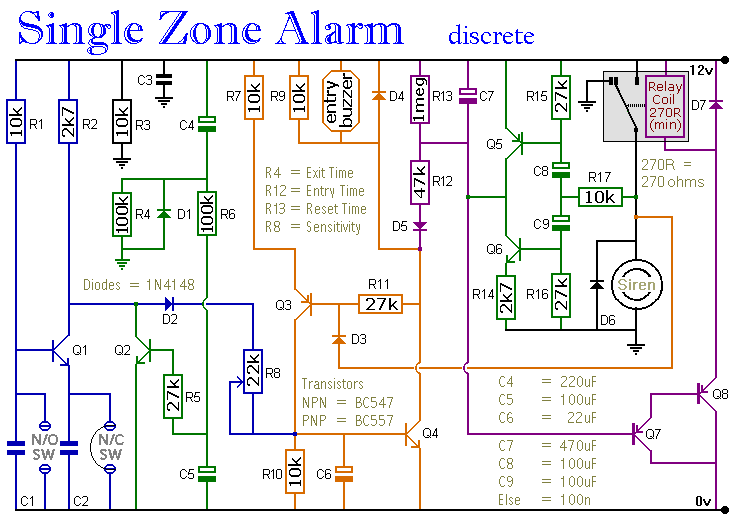
transistor based single zone alarm
The circuit incorporates automatic exit and entry delays, a timed bell cut-off, and a system reset feature. It accommodates both normally-open and normally-closed switches and is compatible with standard input devices such as pressure mats, magnetic reed contacts, foil tape,...
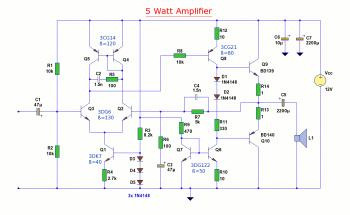
5W Audio Amplifier Circuit based BD139/BD140
The diagram illustrates a 5W audio amplifier circuit constructed using power transistors BD139 and BD140 for the final amplification stage. This compact amplifier serves as a general-purpose amplifier suitable for applications such as computer audio, radio, MP3 players, and video...
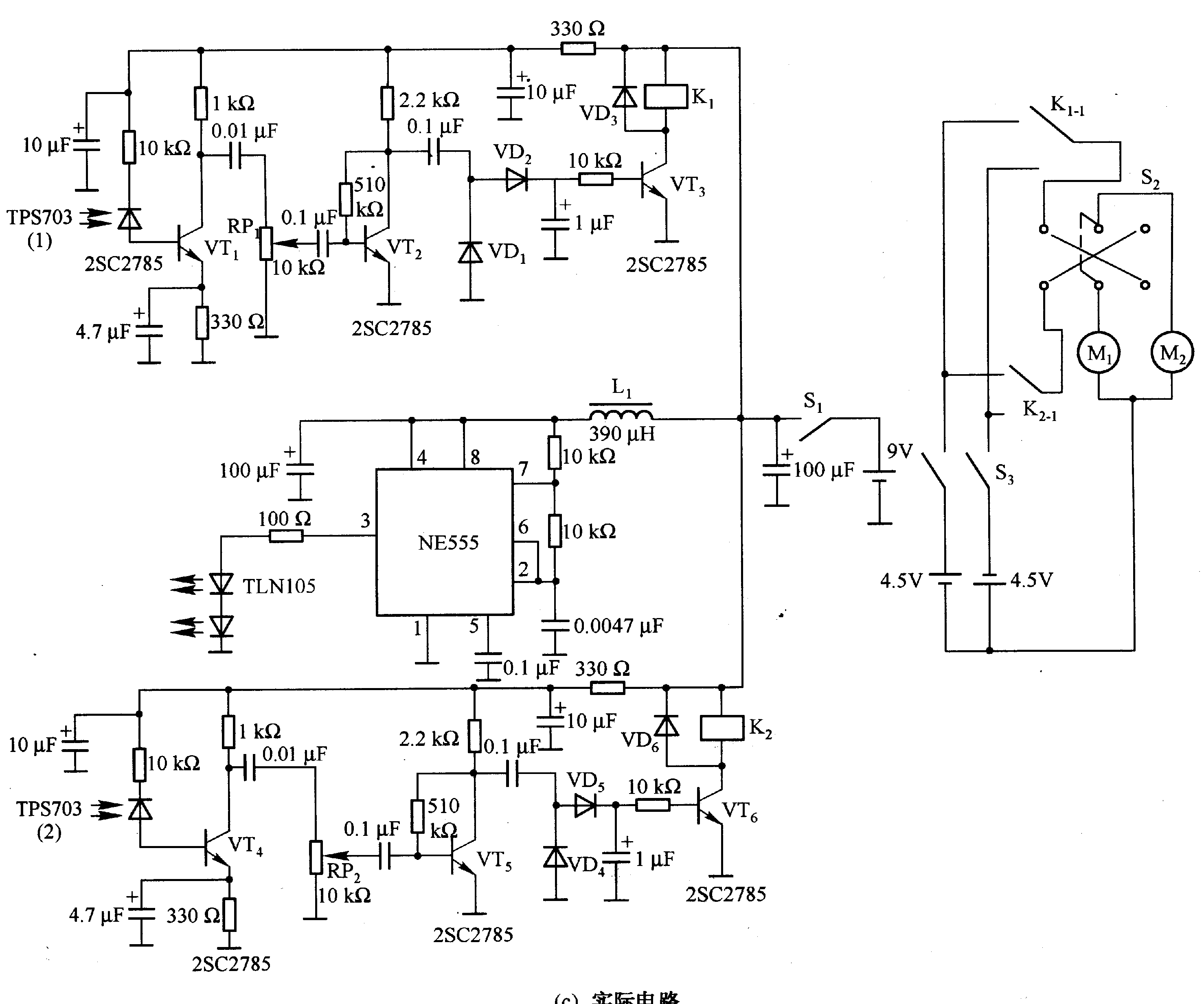
Robot control circuit composed of transistor and NE555
Figure 2-33 (a) illustrates the schematic diagram of a robot approaching an object. When no objects are detected in front of the robot, it moves forward in a straight line. If an object is detected on the left or right...