


Simple portable Audio power amplifier circuit using LM386 IC
#LM386
#audio amplifier
#low voltage
#power amplifier
#speaker
#music player
#headphone
#consumer electronics
#portable
#circuit schematic
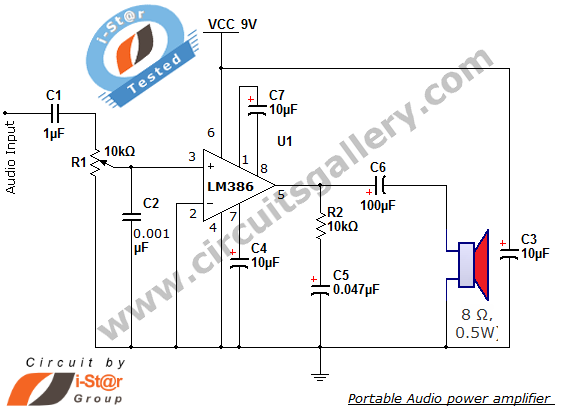
Description: The i-St@r presents a simple mini audio amplifier circuit schematic utilizing the LM386 low voltage audio power amplifier IC. This circuit is designed to power medium-sized speakers from a music player that typically drives only earphones (LM386 headphone). The LM386 is a low voltage power amplifier IC intended for low voltage consumer applications. It operates effectively under battery power and accommodates a wide supply voltage range of 4V to 12V or 5V to 18V, making it suitable for portable amplification. This audio amplifier has numerous applications, including AM-FM radio amplifiers, portable tape player amplifiers, intercoms, TV sound systems, line drivers, ultrasonic drivers, small servo drivers, power converters, and more. The audio signal is connected to the circuit through capacitor C1, which allows only audio frequencies to pass while blocking any direct current (DC) that could affect the amplifier's biasing conditions. The LM386 features two pins (1 and 8) for gain control and adjustments. With these pins left open, the internal resistance of 1.35 kΩ sets the gain at 20 (26 dB). Adding a capacitor between pins 1 and 8 bypasses the internal resistor, increasing the gain to 200 (46 dB). Resistor R2 and capacitor C5 form a filter circuit that eliminates high-frequency signals, likely noise generated during the amplification process of the LM386 IC. Capacitor C6, connected at the output pin, serves a similar purpose as the input stage capacitor by blocking DC biasing from the LM386 amplifier IC, thus preventing undesirable speaker operation.
The LM386 audio amplifier circuit is a versatile and efficient solution for various audio amplification needs. The circuit design is straightforward, making it accessible for hobbyists and professionals alike. The LM386 IC is favored for its low power consumption and ability to operate effectively with limited supply voltage, which is particularly advantageous in battery-operated devices.
In practical applications, the circuit can be configured to drive speakers with impedances typically ranging from 4 to 8 ohms, making it suitable for a variety of small to medium speakers. The gain control feature allows for customization of audio output levels, enabling users to tailor the amplifier's performance to specific requirements.
The use of capacitors C1 and C6 is critical in ensuring that only audio signals are amplified, preventing any DC offset that could potentially damage connected speakers or result in poor audio quality. Capacitor C5 plays an essential role in maintaining audio fidelity by filtering out unwanted high-frequency noise, which can degrade the listening experience.
Overall, the LM386-based mini audio amplifier circuit is a reliable choice for enhancing sound output in portable devices and various audio applications, providing a practical balance of simplicity, effectiveness, and adaptability.Here i-St@r comes with thesimplest mini audio amplifier circuitschematicusing LM386 low voltage audio power amplifier IC. This circuit is applicable to power medium sized speakers from a music player that can only drive earphones (lm386 headphone).
The LM386 is a low voltage power amplifier IC designed for use in low voltage consumer applications. It can be used under battery operation and has a wide supply voltage range: 4V 12V or 5V 18V enabling us to use the circuit as a portable amplifier. Our simple audio amplifier has many applications, the common lm386 projects are AM-FM radio amplifiers, portable tape player amplifiers, intercoms, TV sound systems, line drivers, ultrasonic drivers, small servo drivers, power converters and much more.
The audio signal is connected to the circuit using a capacitor C1. This capacitor passes only audio, and blocks any direct current (DC) that may influence the biasing conditions of the amplifier. To make the LM386 a more flexible audio amplifier, two pins (1 and 8) are provided for gain control and gain adjustments.
With pins 1 and 8 open, the 1. 35 kW internal resistance sets the gain at 20 (26 dB). If a capacitor is placed from pin 1 to 8, bypassing the 1. 35 kW internal resistor, the gain will go up to 200 (46 dB). The resistor R2 and capacitor C5 forms a filter circuit, which prevents high frequency signals coming from the amplifier, most probably noise picked up or generated in the amplifying process of LM386 IC. The capacitor C6 connected at the output pin has the same function as the capacitor used in the input stage i.
e. to prevent direct current (DC) due to the biasing of LM385 amplifier IC, causing undesired operation of the speaker.
The LM386 audio amplifier circuit is a versatile and efficient solution for various audio amplification needs. The circuit design is straightforward, making it accessible for hobbyists and professionals alike. The LM386 IC is favored for its low power consumption and ability to operate effectively with limited supply voltage, which is particularly advantageous in battery-operated devices.
In practical applications, the circuit can be configured to drive speakers with impedances typically ranging from 4 to 8 ohms, making it suitable for a variety of small to medium speakers. The gain control feature allows for customization of audio output levels, enabling users to tailor the amplifier's performance to specific requirements.
The use of capacitors C1 and C6 is critical in ensuring that only audio signals are amplified, preventing any DC offset that could potentially damage connected speakers or result in poor audio quality. Capacitor C5 plays an essential role in maintaining audio fidelity by filtering out unwanted high-frequency noise, which can degrade the listening experience.
Overall, the LM386-based mini audio amplifier circuit is a reliable choice for enhancing sound output in portable devices and various audio applications, providing a practical balance of simplicity, effectiveness, and adaptability.Here i-St@r comes with thesimplest mini audio amplifier circuitschematicusing LM386 low voltage audio power amplifier IC. This circuit is applicable to power medium sized speakers from a music player that can only drive earphones (lm386 headphone).
The LM386 is a low voltage power amplifier IC designed for use in low voltage consumer applications. It can be used under battery operation and has a wide supply voltage range: 4V 12V or 5V 18V enabling us to use the circuit as a portable amplifier. Our simple audio amplifier has many applications, the common lm386 projects are AM-FM radio amplifiers, portable tape player amplifiers, intercoms, TV sound systems, line drivers, ultrasonic drivers, small servo drivers, power converters and much more.
The audio signal is connected to the circuit using a capacitor C1. This capacitor passes only audio, and blocks any direct current (DC) that may influence the biasing conditions of the amplifier. To make the LM386 a more flexible audio amplifier, two pins (1 and 8) are provided for gain control and gain adjustments.
With pins 1 and 8 open, the 1. 35 kW internal resistance sets the gain at 20 (26 dB). If a capacitor is placed from pin 1 to 8, bypassing the 1. 35 kW internal resistor, the gain will go up to 200 (46 dB). The resistor R2 and capacitor C5 forms a filter circuit, which prevents high frequency signals coming from the amplifier, most probably noise picked up or generated in the amplifying process of LM386 IC. The capacitor C6 connected at the output pin has the same function as the capacitor used in the input stage i.
e. to prevent direct current (DC) due to the biasing of LM385 amplifier IC, causing undesired operation of the speaker.
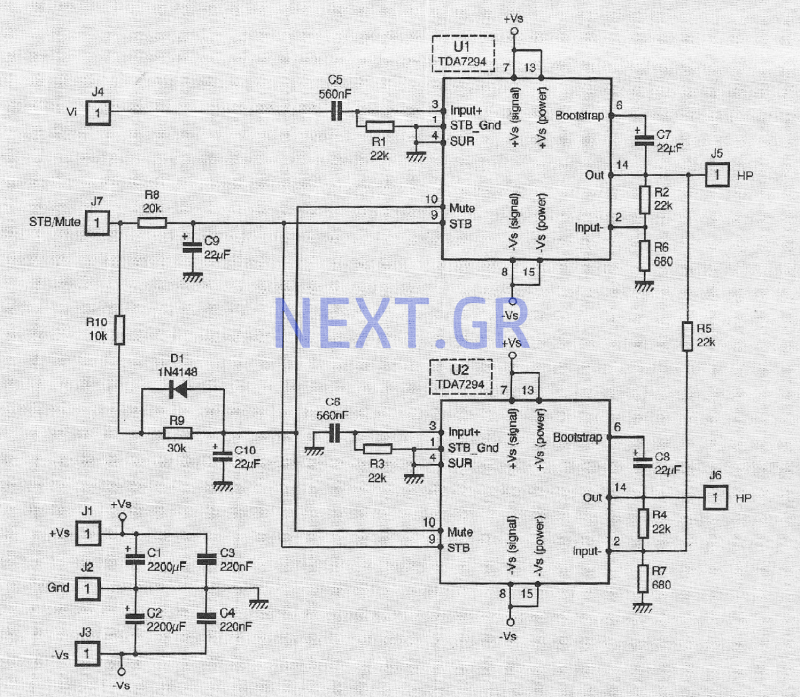
Power Audio Amplifier DMOS 2x100W using two TDA2794
The TDA 7294 from T-MICROELECTRONICS is a monolithic integrated circuit housed in a "Multiwatt 15" package, primarily designed for use in Class AB amplifiers for high-fidelity applications, including stereo systems, active speakers, and television receivers. Its large feed area and...
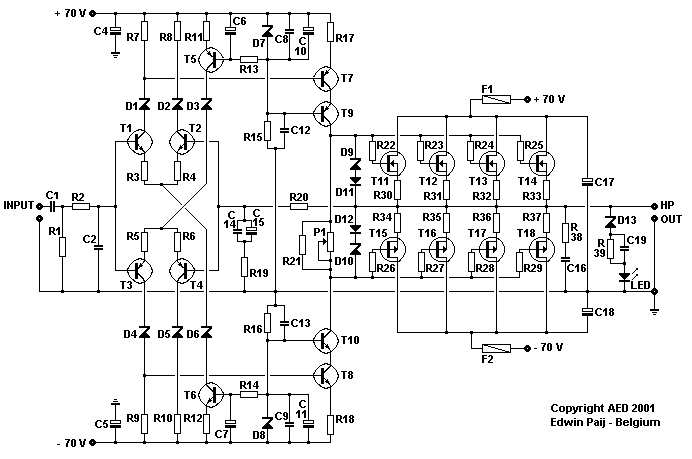
200 Watt audio power amplifier
Here I propose a project of an AB class power amplifier, at its simplest, assembled with common components (not very expensive), based on traditional diagrams: a symmetrical differential input stage, a cascode stage driver, and a MOSFET output stage. The...
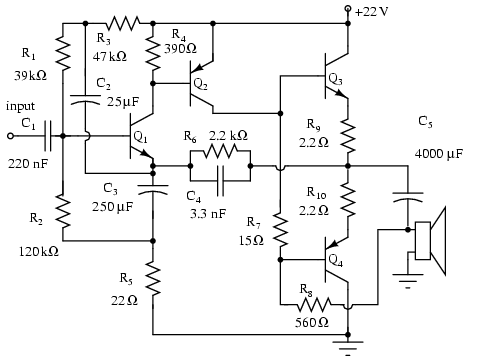
Amplifier circuits
Note that Q3 and Q4 in the figure below are complementary, with Q3 being an NPN transistor and Q4 being a PNP transistor. This circuit is suitable for moderate power audio amplifiers. For a detailed explanation of this circuit, refer...
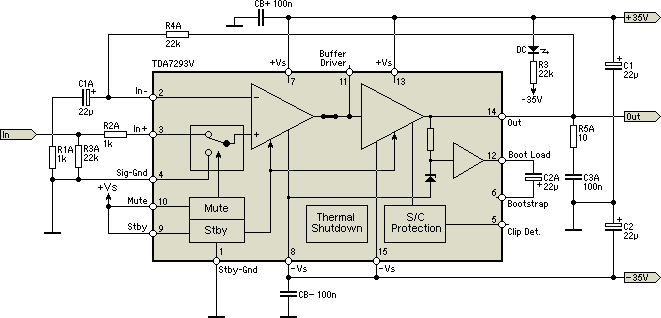
Dual Power Amplifier Using TDA7293 MOSFET IC
As readers may know, there are several power amplifier projects, including two that utilize integrated circuit (IC) power amplifiers, commonly referred to as power op-amps. Both of these projects have gained popularity, and this new project is not intended to...
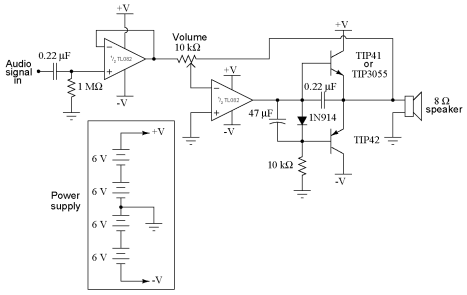
Fundamentals of Electrical Engineering and Class B audio amplifier
It is advisable to obtain TIP41 and TIP42 transistors, which are closely matched NPN and PNP power transistors with dissipation ratings of 65 watts each. If a TIP41 NPN transistor is unavailable, the TIP3055 (available from Radio Shack) serves as...
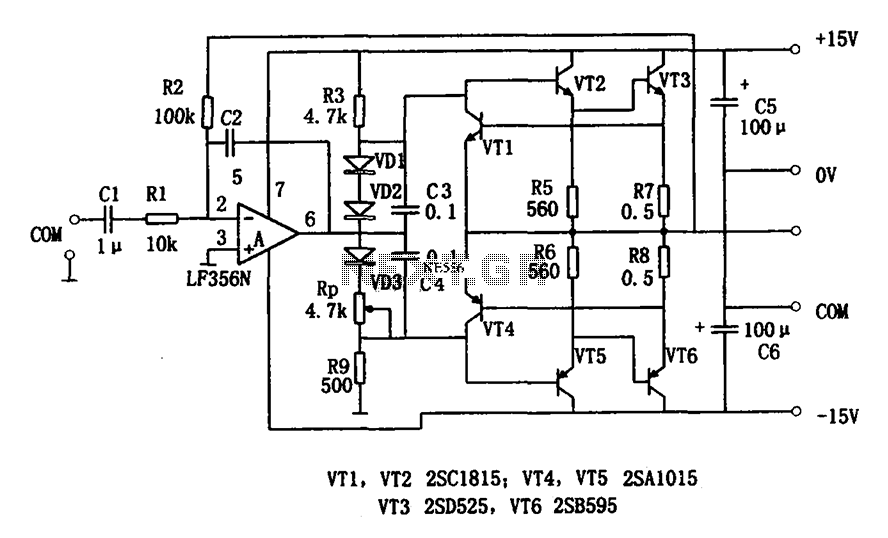
7W Audio Power Amplifier LF356
The circuit depicted is a low-frequency output 7W power amplifier. It employs a FET input operational amplifier, the LF356, for voltage amplification. The design features a transistor amplifier circuit that includes a driver stage. A significant negative feedback loop is...
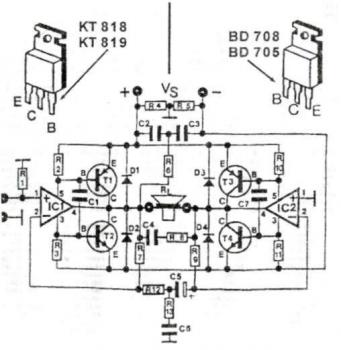
200 Watt High Quality Audio Amplifier
This high-power audio amplifier provides top-quality performance for loudspeakers with an impedance of 4 to 8 ohms. It operates within a frequency range of 20 to 20,000 Hz and requires a voltage supply of 24 to 36 volts, with a...
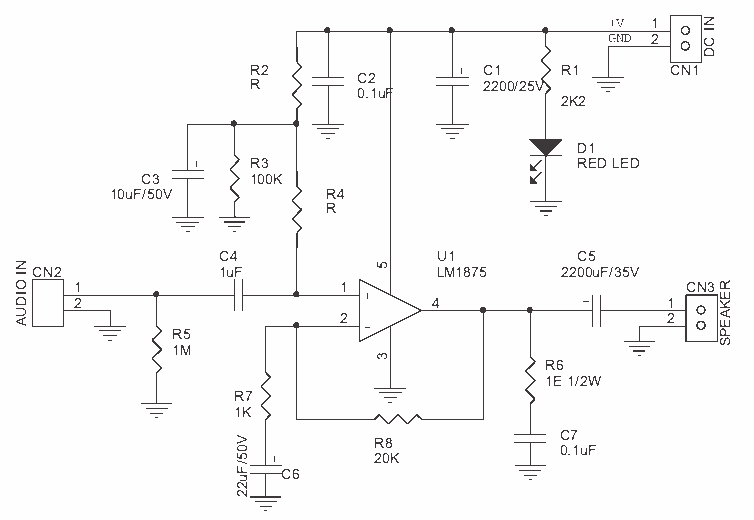
20 watt amplifier with LM1875
This is a nice amplifier and very easy to make it. Its an 20W Audio Amplifier based on LM1875 IC. More: Power supply - 48 VDC Output - 20 W, 4 ? Very low distortion (THD - 0.015%), good channel...

Power Amplifier 2000 Watt
This is a linear amplifier that requires advanced knowledge in electronics due to the complexity of the schematic diagram for a handmade circuit. It is advisable to redesign the schematic diagram using circuit design software such as DipTrace, Eagle, or...