


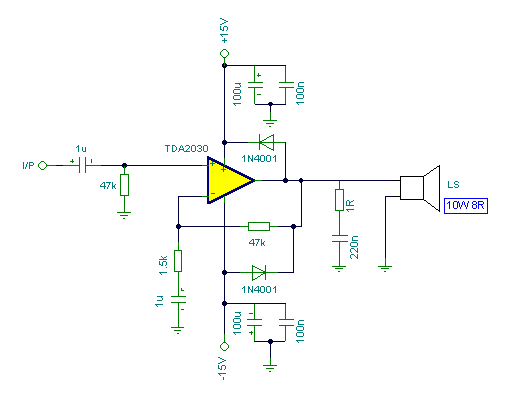
TDA2030A application circuit single supply operation
#TDA2030A
#audio amplifier
#single supply
#18W output
#harmonic distortion
#power amplifier
#audio circuit
#IC amplifier
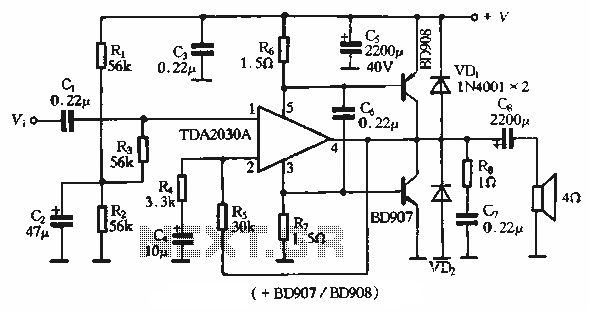
Description: The rDA2030A TDA2030 is an enhanced version of the original product, with a maximum working voltage increased to 18V and a maximum output power of 18W. Additionally, harmonic distortion has been significantly reduced. The application circuit is illustrated.
The rDA2030A TDA2030 is a robust audio amplifier integrated circuit designed for high-fidelity sound reproduction. It operates efficiently within a voltage range of up to 18V, making it suitable for various audio applications, including home audio systems, car stereos, and portable sound devices. With a maximum output power of 18W, this amplifier can drive speakers effectively, delivering clear and powerful audio performance.
One of the notable improvements in the rDA2030A is the reduction in harmonic distortion compared to its predecessor. This enhancement allows for a cleaner sound output, which is critical in audio applications where sound quality is paramount. The reduced distortion contributes to a more pleasant listening experience, particularly at higher volumes.
The typical application circuit for the rDA2030A includes essential components such as resistors, capacitors, and a heat sink to ensure optimal performance and thermal management. The circuit configuration typically involves connecting the input signal to the amplifier's input pin, with appropriate biasing and coupling capacitors to filter out unwanted noise. The output stage is designed to drive a load, such as an 8-ohm speaker, while maintaining stability and preventing oscillations.
In summary, the rDA2030A TDA2030 is a significant advancement in audio amplification technology, offering improved voltage handling, higher power output, and reduced distortion, making it an excellent choice for various audio amplification needs. The application circuit design is crucial for maximizing the performance of the amplifier while ensuring reliability and sound quality.rDA2030A TDA2030 is improved product that the original maximum working voltage up to 18V 2ZV, the maximum output power up to 18W. Harmonic distortion is also greatly reduced. Its application circuit is shown
The rDA2030A TDA2030 is a robust audio amplifier integrated circuit designed for high-fidelity sound reproduction. It operates efficiently within a voltage range of up to 18V, making it suitable for various audio applications, including home audio systems, car stereos, and portable sound devices. With a maximum output power of 18W, this amplifier can drive speakers effectively, delivering clear and powerful audio performance.
One of the notable improvements in the rDA2030A is the reduction in harmonic distortion compared to its predecessor. This enhancement allows for a cleaner sound output, which is critical in audio applications where sound quality is paramount. The reduced distortion contributes to a more pleasant listening experience, particularly at higher volumes.
The typical application circuit for the rDA2030A includes essential components such as resistors, capacitors, and a heat sink to ensure optimal performance and thermal management. The circuit configuration typically involves connecting the input signal to the amplifier's input pin, with appropriate biasing and coupling capacitors to filter out unwanted noise. The output stage is designed to drive a load, such as an 8-ohm speaker, while maintaining stability and preventing oscillations.
In summary, the rDA2030A TDA2030 is a significant advancement in audio amplification technology, offering improved voltage handling, higher power output, and reduced distortion, making it an excellent choice for various audio amplification needs. The application circuit design is crucial for maximizing the performance of the amplifier while ensuring reliability and sound quality.rDA2030A TDA2030 is improved product that the original maximum working voltage up to 18V 2ZV, the maximum output power up to 18W. Harmonic distortion is also greatly reduced. Its application circuit is shown
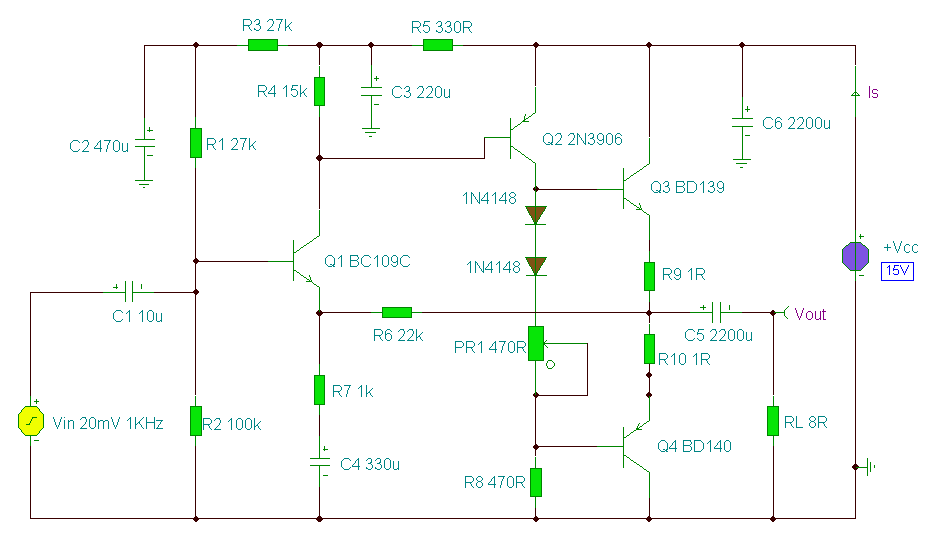
2 Watt Audio Amplifier
A 2 Watt audio amplifier made from discrete components. This was one of the earliest circuits that I ever designed and built, in Spring 1982. At that time I had only an analogue meter and a calculator to work with....
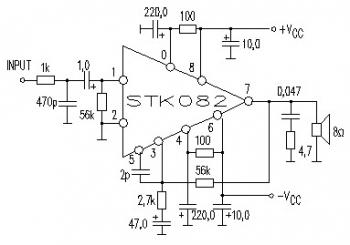
Audio
This device is a 2 x 2, 500W RMS stereo amplifier that is super-light and features a switching-mode power supply. The design only displays one channel, but the power supply supports both channels. The amplifier should be duplicated, but the...
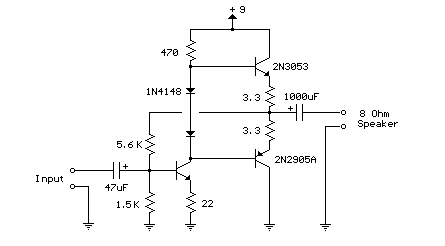
50mW amplifier schematic
Here is a little audio amplifier similar to what you might find in a small transistor radio. The input stage is biased so that the supply voltage is divided equally across the two complimentary output transistors which are slightly biased...
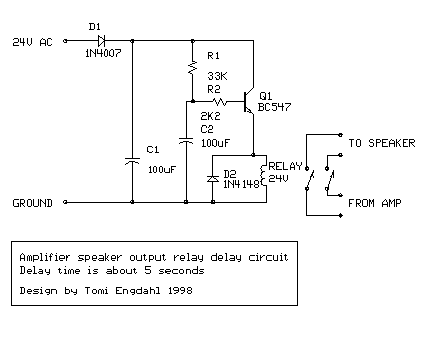
Audio amplifier output relay delay
This circuit was designed for an audio amplifier project to control the speaker output relay. Its primary function is to manage the relay that activates the speaker output in the audio amplifier, ensuring a delay of approximately 5 seconds after...
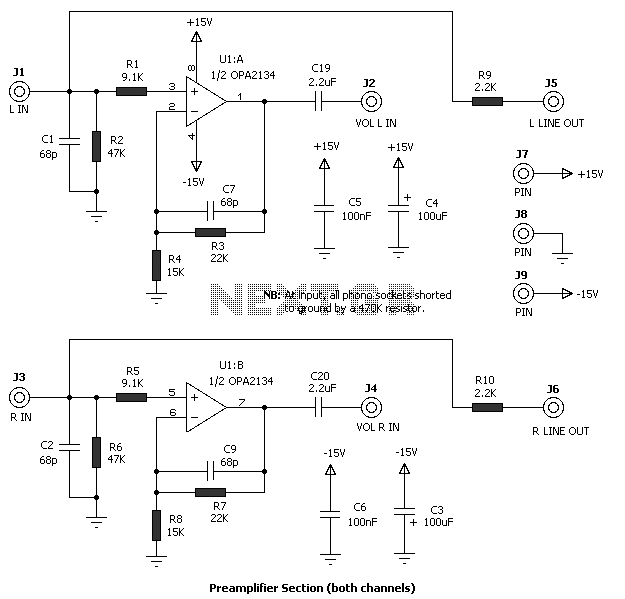
50 Watt power Amplifier with preamplifier and headphone output
The amplifier drives a pair of loudspeakers using two LM3876 integrated power amp ICs (50 watts per channel), or a pair of headphones via a Meier crossfeed filter and an OPA2134 dual opamp. It provides four switchable line level inputs,...
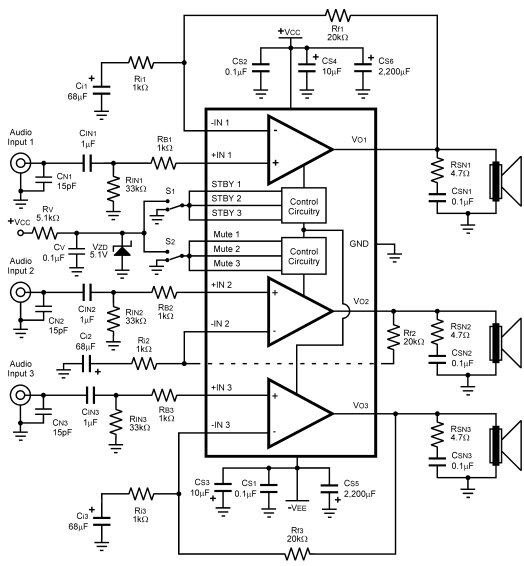
Circuit power audio amplifier potency lm4782 overture three channel
The LM4782 utilizes a protection system known as National Self Peak Instantaneous Temperature (Ke) (SPiKeTM). SPiKe safeguards the output of the LM4782 against over-voltage on the load, short circuits to ground, and provides temperature protection by monitoring instantaneous temperature. Each...
200W Hybrid Audio Amplifier Circuit
Connecting two TDA2030 through inexpensive power transistors allows for the creation of an amplifier capable of delivering higher power. This can be achieved by utilizing the component values specified in the schematic.
To implement this circuit, two TDA2030 integrated circuits are...
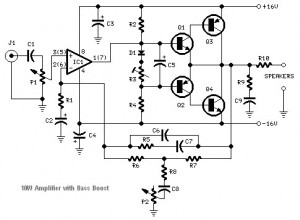
Transistored 10W Audio Amplifier
This audio amplifier circuit is based on the operational amplifier NE5532 and utilizes a pair of power transistors, TIP41A and TIP42A. It is capable of delivering up to 10W of audio power output into an 8-ohm speaker. The design is...
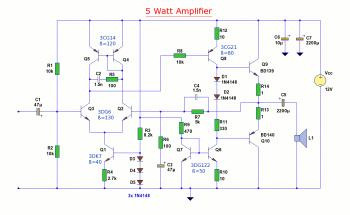
5W Audio Amplifier Circuit based BD139/BD140
The diagram illustrates a 5W audio amplifier circuit constructed using power transistors BD139 and BD140 for the final amplification stage. This compact amplifier serves as a general-purpose amplifier suitable for applications such as computer audio, radio, MP3 players, and video...