


TDA7250 high power audio amplifier schematic electronic project
#TDA7250
#audio amplifier
#high power
#SGS Thomson
#8 ohms
#4 ohms
#electronic project
#audio driver
#stereo amplifier
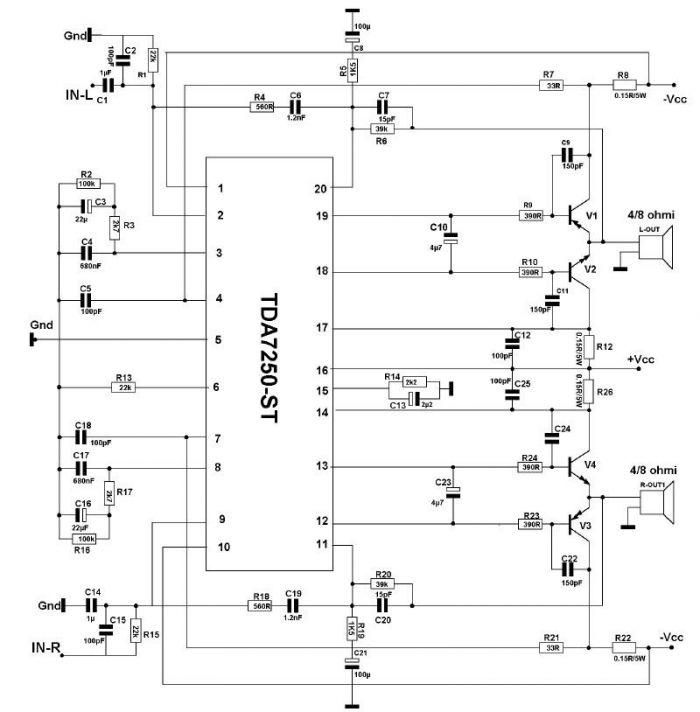
Description: The TDA7250 audio driver, manufactured by SGS Thomson, can be utilized to design a straightforward high-power audio amplifier project with minimal external components. This audio amplifier can operate with either a 4-ohm or an 8-ohm load, delivering a maximum output power of 2x80 watts with an 8-ohm load and up to 2x125 watts with a 4-ohm load. A dual power supply providing 35 volts output is required for the 4-ohm load, while a dual power supply offering 40-45 volts output is necessary for the 8-ohm load (do not exceed 45 volts, as this is the maximum voltage supported by the chip). For the 4-ohm load, a center-tapped transformer that provides 25 volts AC at output (300VA/2x25 volts) is needed. For the 8-ohm load, a center-tapped transformer that provides 35 volts AC at output (250VA/2x35 volts) is required. Various types of final transistors can be used in this audio amplifier project, including BDX 53/54A, BDW93/94B, TIP142/147, BDV64/65B, and MJ 11013/11014; however, the circuit diagram specifically uses TIP142/147 transistors.
The TDA7250 audio amplifier circuit is designed to deliver high-quality audio output with significant power handling capabilities. The amplifier's architecture allows for the efficient driving of speakers with impedances of 4 ohms or 8 ohms, making it versatile for various applications. The output power ratings indicate that the design is suitable for medium to large audio systems, providing robust sound reproduction.
For the power supply requirements, the dual power supply configuration is critical to achieving the desired output levels. The 4-ohm load necessitates a supply voltage of 35 volts, which enables the amplifier to reach its maximum output of 2x125 watts. The use of a center-tapped transformer is essential, as it provides the necessary AC voltage for rectification and filtering, ensuring stable DC voltage for the amplifier's operation.
When dealing with an 8-ohm load, the power supply requirement increases to a range of 40-45 volts. This higher voltage allows the amplifier to achieve a maximum output of 2x80 watts. The transformer specifications (250VA/2x35 volts) indicate that it must be capable of handling the power demands of the amplifier while maintaining efficiency.
The choice of output transistors is crucial for the amplifier's performance. The TIP142 and TIP147 transistors are selected for their high current handling capabilities and thermal stability, which are vital in high-power applications. These transistors are capable of delivering the necessary output current to drive the connected load effectively while maintaining low distortion levels.
Overall, the TDA7250 audio amplifier project is a well-rounded design that showcases the capabilities of the TDA7250 chip in conjunction with robust external components, offering an effective solution for high-power audio amplification needs.Using TDA7250 audio driver manufactured by SGS Thomson, can be designed a very simple high power audio amplifier electronic project using few external electronic parts. This TDA7250 audio amplifier electronic project can be used using a 4 ohms load or a 8 ohms load and will produce a maximum output power of 2x80 watts using an 8 ohms load and 2x
125 watts using a 4 ohms load. For a 4 ohms load is required a dual power supply that will provide a 35 volt output, and for a 8 ohms load is required a dual power supply that will provide a 40-45 volts output ( don`t power the circuit with more than 45 volts, because this is the maximum voltage supported by the chip). For a 4 ohms load you`ll need a center trapped transformer that will provide 25 volts AC at output ( 300VA/2x25 volts).
For a 8 ohms load you`ll need a center trapped transformer that will provide a 35 volts AC at output ( 250VA/2x35 volts). For this audio amplifier electronic project you can use various types of final transistors like : BDX 53/54A, BDW93/94B, TIP142/147, BDV64/65B, MJ 11013/11014, etc.
but in this circuit diagram are used TIP142/147 transistors.
The TDA7250 audio amplifier circuit is designed to deliver high-quality audio output with significant power handling capabilities. The amplifier's architecture allows for the efficient driving of speakers with impedances of 4 ohms or 8 ohms, making it versatile for various applications. The output power ratings indicate that the design is suitable for medium to large audio systems, providing robust sound reproduction.
For the power supply requirements, the dual power supply configuration is critical to achieving the desired output levels. The 4-ohm load necessitates a supply voltage of 35 volts, which enables the amplifier to reach its maximum output of 2x125 watts. The use of a center-tapped transformer is essential, as it provides the necessary AC voltage for rectification and filtering, ensuring stable DC voltage for the amplifier's operation.
When dealing with an 8-ohm load, the power supply requirement increases to a range of 40-45 volts. This higher voltage allows the amplifier to achieve a maximum output of 2x80 watts. The transformer specifications (250VA/2x35 volts) indicate that it must be capable of handling the power demands of the amplifier while maintaining efficiency.
The choice of output transistors is crucial for the amplifier's performance. The TIP142 and TIP147 transistors are selected for their high current handling capabilities and thermal stability, which are vital in high-power applications. These transistors are capable of delivering the necessary output current to drive the connected load effectively while maintaining low distortion levels.
Overall, the TDA7250 audio amplifier project is a well-rounded design that showcases the capabilities of the TDA7250 chip in conjunction with robust external components, offering an effective solution for high-power audio amplification needs.Using TDA7250 audio driver manufactured by SGS Thomson, can be designed a very simple high power audio amplifier electronic project using few external electronic parts. This TDA7250 audio amplifier electronic project can be used using a 4 ohms load or a 8 ohms load and will produce a maximum output power of 2x80 watts using an 8 ohms load and 2x
125 watts using a 4 ohms load. For a 4 ohms load is required a dual power supply that will provide a 35 volt output, and for a 8 ohms load is required a dual power supply that will provide a 40-45 volts output ( don`t power the circuit with more than 45 volts, because this is the maximum voltage supported by the chip). For a 4 ohms load you`ll need a center trapped transformer that will provide 25 volts AC at output ( 300VA/2x25 volts).
For a 8 ohms load you`ll need a center trapped transformer that will provide a 35 volts AC at output ( 250VA/2x35 volts). For this audio amplifier electronic project you can use various types of final transistors like : BDX 53/54A, BDW93/94B, TIP142/147, BDV64/65B, MJ 11013/11014, etc.
but in this circuit diagram are used TIP142/147 transistors.
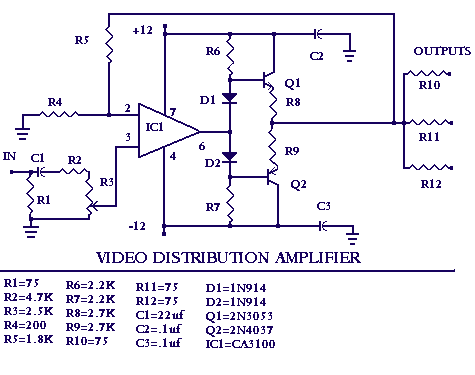
Audio / Video Distribution Amplifier
With the amount of equipment in home entertainment centers today the need to be able to vary the gain of the audio or video signal is needed. I found this particular circuit helpful when used in conjunction with the Universal...
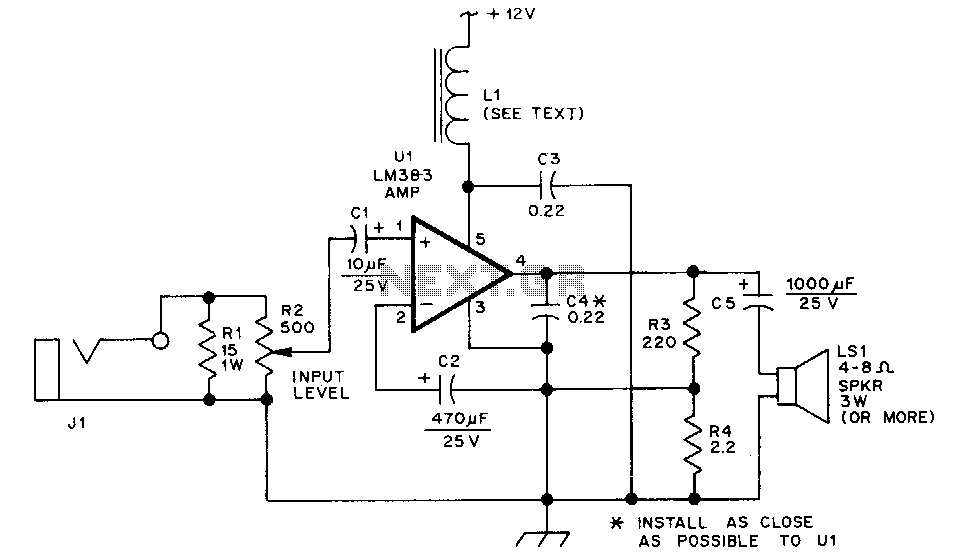
Speaker-amplifier
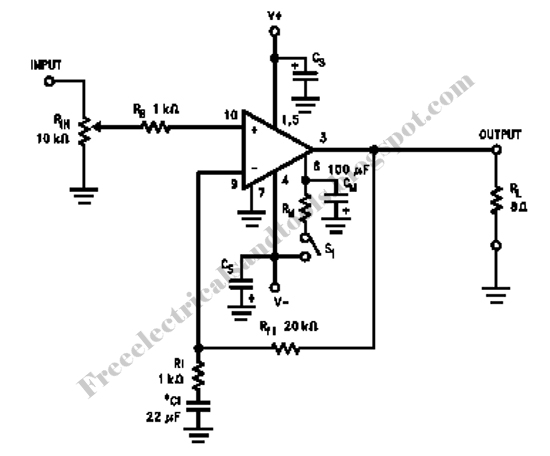
The LM383 is an audio power amplifier capable of delivering up to 8 watts of audio output. Resistor R1 serves as a load resistor for the audio output of a hand-held transceiver. Resistor R2 can be implemented using two fixed...
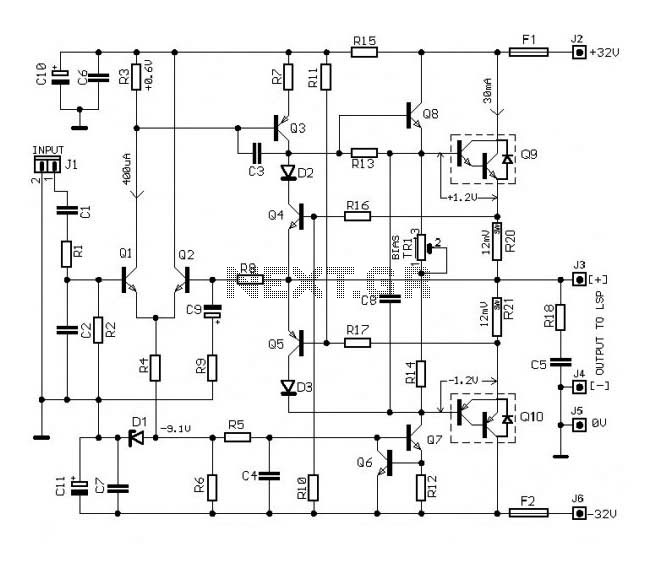
30w Audio Amplifier Circuit
The circuit of this 30W audio amplifier produces clear audio output quality. The circuit module does not have any improvements. It utilizes a Darlington pair in the transistor configuration.
The 30W audio amplifier circuit is designed to deliver high-fidelity sound reproduction,...
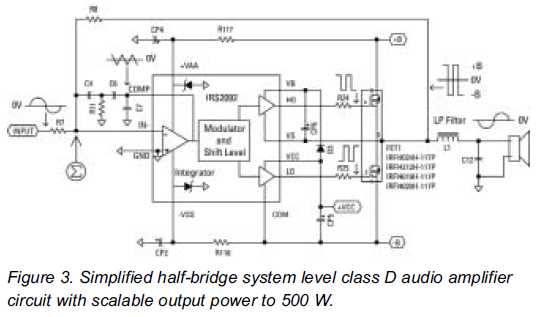
Class D Audio Amplifier Matches Class AB With Higher Efficiency
Class D audio amplifiers are now prepared to replace Class AB amplifiers. An integrated high-voltage audio driver simplifies the design and construction of high-power audio systems.
Class D audio amplifiers, also known as switching amplifiers, utilize pulse-width modulation (PWM) to convert...
Simple Hybrid Audio Amplifier Circuit
Here is an amplifier circuit based on the BUZ11, which can be replaced by an IRFZ34N, and an ECC83 can be used instead of the ECC88. In this case, the anode voltage should be reduced slightly to 155 V. The...
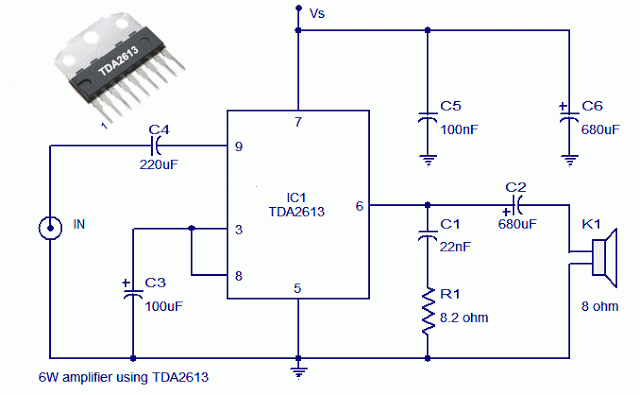
6 Watt Hi Fi Audio Amplifier Using TDA2613
A 6-watt audio amplifier circuit utilizing the TDA2613 is presented here. The TDA2613 is an integrated Hi-Fi audio amplifier IC produced by Philips Semiconductors. The IC is designed for high-quality audio amplification.
The circuit features the TDA2613 IC, which is capable...
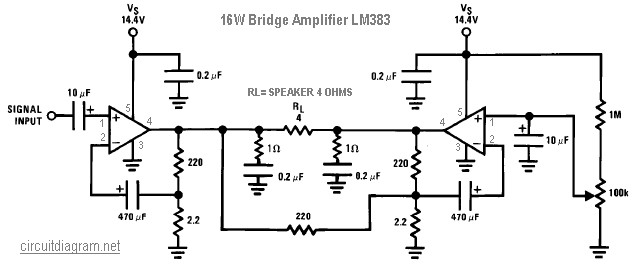
16w bridge amplifier using lm383
The following diagram illustrates a 16W bridge audio amplifier circuit. The design incorporates two LM383 power ICs in a head connection, making this amplifier a head amplifier. The LM383 is an older model that has been discontinued, which may make...
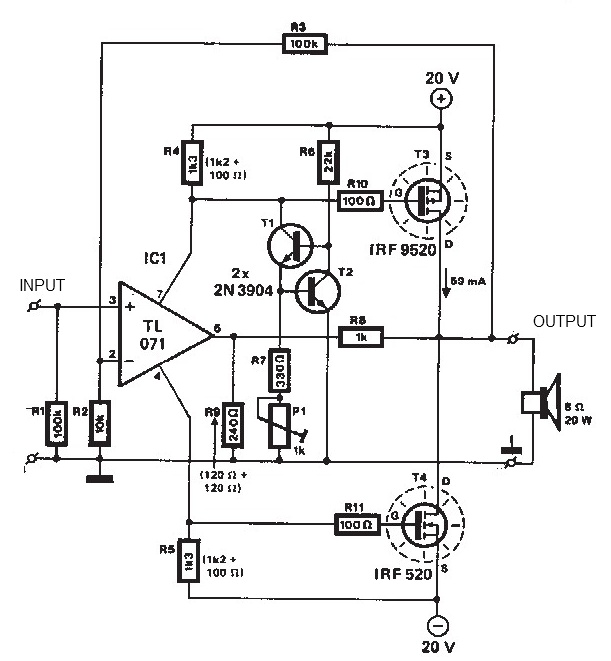
Mosfet Amplifier 20Watt Output Power Schematic Diagram
The audio amplifier illustrated in this circuit diagram is a straightforward and efficient audio amplifier circuit based on the TDA1308 integrated class-AB stereo headphone amplifier. This device is manufactured using a 1 mm Complementary Metal Oxide Semiconductor (CMOS) process and...
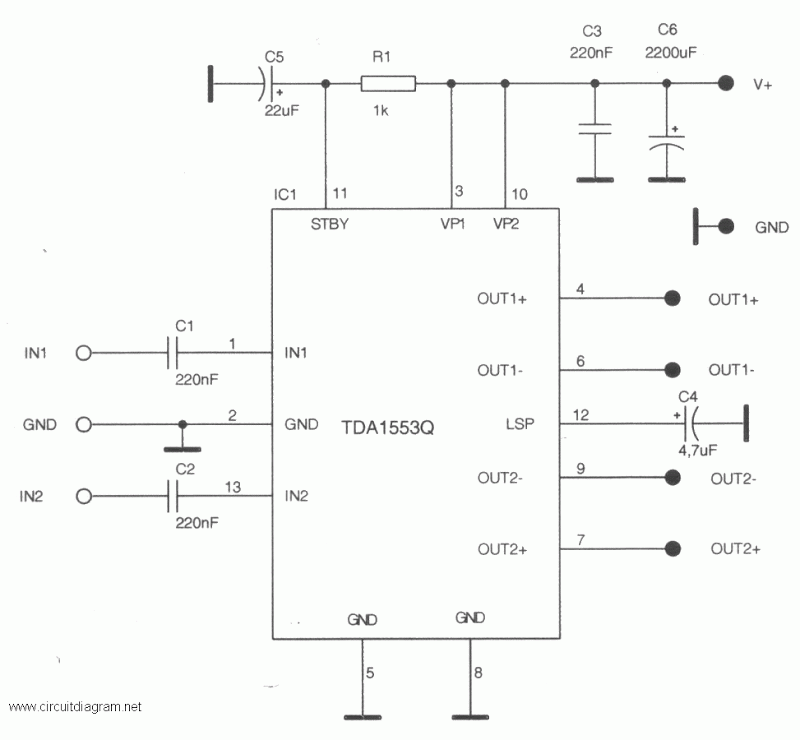
Audio Car Stereo Audio Amplifier with TDA1553CQ
When a short circuit to ground occurs, causing a DC voltage across the loudspeaker to be greater than or equal to V, an integrated protection circuit activates. This circuit limits the DC voltage across the loudspeaker to a value less...