


2 to 4 wire audio converter
#audio converter
#2 to 4 wire
#isolation
#balancing potentiometer
#gain adjustment
#audio signal
#line connection
#LC2
#40 dB isolation
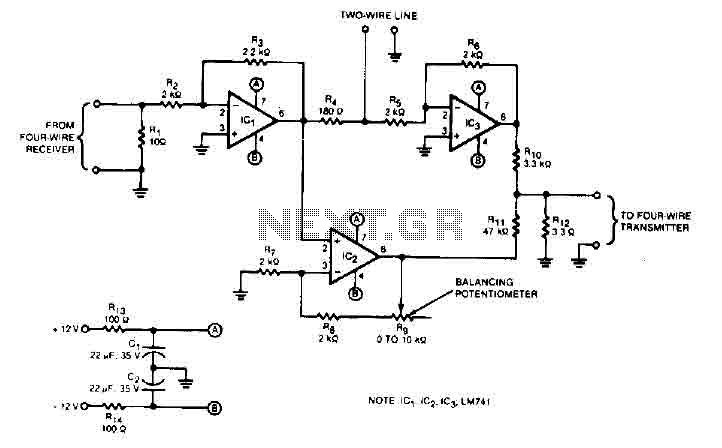
Description: This audio converter circuit maintains 40 dB of isolation between the two halves of entry and exit of a four-line system while allowing a line connection between the two systems. A balancing potentiometer, R, adjusts the gain of the signal from the input to the output. The adjustment is performed during installation by inserting a 1 kHz tone at the entrance of the four-line system and setting R to achieve the minimum output signal. An 82-ohm dummy load resistor is placed between the two wire terminals.
The audio converter circuit is designed to facilitate the transmission of audio signals while ensuring significant isolation between the input and output stages. The 40 dB isolation implies that the circuit effectively minimizes the risk of interference and crosstalk between the two halves of the system, which is crucial in applications where audio fidelity is paramount.
The circuit utilizes a balancing potentiometer, denoted as R, which serves to fine-tune the gain of the audio signal. This adjustment is critical for achieving optimal performance, ensuring that the output signal is neither too weak nor too strong, which could lead to distortion or clipping. The procedure for adjusting the potentiometer is straightforward; during the installation phase, a 1 kHz test tone is introduced at the input. The technician then adjusts the potentiometer until the output signal is minimized, indicating that the gain has been properly set.
In addition to the potentiometer, the circuit incorporates an 82-ohm dummy load resistor connected between the two wire terminals. This resistor plays a vital role in stabilizing the circuit by providing a consistent load, which can help prevent signal reflections and ensure that the audio signal is transmitted smoothly through the system. The use of a dummy load is particularly important in audio applications, as it helps maintain the integrity of the signal path and enhances overall performance.
Overall, this audio converter circuit is an effective solution for maintaining audio quality and isolation in multi-line systems, making it suitable for various applications in professional audio environments.This audio converter circuit maintains 40 dB of isolation between the two halves of entry and exit of a four-line son, while allowing a line connecting two son. A balancing potentiometer, R, adjusts the gain of zero lC2to crossing the inlet to the outlet. The adjustment is done in terms of work just after installation by inserting a 1 kHz tone at the entrance of four son and setting R to the minimum output signal 82-ohm dummy-load resistor is placed between two wire terminals.
The audio converter circuit is designed to facilitate the transmission of audio signals while ensuring significant isolation between the input and output stages. The 40 dB isolation implies that the circuit effectively minimizes the risk of interference and crosstalk between the two halves of the system, which is crucial in applications where audio fidelity is paramount.
The circuit utilizes a balancing potentiometer, denoted as R, which serves to fine-tune the gain of the audio signal. This adjustment is critical for achieving optimal performance, ensuring that the output signal is neither too weak nor too strong, which could lead to distortion or clipping. The procedure for adjusting the potentiometer is straightforward; during the installation phase, a 1 kHz test tone is introduced at the input. The technician then adjusts the potentiometer until the output signal is minimized, indicating that the gain has been properly set.
In addition to the potentiometer, the circuit incorporates an 82-ohm dummy load resistor connected between the two wire terminals. This resistor plays a vital role in stabilizing the circuit by providing a consistent load, which can help prevent signal reflections and ensure that the audio signal is transmitted smoothly through the system. The use of a dummy load is particularly important in audio applications, as it helps maintain the integrity of the signal path and enhances overall performance.
Overall, this audio converter circuit is an effective solution for maintaining audio quality and isolation in multi-line systems, making it suitable for various applications in professional audio environments.This audio converter circuit maintains 40 dB of isolation between the two halves of entry and exit of a four-line son, while allowing a line connecting two son. A balancing potentiometer, R, adjusts the gain of zero lC2to crossing the inlet to the outlet. The adjustment is done in terms of work just after installation by inserting a 1 kHz tone at the entrance of four son and setting R to the minimum output signal 82-ohm dummy-load resistor is placed between two wire terminals.
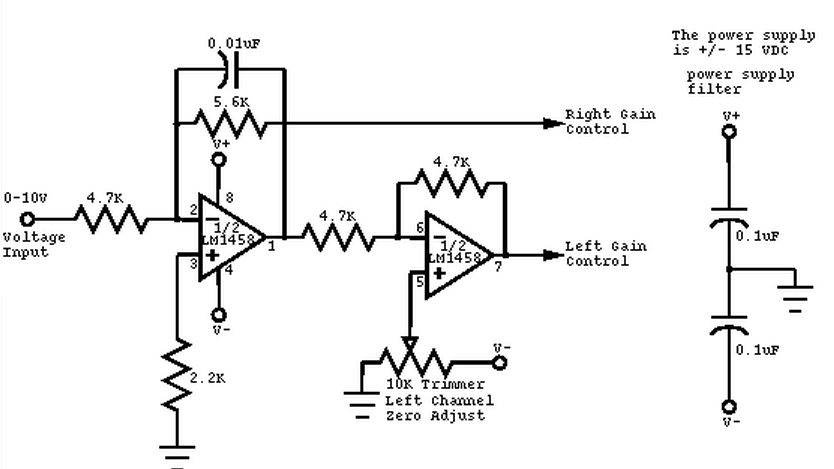
Mono to Stereo Audio Signal Circuit Converter
This circuit converts a mono audio signal into a stereo signal that can be panned between the left and right channels using a 0-10V control signal. It is designed for analog synthesizer systems.
The circuit operates by taking a single mono...
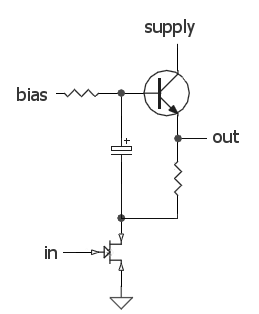
DC biasing audio signal
The audio source will be a line-level audio signal ranging from -2V to +2V AC, which will be passed through a 220µF coupling capacitor followed by a two-pole low-pass filter (RC). The signal will be processed by an Analog-to-Digital Converter...
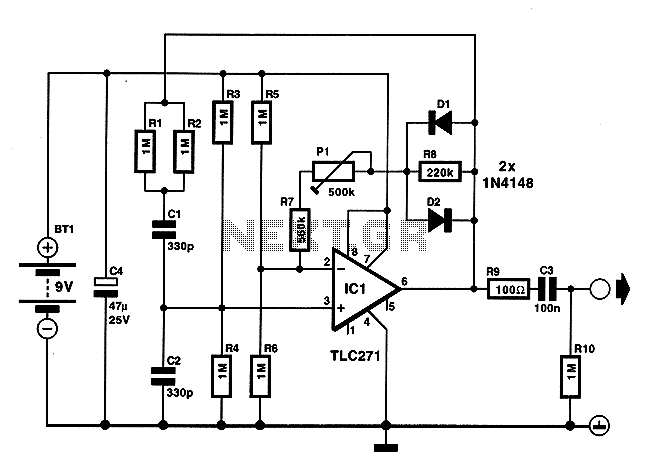
Low energy consumption audio signal generator
On occasions when it is necessary to determine if an amplifier is functioning, the most effective tool is an acoustic signal source with a frequency around 1 kHz. The specifications can be considered flexible, as rapid tests typically do not...
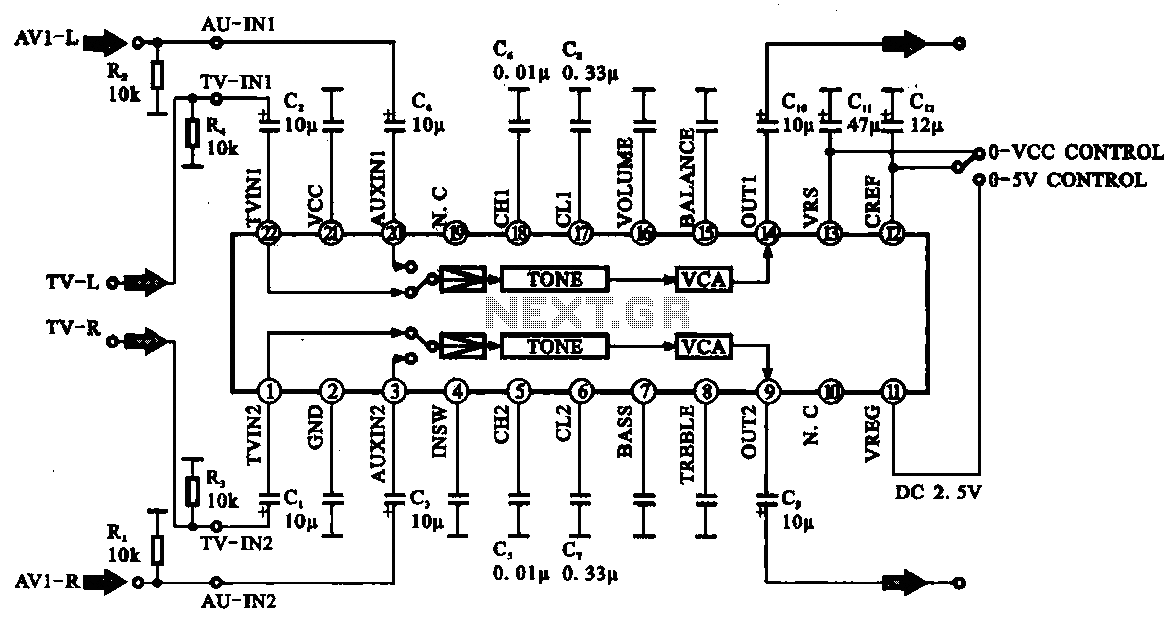
Audio signal control circuit
Audio signal control circuit. It illustrates a typical audio signal control circuit where two audio signals enter the integrated circuit through switching and tone controls (treble and bass), subsequently adjusting the output sent to the audio power amplifier.
The audio signal...
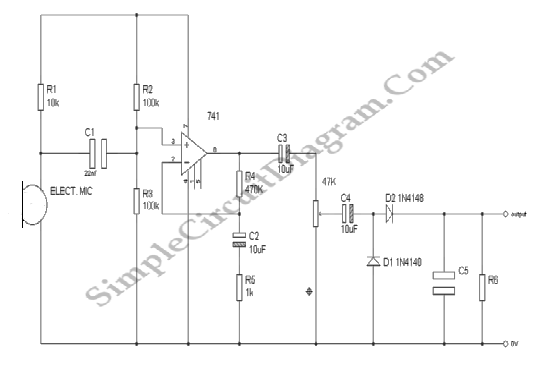
Audio Signal Strength Detector/Converter
Below is the schematic diagram of an audio input module. This module is capable of producing a DC output voltage that is proportional to the amplitude of the input signal.
The audio input module typically consists of several key components that...