


analog delay line (echo and reverb)
#delay line
#echo
#reverb
#analog circuit
#audio processing
#clock frequency
#signal delay
#sound effects
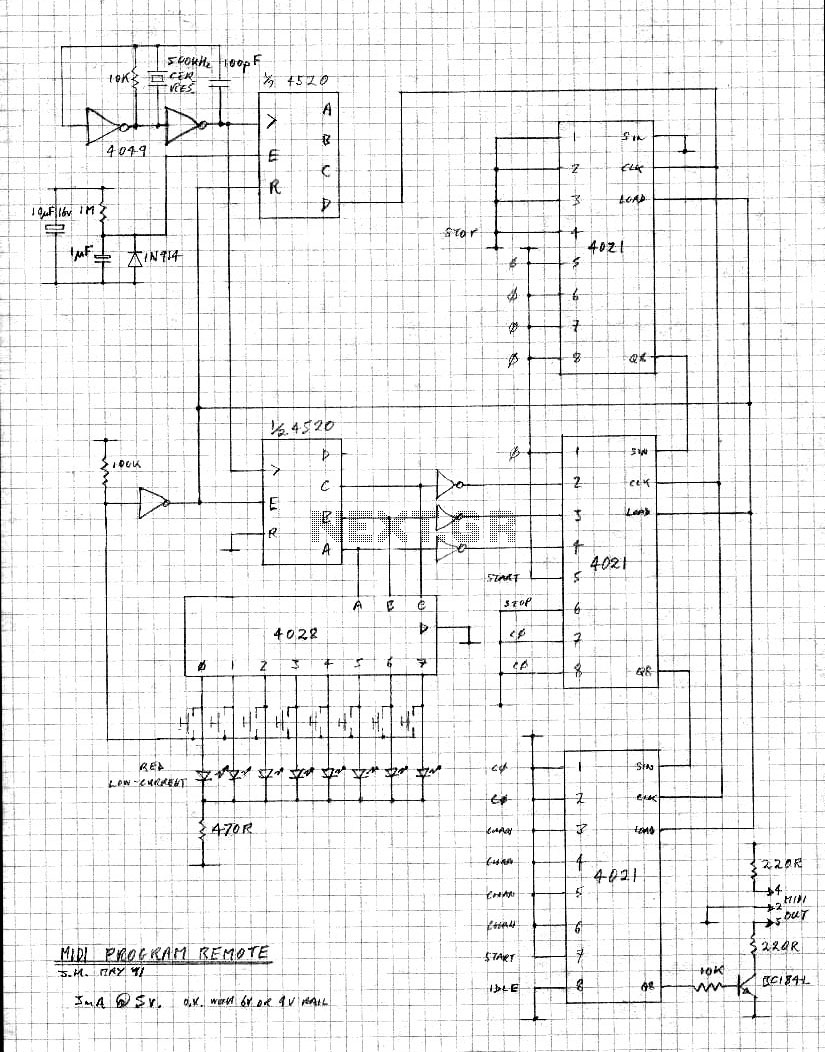
Description: The clock frequency ranges from 5 kHz to 50 kHz, with a delay time adjustable between 51.2 ms and 5.12 ms. The clock frequency must be at least double the highest audio frequency.
The described circuit operates within a clock frequency range of 5 kHz to 50 kHz. This frequency range is critical for ensuring that the circuit can adequately process audio signals, as it must be at least twice the maximum audio frequency to satisfy the Nyquist theorem. Typically, audio signals can reach frequencies up to 20 kHz; therefore, the minimum clock frequency of 40 kHz is necessary to avoid aliasing and ensure accurate signal representation.
The delay time, adjustable from 51.2 ms to 5.12 ms, indicates the circuit's capacity to introduce a time lag in the processing of signals. This feature can be utilized for various audio effects such as echo or reverb, where the delayed signal is mixed with the original to create a fuller sound.
In practical terms, the clock signal can be generated using a 555 timer IC configured in astable mode or by employing a microcontroller with a PWM output that can be fine-tuned to achieve the desired frequency. The delay can be implemented using a digital delay line, which can be constructed using shift registers or dedicated delay line ICs.
The circuit should also include appropriate filtering components to manage the frequency response and minimize noise. Capacitors and resistors may be utilized in conjunction with operational amplifiers to shape the signal and ensure that it remains within the desired frequency range.
Overall, careful consideration must be given to the selection of components to maintain signal integrity and achieve the desired performance within the specified frequency and delay parameters.E clock frequency between 5 and 50 kHz, delay time can be set between 51. 2 and 5. 12 ms. The clock frequency must be at least twice the highest audio frequency.
The described circuit operates within a clock frequency range of 5 kHz to 50 kHz. This frequency range is critical for ensuring that the circuit can adequately process audio signals, as it must be at least twice the maximum audio frequency to satisfy the Nyquist theorem. Typically, audio signals can reach frequencies up to 20 kHz; therefore, the minimum clock frequency of 40 kHz is necessary to avoid aliasing and ensure accurate signal representation.
The delay time, adjustable from 51.2 ms to 5.12 ms, indicates the circuit's capacity to introduce a time lag in the processing of signals. This feature can be utilized for various audio effects such as echo or reverb, where the delayed signal is mixed with the original to create a fuller sound.
In practical terms, the clock signal can be generated using a 555 timer IC configured in astable mode or by employing a microcontroller with a PWM output that can be fine-tuned to achieve the desired frequency. The delay can be implemented using a digital delay line, which can be constructed using shift registers or dedicated delay line ICs.
The circuit should also include appropriate filtering components to manage the frequency response and minimize noise. Capacitors and resistors may be utilized in conjunction with operational amplifiers to shape the signal and ensure that it remains within the desired frequency range.
Overall, careful consideration must be given to the selection of components to maintain signal integrity and achieve the desired performance within the specified frequency and delay parameters.E clock frequency between 5 and 50 kHz, delay time can be set between 51. 2 and 5. 12 ms. The clock frequency must be at least twice the highest audio frequency.
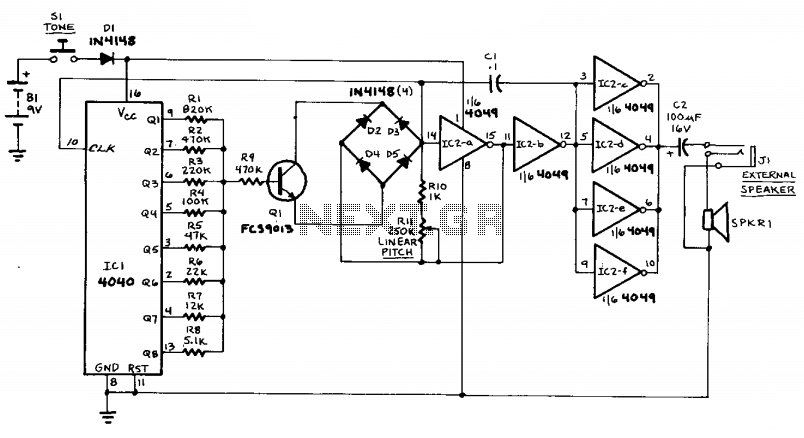
Sound effects generator
This circuit can generate sounds such as a European police-car siren, bird noises, and spaceship sounds. It can also function as a doorbell or an alarm. The circuit consists of four main components: a binary counter, a digital-to-analog (D/A) converter,...
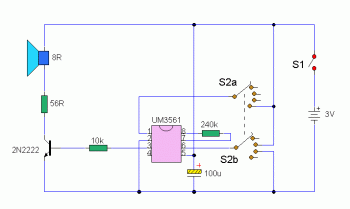
Sound Effects Alarm Generator
This schematic is simple and easy to construct. The integrated circuit (IC) generates all the sound effects, with the output at Pin 3 being amplified by a transistor. A 64-ohm loudspeaker can be used instead of the 56-ohm resistor and...
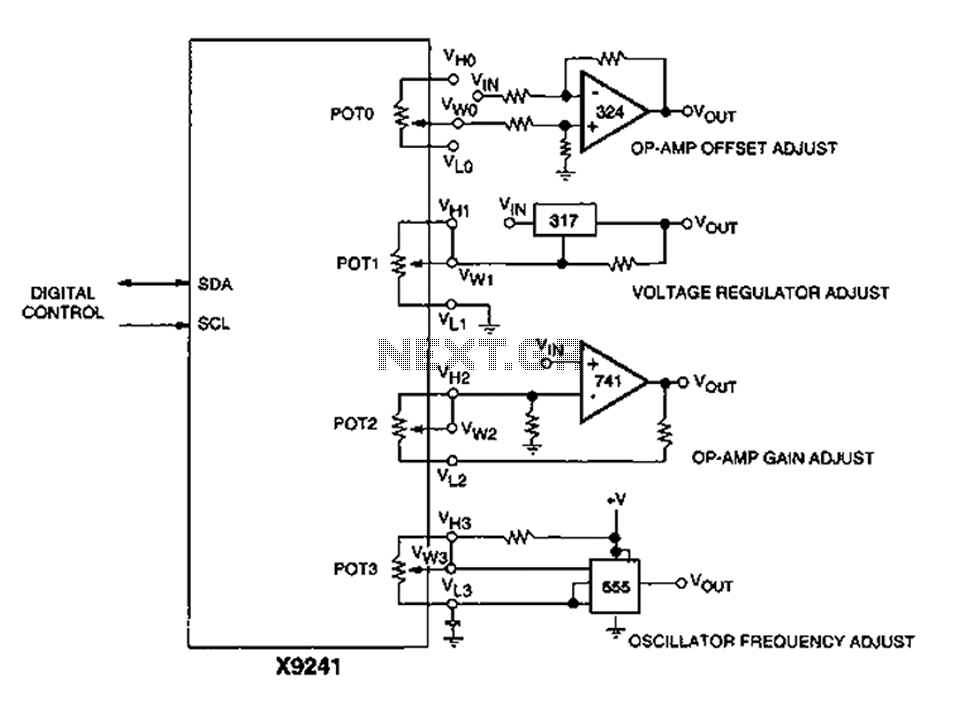
Corrector circuit diagram of an analog circuit
A XICOR X9241 POT IC module can be utilized to modify the four digital analog circuits, as depicted in the schematic.
The XICOR X9241 is a digital potentiometer integrated circuit designed for precise adjustment of analog signal levels in various electronic...
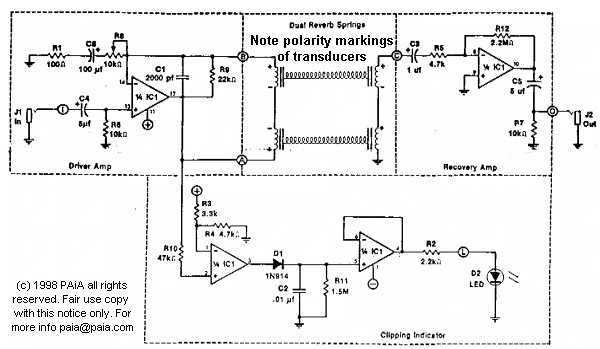
Hot Springs Reverb
The Hot Springs tanks and circuit board should be mounted in a location that is free of ambient electro-magnetic fields. The input and output jacks are typically placed on a patch panel with other effects inputs and outputs. In use,...
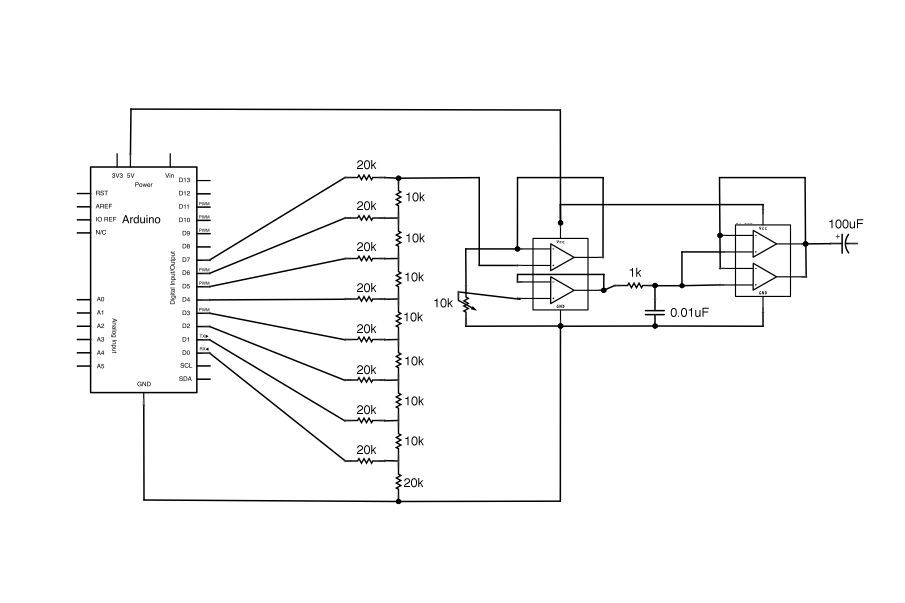
Arduino Vocal Effects Box
This Arduino-powered vocal effects box pitch shifts and distorts incoming audio signals to produce a wide variety of vocal effects. This project is an experiment with real-time digital signal processing using Arduino. It samples an incoming microphone signal at a...
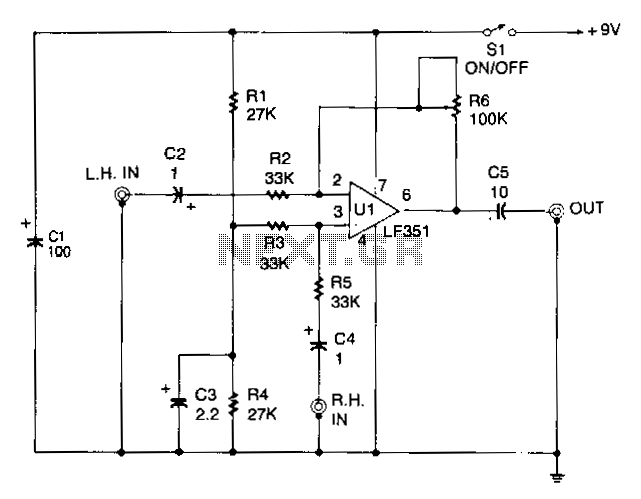
Central-image-canceller
The circuit is designed to eliminate the vocal portion of an audio signal while preserving the instrumental portion. It achieves this by mixing two channels that are 180° out of phase, allowing the signals that create the center-stereo image to...
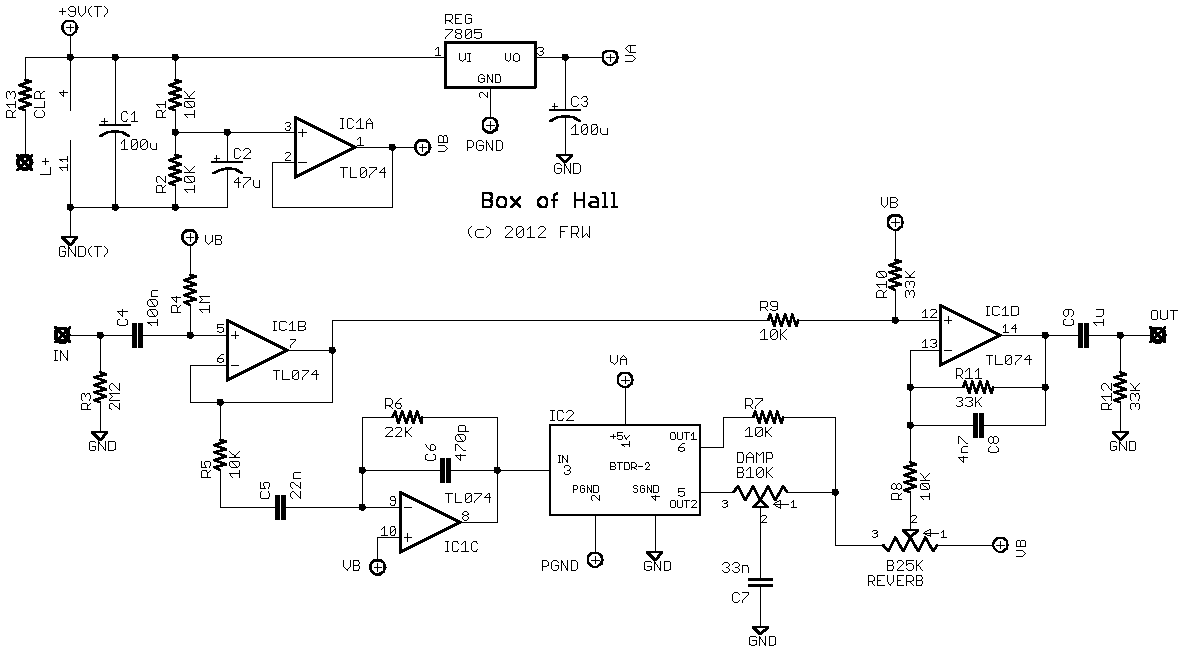
prototype reverb pedal using the accutronicsbelton btdr 2h module
This text provides information about an initial attempt at creating a circuit, referencing a schematic found in an application note for a specific module. However, it notes that the schematic did not include details for the power supply circuitry, and...
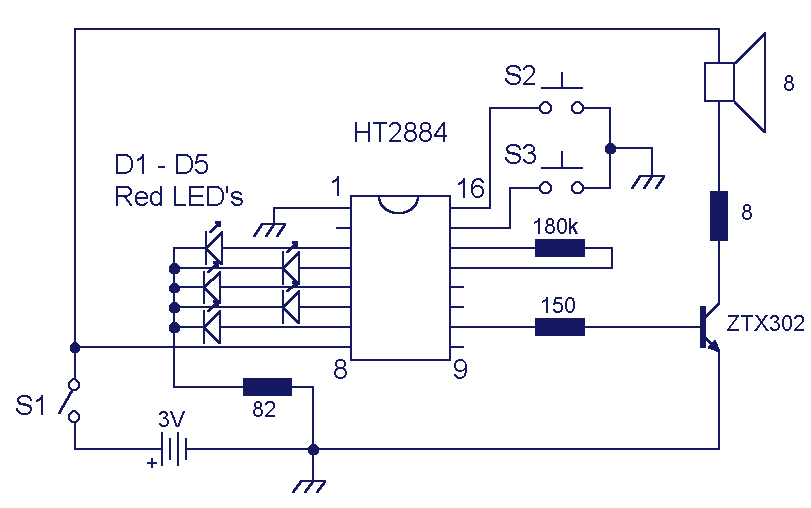
Sound Effects Generator 2
This circuit uses the Holtek HT2884 IC to produce 8 different sound effects. All sound effects are generated internally by the HT2884 IC. Power is a 3 Volt battery, but the IC will work with any voltage between 2.5 and...
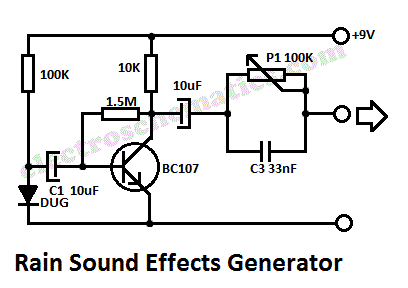
Rain Sound Effects Generator
This rain sound effects generator circuit simulates the sound of rain and can be utilized in electronic music and radio shows. The noise source employs a germanium diode that is directly polarized and subsequently amplified by a single-stage amplifier to...