


Audio Reproduction on HCS12 Microcontrollers with Pulse-Width Modulation (PWM) Capability
#HCS12
#microcontroller
#PWM
#audio reproduction
#digital-to-analogue conversion
#DAC
#audio signal
#embedded systems
#signal processing
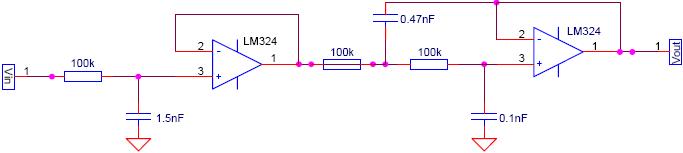
Description: The HCS12 series of microcontrollers does not include dedicated internal digital-to-analog conversion hardware. Therefore, external hardware, such as a digital-to-analog conversion integrated circuit (IC), is required.
To implement digital-to-analog conversion (DAC) in systems utilizing the HCS12 microcontroller, an external DAC IC must be integrated into the circuit. The choice of DAC IC will depend on several factors, including the required resolution, output voltage range, and communication interface.
For example, a commonly used DAC is the MCP4725, which is a 12-bit DAC that communicates via the I2C protocol. It allows for easy interfacing with the HCS12 microcontroller, enabling the microcontroller to send digital signals to the DAC, which then converts these signals into corresponding analog voltages.
The typical connection scheme involves connecting the I2C data (SDA) and clock (SCL) lines from the HCS12 to the corresponding pins on the MCP4725. Additionally, the power supply pins of the DAC must be connected to the appropriate voltage levels, typically 3.3V or 5V, depending on the specifications of both the microcontroller and the DAC.
Furthermore, a bypass capacitor may be placed close to the power pins of the DAC to filter out any noise and ensure stable operation. The output of the DAC can be connected to an analog load, such as an audio amplifier or a control circuit, depending on the application requirements.
In summary, while the HCS12 microcontroller lacks built-in DAC capabilities, it can effectively utilize external DAC ICs to achieve desired analog output functionality, thereby enhancing its versatility in various electronic applications.The HCS12 series of microcontrollers does not support dedicated internal digital-to-analogue conversion hardware, and thus external hardware, perhaps in the form of a digital-to-analogue conversion IC.
To implement digital-to-analog conversion (DAC) in systems utilizing the HCS12 microcontroller, an external DAC IC must be integrated into the circuit. The choice of DAC IC will depend on several factors, including the required resolution, output voltage range, and communication interface.
For example, a commonly used DAC is the MCP4725, which is a 12-bit DAC that communicates via the I2C protocol. It allows for easy interfacing with the HCS12 microcontroller, enabling the microcontroller to send digital signals to the DAC, which then converts these signals into corresponding analog voltages.
The typical connection scheme involves connecting the I2C data (SDA) and clock (SCL) lines from the HCS12 to the corresponding pins on the MCP4725. Additionally, the power supply pins of the DAC must be connected to the appropriate voltage levels, typically 3.3V or 5V, depending on the specifications of both the microcontroller and the DAC.
Furthermore, a bypass capacitor may be placed close to the power pins of the DAC to filter out any noise and ensure stable operation. The output of the DAC can be connected to an analog load, such as an audio amplifier or a control circuit, depending on the application requirements.
In summary, while the HCS12 microcontroller lacks built-in DAC capabilities, it can effectively utilize external DAC ICs to achieve desired analog output functionality, thereby enhancing its versatility in various electronic applications.The HCS12 series of microcontrollers does not support dedicated internal digital-to-analogue conversion hardware, and thus external hardware, perhaps in the form of a digital-to-analogue conversion IC.
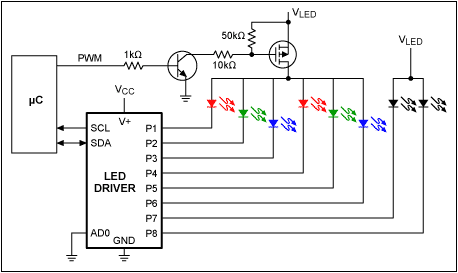
How to Apply Additional PWM Intensity Control to LED Drivers
Various techniques demonstrate how enhanced PWM (pulse-width modulation) intensity control can be utilized in LED (light-emitting diode) drivers.
PWM intensity control is a widely adopted method in LED driver circuits to regulate brightness levels. This technique involves modulating the width of...
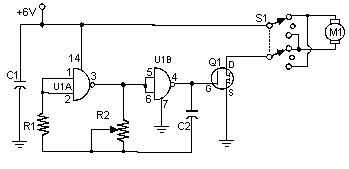
Pulse Width Modulation DC Motor Control
Often, people attempt to control DC motors with a variable resistor or variable resistor connected to a transistor. While the latter approach works well, it generates heat and hence wastes power. This simple pulse width modulation DC motor control eliminates...
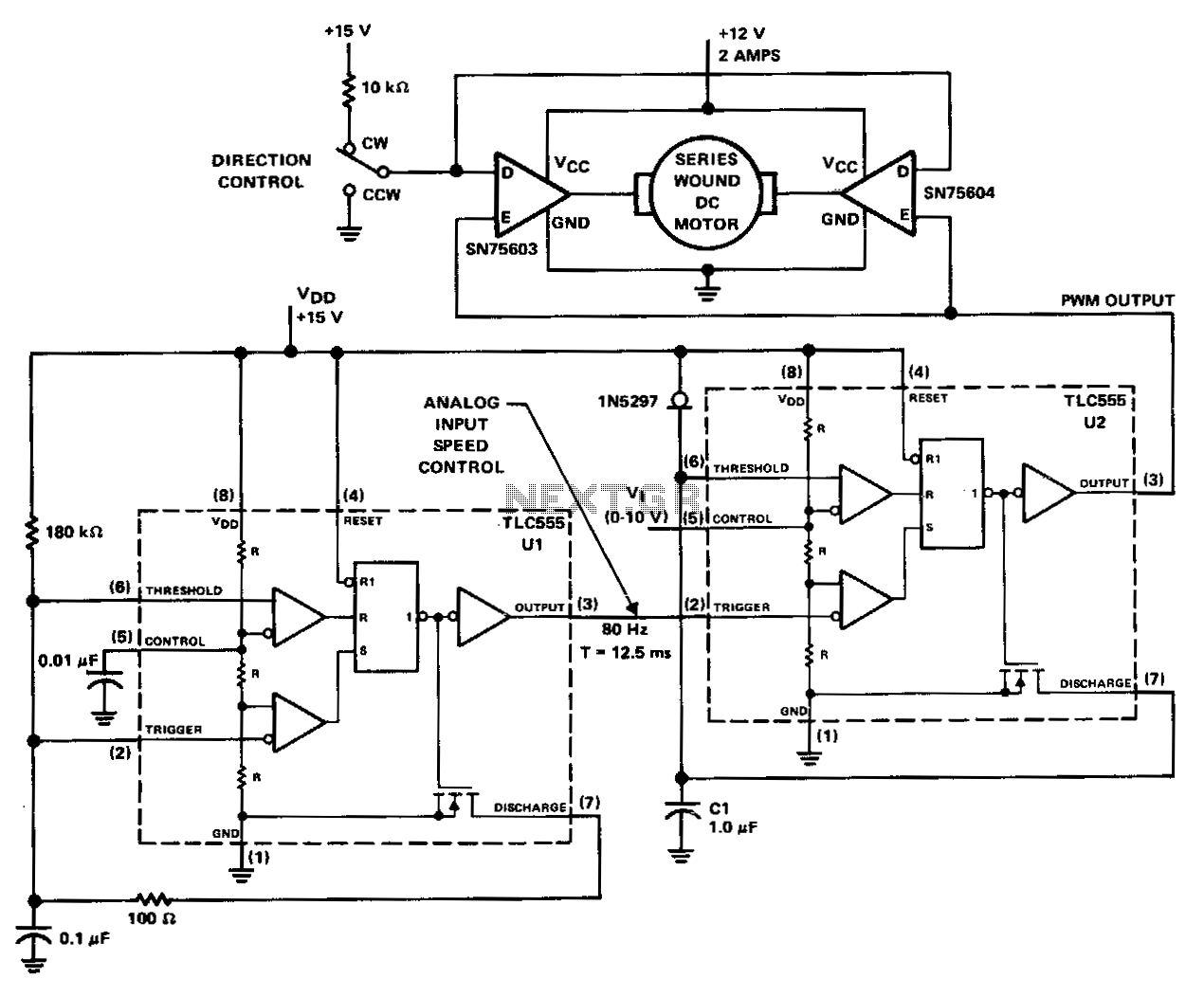
Pwm-motor-controller
The PWM controller utilizes complementary half-H peripheral drivers SN75603 and SN75604, featuring totem-pole outputs rated at 40 V and 2.0 A. These drivers effectively configure the motor in a full-bridge setup, enabling bidirectional control. Timer U1 operates in astable mode...
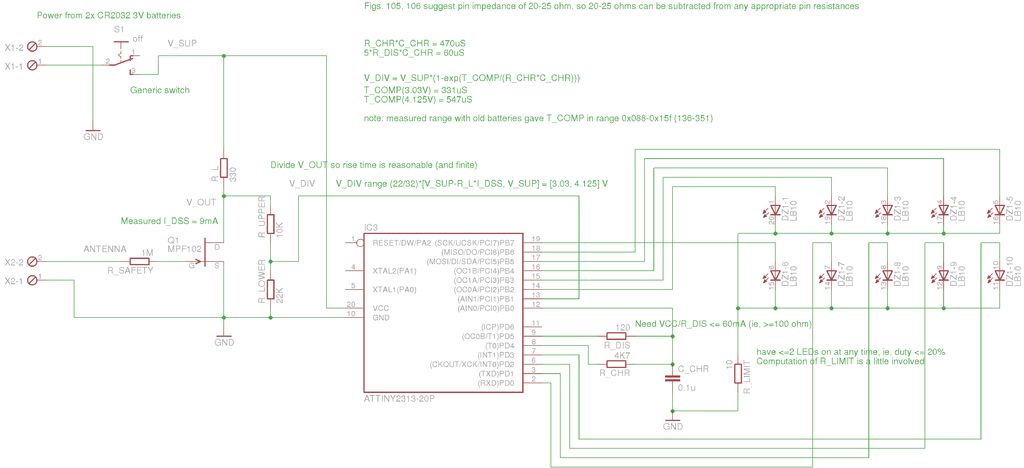
Microcontroller interface electrometer
A method for measuring static electricity for a science project was sought. An old copy of "Getting Started in Electronics" by Forrest M. Mims III was referenced for guidance.
To create a static electricity measurement circuit, a simple design can be...
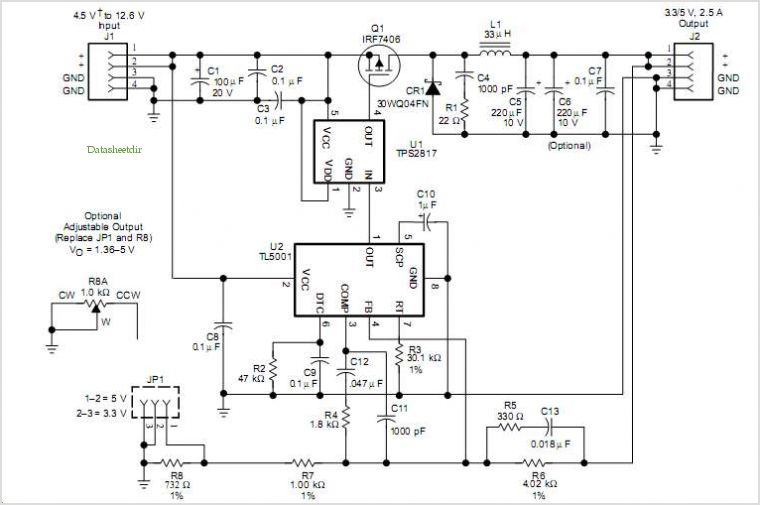
Tl5001 Pulse-width-modulation (pwm) Controller Coupled With A Tps2817 Mosfet Driver
The TLE6282G is an H-Bridge and Half Bridge Driver IC designed for high-current DC brush motor applications in PWM control mode. It is suitable for use in injector and valve applications across 12V, 24V, and 42V power networks. This IC...
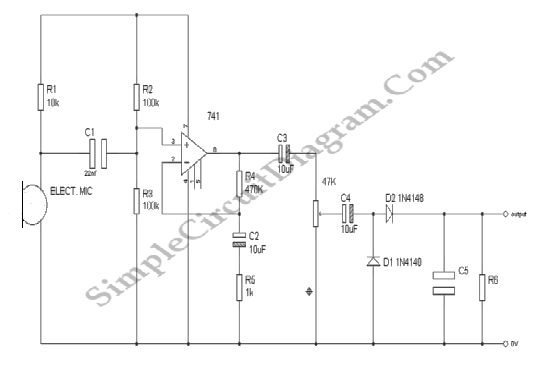
Audio Signal Strength Detector/Converter
Below is the schematic diagram of an audio input module. This module is capable of producing a DC output voltage that is proportional to the amplitude of the input signal.
The audio input module typically consists of several key components that...
250 to 5000 watts PWM DC/AC 220V Power Inverter
The schematic circuit design is for a 250-watt output inverter. To increase the power of the circuit, additional Q7 and Q8 transistors can be added in parallel; each pair contributes an additional 250 watts. For instance, to achieve 750 watts,...
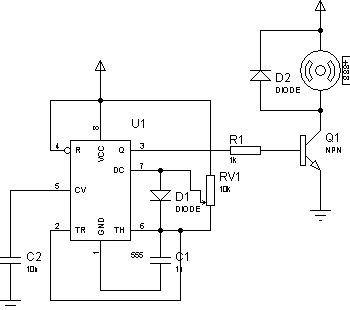
Control motor PWM schematic
There are two primary methods to control the speed of a DC motor: by varying the supply voltage and through pulse width modulation (PWM). The first method is less convenient, particularly in digital systems, as it necessitates the use of...
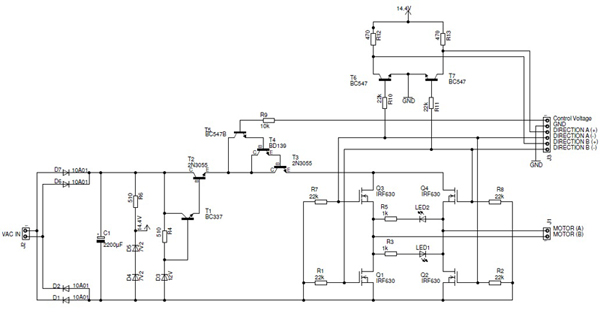
hp dac circuit
The K8000 DAC High Power Amplifier is an electronic amplifier with an adjustable output voltage ranging from 0 to 9 V and capable of delivering an output current of up to 9 Amperes.
The K8000 DAC High Power Amplifier is designed...