


Electronic devices yell LM386 PT-8830
#LM386
#audio amplifier
#power supply
#voice recording
#IC
#sound circuit
#amplification
#electronic circuit
#audio signal
#low voltage
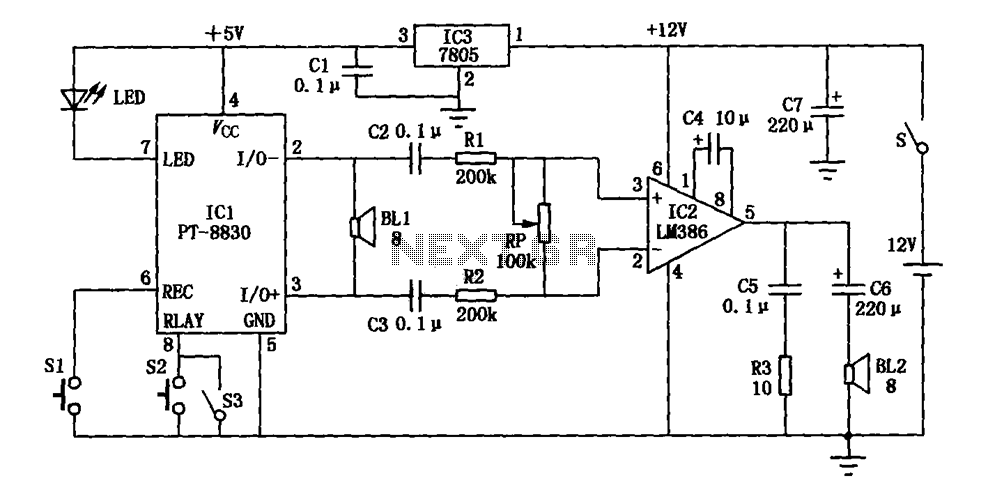
Description: The electronic circuit illustrated in the figure consists of three main components: a voice recording module, an audio power amplifier, and a power supply circuit. The first component, IC1, is a voice recording integrated circuit (IC) of type PT-8815/20/30, capable of recording and playing back audio for up to 30 seconds. The second component, IC2, is an integrated power amplifier, specifically the LM386, which amplifies the voice signal from IC1 to drive a speaker, ensuring sufficient power output and volume. The third component, IC3, is a 7805 type fixed three-terminal voltage regulator, which provides a stable 5V output to power the circuit.
The electronic circuit is designed to facilitate a straightforward voice recording and playback system, making it suitable for applications such as greeting cards, toys, or any device requiring brief audio messages. The PT-8815/20/30 series of voice recording ICs is known for its ease of use, allowing for simple integration into various projects. It operates by recording audio signals through a microphone input and storing them in its internal memory for playback.
The LM386 power amplifier is a low-voltage audio amplifier that can deliver up to 1 watt of output power, making it ideal for driving small speakers. Its low quiescent current and minimal external components required for operation enhance its applicability in battery-operated devices. The output from the PT-8815/20/30 is routed to the LM386, which boosts the audio signal to a level suitable for audible playback through the connected speaker.
The power supply circuit, using the 7805 voltage regulator, ensures that the entire circuit operates reliably at a constant 5V. This regulator is capable of providing a maximum output current of 1A, sufficient for the requirements of the voice recording IC and the power amplifier. It is important to include appropriate filtering capacitors at the input and output of the 7805 to stabilize the voltage and minimize noise, which could affect the audio quality.
Overall, this electronic circuit design effectively combines voice recording, amplification, and power regulation in a compact and efficient manner, making it an excellent choice for various consumer electronics applications.Electronic circuit shown in Figure crying, which consists of voice recording, audio power amplifier and power supply circuit composed of three parts. Wherein ICl to fool type o f voice recording IC PT-8815/20/30, it can be 30 seconds voice recording and playback; IC2 for the integrated power amplifier LM386, ICl output for amplifying a voice signal to the speaker to get enough power and loud voice; IC3 use 7805 type fixed three-terminal integrated voltage regulator.
The electronic circuit is designed to facilitate a straightforward voice recording and playback system, making it suitable for applications such as greeting cards, toys, or any device requiring brief audio messages. The PT-8815/20/30 series of voice recording ICs is known for its ease of use, allowing for simple integration into various projects. It operates by recording audio signals through a microphone input and storing them in its internal memory for playback.
The LM386 power amplifier is a low-voltage audio amplifier that can deliver up to 1 watt of output power, making it ideal for driving small speakers. Its low quiescent current and minimal external components required for operation enhance its applicability in battery-operated devices. The output from the PT-8815/20/30 is routed to the LM386, which boosts the audio signal to a level suitable for audible playback through the connected speaker.
The power supply circuit, using the 7805 voltage regulator, ensures that the entire circuit operates reliably at a constant 5V. This regulator is capable of providing a maximum output current of 1A, sufficient for the requirements of the voice recording IC and the power amplifier. It is important to include appropriate filtering capacitors at the input and output of the 7805 to stabilize the voltage and minimize noise, which could affect the audio quality.
Overall, this electronic circuit design effectively combines voice recording, amplification, and power regulation in a compact and efficient manner, making it an excellent choice for various consumer electronics applications.Electronic circuit shown in Figure crying, which consists of voice recording, audio power amplifier and power supply circuit composed of three parts. Wherein ICl to fool type o f voice recording IC PT-8815/20/30, it can be 30 seconds voice recording and playback; IC2 for the integrated power amplifier LM386, ICl output for amplifying a voice signal to the speaker to get enough power and loud voice; IC3 use 7805 type fixed three-terminal integrated voltage regulator.
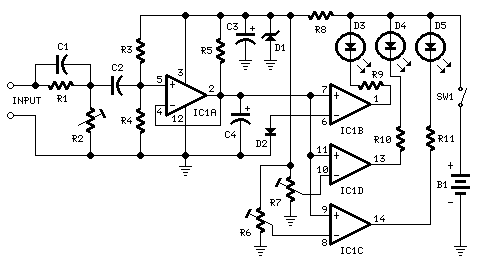
three level audio power indicator
This circuit is designed to indicate the power output level of any audio amplifier. It is simple, portable, and displays three power levels that can be adjusted to any desired value.
The circuit operates by measuring the output voltage from the...
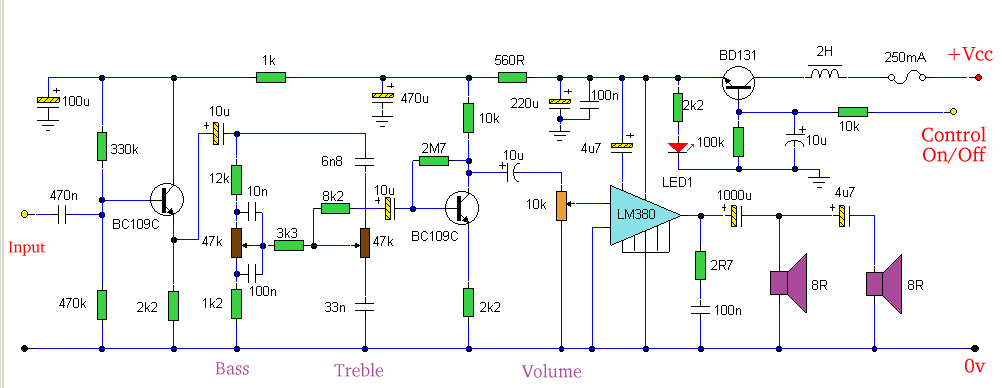
Amp with Tone Controls & Soft Switching
Amplifier with tone controls and soft switching. Notes: The soft switching is enabled by a BD131 transistor configured as a switch in an emitter follower arrangement. The collector is connected to a permanent load.
The described amplifier circuit incorporates tone controls...
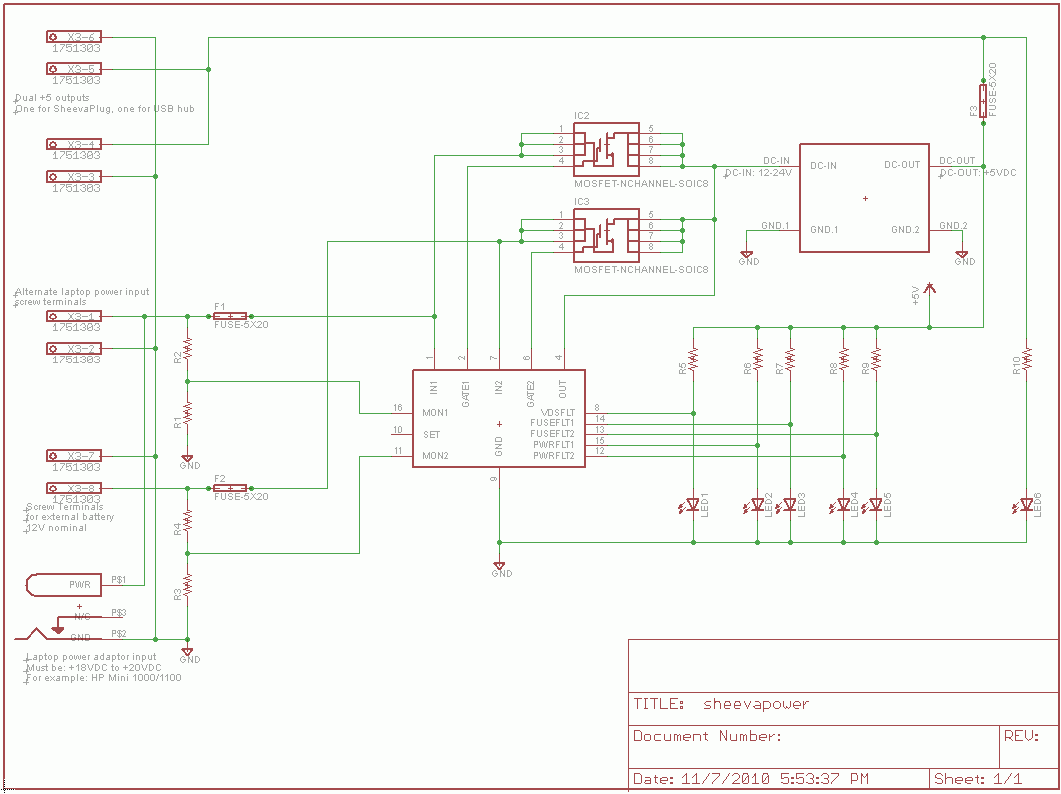
power supply circuit
The SheevaPlug is known to have a suboptimal power supply, particularly affecting users in the UK operating at 240VAC. Additionally, heavy loads on the USB can cause issues, especially when connecting an external mechanical disk drive. This project aims to...
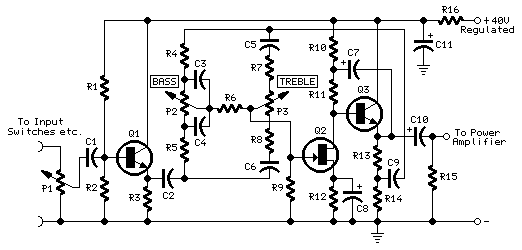
Mini-MosFet Audio Amplifier
R1 2.2K 1/4W Resistor, R2 27K 1/4W Resistor, R3, R4 2.2K 1/2W Trimmers (Cermet or Carbon), R5 100R 1/4W Resistor, R6 1K 1/4W Resistor, R7, R8 330R 1/4W Resistors, C1 22 µF 25V Electrolytic Capacitor, C2 47pF 63V Polystyrene or...
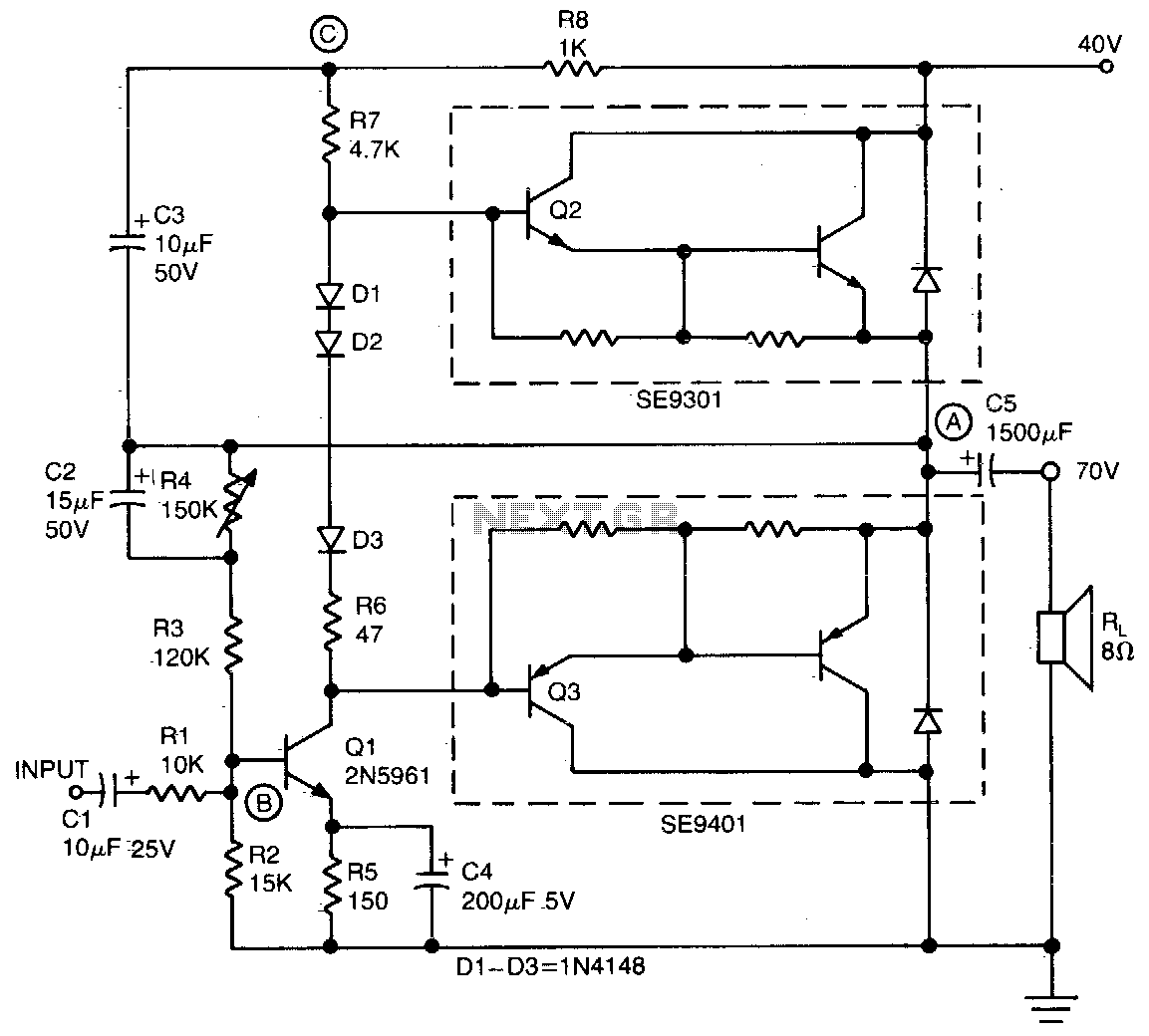
Low cost 20 w audio amplifier
This simple and inexpensive audio amplifier can be constructed using a couple of TO-220 monolithic Darlington transistors for the push-pull output stage. The frequency response is flat within 1 dB from 30 Hz to 200 kHz, with typical harmonic distortion...
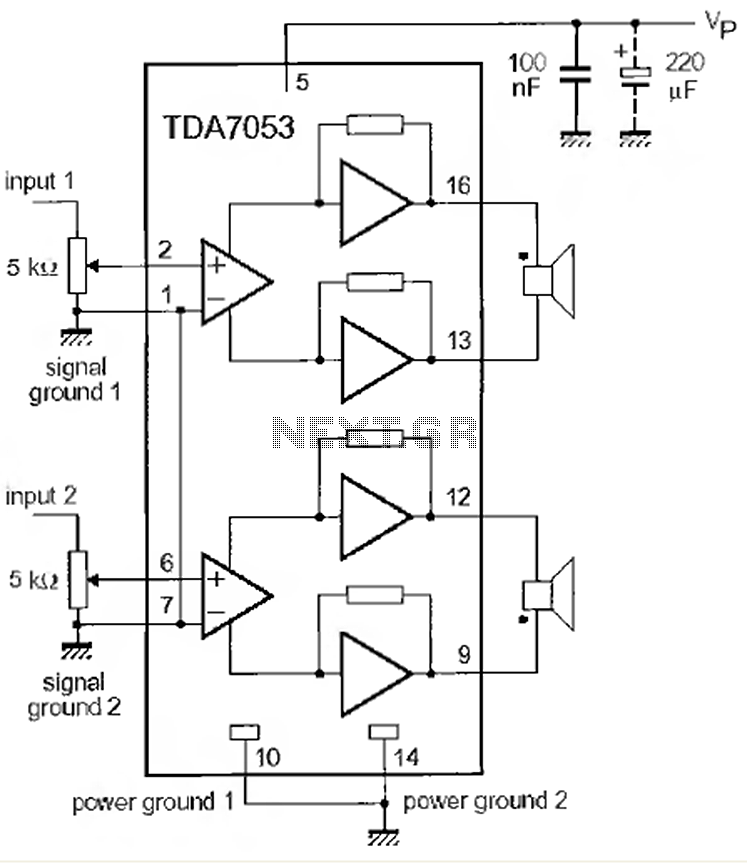
TDA 7053 Stereo Audio Amplifier Circuit
This is a 1-watt stereo audio amplifier circuit utilizing the TDA 7053 integrated circuit from Philips. It is specifically designed for battery operation, delivering 1 watt per channel from a 6V DC supply. The circuit operates optimally between 6V and...
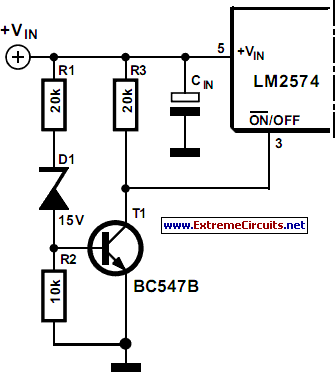
Soft Start For Switching Power Supply
A switching power supply that has an output voltage significantly lower than its input voltage exhibits a unique characteristic: the current drawn from the supply is less than the output current. However, the input power (UI) is, naturally, greater than...
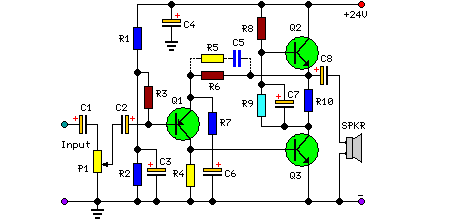
5 Watt Class-A Audio Amplifier Circuit diagram
This solid-state push-pull single-ended Class A circuit is designed to deliver sound quality comparable to valve amplifiers, providing an output power of 6.9W measured across an 8 Ohm loudspeaker cabinet load. It features reduced total harmonic distortion (THD), increased input...
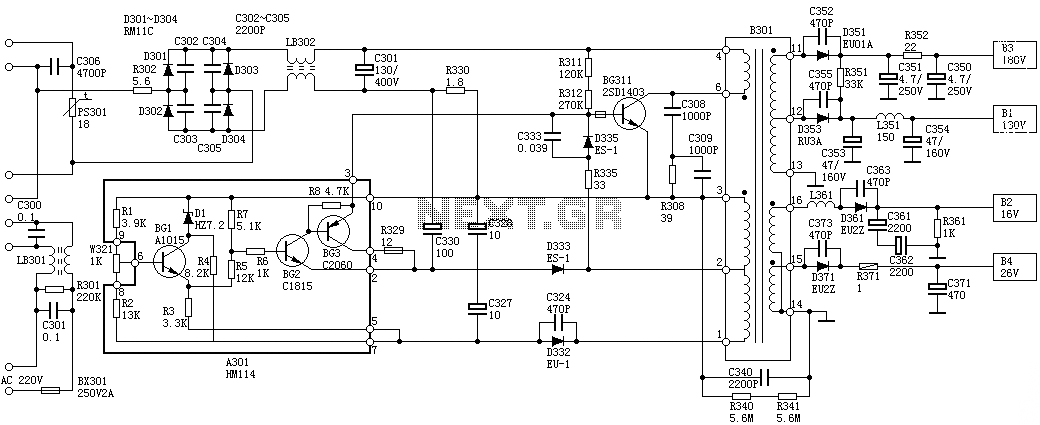
Sanyo 83P switching power supply circuit diagram
Oscillation: The positive terminal voltage of C310 is approximately 300V. The resistors R311 and R312 are connected to the switch BG311 at the B pole, while the B301 winding via the switching transformer (4) and (6) is connected to the...