


Electronics as a Hobby
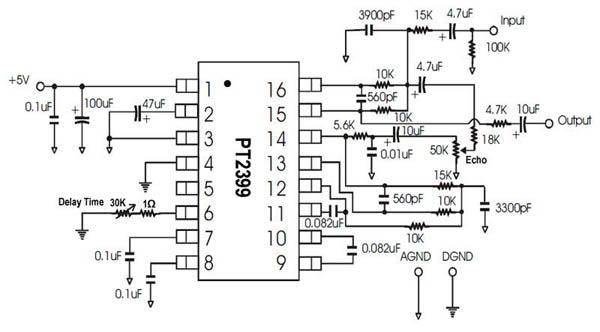
Description: A single-chip circuit for echo and delay. If a microphone mixer circuit can be modified, this circuit can be easily used with a microphone. The PT2399 is an echo audio processor integrated circuit (IC) that utilizes CMOS technology and is equipped with an analog-to-digital converter (ADC) and a digital-to-analog converter (DAC). It has a high sampling frequency and an internal memory of 44K. Digital processing is employed to generate the delay time, and it also features an internal voltage-controlled oscillator (VCO) circuit in the system clock, allowing for easy frequency adjustment. It exhibits very low distortion (total harmonic distortion < 0.5%) and very low noise (noise level < -90 dBV).
The PT2399 IC is a versatile component widely used in audio applications for creating echo and delay effects. The architecture of the PT2399 includes a signal input stage that captures audio signals from a microphone or other audio sources. The ADC converts the analog signal into a digital format, which is then processed using digital signal processing techniques to introduce the desired delay effect. The internal memory of 44K allows for significant delay times, making it suitable for various audio applications.
The output of the processing stage is then converted back to an analog signal using the DAC, ensuring that the processed audio maintains high fidelity. The VCO within the IC provides the capability to adjust the frequency of the echo effect, allowing users to customize the sound to their preference. The low distortion and noise specifications make the PT2399 an ideal choice for professional audio applications, as it ensures that the integrity of the original audio signal is preserved while adding the desired effects.
To implement this circuit, a basic microphone mixer can be modified to integrate the PT2399. The circuit would typically include power supply connections, input and output jacks for audio signals, and potentiometers to adjust parameters such as delay time and feedback levels. The schematic would illustrate the connections between the microphone input, the PT2399 IC, and the output stage, providing a clear representation of how the components interact to create echo and delay effects.
Overall, the PT2399 is a highly effective solution for those looking to explore audio effects in both hobbyist and professional settings, allowing for creative manipulation of sound through echo and delay processing.A single chip circuit for Echo & Delay. If you can modify a mic mixer circuit, you can easyly use this circuit with your microphone. PT2399 is an echo audio processor IC utilizing CMOS Technology which is equipped with ADC and DAC, high sampling frequency and an internal memory of 44K Digital processing is used to generate the delay time, it also features an internal VCO circuit in the system clock, thereby, making the frequency easily adjustable. Very low distortion (THD<0. 5%) and very low noise (No<-90dBV). Thanks. That apparently comes from the IC data sheet at. There is a more complete data sheet available from, but the diagram for the echo application is not quite as easy to read. purob, I`m also interested in audio electronics. My sole interest so far has been analog sound synthesizers like Theremin or those made by Moog. It hasn`t become a fully qualified hobby yet. I`m still playing with a curcuit simulation program and haven`t really soldered anything. I`d really want to start practising with hardware. I like analog electronics. I enjoy thinking about it. However, my job is concerned with software that is very far from either sound or analog computations!
I like playing with equipment. Both audio and video. Since I run a video post outfit I have lots of things lying around. Some which are useless I dismantle and learn from. And though dont have much knowledge can figure out whats wrong and repair loose connections etc. Its a combo of hobby and some professional income. From the year 2000 I started to work with various electronics projects like radio transmitters, audio amplifiers, sound processing kits, digital logic circuits, microprocessor based device, etc. But that time I had very poor knowledge about it. After I increased my knowledge it became a serious hobby to me. I like songs very much and like to sing. When I entered to voice conference at any chat, I tried to use a voice effect with my microphone to surprise my friends.
I simply use an ECHO and Delay attaching device.
The PT2399 IC is a versatile component widely used in audio applications for creating echo and delay effects. The architecture of the PT2399 includes a signal input stage that captures audio signals from a microphone or other audio sources. The ADC converts the analog signal into a digital format, which is then processed using digital signal processing techniques to introduce the desired delay effect. The internal memory of 44K allows for significant delay times, making it suitable for various audio applications.
The output of the processing stage is then converted back to an analog signal using the DAC, ensuring that the processed audio maintains high fidelity. The VCO within the IC provides the capability to adjust the frequency of the echo effect, allowing users to customize the sound to their preference. The low distortion and noise specifications make the PT2399 an ideal choice for professional audio applications, as it ensures that the integrity of the original audio signal is preserved while adding the desired effects.
To implement this circuit, a basic microphone mixer can be modified to integrate the PT2399. The circuit would typically include power supply connections, input and output jacks for audio signals, and potentiometers to adjust parameters such as delay time and feedback levels. The schematic would illustrate the connections between the microphone input, the PT2399 IC, and the output stage, providing a clear representation of how the components interact to create echo and delay effects.
Overall, the PT2399 is a highly effective solution for those looking to explore audio effects in both hobbyist and professional settings, allowing for creative manipulation of sound through echo and delay processing.A single chip circuit for Echo & Delay. If you can modify a mic mixer circuit, you can easyly use this circuit with your microphone. PT2399 is an echo audio processor IC utilizing CMOS Technology which is equipped with ADC and DAC, high sampling frequency and an internal memory of 44K Digital processing is used to generate the delay time, it also features an internal VCO circuit in the system clock, thereby, making the frequency easily adjustable. Very low distortion (THD<0. 5%) and very low noise (No<-90dBV). Thanks. That apparently comes from the IC data sheet at. There is a more complete data sheet available from, but the diagram for the echo application is not quite as easy to read. purob, I`m also interested in audio electronics. My sole interest so far has been analog sound synthesizers like Theremin or those made by Moog. It hasn`t become a fully qualified hobby yet. I`m still playing with a curcuit simulation program and haven`t really soldered anything. I`d really want to start practising with hardware. I like analog electronics. I enjoy thinking about it. However, my job is concerned with software that is very far from either sound or analog computations!
I like playing with equipment. Both audio and video. Since I run a video post outfit I have lots of things lying around. Some which are useless I dismantle and learn from. And though dont have much knowledge can figure out whats wrong and repair loose connections etc. Its a combo of hobby and some professional income. From the year 2000 I started to work with various electronics projects like radio transmitters, audio amplifiers, sound processing kits, digital logic circuits, microprocessor based device, etc. But that time I had very poor knowledge about it. After I increased my knowledge it became a serious hobby to me. I like songs very much and like to sing. When I entered to voice conference at any chat, I tried to use a voice effect with my microphone to surprise my friends.
I simply use an ECHO and Delay attaching device.
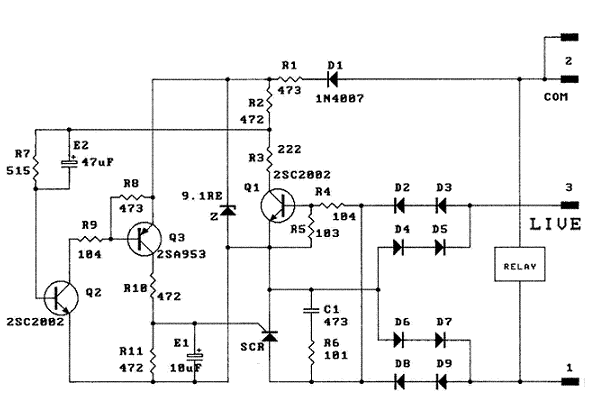
Delay Timer
Once the mains power supply is interrupted, the relay will only activate after a delay of 150 to 210 seconds, depending on the tolerance of the RC circuit.
The described circuit operates as a time delay relay system, which is crucial...
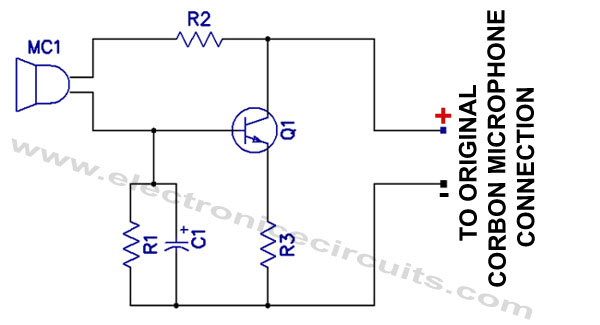
Carbon Mic Replacement To Magnetic Mike Converter Circuit
Effective pitching surpasses effective hitting, and a high-quality magnetic microphone outperforms a carbon microphone. This circuit utilizes a single transistor to convert a carbon microphone input into a magnetic microphone output. It is important to note that no ground connection...
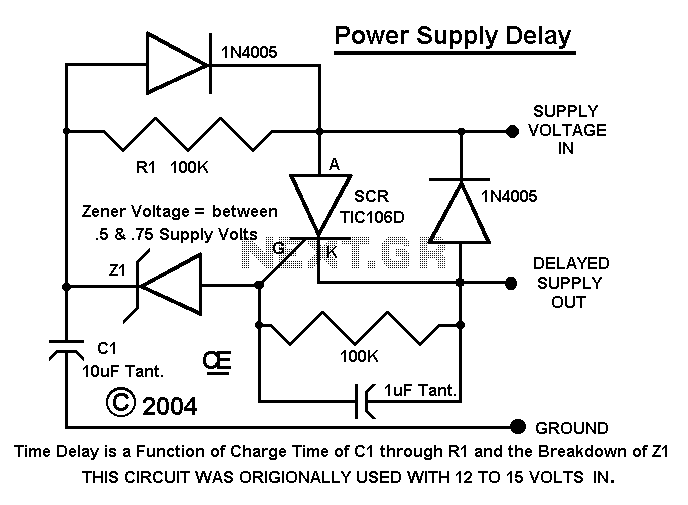
Delayed Power supply schematic
I had designed up an oscillator with a Power Output circuit. Problem was when power was applied to the entire circuit, the output of the Oscillator gave a Momentary Spike into the output circuit. Thus Driving it full on for...
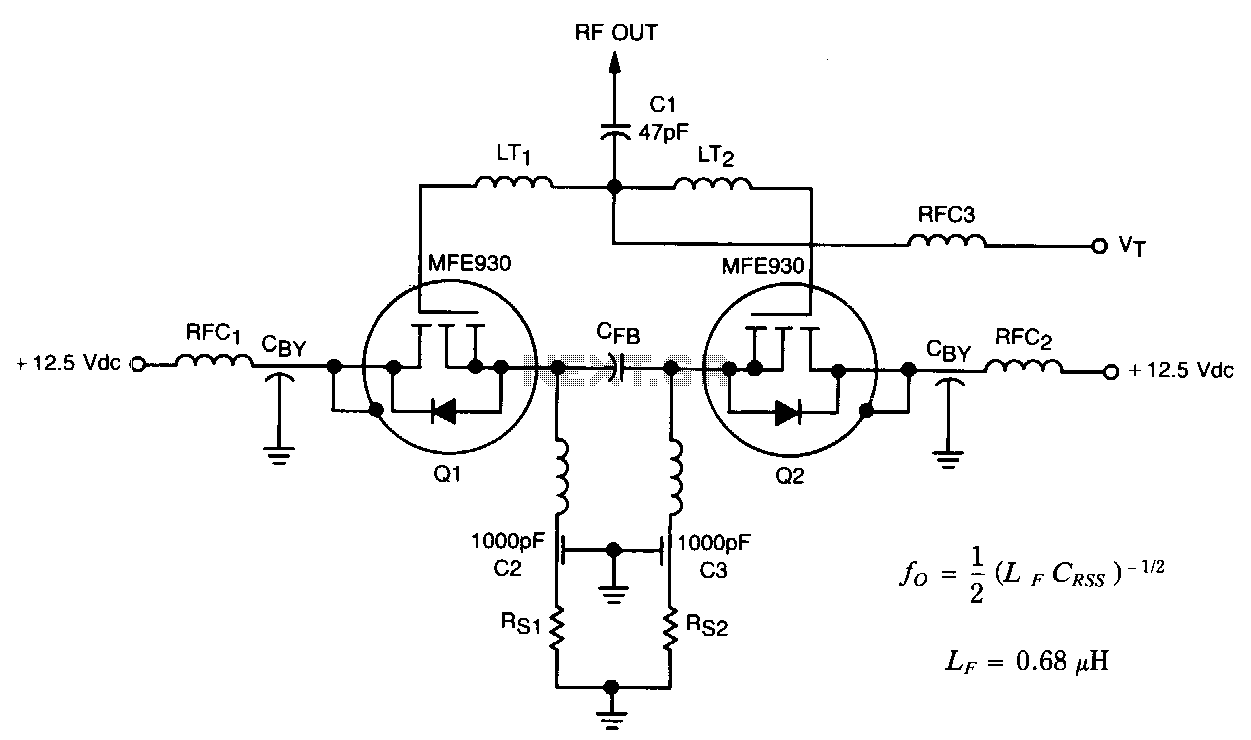
Balanced-tmos-vco
This TMOS voltage-controlled oscillator (VCO) operates in a push-pull configuration to produce 4 Watts at 70 MHz. It consists of two MFE930 TMOS devices arranged in a balanced VCO configuration, which generally provides better linearity compared to single-ended designs. Varactors...
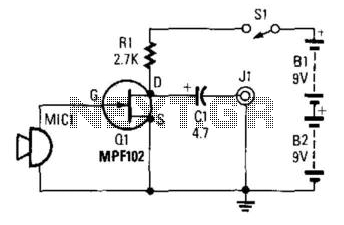
Simple Microphone Preamp
This preamplifier utilizes a small dynamic microphone connected to the gate of Q1. R1 acts as a load resistor. The audio output is taken from the negative side of C1 to ground. The output voltage will range between 10 and...
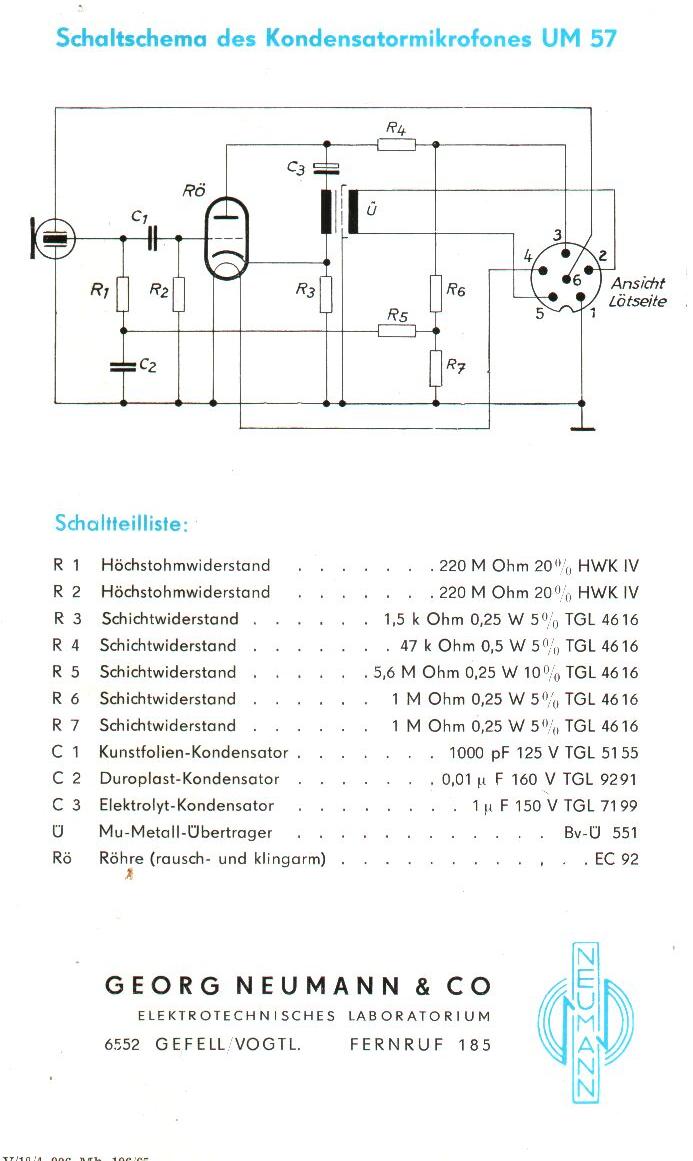
microphone Neumann UM 57
The Neumann/Gefell UM 57 is a large-diaphragm tube condenser microphone produced by the Neumann company in Gefell, Germany, now known as Microtech-Gefell. This microphone features the renowned M7 capsule from Gefell, which is a dual-diaphragm, center-terminated design with a PVC...
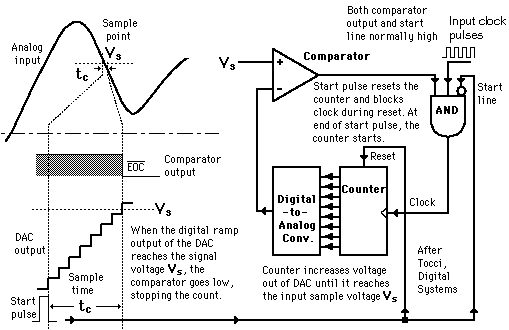
adc interfacing
Analog to Digital Converter (ADC) interfacing with microcontrollers such as AVR, 8051, and PIC, including Digital-Ramp ADC, Successive Approximation ADC, Flash ADC, and basic working of an analog to digital converter.
Analog to Digital Converters (ADCs) are essential components in modern...
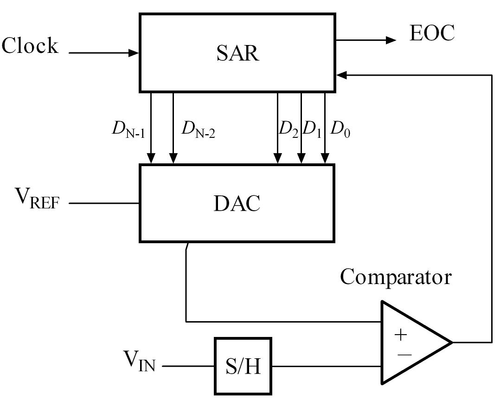
Successive Approximation ADC
An analog-to-digital converter is a device that converts a continuous quantity to a discrete time digital representation. An ADC may also provide an isolated measurement. An analog signal is any continuous signal where the time-varying feature represents another time-varying quantity....
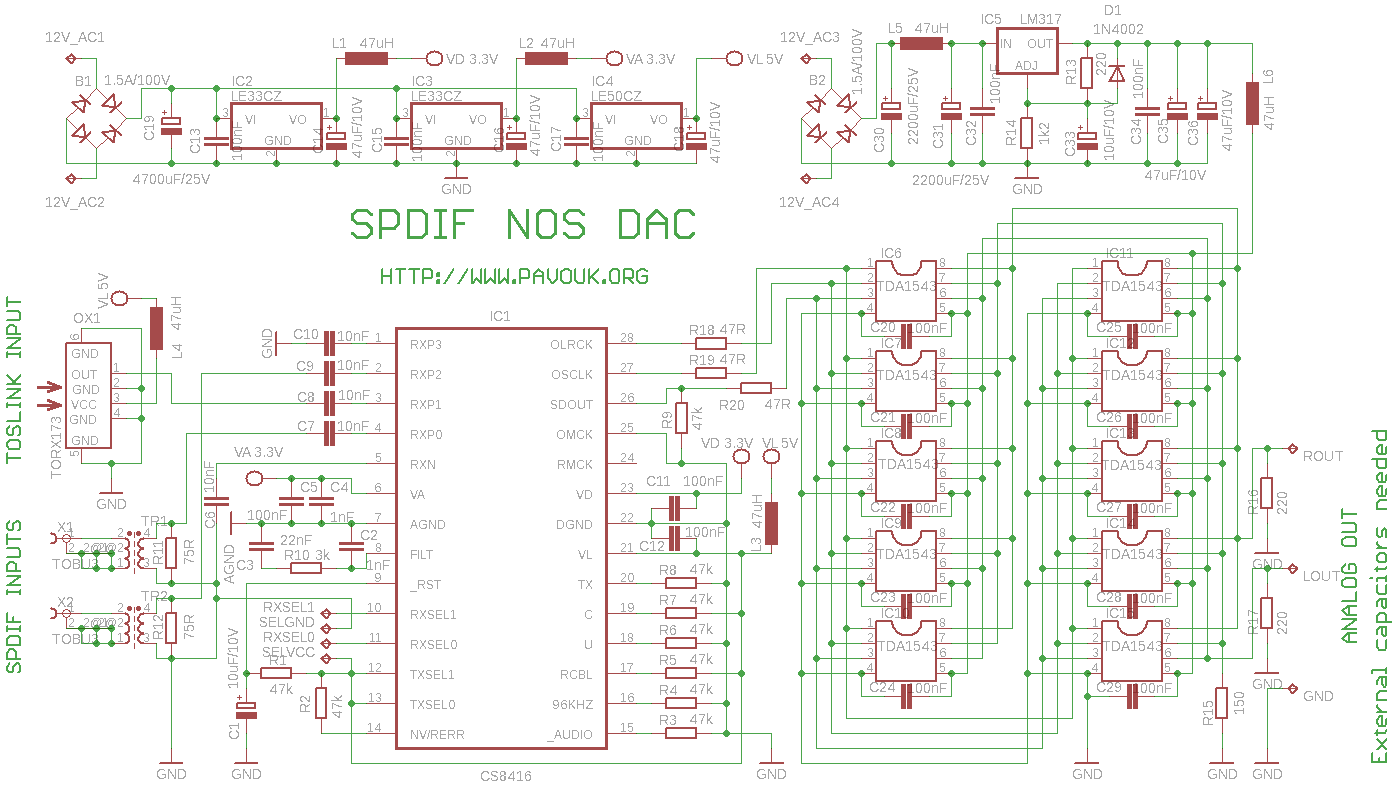
SPDIF audio DAC with CS8416 and TDA1543
This circuit is an experiment designed to build a high-quality digital-to-analog converter (DAC) with optical input (TOSLINK), electrical input (S/PDIF), and USB input. Both electrical inputs are galvanically isolated from the DAC. The circuit is intended as part of a...