


Fuzz-box
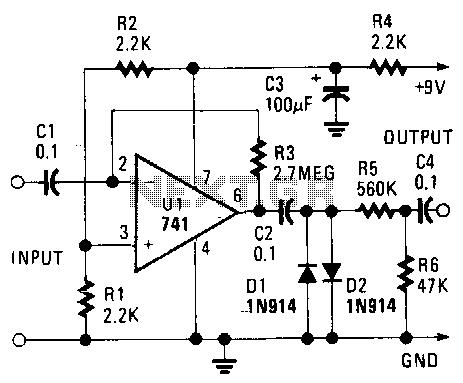
Description: The maximum gain of the 741 operational amplifier, which is typically 20,000, can be increased to nearly 3 million dB, resulting in output distortion. This distortion produces a fuzz sound. Additionally, the signal level is reduced by clipping through the use of two diodes.
The 741 operational amplifier is a widely used device in analog electronics, known for its versatility and ease of use. When configured for high gain applications, the 741 can achieve a maximum gain of approximately 20,000. However, in certain configurations, this gain can be manipulated to reach levels close to 3 million dB, leading to significant distortion in the output signal. This distortion is a key characteristic that can be exploited in audio applications to produce a "fuzz" effect, commonly desired in electric guitar circuits.
To achieve this fuzz sound, the circuit typically incorporates two diodes that are placed in a feedback loop or in parallel with the output. The role of these diodes is to clip the output waveform, effectively limiting the amplitude of the signal. When the signal exceeds a certain threshold, the diodes become forward-biased and conduct, thereby "clipping" the peaks of the waveform. This clipping action introduces harmonic distortion, which contributes to the rich, saturated sound associated with fuzz effects.
In practical applications, the arrangement of the 741 op-amp and the clipping diodes can be adjusted to tailor the characteristics of the fuzz sound. The choice of diode type, as well as their placement within the circuit, can influence the tonal quality and response of the effect. For example, silicon diodes may produce a sharper clipping effect compared to germanium diodes, which tend to yield a warmer sound.
Overall, the combination of the 741 operational amplifier's high gain and the intentional distortion introduced by diode clipping makes this configuration a popular choice for achieving unique audio effects in various electronic music applications.The 741"s maximum gain of 20,000 is pushed to nearly 3 million dB, and therefore distorts the output. That distortion provides the fuzz sound. The level is dropped by clipping the two diodes.
The 741 operational amplifier is a widely used device in analog electronics, known for its versatility and ease of use. When configured for high gain applications, the 741 can achieve a maximum gain of approximately 20,000. However, in certain configurations, this gain can be manipulated to reach levels close to 3 million dB, leading to significant distortion in the output signal. This distortion is a key characteristic that can be exploited in audio applications to produce a "fuzz" effect, commonly desired in electric guitar circuits.
To achieve this fuzz sound, the circuit typically incorporates two diodes that are placed in a feedback loop or in parallel with the output. The role of these diodes is to clip the output waveform, effectively limiting the amplitude of the signal. When the signal exceeds a certain threshold, the diodes become forward-biased and conduct, thereby "clipping" the peaks of the waveform. This clipping action introduces harmonic distortion, which contributes to the rich, saturated sound associated with fuzz effects.
In practical applications, the arrangement of the 741 op-amp and the clipping diodes can be adjusted to tailor the characteristics of the fuzz sound. The choice of diode type, as well as their placement within the circuit, can influence the tonal quality and response of the effect. For example, silicon diodes may produce a sharper clipping effect compared to germanium diodes, which tend to yield a warmer sound.
Overall, the combination of the 741 operational amplifier's high gain and the intentional distortion introduced by diode clipping makes this configuration a popular choice for achieving unique audio effects in various electronic music applications.The 741"s maximum gain of 20,000 is pushed to nearly 3 million dB, and therefore distorts the output. That distortion provides the fuzz sound. The level is dropped by clipping the two diodes.
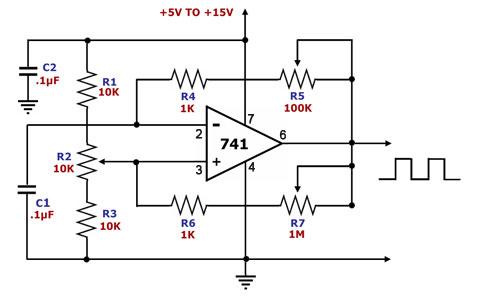
op amp square wave generator
This is a square wave generator circuit. The primary component of this circuit is the 741, a general-purpose operational amplifier. The circuit operates with a single power supply voltage (Vs) that can vary between +5V and +15V. The square wave...
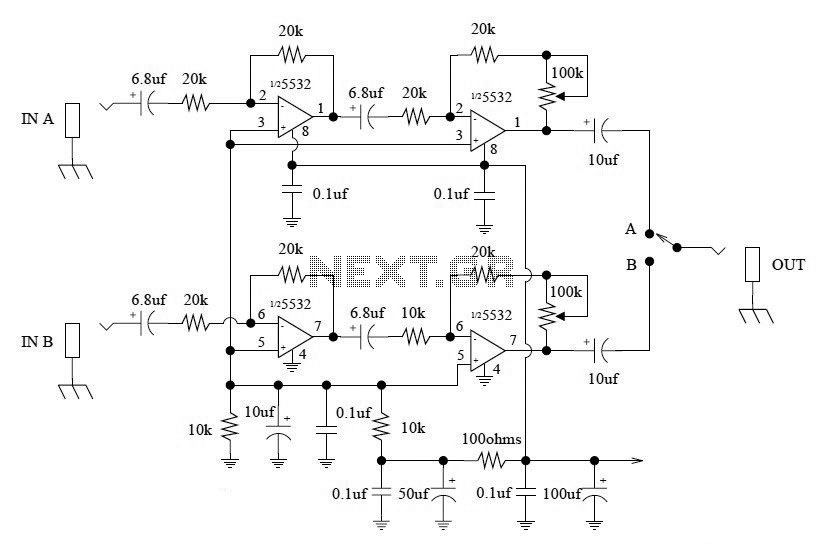
A/B Box Guitar Effect Schematic
This A/B Box pedal schematic for electric guitar was designed by Rick Barker. The A/B Box effect was originally intended for switching between different harmonica microphones. It features a low-noise dual preamp for improved performance.
The A/B Box schematic serves as...
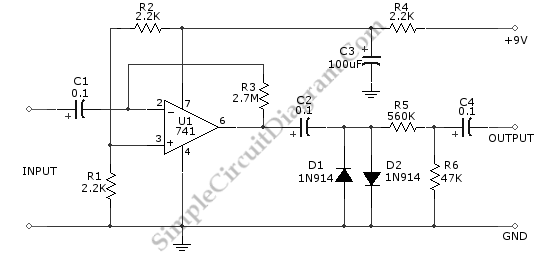
Fuzz Box Distortion Pedal Guitar Effect
This guitar effect circuit employs a straightforward high-gain amplification stage, succeeded by symmetric clipping achieved through a parallel diode clipper. The gain is provided by a 741 operational amplifier.
The circuit design begins with a high-gain amplification stage utilizing the 741...
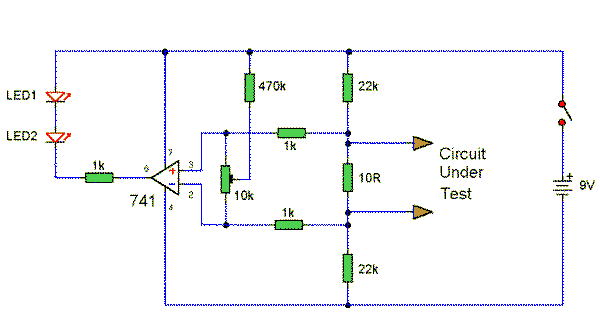
Connection Tester
This simple circuit utilizes a 741 operational amplifier (op-amp) in differential mode to function as a continuity tester. The voltage difference between the non-inverting and inverting inputs is amplified by the op-amp's full open-loop gain. Initially, if the resistors were...
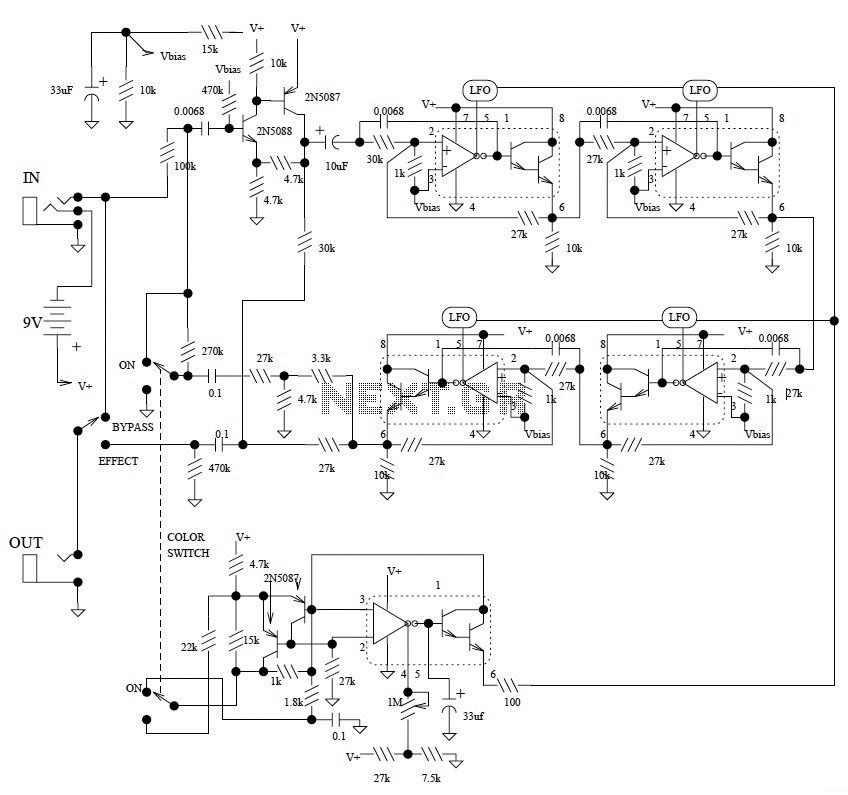
Electro-Harmonix Small Stone Phaser Guitar Effect
This is the schematic diagram of the Electro-Harmonix Small Stone Phaser guitar effect pedal. The Small Stone is notable for using Operational Transconductance Amplifiers (OTAs) for phase shift stages instead of traditional operational amplifiers.
The Electro-Harmonix Small Stone Phaser is a...
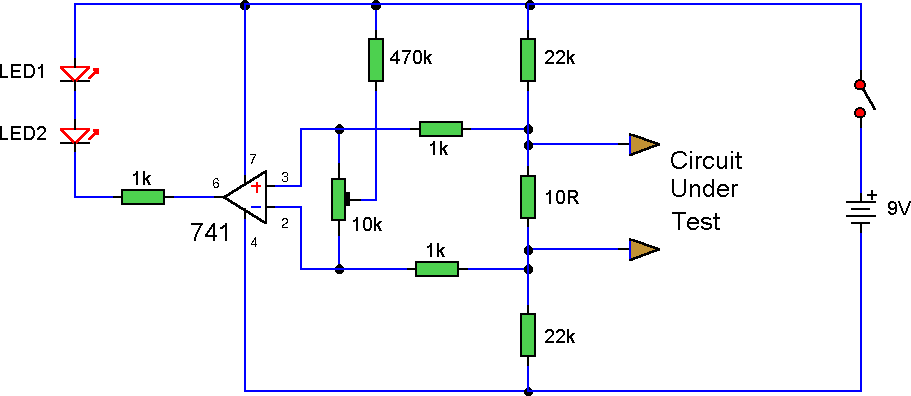
connection tester schematics
This simple circuit employs a 741 operational amplifier (op-amp) in differential mode to function as a continuity tester. The voltage difference between the non-inverting and inverting inputs is amplified by the full open-loop gain of the op-amp. Initially, ignore the...
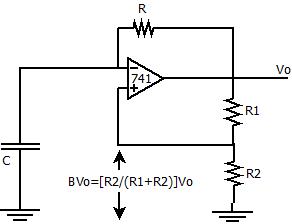
Astable Multivibrator Using 741 Op-Amp
The positive feedback comparator circuit enhances the gain of the operational amplifier (op-amp), facilitating rapid switching between the two states of a multivibrator. This positive feedback also introduces hysteresis into the circuit. A capacitor, denoted as `C`, is connected to...
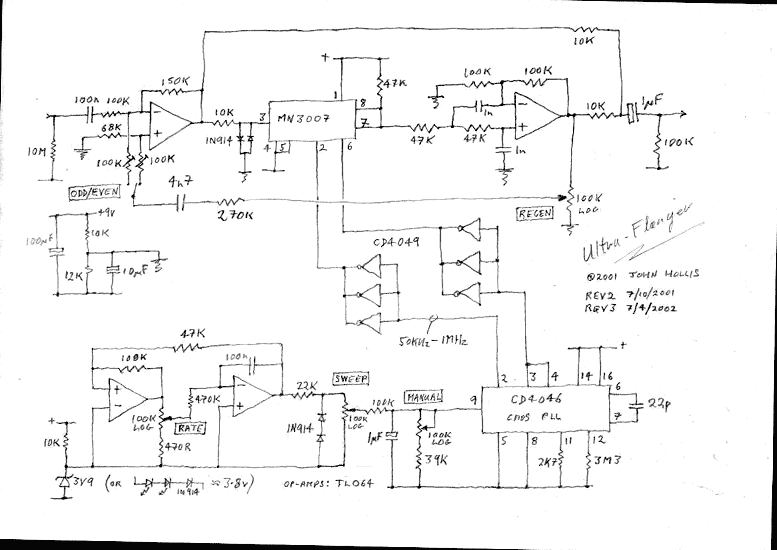
Ultra-Flanger guitar effect
I was originally going to develop a minimum part count version of the EH Electric Mistress. Instead I went for a something with the versatility of an MXR flanger and the extra wide sweep that the A/DA flanger was known...
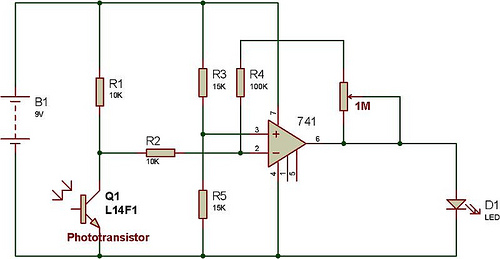
experiments with 741 operational amplifier
This versatile 741 operational amplifier module can be utilized to create a dark detector using a light-dependent resistor (LDR), a phototransistor, and a photodiode. The amplifier is configured in inverting mode, where it compares the voltage change at pin 2...