


MIDI Tester Schematic diagram
#MIDI
#opto-isolator
#6N139
#current loop
#TTL
#music
#instrument
#signal conversion
#digital audio
#schematic
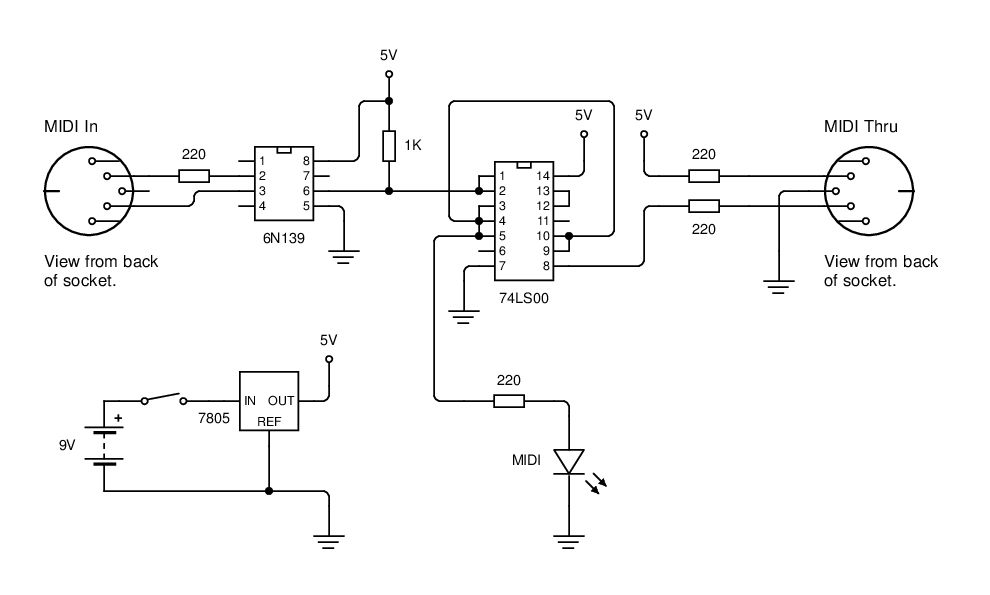
Description: MIDI data is transmitted between instruments using a current loop, and an opto-isolator (6N139) is employed to convert this current loop into TTL pulses.
The circuit utilizes the 6N139 opto-isolator to separate the MIDI signal from the receiving device, ensuring that any electrical noise or ground loops do not affect the performance of the MIDI system. The opto-isolator consists of an LED and a phototransistor, which are optically coupled but electrically isolated from each other.
In this configuration, the MIDI signal is applied to the LED side of the 6N139. When the current loop is activated by the MIDI signal, the LED emits light, which is detected by the phototransistor on the output side. This results in a corresponding TTL pulse, which can be used by digital devices for further processing.
The circuit design should include appropriate resistors to limit the current through the LED to a safe level, typically around 10-20 mA, ensuring reliable operation of the opto-isolator. The output from the phototransistor can be connected to the input of a microcontroller or any other digital logic device that requires TTL level signals.
By implementing this approach, the integrity of the MIDI data transmission is maintained while providing electrical isolation, which is critical for preventing interference and protecting sensitive components in the MIDI system.As MIDI data is transmitted between instruments using a current loop, a opto-isolator (6N139) is used to convert this current loop into TTL pulses. Th..
The circuit utilizes the 6N139 opto-isolator to separate the MIDI signal from the receiving device, ensuring that any electrical noise or ground loops do not affect the performance of the MIDI system. The opto-isolator consists of an LED and a phototransistor, which are optically coupled but electrically isolated from each other.
In this configuration, the MIDI signal is applied to the LED side of the 6N139. When the current loop is activated by the MIDI signal, the LED emits light, which is detected by the phototransistor on the output side. This results in a corresponding TTL pulse, which can be used by digital devices for further processing.
The circuit design should include appropriate resistors to limit the current through the LED to a safe level, typically around 10-20 mA, ensuring reliable operation of the opto-isolator. The output from the phototransistor can be connected to the input of a microcontroller or any other digital logic device that requires TTL level signals.
By implementing this approach, the integrity of the MIDI data transmission is maintained while providing electrical isolation, which is critical for preventing interference and protecting sensitive components in the MIDI system.As MIDI data is transmitted between instruments using a current loop, a opto-isolator (6N139) is used to convert this current loop into TTL pulses. Th..
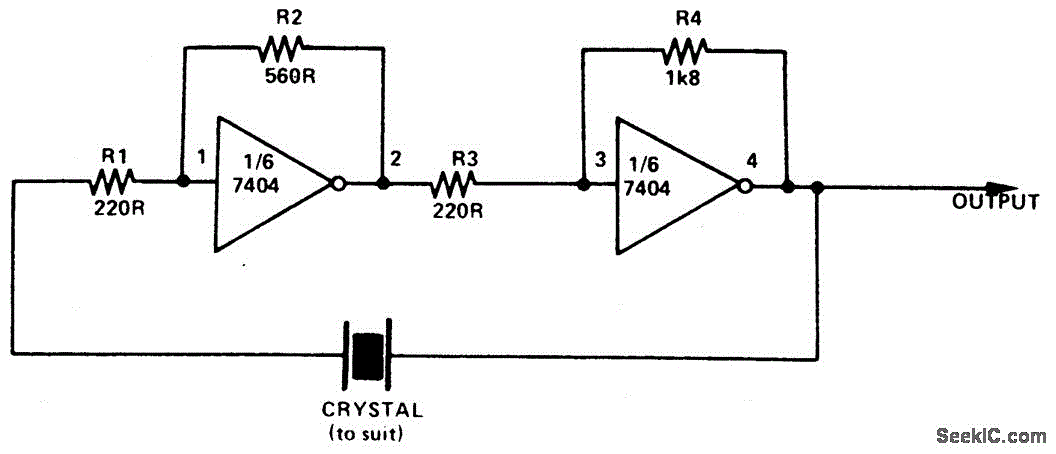
SIMPLE TTL CRYSTAL OSCILLATOR
This simple and inexpensive crystal oscillator consists of one-third of a 7404 hex inverter, four resistors, and a crystal. The inverters are biased into their linear regions by resistors R1 to R4, while the crystal provides the necessary feedback. Oscillation...
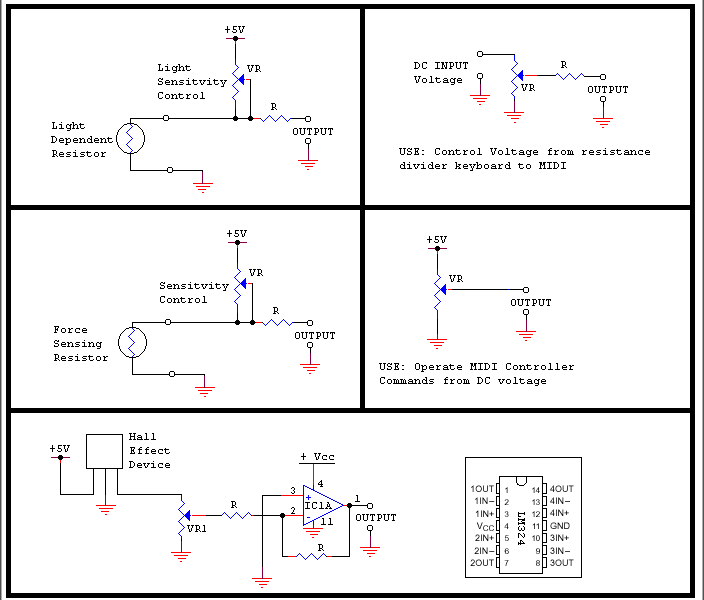
Analogue Inputs to MIDI Out
This device supports up to 8 analog inputs with a voltage range of 0 to 5 volts, generating selectable MIDI control output commands. The analog inputs can include rotary or slider potentiometers connected to the 0 to 5 volts supply....
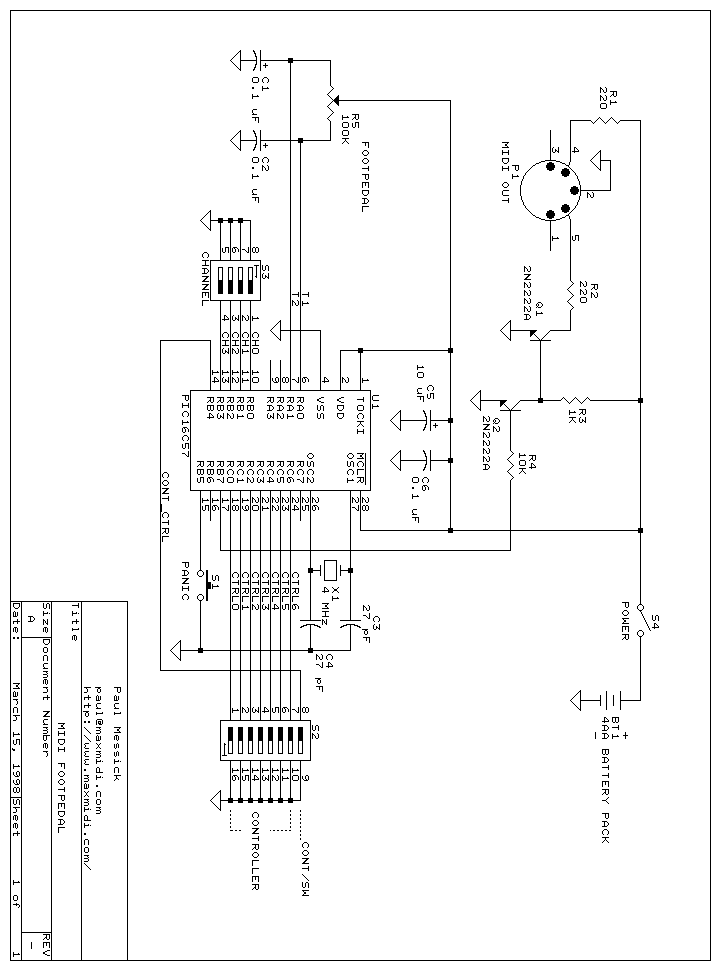
MIDI Controller Footpedal
Here is a simple project that sends continuous or switch controller MIDI messages that correspond to the position of a potentiometer. Given a few parts and a cannibalized volume or wah-wah pedal, you can build this MIDI controller pedal and...
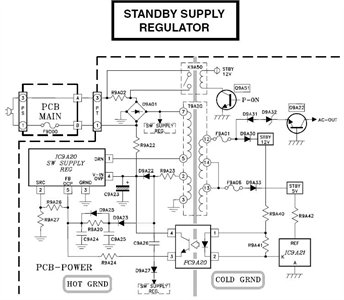
Need to have the circuit schematic for LG 29SA1RL model
The schematic is in PDF format and cannot be sent through this site. It is recommended to check a specific website that contains various schematics, including older posts that might have the schematic needed. A WS-55807 model is experiencing issues...
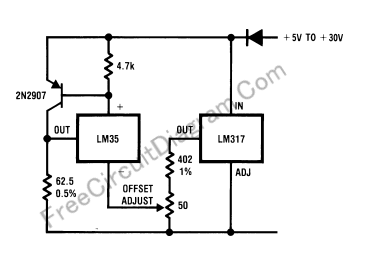
Current Loop Transmitter For Temperature Sensor
The current loop interface is widely used in industrial environments due to its robustness. Its noise resistance and failure detection capabilities make it suitable for various applications.
The current loop interface, commonly referred to as a 4-20 mA current loop, is...
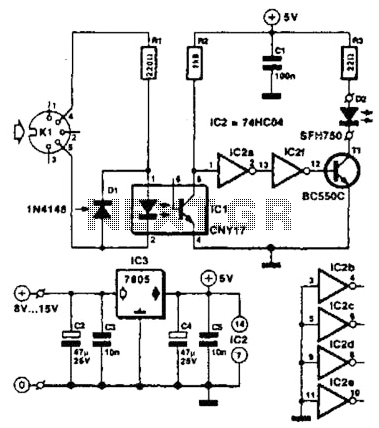
Musical Instrument Digital Interface (Midi) Transmitter Circuit
Used for digital control of musical instruments, this transmitter converts digital data signals into equivalent optical signals for a fiber optic cable interface. Optocoupler IC1 provides isolation, driving IC2-a and -b, and T1, ultimately providing a cable driver LED (SFH750)....
SIMPLE TTL CRYSTAL OSCILLATOR
This simple and inexpensive crystal oscillator consists of one-third of a 7404 hex inverter, four resistors, and a crystal. The inverters are biased into their linear regions by resistors R1 to R4, while the crystal provides the necessary feedback. Oscillation...
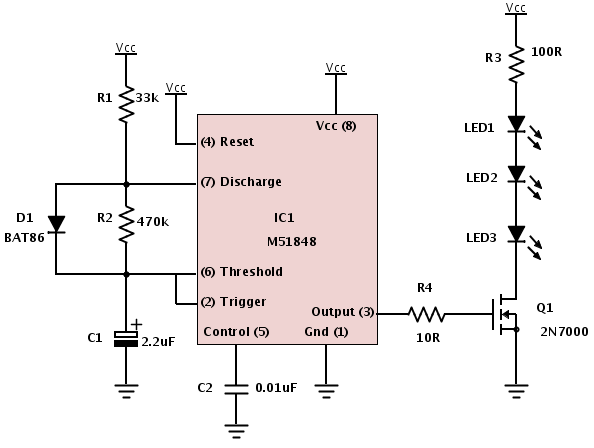
Building a device from a schematic
A common issue encountered is that individuals possess a schematic, also known as a circuit diagram, that they wish to construct. However, they discover that there are...
Building a circuit from a schematic requires a clear understanding of the components involved...
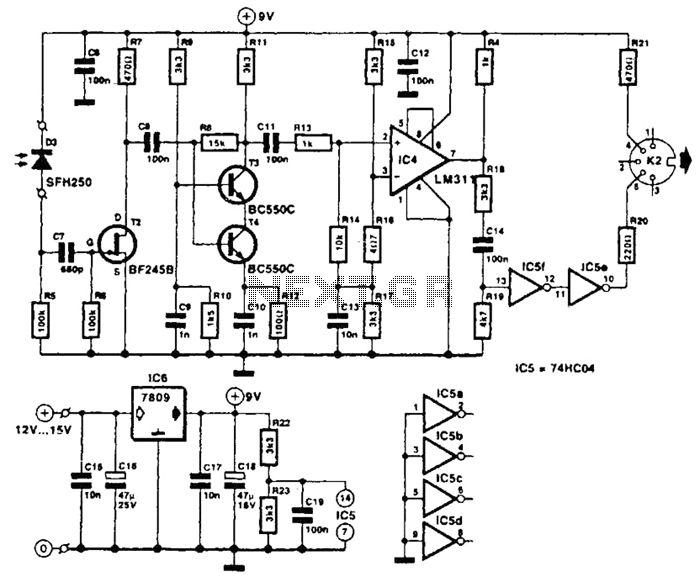
Musical Instrument Digital Interface (Midi) Receiver Circuit
The receiver photodiode SFH250 is utilized to convert optical data pulses at a rate of 32.5 Kbps into electrical signals. The buffer T2 transmits these signals to a cascade amplifier consisting of transistors T3 and T4, followed by an operational...