


Quality Stereo Wireless Microphone or Audio Link
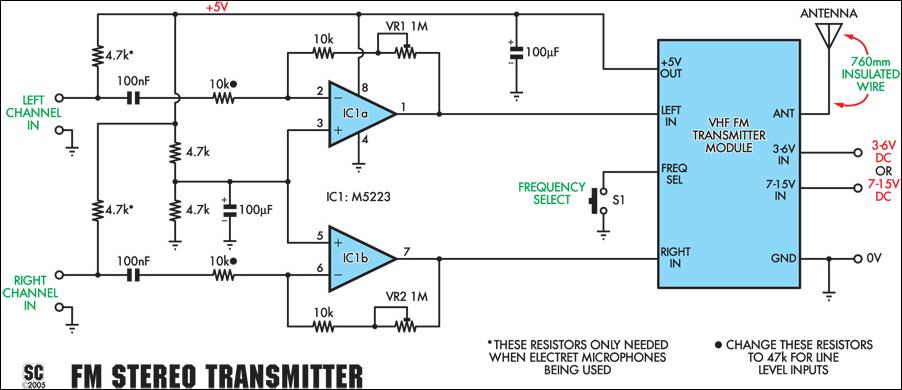
Description: This stereo FM wireless microphone serves as an excellent audio link. Testing revealed a reliable range exceeding 50 meters. It is distinct from previous wireless microphones due to its stereo capability, which delivers unexpectedly high-quality sound. The range was tested significantly beyond 50 meters, maintaining a noise-free performance, suggesting potential for even greater distances. The construction of the unit is straightforward, requiring minimal setup, and it is affordably priced. Although some may assume low quality due to the low cost, users may be pleasantly surprised. The assembly process is simplified as the transmitter module is pre-designed. The user only needs to assemble the microphone module, which includes the electret microphones, preamplifier, and level controls, then solder the transmitter module in a "piggyback" configuration. The transmitter module is crystal-locked, eliminating drift issues common in earlier wireless microphones. It features a synthesis circuit allowing selection among seven frequencies ranging from 106.7 MHz to 107.7 MHz. Additionally, the transmitter module can function at line level, suitable for transmitting audio throughout a home, with a sensitivity of approximately 100 mV. Oatley Electronics, the kit's designer, offers the transmitter module separately. The kit provides options for two power supply levels: 3-6V or 7-15V DC, with the latter resulting in lower current consumption. A "5V out" rail is included to power the preamplifier module. The kit comes with two electret microphone inserts that can be directly soldered to the PCB for a fully integrated project or connected via mini shielded coax cables. Alternatively, users can utilize conventional microphones, whether electret or dynamic, although no specific provisions for plugging them in have been included.
This stereo FM wireless microphone system is designed to deliver high-quality audio transmission over a considerable range, making it suitable for various applications, including public speaking, performances, and home audio distribution. The system's stereo capability enhances audio fidelity, making it an appealing choice for users seeking superior sound quality. The crystal-locked transmitter module ensures stable frequency transmission, reducing the likelihood of interference and drift, which is a common issue in analog wireless systems.
The assembly process is optimized for ease of use, allowing users with basic soldering skills to construct the device without extensive technical knowledge. The inclusion of a synthesis circuit that offers multiple frequency options enhances flexibility, enabling users to select the best frequency for their environment, thus minimizing potential interference from other devices.
The power supply versatility allows for adaptability to different operating conditions, providing options that cater to both low-power and higher-performance scenarios. The additional "5V out" rail is particularly beneficial for powering other components, such as the preamplifier, simplifying the overall design and reducing the need for external power sources.
The microphone inserts included in the kit enhance the project's self-containment, while the option for using standard microphones provides users with the flexibility to customize their setup according to specific needs. Overall, this FM wireless microphone system presents an accessible yet high-quality solution for audio transmission, encouraging experimentation and use in various settings.This stereo FM wireless microphone also makes a great quality audio link. We tested it to beyond 50 meters and it was rock solid. It`s certainly not the first wireless microphone we`ve ever published but this one is a little different. It`s stereo, providing surprisingly good quality sound. Second, it has a really good range. We tested it at well over 50m and it was still performing very well noise-free, in fact but at the time we couldn`t get our receiver any further away. So it`s likely to have even better range than that. It`s easy to build, requires very little setup. and it`s cheap! In fact, the low price might turn some people off, thinking it`s low quality. Try it - and be pleasantly surprised! Third, it really is simple to build the hard work (the transmitter module) is already done for you. It`s just a matter of assembling the microphone module, which contains the electret mics themselves, preamp and level controls, and soldering the transmitter module onto it, "piggy back" style.
Finally, the transmitter module is crystal-locked, so you won`t have the drift probles of some earlier wireless microphones. And just in case you were wondering, that doesn`t mean the output is locked to one particular frequency it has a nifty synthesis circuit built in to give you the choice of seven different frequencies between 106.
7MHz and 107. 7MHz. By the way, the transmitter module is quite capable of operating at line level if you want just a line level transmitter (eg, to feed an audio program around your home). Sensitivity is about 100mV. Oatley Electronics, who designed the kit, have the transmitter module available by itself if that`s what you`re after.
But more on that anon. You also have the choice of two power supply levels 3-6V or 7-15V DC. The latter results in a lower current drain. The transmitter module also has a "5V out" rail to supply power to the preamp module. Two electret microphone inserts are supplied in the kit. These can be soldered direct to the PC board to make it a fully self-contained project or they can be attached to the board via suitable lengths of mini shielded coax cable. A third option is to use "proper" microphones they can be electret or dynamic types but no provision has been made for plugging these in.
This stereo FM wireless microphone system is designed to deliver high-quality audio transmission over a considerable range, making it suitable for various applications, including public speaking, performances, and home audio distribution. The system's stereo capability enhances audio fidelity, making it an appealing choice for users seeking superior sound quality. The crystal-locked transmitter module ensures stable frequency transmission, reducing the likelihood of interference and drift, which is a common issue in analog wireless systems.
The assembly process is optimized for ease of use, allowing users with basic soldering skills to construct the device without extensive technical knowledge. The inclusion of a synthesis circuit that offers multiple frequency options enhances flexibility, enabling users to select the best frequency for their environment, thus minimizing potential interference from other devices.
The power supply versatility allows for adaptability to different operating conditions, providing options that cater to both low-power and higher-performance scenarios. The additional "5V out" rail is particularly beneficial for powering other components, such as the preamplifier, simplifying the overall design and reducing the need for external power sources.
The microphone inserts included in the kit enhance the project's self-containment, while the option for using standard microphones provides users with the flexibility to customize their setup according to specific needs. Overall, this FM wireless microphone system presents an accessible yet high-quality solution for audio transmission, encouraging experimentation and use in various settings.This stereo FM wireless microphone also makes a great quality audio link. We tested it to beyond 50 meters and it was rock solid. It`s certainly not the first wireless microphone we`ve ever published but this one is a little different. It`s stereo, providing surprisingly good quality sound. Second, it has a really good range. We tested it at well over 50m and it was still performing very well noise-free, in fact but at the time we couldn`t get our receiver any further away. So it`s likely to have even better range than that. It`s easy to build, requires very little setup. and it`s cheap! In fact, the low price might turn some people off, thinking it`s low quality. Try it - and be pleasantly surprised! Third, it really is simple to build the hard work (the transmitter module) is already done for you. It`s just a matter of assembling the microphone module, which contains the electret mics themselves, preamp and level controls, and soldering the transmitter module onto it, "piggy back" style.
Finally, the transmitter module is crystal-locked, so you won`t have the drift probles of some earlier wireless microphones. And just in case you were wondering, that doesn`t mean the output is locked to one particular frequency it has a nifty synthesis circuit built in to give you the choice of seven different frequencies between 106.
7MHz and 107. 7MHz. By the way, the transmitter module is quite capable of operating at line level if you want just a line level transmitter (eg, to feed an audio program around your home). Sensitivity is about 100mV. Oatley Electronics, who designed the kit, have the transmitter module available by itself if that`s what you`re after.
But more on that anon. You also have the choice of two power supply levels 3-6V or 7-15V DC. The latter results in a lower current drain. The transmitter module also has a "5V out" rail to supply power to the preamp module. Two electret microphone inserts are supplied in the kit. These can be soldered direct to the PC board to make it a fully self-contained project or they can be attached to the board via suitable lengths of mini shielded coax cable. A third option is to use "proper" microphones they can be electret or dynamic types but no provision has been made for plugging these in.
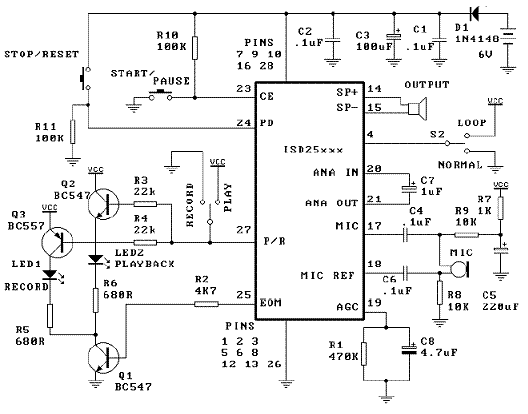
mic recorder circuit
A voice sound recording circuit is desired, which, when triggered, will play the recorded sound through an amplifier circuit.
The proposed voice sound recording circuit can be designed using a microcontroller or dedicated audio recording ICs, along with an amplifier for...
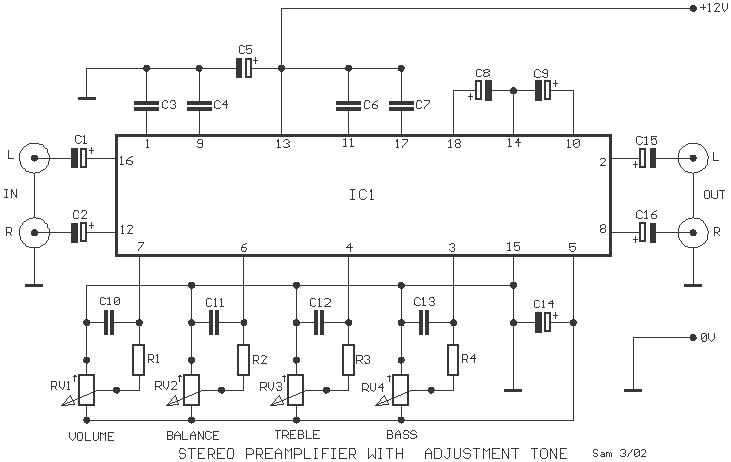
Stereo Preamplifier with adjustment tone
Cleaned Input: Many times we needed to use a simple circuit of preamplifier, with few components and facility of made. This circuit uses an opamp, the Motorola, TCA5550, that contains a double amplifier, as outputs for the adjust of volume,...
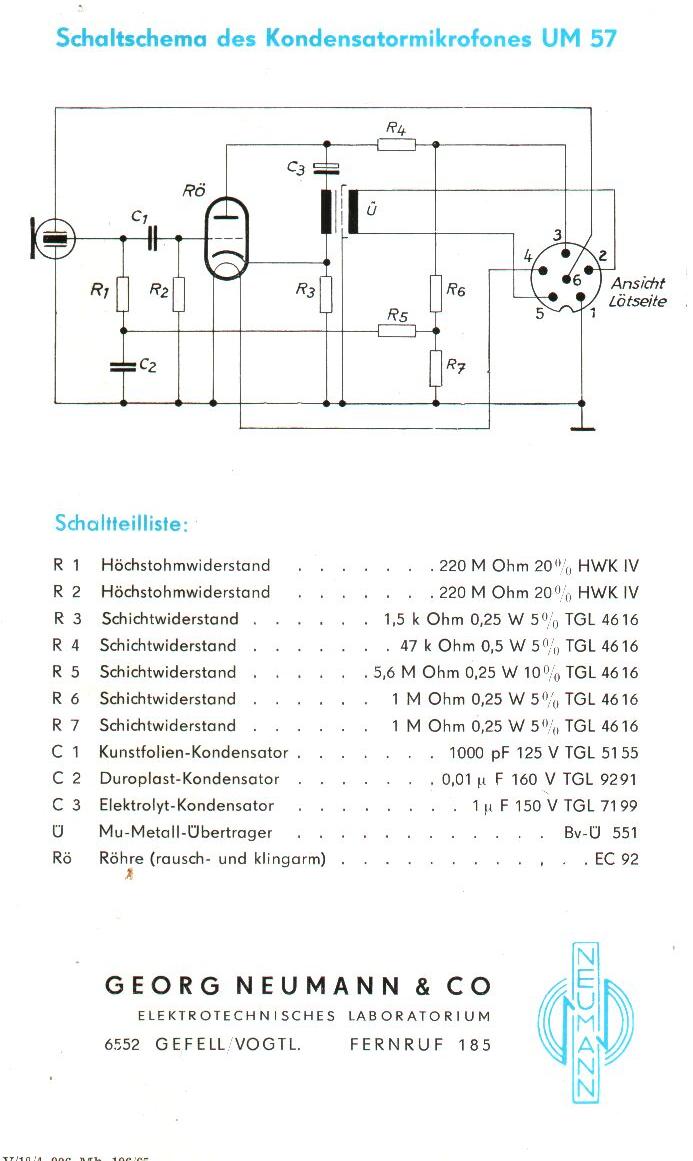
microphone Neumann UM 57
The Neumann/Gefell UM 57 is a large-diaphragm tube condenser microphone produced by the Neumann company in Gefell, Germany, now known as Microtech-Gefell. This microphone features the renowned M7 capsule from Gefell, which is a dual-diaphragm, center-terminated design with a PVC...
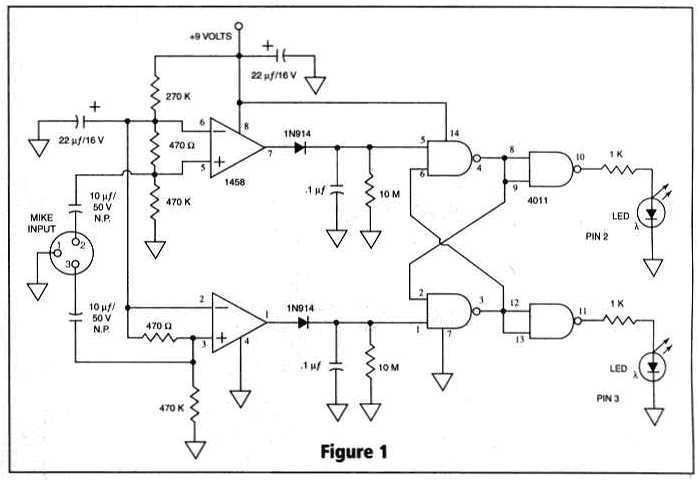
Build a Microphone Polarity Tester
Many things can go wrong in a modern recording studio, but few are as difficult to track down as reversed microphone polarity. When a microphone is placed in front of a sound source, a positive pressure on its diaphragm caused...
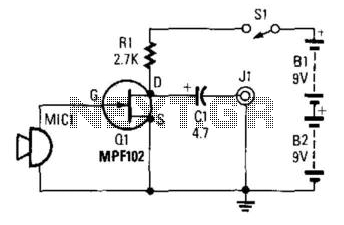
Simple Microphone Preamp
This preamplifier utilizes a small dynamic microphone connected to the gate of Q1. R1 acts as a load resistor. The audio output is taken from the negative side of C1 to ground. The output voltage will range between 10 and...
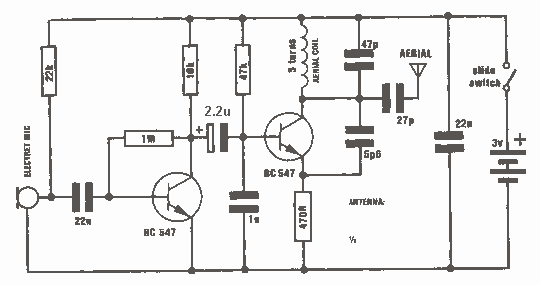
FM bug circuit
This is just one of the many bugging devices available on the eavesdropping market. The range includes pen and pencil holders, trophies, framed pictures, and office furniture with false bottom drawers. These products are readily sold to fledgling companies, eager...
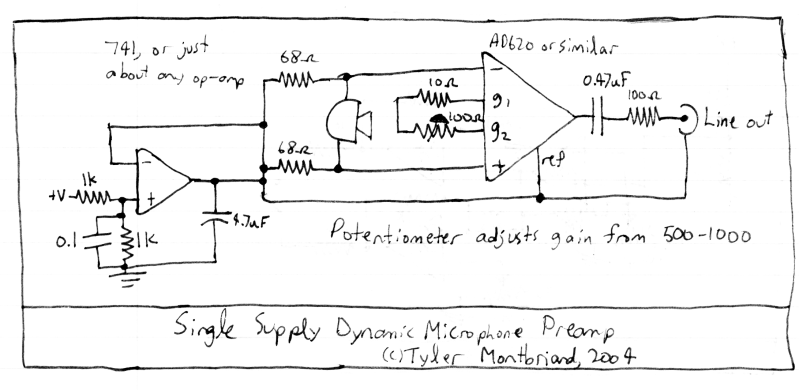
Dynamic Microphone Preamp
This circuit amplifies the output from a 150-ohm dynamic microphone to line level using an instrumentation amplifier. Instrumentation amplifiers are similar to operational amplifiers (op-amps) but offer adjustable gain and improved common-mode rejection. They provide high gain, high precision, low...
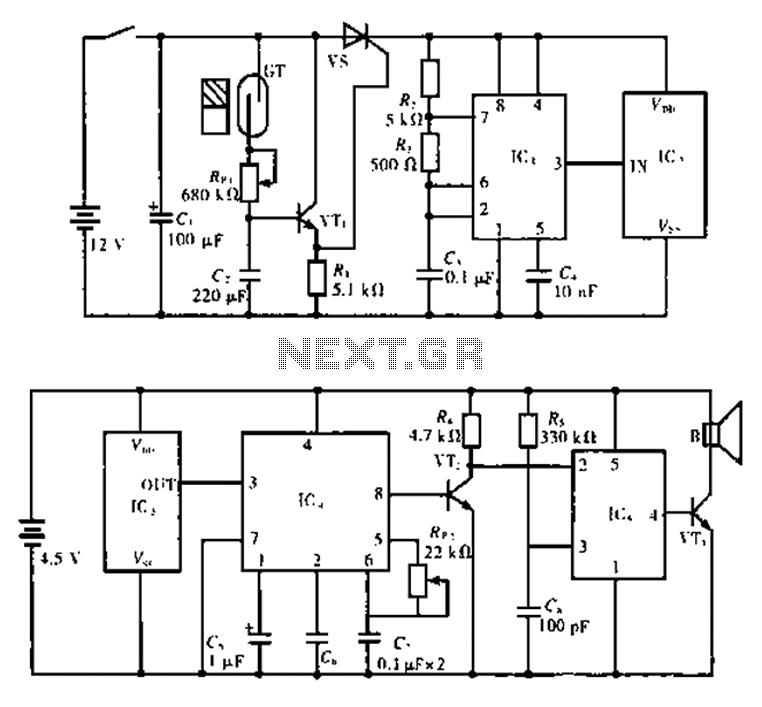
Carport wireless alarm circuit a
The alarm circuit is composed of two main components: the transmitter and the receiver. The transmitter circuit, as illustrated in Figure A, features a smoke break reed switch labeled GT. When a magnet approaches the GT, the internal contacts open....
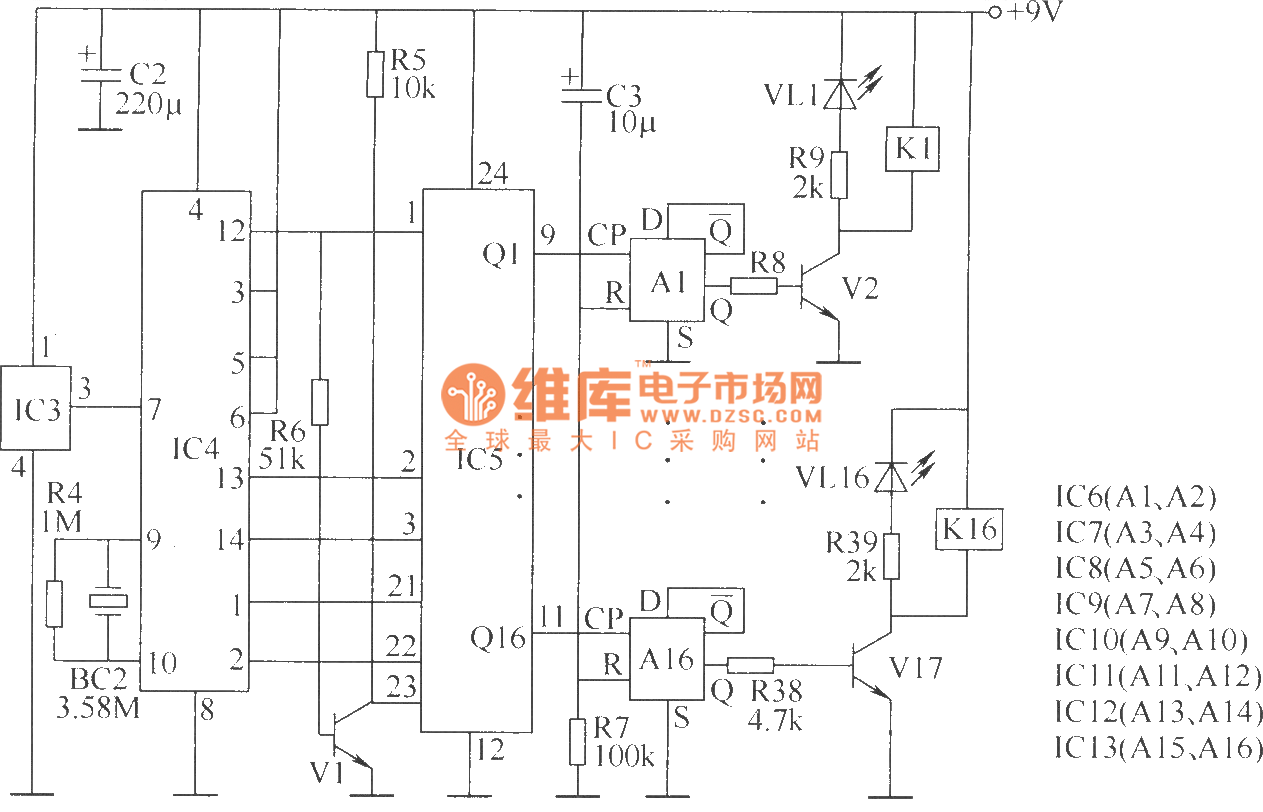
Wireless remote control switch circuit 5
The wireless remote control transmitter circuit consists of control buttons S1 to S16, resistors R1 to R3, a capacitor C1, a regulator diode VS, a crystal oscillator BC1, and DTMF encoder integrated circuits IC1 and IC2. The circuit components are...