


Simple Active Mixer on sinlge voltage
#active mixer
#single supply
#9V battery
#audio mixer
#power regulation
#guitar input
#microphone input
#wall wart
#loud
#regulated 5V
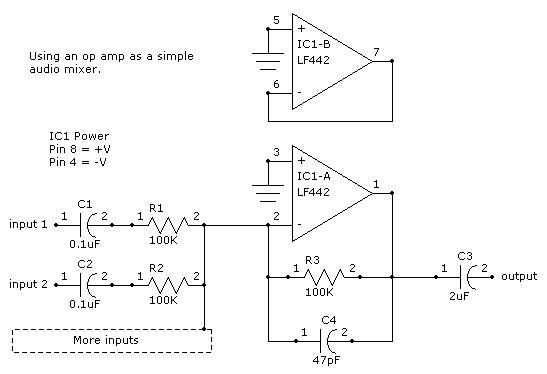
Description: It will operate on a single supply. It has been tested with a 9-volt battery and continues to perform well with a regulated 5-volt wall adapter. A modified version with input gains is available for connecting guitars or microphones, which includes power regulation to eliminate humming when using a wall adapter. For those who prefer to use a 9-volt battery without the additional features, it is recommended to omit the LM317 along with the associated capacitors and resistors. In this case, connect the positive terminal of the battery to the line where the four 10k resistors are located, and the negative terminal to the ground.
This circuit design allows for flexibility in power supply options, accommodating both battery and wall adapter configurations. The core component, the LM317 voltage regulator, is used in the modified version to provide stable output voltage and minimize noise, which is particularly beneficial for audio applications. The inclusion of input gains in the modified version enhances the circuit's ability to interface with higher-impedance sources such as guitars and microphones, ensuring optimal signal levels are maintained.
When utilizing the circuit with a 9-volt battery, the omission of the LM317 and its associated components simplifies the design, making it more efficient for battery operation. The connection of the positive terminal to the line with the four 10k resistors is crucial for maintaining the desired voltage levels across the circuit. The four 10k resistors can be configured in various ways depending on the application, such as forming a voltage divider or providing load resistance.
The grounding of the negative terminal is essential for establishing a common reference point within the circuit, ensuring proper operation and signal integrity. This design is suitable for various applications, including audio amplification, signal processing, and experimental electronic projects, making it a versatile choice for both hobbyists and professionals.It`ll work on single supply. I`ve used it when I ran my lunetta on a 9 volt battery for a while and it`s still loud and proud running on my new regulated 5 volt wallwart. If you want one with input gains (to plug in guitars or mics), I made a modified version, also with power regulation to run off of a wall wart without humming.
If you don`t need that and just want to run on a 9v battery, then omit the LM317 and caps/resistors connected to it, and hook the + of the battery to the line where the four 10k resistors are, and negative terminal to the bottom line, which is ground:
This circuit design allows for flexibility in power supply options, accommodating both battery and wall adapter configurations. The core component, the LM317 voltage regulator, is used in the modified version to provide stable output voltage and minimize noise, which is particularly beneficial for audio applications. The inclusion of input gains in the modified version enhances the circuit's ability to interface with higher-impedance sources such as guitars and microphones, ensuring optimal signal levels are maintained.
When utilizing the circuit with a 9-volt battery, the omission of the LM317 and its associated components simplifies the design, making it more efficient for battery operation. The connection of the positive terminal to the line with the four 10k resistors is crucial for maintaining the desired voltage levels across the circuit. The four 10k resistors can be configured in various ways depending on the application, such as forming a voltage divider or providing load resistance.
The grounding of the negative terminal is essential for establishing a common reference point within the circuit, ensuring proper operation and signal integrity. This design is suitable for various applications, including audio amplification, signal processing, and experimental electronic projects, making it a versatile choice for both hobbyists and professionals.It`ll work on single supply. I`ve used it when I ran my lunetta on a 9 volt battery for a while and it`s still loud and proud running on my new regulated 5 volt wallwart. If you want one with input gains (to plug in guitars or mics), I made a modified version, also with power regulation to run off of a wall wart without humming.
If you don`t need that and just want to run on a 9v battery, then omit the LM317 and caps/resistors connected to it, and hook the + of the battery to the line where the four 10k resistors are, and negative terminal to the bottom line, which is ground:
audio mixer in ads
The circuit utilized was primarily designed for audio mixing, featuring inputs from both a triangular wave generator and a noise generator. These signals are processed through an audio mixer to create the final output wave.
This audio mixing circuit integrates two...
Audio Mixer
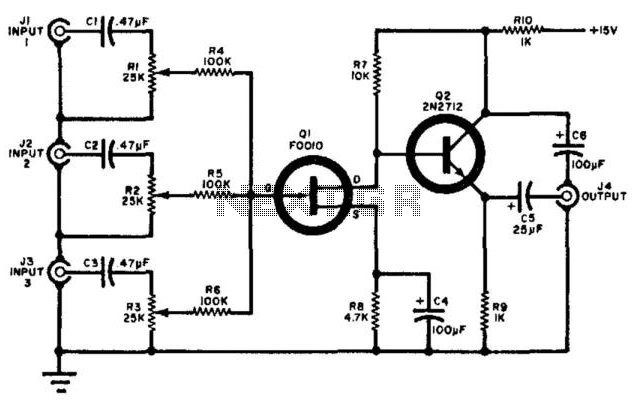
Three audio circuits are combined in the circuit shown. Each input is connected to its own level potentiometer (R1, R2, or R3), and they are combined at the gate of FET Q1. The output of Q1 is coupled to the...
Audio Mixers Circuits
The mixer circuit described features three line inputs and three microphone inputs. The microphone inputs are designed for low impedance dynamic microphones with a range of 200 to 1000 ohms. Alternatively, an electret condenser microphone (ECM) can be used, provided...
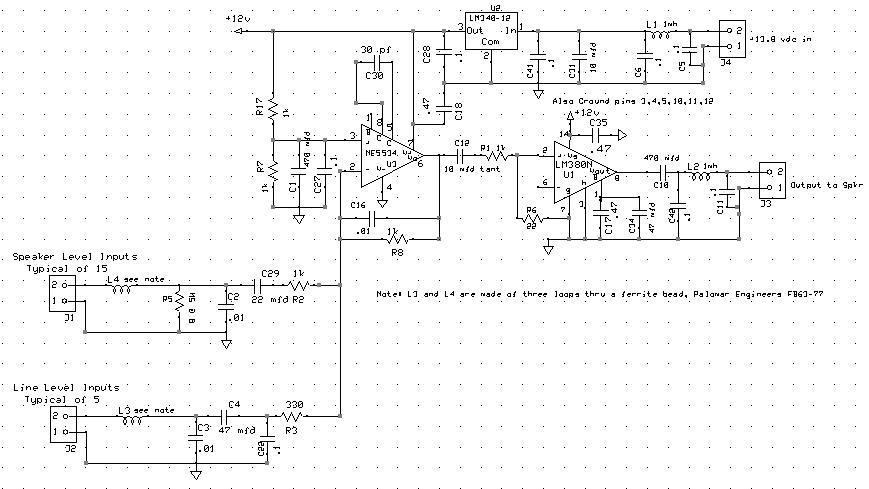
A 20 Input Audio Mixer for Multiple Receiver Setups
The audio mixer allows for easy comparison of various receivers by adjusting the gain controls without the need for switching. This setup simplifies A/B comparisons since all receivers are connected to the same antenna. Previously, different speakers were used for...
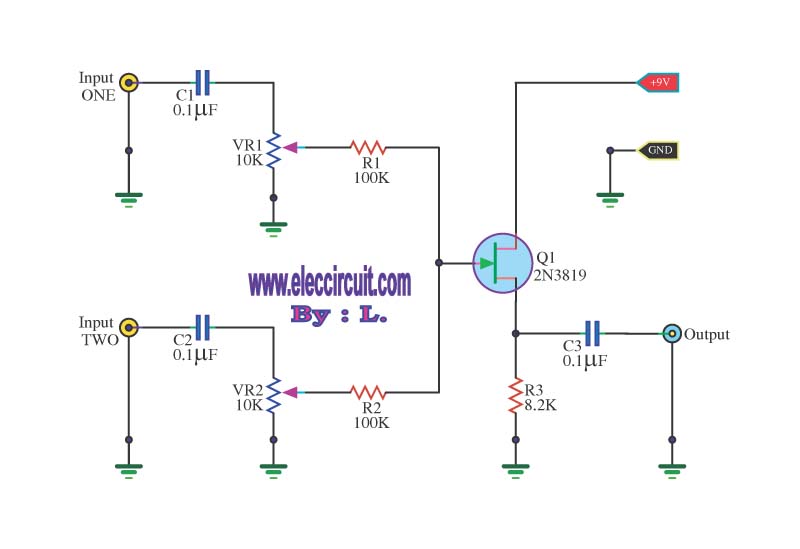
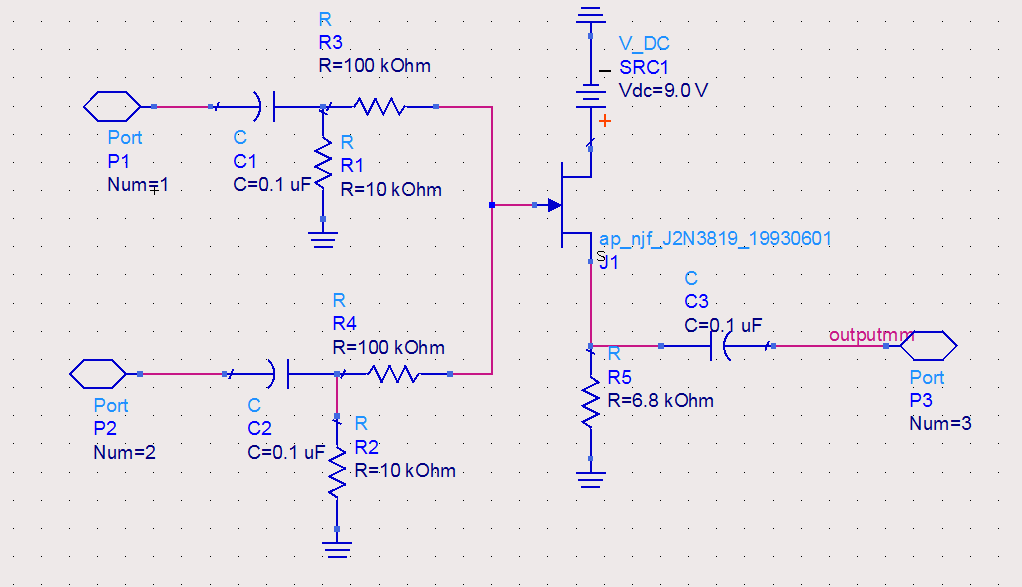
Simple audio mixer circuit with fet 2n3819
This circuit is a simple mixer circuit that can mix two signal channels into one output channel. It utilizes a codec circuit to convert stereo audio into mono audio. The circuit can also increase the number of channels by adding...
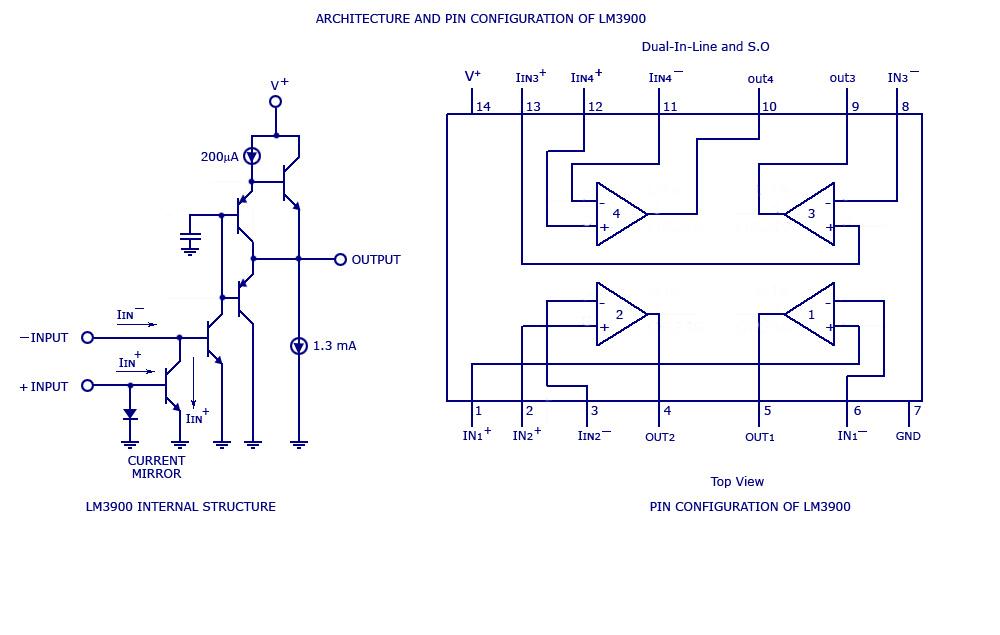
multi channel audio mixer using lm 3900
By adding the same circuit in parallel, the number of inputs can be increased according to the applications. Each input is connected to the inverting terminal of the LM3900. The built-in amplifier of each section amplifies every audio input separately...
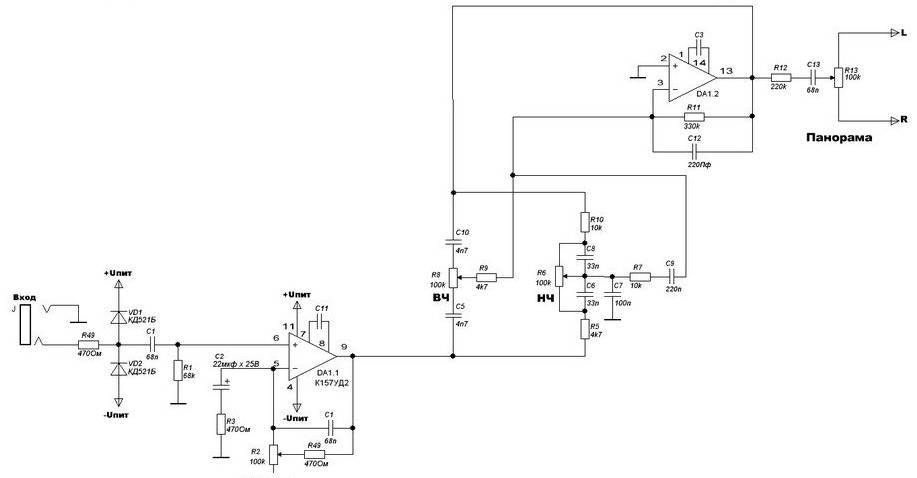
Mini Audio Mixer Impulse MM-04
The four main input channels are identical and feature independently adjustable input sensitivity, tone, and sound panning. The fifth input is a linear channel. Despite its inexpensive and basic design, the Mini Audio Mixer "Impulse MM-04" performs satisfactorily.
The Mini Audio...
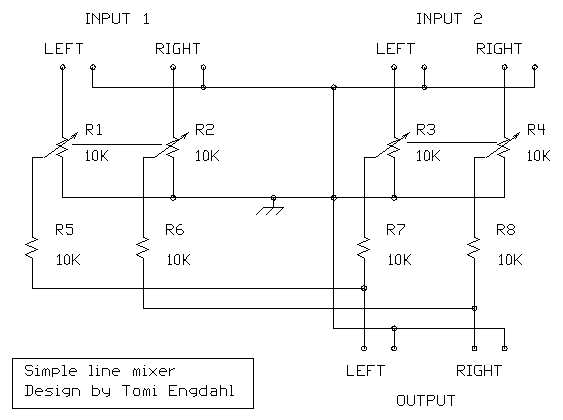
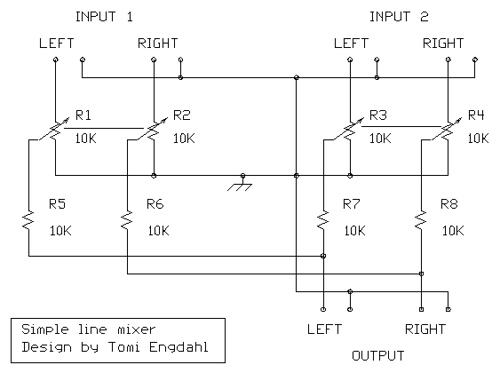
Simple mixer
This circuit was designed as a small portable DJ mixer for a friend. It is a simple audio mixer circuit featuring two dual logarithmic potentiometers to adjust input signal levels, along with several resistors for mixing. The circuit operates entirely...
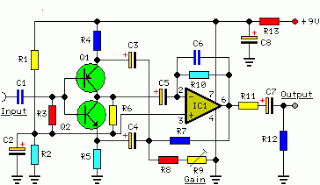
new 4 channel portable audio mixer
The objective of this project was to design a compact, portable mixer powered by a 9V PP3 battery while maintaining high-quality performance. The mixer consists of three primary modules that can be adjusted in number and configuration to meet individual...