


Single Cell 1.5V Hearing Aid
#hearing aid
#1.5V
#low voltage
#sound amplification
#earpiece
#faint sound detection
#audio amplifier
#medical electronics
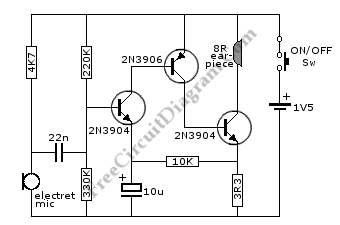
Description: This is a hearing aid circuit powered by a 1.5V supply. It is designed to detect very faint sounds and deliver these sounds to an 8-ohm earpiece.
The hearing aid circuit operates by amplifying low-level audio signals to make them audible for individuals with hearing impairments. The primary components typically include a microphone, an amplifier, and a speaker (earpiece).
The microphone captures ambient sounds, converting them into electrical signals. These signals are often very weak, necessitating amplification for proper hearing. The amplifier, which can be implemented using operational amplifiers (op-amps) or dedicated audio amplifier ICs, increases the signal strength. The gain of the amplifier must be carefully selected to ensure that it enhances the sound without introducing excessive noise or distortion.
The output of the amplifier is then fed to an 8-ohm earpiece, which converts the amplified electrical signals back into sound waves. The earpiece is designed to match the output impedance of the amplifier, ensuring efficient power transfer and optimal sound quality.
Power management is crucial in hearing aid circuits, especially since they are often battery-operated. The 1.5V supply is typically derived from standard batteries, such as AA or AAA cells. Circuit design considerations may include low-power components and techniques to extend battery life, such as automatic shut-off features when not in use.
Additional features may include volume control, tone adjustment, and noise filtering to enhance the listening experience. These can be achieved through the use of potentiometers and passive components, or more advanced digital signal processing techniques in modern designs.
Overall, the hearing aid circuit is a compact and efficient system tailored to improve sound detection and clarity for users with hearing difficulties.This is a hearing aid circuit with 1.5v supply. This circuit is used to detect very faint sounds, then deliver the sounds to an 8 ohm earpiece. This circuit.
The hearing aid circuit operates by amplifying low-level audio signals to make them audible for individuals with hearing impairments. The primary components typically include a microphone, an amplifier, and a speaker (earpiece).
The microphone captures ambient sounds, converting them into electrical signals. These signals are often very weak, necessitating amplification for proper hearing. The amplifier, which can be implemented using operational amplifiers (op-amps) or dedicated audio amplifier ICs, increases the signal strength. The gain of the amplifier must be carefully selected to ensure that it enhances the sound without introducing excessive noise or distortion.
The output of the amplifier is then fed to an 8-ohm earpiece, which converts the amplified electrical signals back into sound waves. The earpiece is designed to match the output impedance of the amplifier, ensuring efficient power transfer and optimal sound quality.
Power management is crucial in hearing aid circuits, especially since they are often battery-operated. The 1.5V supply is typically derived from standard batteries, such as AA or AAA cells. Circuit design considerations may include low-power components and techniques to extend battery life, such as automatic shut-off features when not in use.
Additional features may include volume control, tone adjustment, and noise filtering to enhance the listening experience. These can be achieved through the use of potentiometers and passive components, or more advanced digital signal processing techniques in modern designs.
Overall, the hearing aid circuit is a compact and efficient system tailored to improve sound detection and clarity for users with hearing difficulties.This is a hearing aid circuit with 1.5v supply. This circuit is used to detect very faint sounds, then deliver the sounds to an 8 ohm earpiece. This circuit.
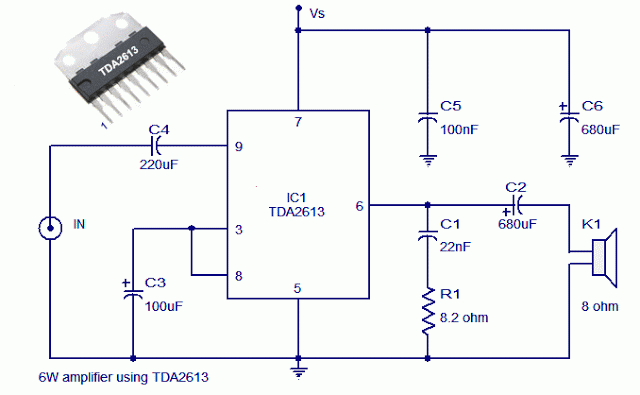
Reliable 6 Watt Hi Fi Audio Amplifier Using TDA2613
A 6-watt audio amplifier circuit utilizing the TDA2613 integrated circuit is presented. The TDA2613, produced by Philips Semiconductors, is a high-fidelity audio amplifier IC. This component is designed to be click-proof when switched on or off, resistant to short circuits,...
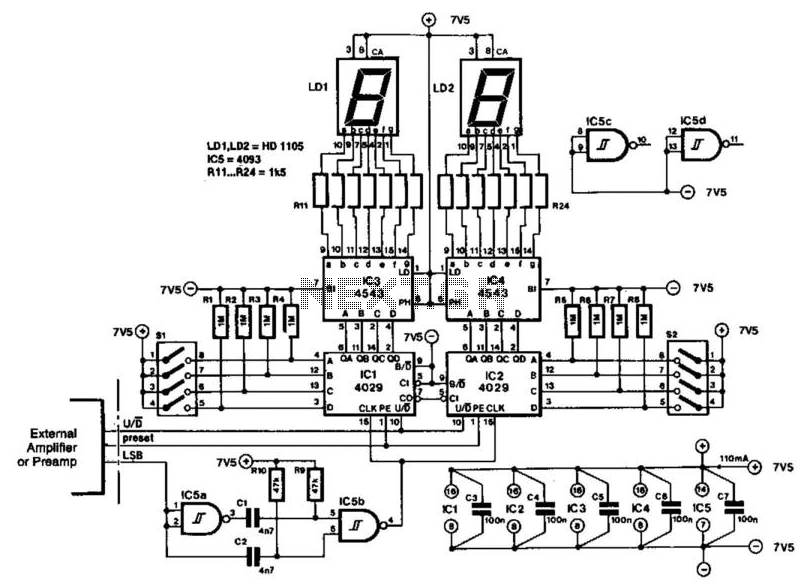
Audio Amplifier Volume Indicator
The indicator is designed for use with an audio amplifier or preamplifier, but it can also be utilized in other applications requiring rapid counting of steps or changes. To avoid interference with the audio signal, the circuit operates in a...
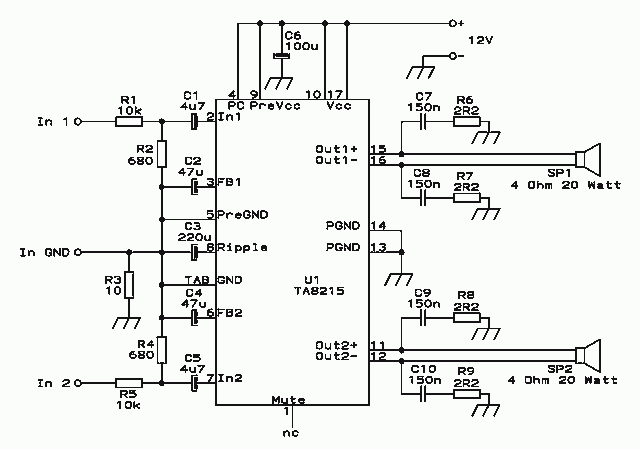
4x15Watt 12volt power audio amplifier
While I would have liked a 4 channel chip with about 20 Watt per channel, the local parts store didn't have any yet, so I opted for two TA8215AH stereo chips, selected by their low price in this particular store....
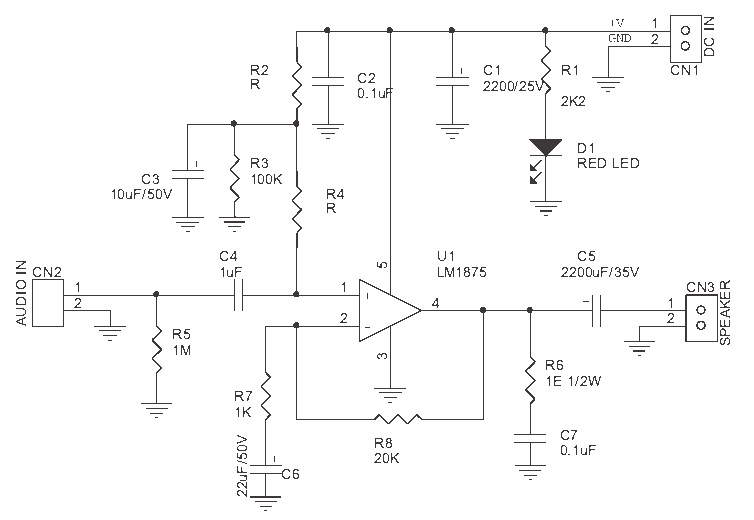
20 watt amplifier with LM1875
This is a nice amplifier and very easy to make it. Its an 20W Audio Amplifier based on LM1875 IC. More: Power supply - 48 VDC Output - 20 W, 4 ? Very low distortion (THD - 0.015%), good channel...
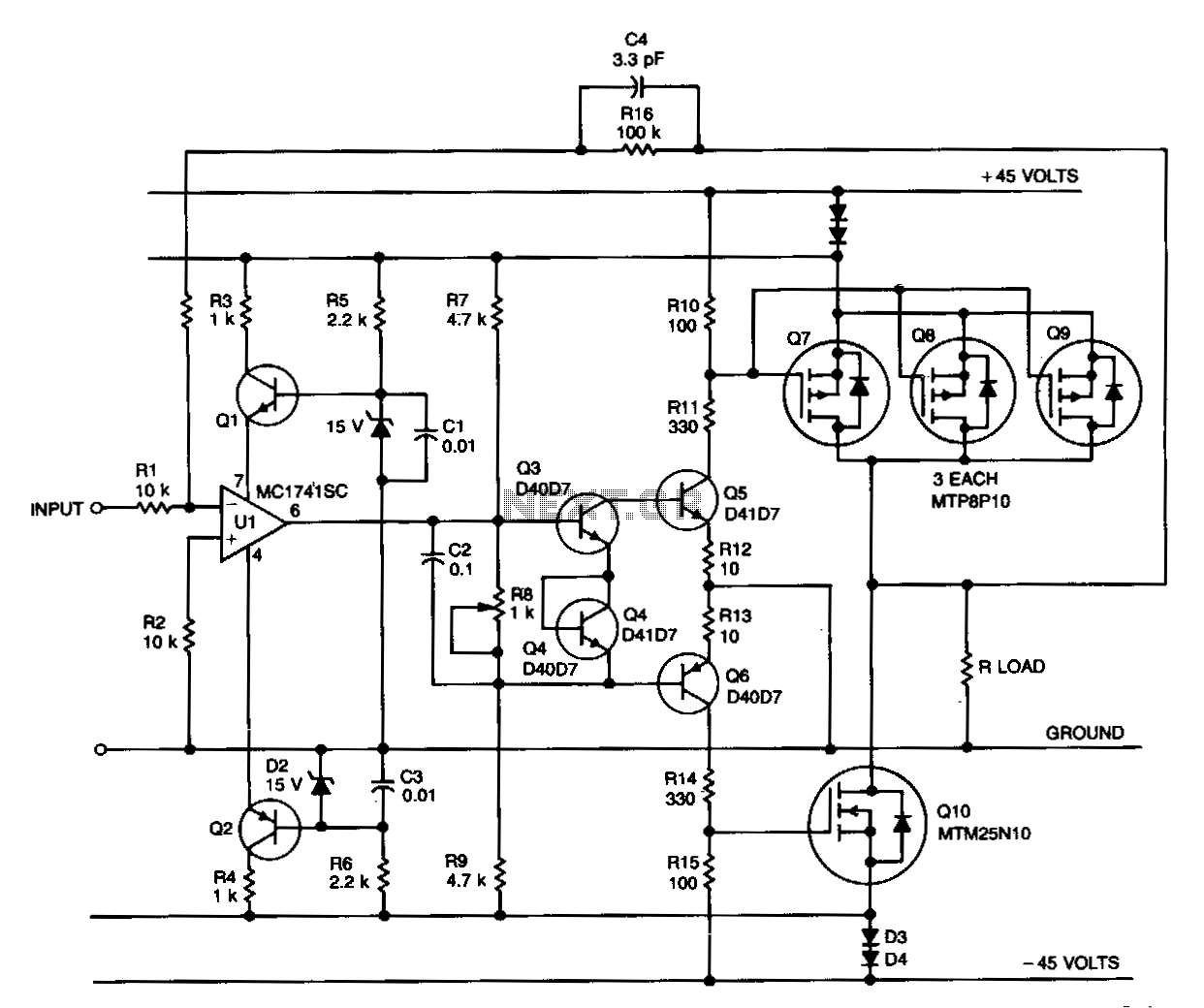
50W-audio-power-amplifier
This audio amplifier design utilizes TMOS Power FETs configured in a complementary common-source arrangement. The FETs are biased to cutoff and can rapidly turn on when a signal is applied. This design approach offers significant thermal stability in the output...
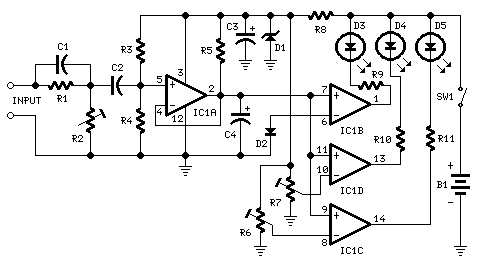
Three-Level Audio Power Indicator circuit
This circuit is designed to indicate the power output level of any audio amplifier. It is simple, portable, and displays three power levels that can be set to any desired value.
The circuit operates by utilizing a combination of resistive voltage...
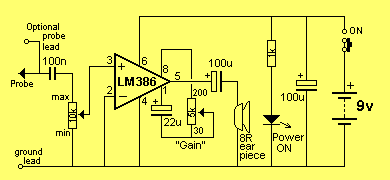
Audio Signal Testing amplifier
This mini audio amplifier will test the audio stages in amplifiers such as the front end of FM bugs. You can also use it on lots of our other projects as well as the output stages of radios. It is...
11W Stereo/22W Mono Power Amp Using TDA1519C
Integrated AF power amplifiers have experienced significant advancements in recent years, offering enhanced power and ease of use. The TDA1519C from Philips features two power amplifiers that provide 11 W per channel in stereo mode or 22 W in mono...
2x300W or 600W Power audio Amplifier
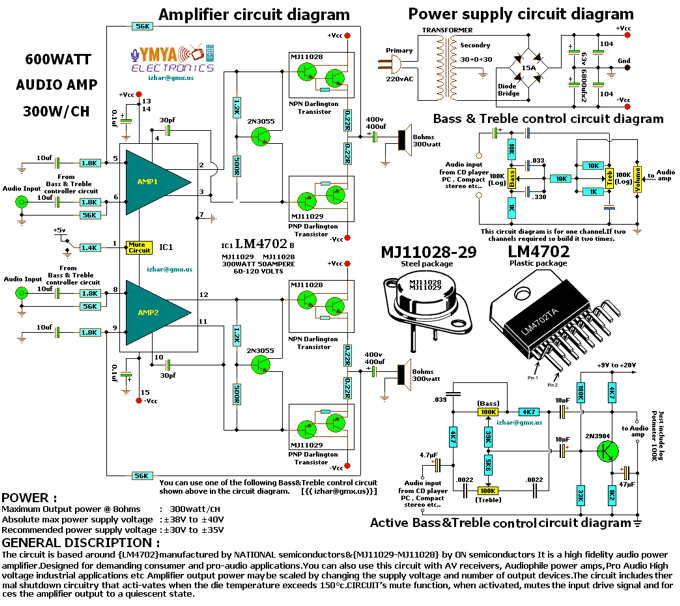
The circuit is based around LM4702 manufactured by NATIONAL semiconductors and MJ11029-MJ11028 by ON semiconductors. It is a high fidelity audio power amplifier designed for demanding consumer and pro-audio applications. You can also use this circuit with AV receivers, audiophile...