


Speech Pitch Controller (MSM6322GSK)
#speech processing
#pitch control
#MSM6322GSK
#microphone preamplifier
#low pass filter
#A/D converter
#D/A converter
#real-time processing
#loudspeaker driver
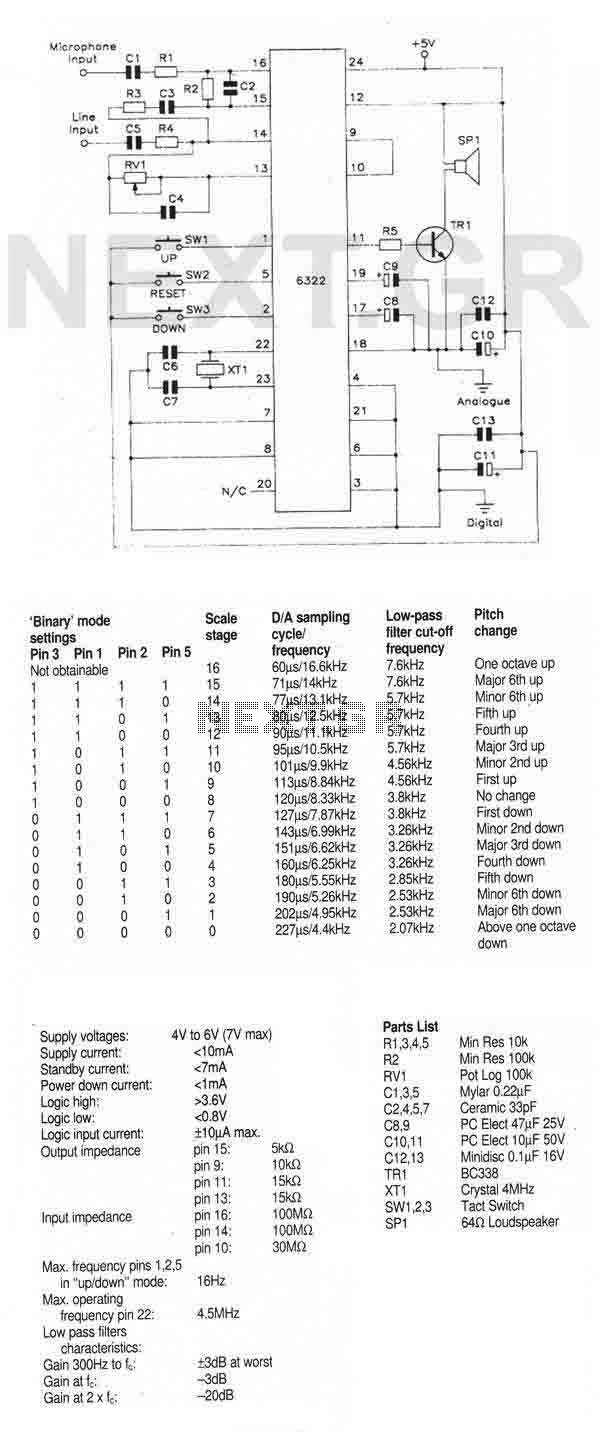
Description: The circuit utilizes the MSM6322GSK, which is available in a compact 24-pin plastic SOP package. This integrated circuit (IC) functions as a real-time speech pitch converter and requires minimal external components. It includes a microphone preamplifier and a line-level input, while the output can drive a loudspeaker directly with the addition of a single transistor. The IC features a 4th order low-pass filter on the input and a 3rd order low-pass filter on the output. Furthermore, it incorporates an 8-bit A/D converter and a 9-bit D/A converter. The pitch of the speech can be modified in 17 steps across a range of one octave upward and one octave downward, and it supports two operational modes. In the up/down mode, two inputs are provided that, when pulsed, sequentially adjust the pitch upward or downward.
The MSM6322GSK circuit is designed for applications requiring real-time manipulation of speech pitch, making it suitable for various audio processing tasks. The compact 24-pin SOP package allows for integration into space-constrained designs, such as portable devices or compact audio systems. The microphone preamplifier amplifies the input signal from a microphone, ensuring that the audio signal is adequately processed by the internal circuitry.
The inclusion of a 4th order low-pass filter on the input stage effectively reduces high-frequency noise, enhancing the clarity of the speech signal before it undergoes pitch conversion. Similarly, the 3rd order low-pass filter on the output stage ensures that the final output to the loudspeaker is smooth, minimizing distortion and artifacts that could arise from abrupt changes in pitch.
The built-in 8-bit A/D converter allows for the digitization of the incoming analog audio signal, while the 9-bit D/A converter enables the reconstruction of the processed audio signal for output. This dual conversion capability ensures high fidelity in audio processing, making the circuit suitable for professional audio applications.
The pitch alteration feature, which allows for adjustments in 17 discrete steps over a range of one octave up and down, provides flexibility in voice modulation. This can be particularly useful in applications such as voice synthesis, audio effects, or assistive technologies for speech enhancement. The two operational modes, including the up/down mode, facilitate intuitive control over pitch changes, allowing for easy implementation in user interfaces where users can pulse the designated inputs to achieve the desired pitch effect.
Overall, the MSM6322GSK circuit presents a versatile solution for real-time speech pitch conversion, combining advanced filtering, conversion capabilities, and user-friendly operation in a compact package.That circuit uses the MSM6322GSK which is only available in small 24 pin plastic SOP style package. A speech pitch converter IC that operates in real time and requires very few external components. It has a microphone preamplifier and line level input and the output requires only a single transistor to directly drive a loudspeaker. As well as the microphone preamplifier, the IC contains a 4th order low pass filter on input and a 3rd order low pass filter on output.
In addition there is a build-in 8-bit A/D converter and 9-bit D/A converter. The pitch of the speech is alterable in 17 steps over a range of one octave up and one octave down, and there are two models of operation. In the up/down mode two inputs are provided which when pulsed, move the pitch up or down sequentially through the pi
The MSM6322GSK circuit is designed for applications requiring real-time manipulation of speech pitch, making it suitable for various audio processing tasks. The compact 24-pin SOP package allows for integration into space-constrained designs, such as portable devices or compact audio systems. The microphone preamplifier amplifies the input signal from a microphone, ensuring that the audio signal is adequately processed by the internal circuitry.
The inclusion of a 4th order low-pass filter on the input stage effectively reduces high-frequency noise, enhancing the clarity of the speech signal before it undergoes pitch conversion. Similarly, the 3rd order low-pass filter on the output stage ensures that the final output to the loudspeaker is smooth, minimizing distortion and artifacts that could arise from abrupt changes in pitch.
The built-in 8-bit A/D converter allows for the digitization of the incoming analog audio signal, while the 9-bit D/A converter enables the reconstruction of the processed audio signal for output. This dual conversion capability ensures high fidelity in audio processing, making the circuit suitable for professional audio applications.
The pitch alteration feature, which allows for adjustments in 17 discrete steps over a range of one octave up and down, provides flexibility in voice modulation. This can be particularly useful in applications such as voice synthesis, audio effects, or assistive technologies for speech enhancement. The two operational modes, including the up/down mode, facilitate intuitive control over pitch changes, allowing for easy implementation in user interfaces where users can pulse the designated inputs to achieve the desired pitch effect.
Overall, the MSM6322GSK circuit presents a versatile solution for real-time speech pitch conversion, combining advanced filtering, conversion capabilities, and user-friendly operation in a compact package.That circuit uses the MSM6322GSK which is only available in small 24 pin plastic SOP style package. A speech pitch converter IC that operates in real time and requires very few external components. It has a microphone preamplifier and line level input and the output requires only a single transistor to directly drive a loudspeaker. As well as the microphone preamplifier, the IC contains a 4th order low pass filter on input and a 3rd order low pass filter on output.
In addition there is a build-in 8-bit A/D converter and 9-bit D/A converter. The pitch of the speech is alterable in 17 steps over a range of one octave up and one octave down, and there are two models of operation. In the up/down mode two inputs are provided which when pulsed, move the pitch up or down sequentially through the pi
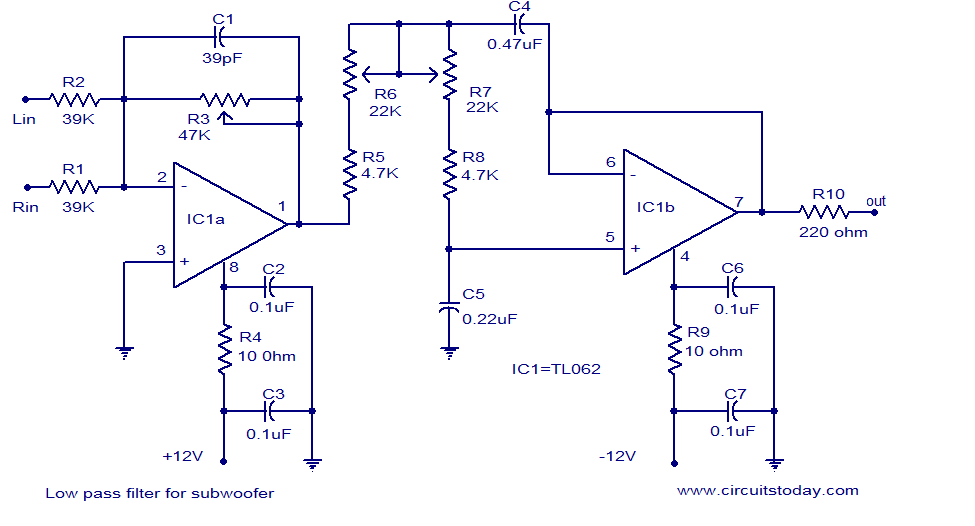
Low pass filter for subwoofer
Several low-pass filter circuits for subwoofers are presented here, and this is another example. The circuit is based on the TL062 op-amp from ST Microelectronics. The TL062 is a dual high-input impedance J-FET op-amp that exhibits very low power consumption...
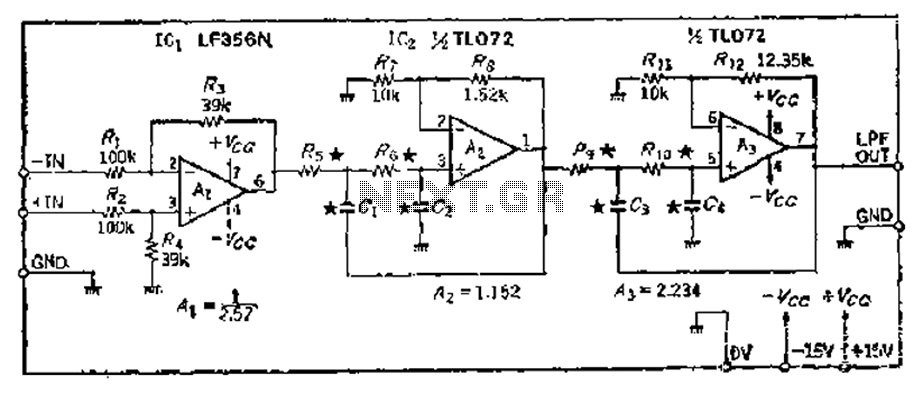
The same capacitance parameters easy to change the cutoff frequency of the low pass filter 24dB-oct
A 24 dB/octave Butterworth filter with a maximally flat characteristic is constructed using two filters, each capable of providing a 12 dB/octave response. This configuration allows for a 3 dB point adjustment. To achieve the desired cutoff frequency, adjustments are...
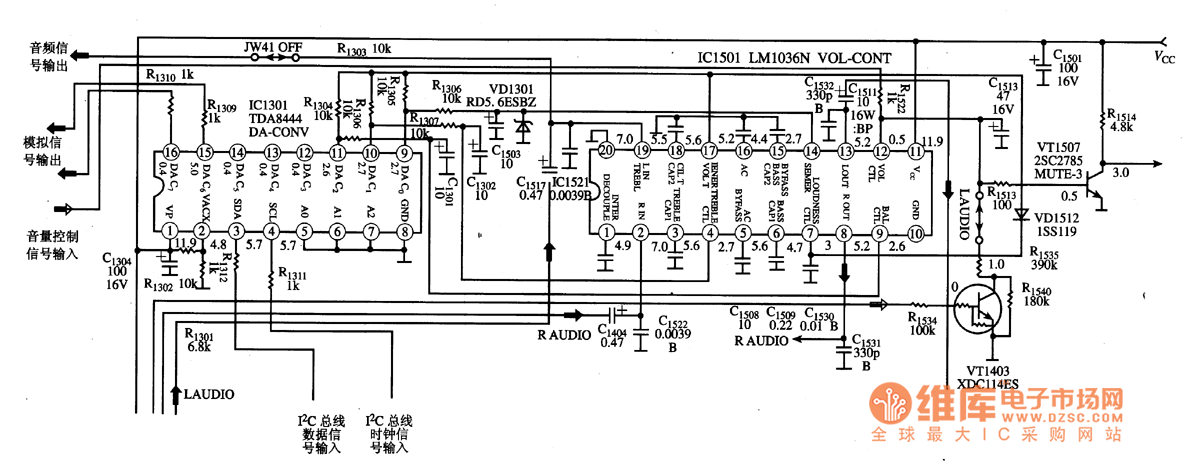
The converter IC circuit diagram
The TDA8444 is a digital-to-analog (D/A) converter integrated circuit (IC) produced by Philips. It is designed to convert digital signals into analog signals. The TDA8444 IC utilizes a 16-pin dual in-line package, with specific pin functions and data outlined in...
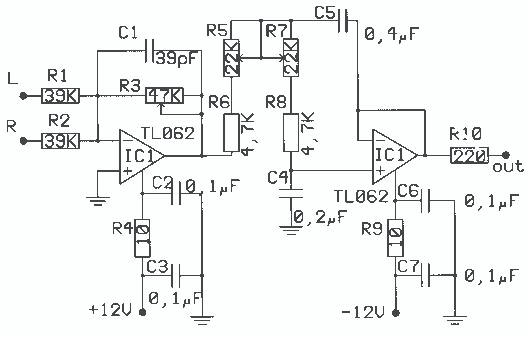
Low pass filter for Subwoofers
In the form it appears the theoretical circuit of filter. In first glance we see three different circuits that are mainly manufactured round two operational amplifiers. This circuits constitute mixed, amplifier with variable aid and a variable filter. The manufacture...
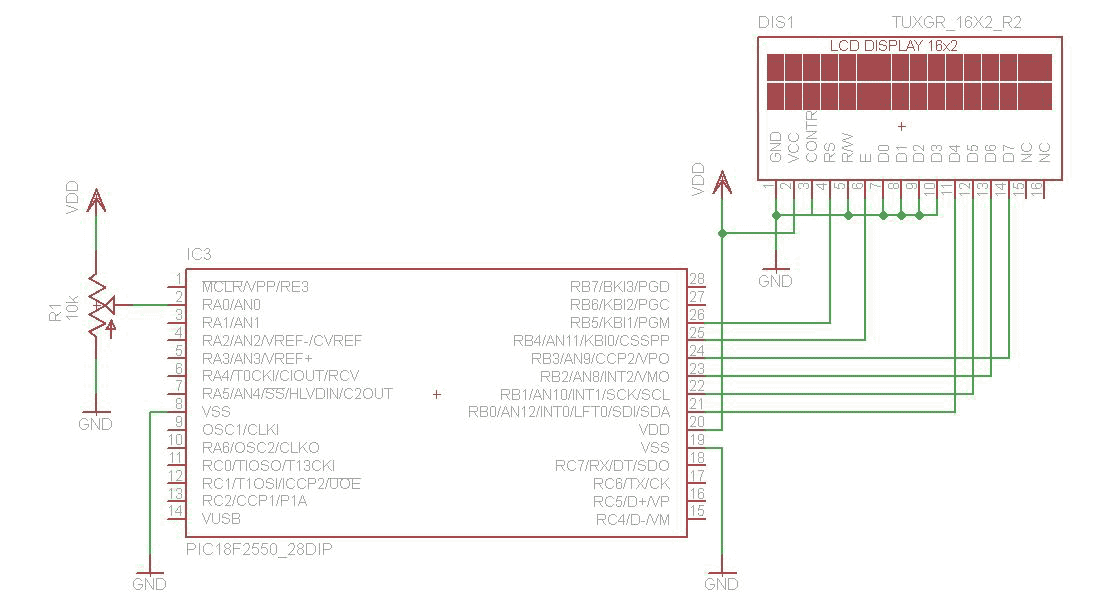
A/D converter 16Bit with LCD and PIC18F2550
The analog to digital converter (ADC) is commonly required in most of the projects. Analog voltage measurement can be done using the ADC hardware built in together in a PIC. The picture below shows a simple setup for measuring the...
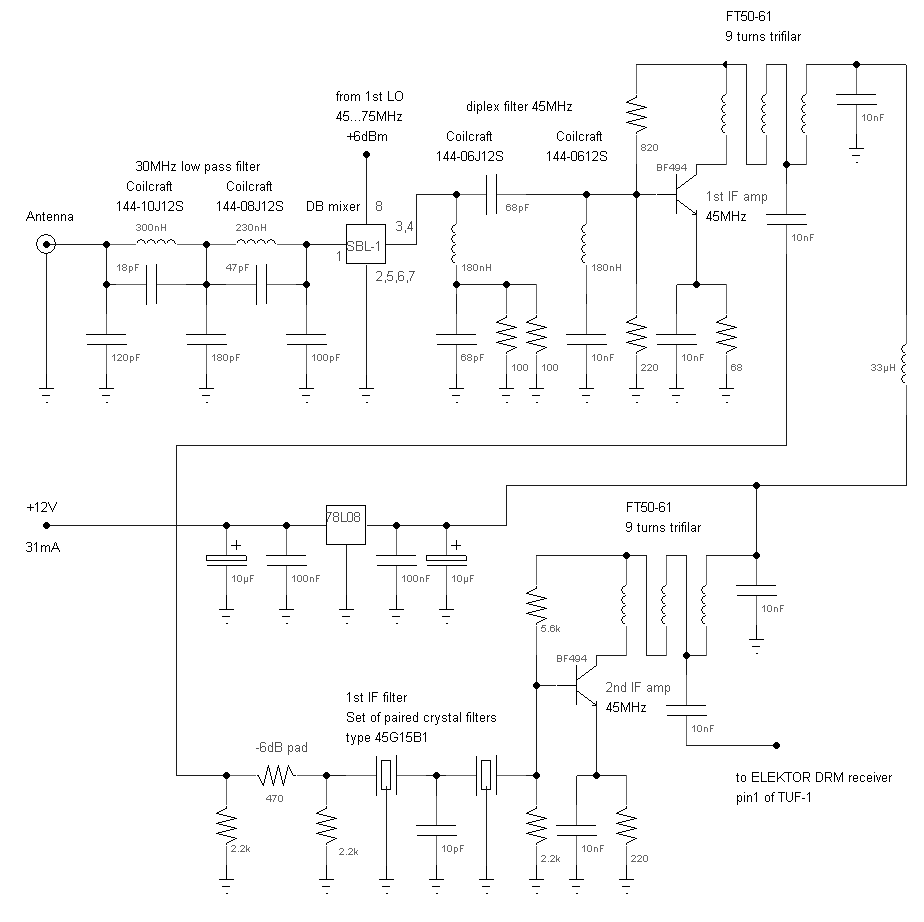
gcr
A 5-pole elliptic low pass filter (impedance: 50 Ohm, -6 dB cutoff frequency 33 MHz) connects the antenna signal to the diode ring mixer, a traditional SBL-1, which performs well even below 500 kHz. A high pass/low pass diplexing filter...
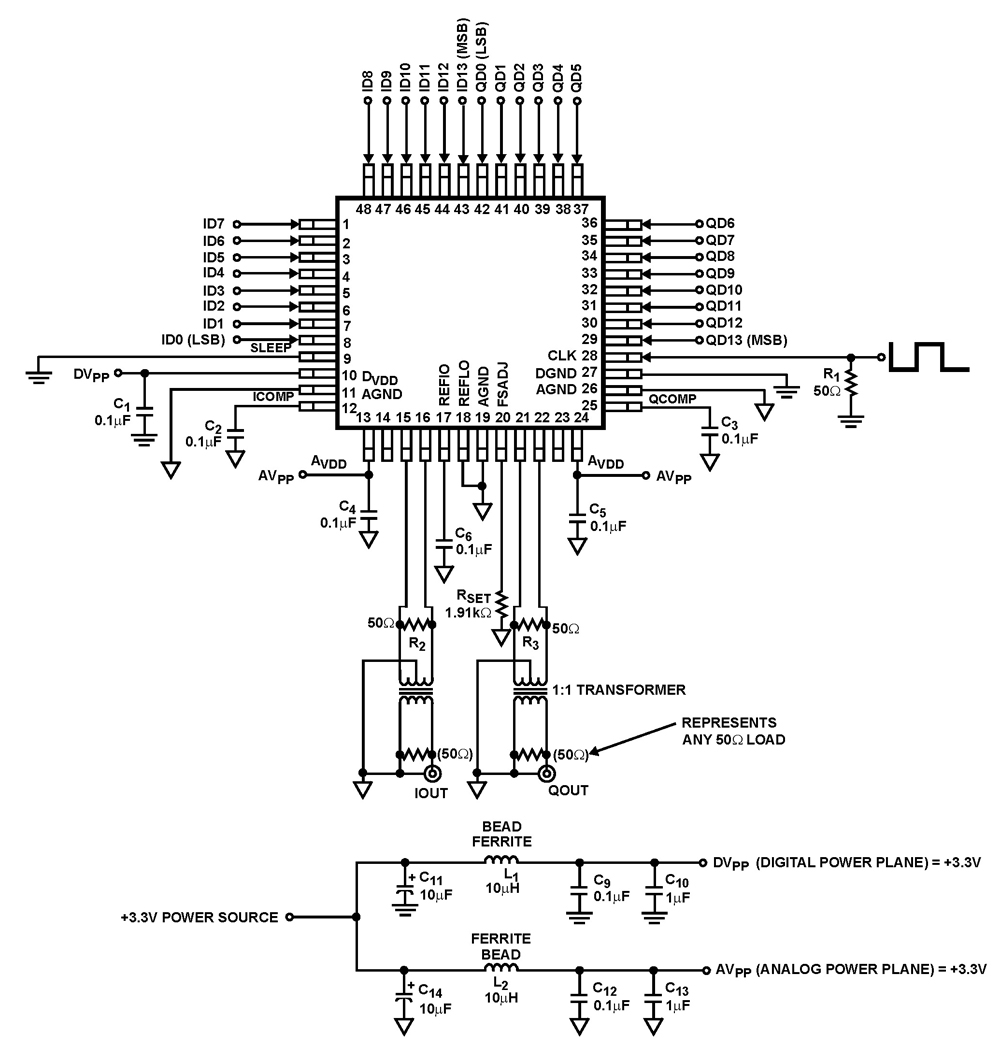
ISL5929 Dual 14-Bit High Speed D/A Converter
The ISL5929 is a dual 14-bit, 130/210+ MSPS (Mega Samples Per Second), CMOS, high-speed, low-power, digital-to-analog converter (DAC) designed specifically for high-performance communication systems, such as base transceiver stations utilizing 2.5G or 3G cellular protocols.
The ISL5929 DAC is engineered to...
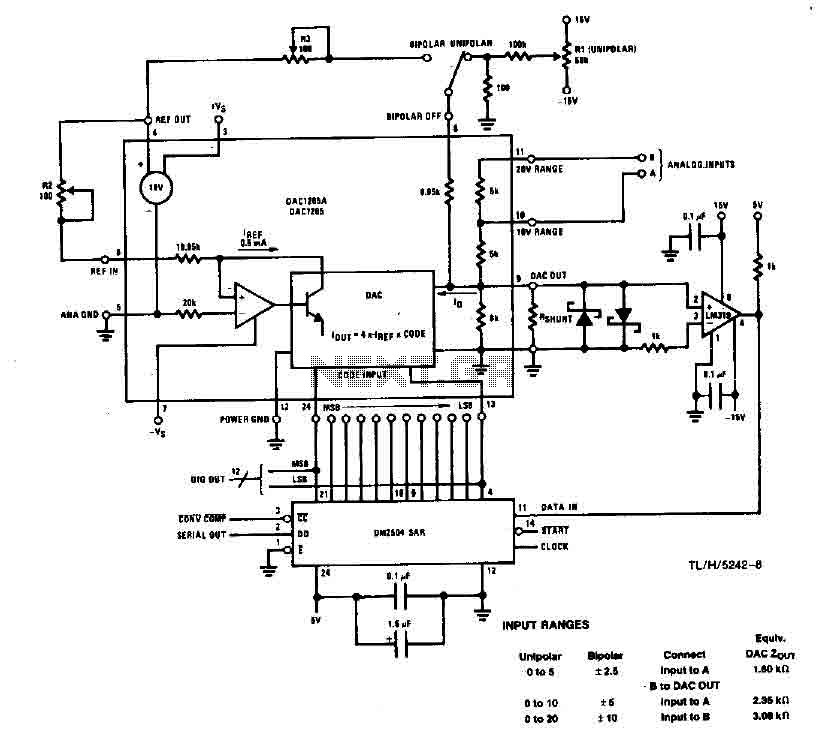
High Speed A/D converter 12-bit
This system performs a complete conversion of 12 bits in both unipolar and bipolar modes. The converter is accurate to ±12-bit LSB with a typical gain temperature coefficient of 10 ppm/°C. In unipolar mode, the system operates within a range...
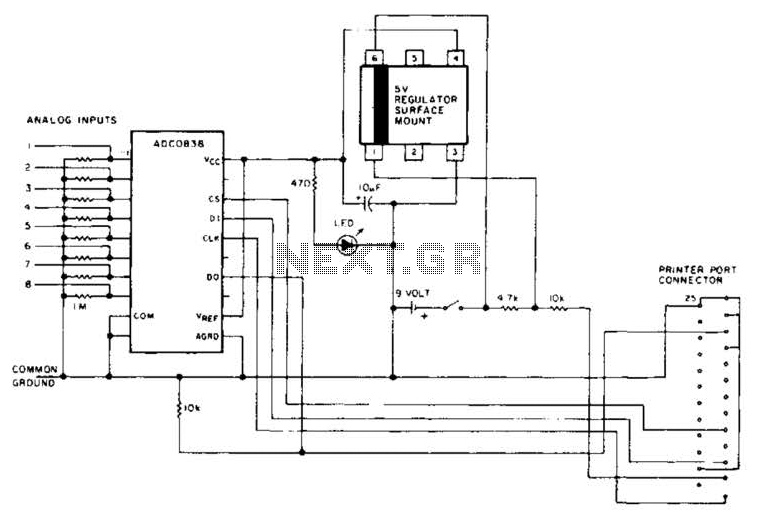
8-Channel A/D Converter For Pc Clones Circuit
An A/D converter by National Semiconductor (ADC0838) converts 0 to 5 V analog inputs into a digital data format. A 9 V battery is utilized. The converter connects to the pointer port connector through a 25-pin connector.
The ADC0838 is a...