


TDA1029 audio signal source switch circuit diagram electronic project
#TDA1029
#audio switch
#operational amplifier
#impedance converter
#signal source
#clamping diodes
#electronic project
#audio signal
#switch circuit
#dual amplifier
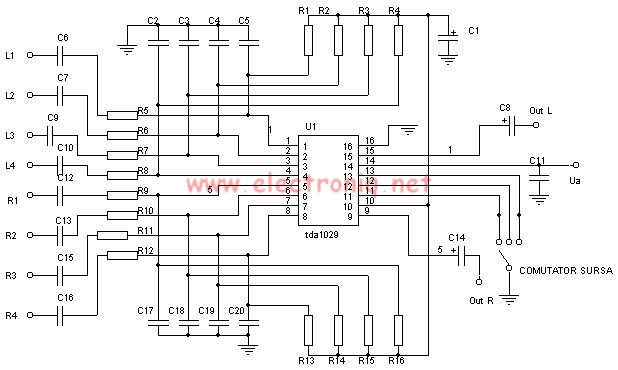
Description: The TDA1029 is a dual operational amplifier configured as an impedance converter. Each amplifier features four mutually switchable inputs that are safeguarded by clamping diodes. Signal sources can be switched in various modes. The electronic components required for this project include: R1, R2, R4, R13, R15, R16 - 120K ohm resistors; R5, R12 - 5.6k ohm resistors; R3, R14 - 680k ohm resistors; C1 - 100 µF polarized capacitor; C2, C7, C9, C12, C14, C20 - 220nF capacitors; C8, C14 - 10 µF polarized capacitors; C11 - 47nF capacitor; U1 - TDA1029 operational amplifier.
The TDA1029 operational amplifier serves as a versatile component in electronic circuits, particularly when configured as an impedance converter. This configuration allows for the efficient transfer of signals from high-impedance sources to low-impedance loads, thus ensuring minimal signal loss and distortion. The dual nature of the TDA1029 enables simultaneous processing of two signals, which can be beneficial in applications requiring differential signal amplification or mixing.
The four mutually switchable inputs on each amplifier facilitate the selection of different signal sources, enhancing the flexibility of the circuit. The presence of clamping diodes provides protection against over-voltage conditions, ensuring the integrity of the operational amplifier and connected components.
The specified resistors and capacitors play critical roles in determining the frequency response and stability of the circuit. For instance, the 120K ohm resistors (R1, R2, R4, R13, R15, R16) can be used to set the gain of the operational amplifier, while the 5.6k ohm resistors (R5, R12) may be employed for biasing purposes. The 680k ohm resistors (R3, R14) can help establish the input impedance, further optimizing the circuit for various applications.
Capacitors C1 through C20 are essential for filtering and decoupling purposes. The 100 µF polarized capacitor (C1) is typically used for power supply decoupling, while the 220nF capacitors (C2, C7, C9, C12, C14, C20) can serve as coupling capacitors, allowing AC signals to pass while blocking DC components. The 10 µF polarized capacitors (C8, C14) may be used in timing applications or for additional power supply filtering, and the 47nF capacitor (C11) can help in stabilizing the feedback loop of the operational amplifier.
In summary, the TDA1029 operational amplifier, along with the specified resistors and capacitors, forms a robust circuit capable of handling various signal processing tasks with high efficiency and reliability. This design can be adapted for multiple applications, including audio processing, sensor signal conditioning, and data acquisition systems.The TDA1029 is a dual operational amplifier (connected as an impedance converter) each amplifier having 4 mutually switchable inputs which are protected by clamping diodes. Signal-sources switch can be made in various mods : Electronic parts required by this electronic project are :R1, R2, R4, R13, R15, R16 - 120K Watt Resistor;R5, R12-5.
6k Watt R esistor;R3-R14-680k Watt Resistor; C1-100 µF pol; C2-C7, C9-C12, C14-C20 220nF C8, C14 10 µF pol; C11 47nF ; U1 TDA1029.
The TDA1029 operational amplifier serves as a versatile component in electronic circuits, particularly when configured as an impedance converter. This configuration allows for the efficient transfer of signals from high-impedance sources to low-impedance loads, thus ensuring minimal signal loss and distortion. The dual nature of the TDA1029 enables simultaneous processing of two signals, which can be beneficial in applications requiring differential signal amplification or mixing.
The four mutually switchable inputs on each amplifier facilitate the selection of different signal sources, enhancing the flexibility of the circuit. The presence of clamping diodes provides protection against over-voltage conditions, ensuring the integrity of the operational amplifier and connected components.
The specified resistors and capacitors play critical roles in determining the frequency response and stability of the circuit. For instance, the 120K ohm resistors (R1, R2, R4, R13, R15, R16) can be used to set the gain of the operational amplifier, while the 5.6k ohm resistors (R5, R12) may be employed for biasing purposes. The 680k ohm resistors (R3, R14) can help establish the input impedance, further optimizing the circuit for various applications.
Capacitors C1 through C20 are essential for filtering and decoupling purposes. The 100 µF polarized capacitor (C1) is typically used for power supply decoupling, while the 220nF capacitors (C2, C7, C9, C12, C14, C20) can serve as coupling capacitors, allowing AC signals to pass while blocking DC components. The 10 µF polarized capacitors (C8, C14) may be used in timing applications or for additional power supply filtering, and the 47nF capacitor (C11) can help in stabilizing the feedback loop of the operational amplifier.
In summary, the TDA1029 operational amplifier, along with the specified resistors and capacitors, forms a robust circuit capable of handling various signal processing tasks with high efficiency and reliability. This design can be adapted for multiple applications, including audio processing, sensor signal conditioning, and data acquisition systems.The TDA1029 is a dual operational amplifier (connected as an impedance converter) each amplifier having 4 mutually switchable inputs which are protected by clamping diodes. Signal-sources switch can be made in various mods : Electronic parts required by this electronic project are :R1, R2, R4, R13, R15, R16 - 120K Watt Resistor;R5, R12-5.
6k Watt R esistor;R3-R14-680k Watt Resistor; C1-100 µF pol; C2-C7, C9-C12, C14-C20 220nF C8, C14 10 µF pol; C11 47nF ; U1 TDA1029.
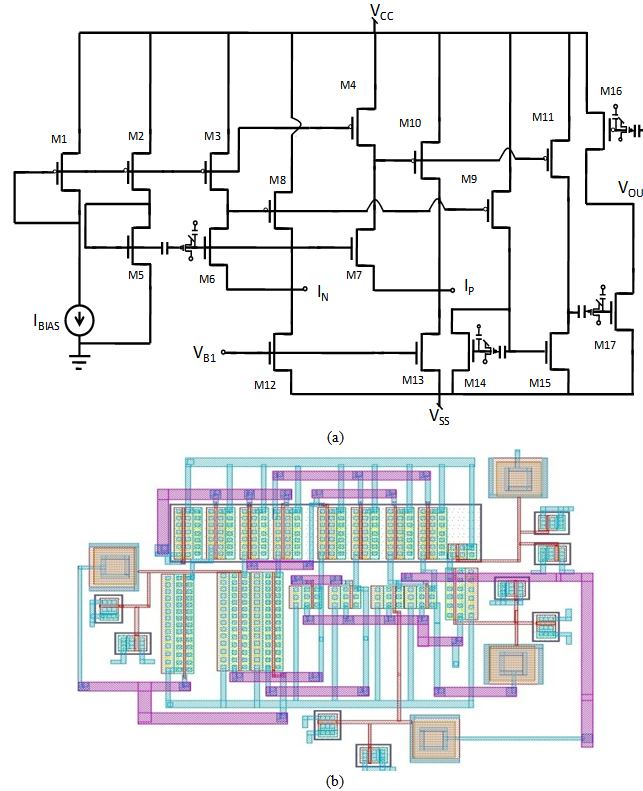
Field-programmable Operational Transresistance Amplifier using Floating-gate MOSFETs
A comprehensive design procedure is proposed for the development of Field-programmable/Reconfigurable Analog Integrated CMOS circuits. Instead of relying on iterative simulation steps to meet design specifications by adjusting the W/L ratios of the FETs, first-order classroom equations are utilized to...
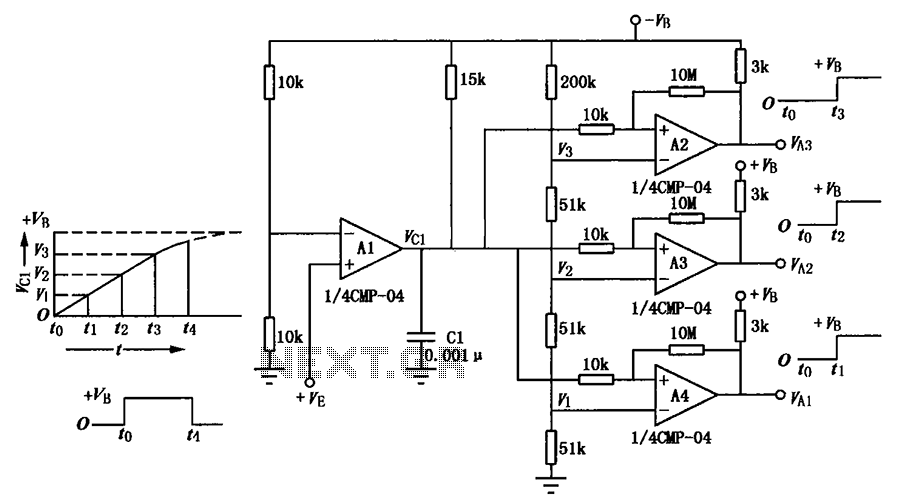
Delay circuit of a multi-level output
A multi-stage delay circuit is presented in this schematic. The operational amplifiers are configured as comparators. Operational amplifier A1 operates when the voltage at the inverting input exceeds + VE. As the voltage at the inverting input of operational amplifiers...
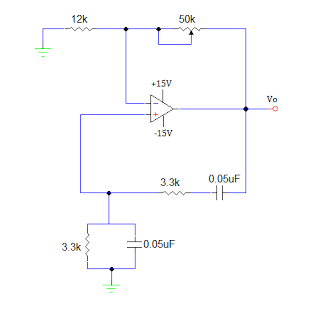
OP AMP SINE WAVE GENERATOR CIRCUIT
An operational amplifier-based sine wave generator circuit, commonly known as a Wien bridge oscillator, is recognized for its simplicity and stability. The Wien bridge oscillator connects the Wien bridge circuit between the amplifier's input and output terminals. The bridge features...
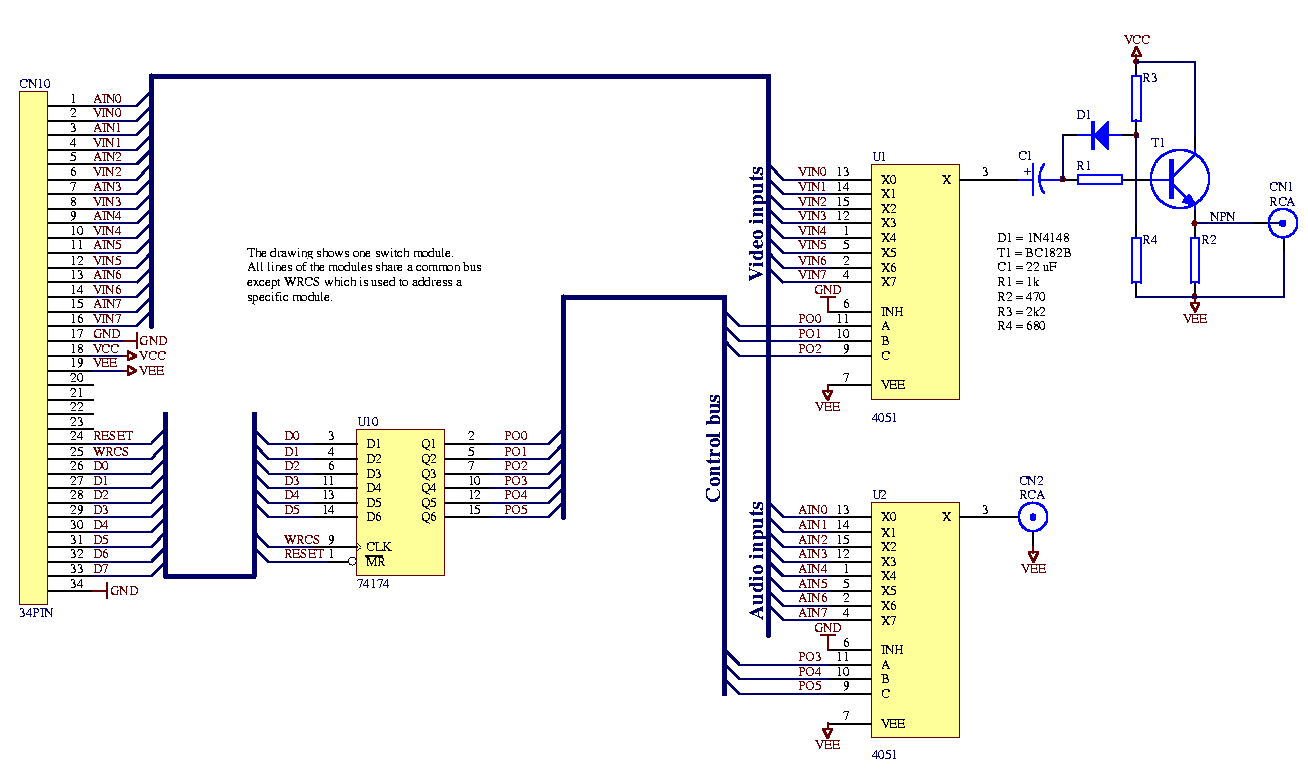
Audio-video switch
Each audio/video output can be switched to any of the eight inputs separately. One module drives one audio/video output and has a 34-pin connector to plug into the system interface. Video operational amplifiers (OPAs) can be used on the 4051...
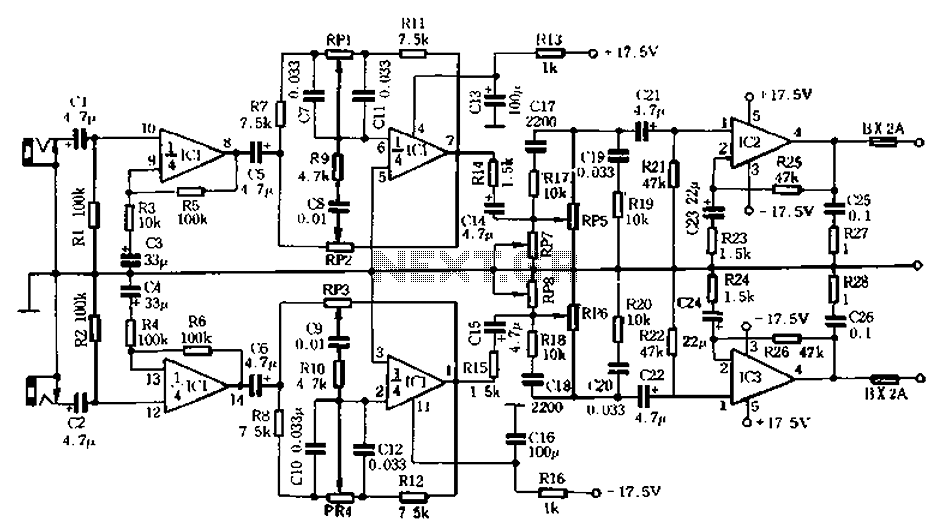
Homemade whole integrated circuit amplifiers 01
The circuit depicted in Figure 5-60 and Figure 6 utilizes an operational amplifier (op-amp) configured as a channel pre-amplifier to address the signal loss introduced by the tone control circuit. Additionally, another group of op-amps forms a channel-driven stage amplifier...
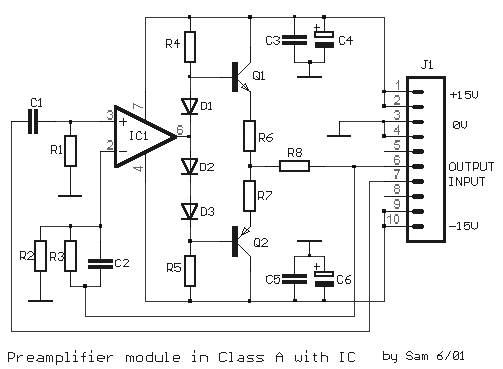
Class A Modular Preamplifier with Single Integrated Circuit
The circuit is based on a single operational amplifier integrated circuit designed to produce a modular preamplifier that operates in Class A configuration.
The modular preamplifier circuit utilizes a single operational amplifier (op-amp) integrated circuit, which serves as the primary amplification...
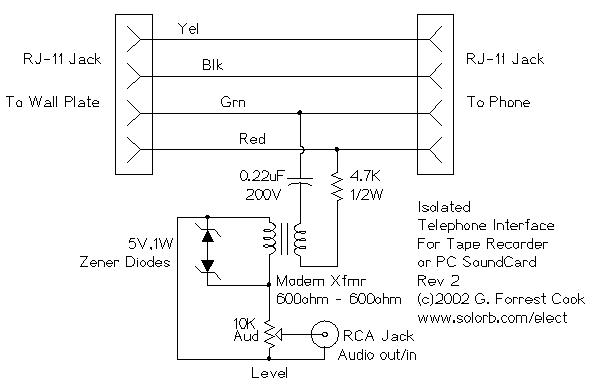
Automobile and Electronic projects
This is an 8-input by 1-output audio/video switch module that can be controlled from a computer, such as through the parallel port. Each audio/video output can be switched to any of the 8 inputs independently. One module drives one audio/video...
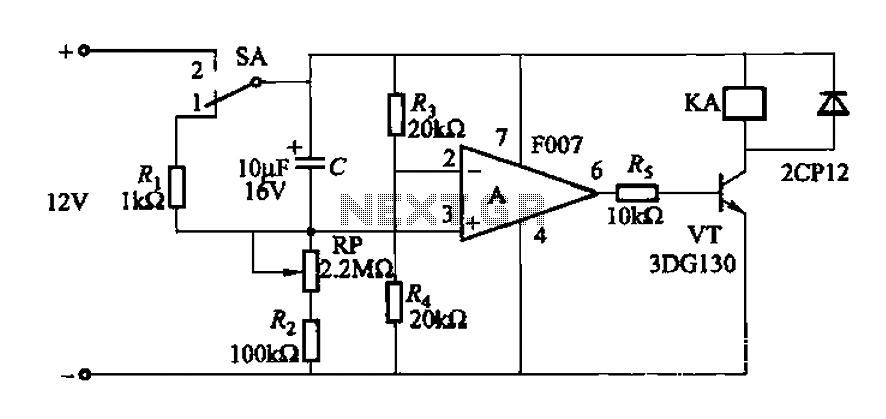
A delay circuit using an operational amplifier
A delay circuit utilizing an operational amplifier functions as a comparator, providing high timing accuracy. The timer's delay range is from 1 to 30 seconds. The delay time is determined by resistors Ri, RP, and capacitor C. By adjusting RP,...
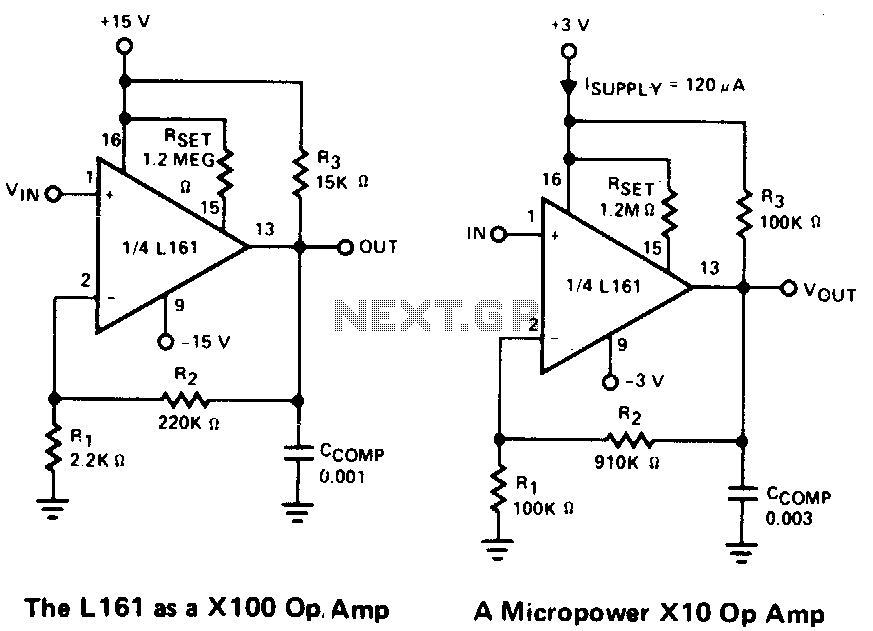
Operational-amplifiers
This is a single gain-of-100 amplifier with a gain-bandwidth product of 20 MHz. The primary limitation in performance is the low slew rate of 0.3 V/μs imposed by the charging of Ccomp. The effects of slew rate and compensation are...