


The Mixer Pre MIC 3 channel by LM348-741G—4
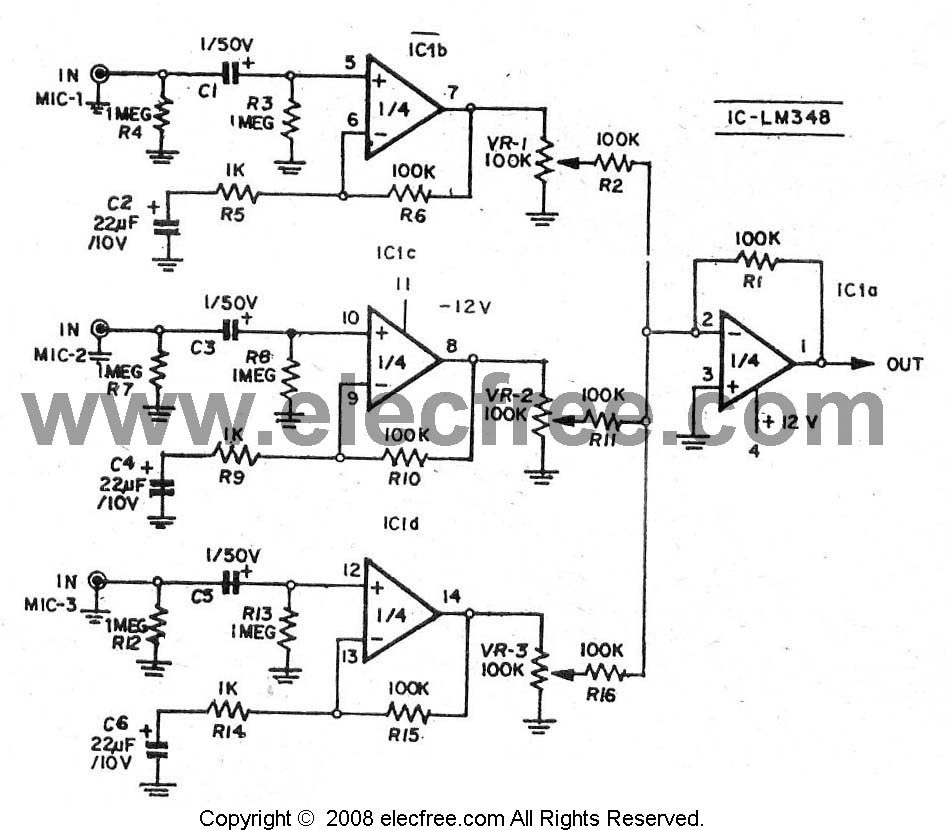
Description: For those seeking a mixer with a microphone, this circuit is highly recommended for easy assembly.
The proposed circuit is designed to serve as a microphone mixer, allowing users to blend audio signals from multiple microphones into a single output. This configuration is particularly useful in applications such as live sound reinforcement, recording studios, and broadcasting environments.
The circuit typically includes several key components: operational amplifiers (op-amps) for signal amplification and mixing, resistors to set gain levels, and capacitors for filtering purposes. The input stage consists of multiple microphone inputs, each connected to an op-amp configured as a non-inverting amplifier. This setup ensures that the audio signals are amplified without inverting their phase, preserving the integrity of the sound.
The mixing process occurs at the output of the op-amps, where resistive mixing is employed. Each microphone's output is fed through a resistor, allowing for the adjustment of individual signal levels before they converge at a single output. This approach provides flexibility in balancing the audio signals, enabling the user to prioritize specific microphones based on their needs.
Additional features may include a master volume control, which allows for overall adjustment of the mixed output signal, and equalization controls to tailor the frequency response of the combined audio. Power supply considerations are also essential, as the circuit typically requires a dual power supply for the op-amps to function effectively.
Overall, this microphone mixer circuit is an accessible and practical solution for users looking to create their own audio mixing setup, offering ease of assembly and effective performance in various audio applications.If you are looking for a mixer with a microphone, and can easily make your own.I highly recommend this circuit.It is a..
The proposed circuit is designed to serve as a microphone mixer, allowing users to blend audio signals from multiple microphones into a single output. This configuration is particularly useful in applications such as live sound reinforcement, recording studios, and broadcasting environments.
The circuit typically includes several key components: operational amplifiers (op-amps) for signal amplification and mixing, resistors to set gain levels, and capacitors for filtering purposes. The input stage consists of multiple microphone inputs, each connected to an op-amp configured as a non-inverting amplifier. This setup ensures that the audio signals are amplified without inverting their phase, preserving the integrity of the sound.
The mixing process occurs at the output of the op-amps, where resistive mixing is employed. Each microphone's output is fed through a resistor, allowing for the adjustment of individual signal levels before they converge at a single output. This approach provides flexibility in balancing the audio signals, enabling the user to prioritize specific microphones based on their needs.
Additional features may include a master volume control, which allows for overall adjustment of the mixed output signal, and equalization controls to tailor the frequency response of the combined audio. Power supply considerations are also essential, as the circuit typically requires a dual power supply for the op-amps to function effectively.
Overall, this microphone mixer circuit is an accessible and practical solution for users looking to create their own audio mixing setup, offering ease of assembly and effective performance in various audio applications.If you are looking for a mixer with a microphone, and can easily make your own.I highly recommend this circuit.It is a..
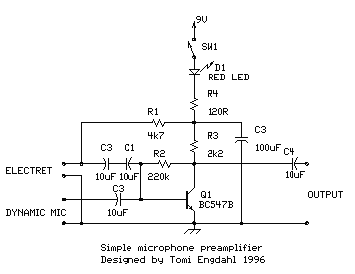
Simple Microphone Preamplifier Project
This is a simple microphone preamplifier circuit designed for use between a microphone and a stereo amplifier. This circuit is compatible with standard home stereo amplifier line, CD, aux, and tape inputs. It can accept both dynamic and electret microphone...
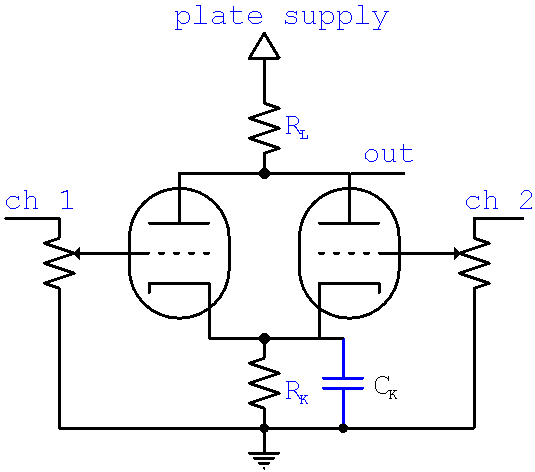
active mixer
The calculator computes the gain and output impedance of a common plate load mixer. Each input channel controls a separate grid, which affects the plate current through the common plate load resistor RL and the cathode resistor RK. The optional...
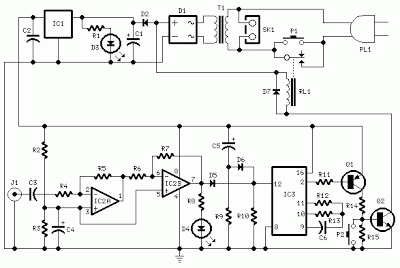
compact dj station circuit diagram
The mixer features two stereo phono inputs and two stereo line-level inputs, along with one stereo bonded channel. It also includes a microphone input and a stereo output with adjustable gain.
The mixer is designed to accommodate a variety of audio...
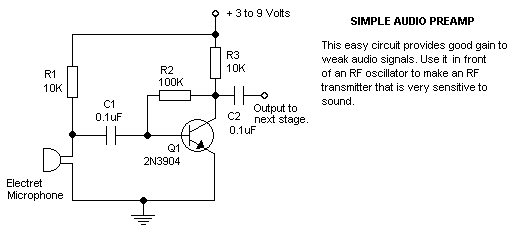
simple mic preamp
this is a very easy circuit to build - all parts can be found at the local electronics shop.
The described circuit is characterized by its simplicity and accessibility, making it an ideal project for beginners or those looking to quickly...
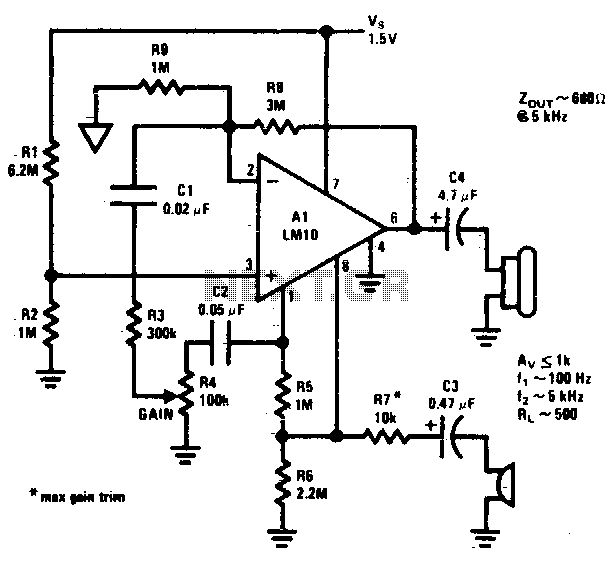
Microphone amplifier
This circuit operates from a 5 V DC source.
The described circuit is powered by a 5 V direct current (DC) supply, which is a common voltage level for many electronic devices and applications. The circuit may utilize various components such...
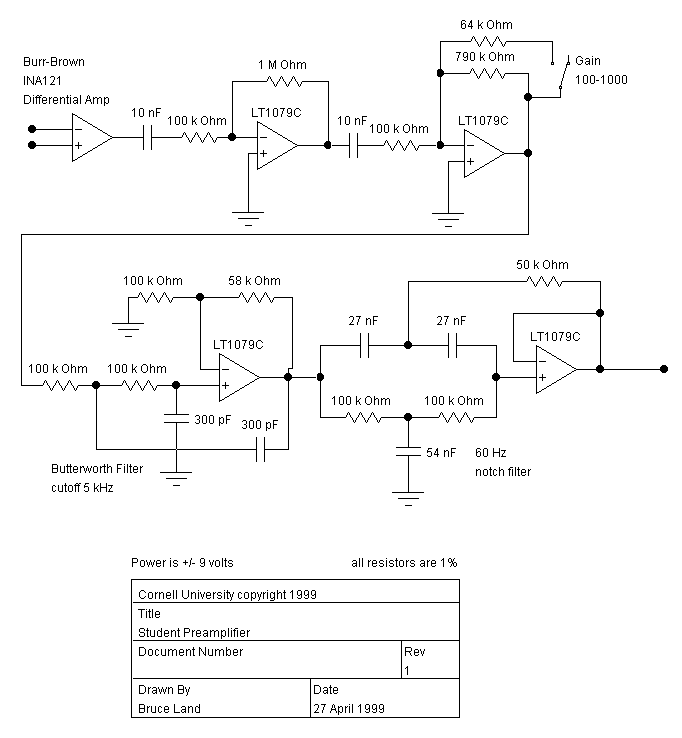
PREAMP
The input stage is critical for common-mode rejection and noise performance. A Burr-Brown INA121 differential amplifier is utilized, configured for a gain of 10. The input stage is DC coupled, and with a 9-volt supply, it can tolerate a differential...
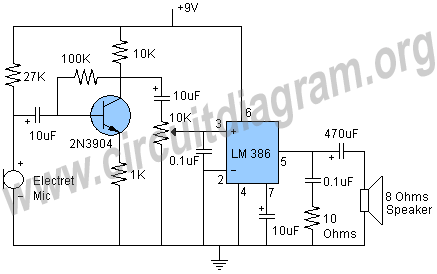
simple mic amplifier
Schematic and description of a simple microphone amplifier circuit. This circuit contains two stages: the first is a microphone preamplifier, and the second is an audio amplifier using the LM386 Amplifier IC.
The simple microphone amplifier circuit is designed to amplify...
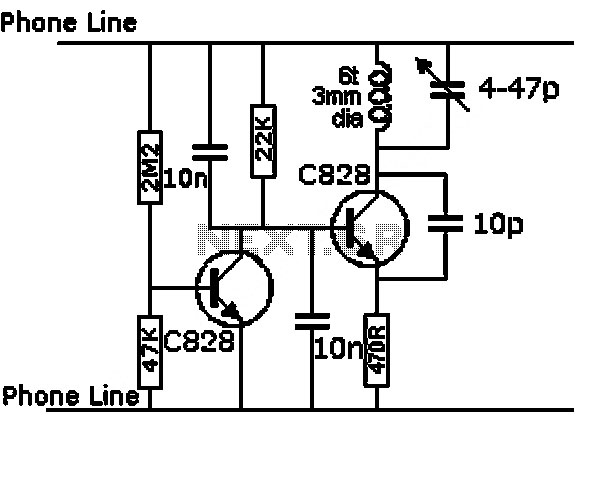
Computer Microphone Circuit
This circuit was designed by Lazar Pancic from Yugoslavia. A typical PC sound card includes a microphone input, speaker output, and occasionally line inputs and outputs. The microphone input is specifically tailored for dynamic microphones with an impedance range of...
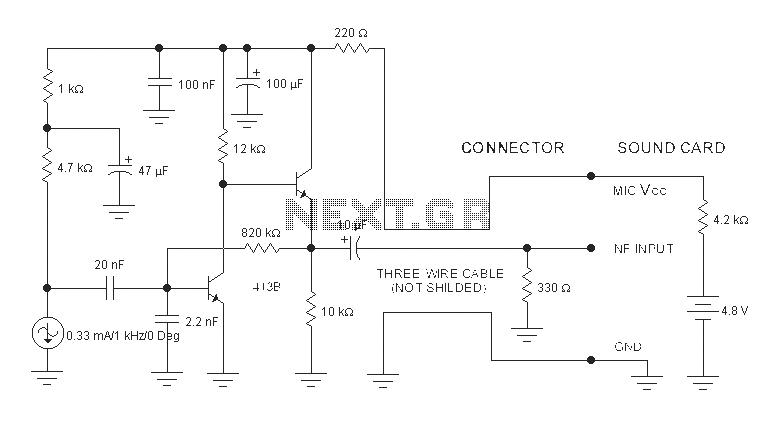
Computer microphone circuit diagram
The sound card for a PC typically includes a microphone input, speaker output, and occasionally line inputs and outputs. The microphone input is specifically designed for dynamic microphones, accommodating an impedance range of 200 to 600 ohms. An adaptation has...