


Ultrasonic sound producer(insect repellent)
#ultrasonic
#sound
#insect repellent
#mosquito
#cockroach
#pest control
#frequency
#audio generator
#irritation
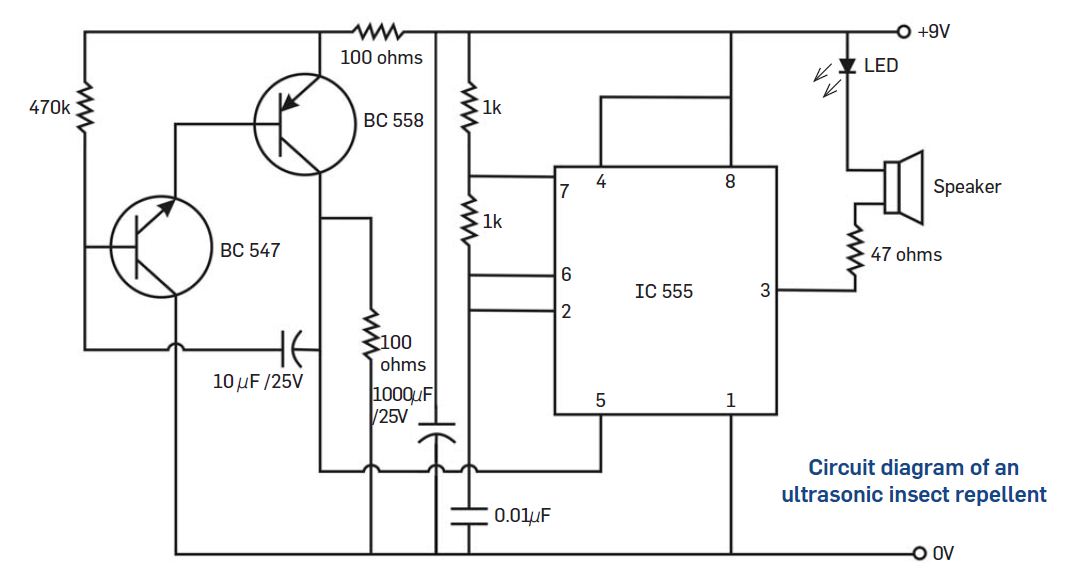
Description: Many types of insects are sensitive to ultrasonic sounds, which can cause them irritation. This project is designed to repel insects such as mosquitoes and cockroaches using ultrasonic sound waves.
The project utilizes an ultrasonic frequency generator, which emits sound waves at frequencies above the audible range for humans but within the sensitivity range for various insects. The circuit typically includes a microcontroller or a dedicated oscillator IC that generates the ultrasonic signals. These signals are then amplified using a power amplifier circuit to ensure they can be emitted at sufficient intensity through a transducer, such as a piezoelectric speaker.
The ultrasonic transducer is strategically placed to maximize the area of effect. The circuit design may also include a variable frequency adjustment feature, allowing the user to change the emitted frequency to find the most effective range for repelling specific types of insects. Additionally, a power supply circuit is necessary to provide the required voltage and current to the ultrasonic generator and amplifier.
To enhance the functionality, the project may incorporate a motion sensor that activates the ultrasonic emitter only when insects are detected, conserving energy and extending the device's operational life. A user interface may also be included to allow for easy adjustments and monitoring of the device's status.
Overall, this electronic schematic effectively combines sound generation, amplification, and control mechanisms to create a practical solution for insect repulsion, leveraging the natural sensitivity of insects to ultrasonic frequencies.As we know many kinds of insects have their tendency to hear ultrasonic sound(which cause them irritation), this project is very useful to swept away those insects like mosquito cockroach etc.
The project utilizes an ultrasonic frequency generator, which emits sound waves at frequencies above the audible range for humans but within the sensitivity range for various insects. The circuit typically includes a microcontroller or a dedicated oscillator IC that generates the ultrasonic signals. These signals are then amplified using a power amplifier circuit to ensure they can be emitted at sufficient intensity through a transducer, such as a piezoelectric speaker.
The ultrasonic transducer is strategically placed to maximize the area of effect. The circuit design may also include a variable frequency adjustment feature, allowing the user to change the emitted frequency to find the most effective range for repelling specific types of insects. Additionally, a power supply circuit is necessary to provide the required voltage and current to the ultrasonic generator and amplifier.
To enhance the functionality, the project may incorporate a motion sensor that activates the ultrasonic emitter only when insects are detected, conserving energy and extending the device's operational life. A user interface may also be included to allow for easy adjustments and monitoring of the device's status.
Overall, this electronic schematic effectively combines sound generation, amplification, and control mechanisms to create a practical solution for insect repulsion, leveraging the natural sensitivity of insects to ultrasonic frequencies.As we know many kinds of insects have their tendency to hear ultrasonic sound(which cause them irritation), this project is very useful to swept away those insects like mosquito cockroach etc.
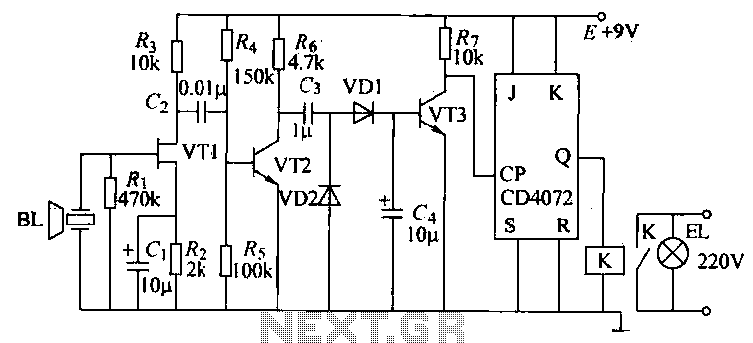
Ultrasonic remote control switch lighting circuit
The T-40-16 and 555 ultrasonic transmitter circuit configuration consists of an ultrasonic transmitter T-40-16 and a 555 timer circuit. By adjusting the potentiometer RP, the oscillation frequency of the circuit can be changed. The output pulse frequency from the 555...
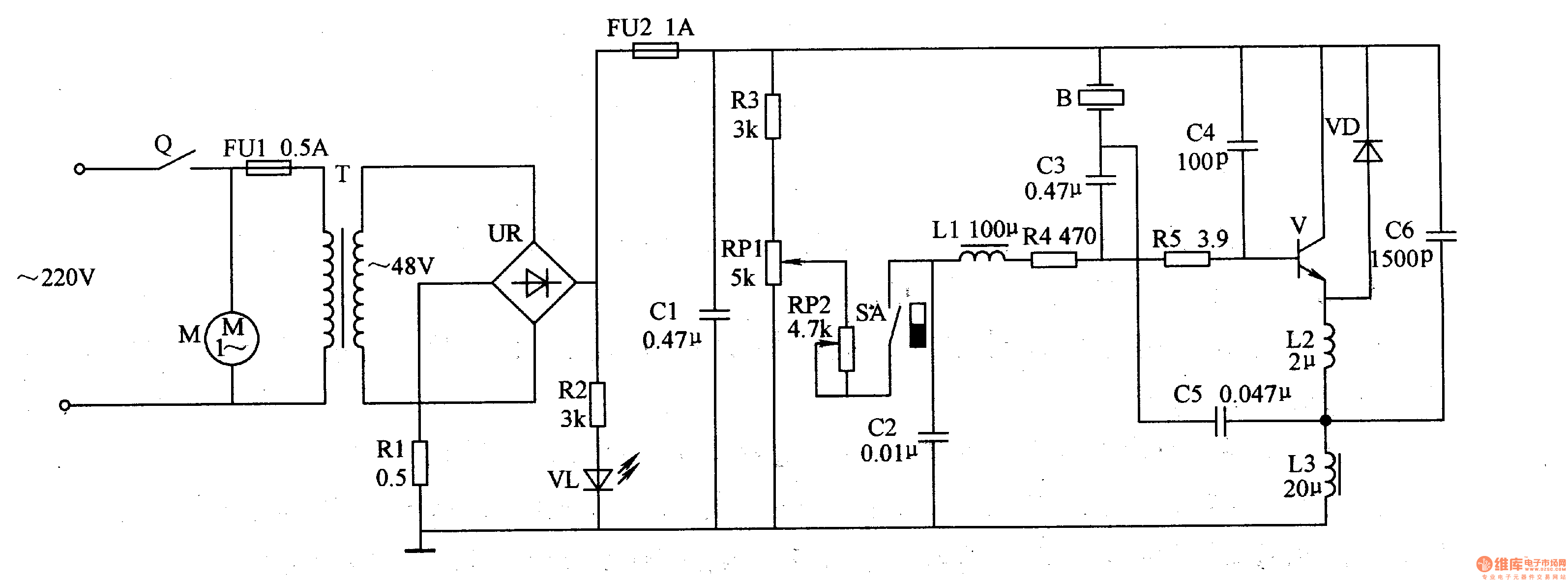
Medical ultrasonic atomizer 2
The medical ultrasonic atomizer circuit consists of a power supply circuit, an atomization amount liquid level detection control circuit, an ultrasonic oscillator, and a fan motor (M). The power supply circuit includes a timer (Q), fuses (FU1, FU2), a power...
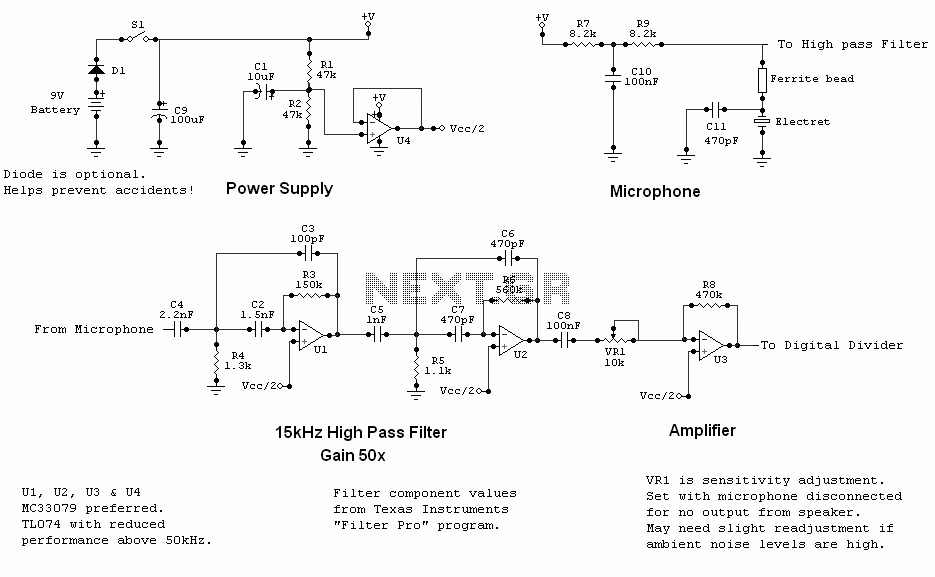
Ultrasonic / Bat detector
I have found this circuit to have better sensitivity, both in distance to a visible bat and in audio frequency, than some other published circuits using a 40kHz transducer with 4000x gain amplification, though the 40kHz transducer I used for...
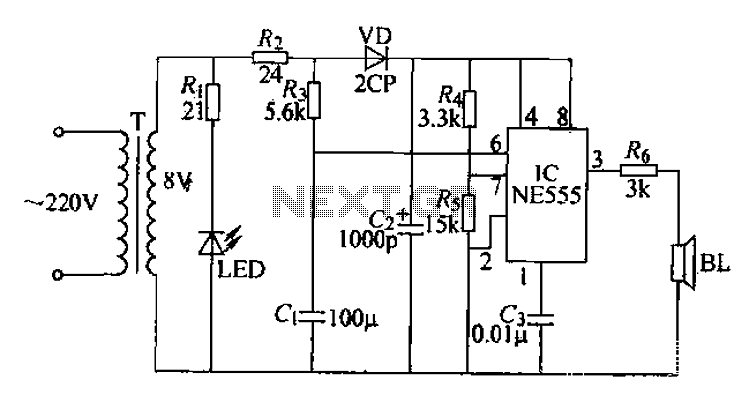
Ultrasonic insect repellent circuit
Electrical pulses are generated by the output of the first base circuit pin and sent through the R6 piezoelectric speaker, which converts the electrical pulses into ultrasonic waves. The circuit operates on a simple sweep principle, utilizing the transformer’s secondary...
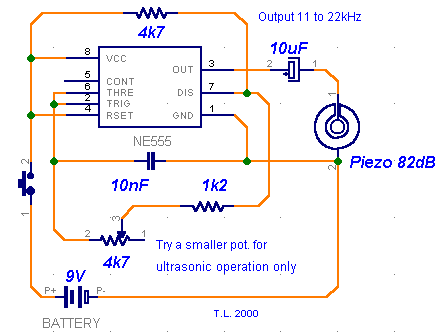
ultrasonic dog whistle
It is well known that many animals are particularly sensitive to high-frequency sounds that humans cannot hear. Many commercial pest repellers based on this principle are available, most of them operating in the range of 30 to 50 kHz. The...
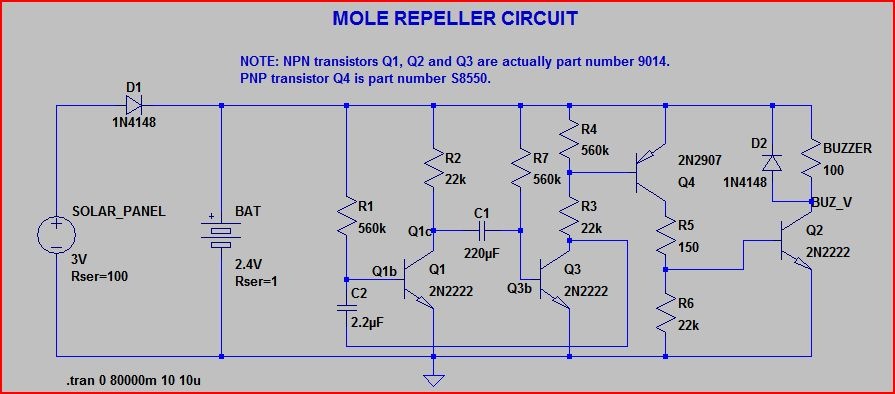
Mole Deterrent Teardown
A healthy population of moles exists in the vicinity, prompting the purchase of four inexpensive ultrasonic mole deterrents from eBay to encourage them to relocate. The devices emit a frequency that is unpleasant to moles, leading them to vacate the...
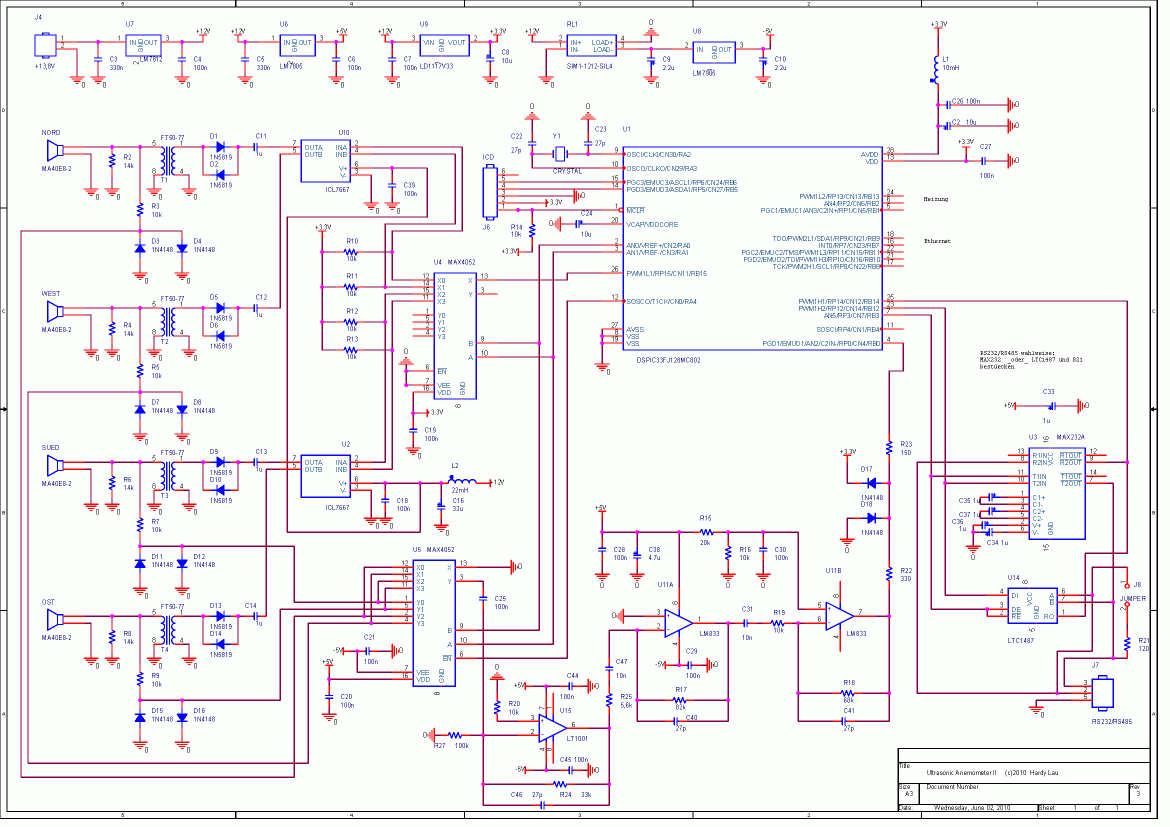
Ultrasonic anemometer Ultrasonic wind sensor
This ultrasonic anemometer is designed for the two-dimensional measurement of horizontal wind speed components and wind direction, as well as virtual temperature. Due to its high measurement rate, the device effectively captures gusts and peak values without delay. The accuracy...
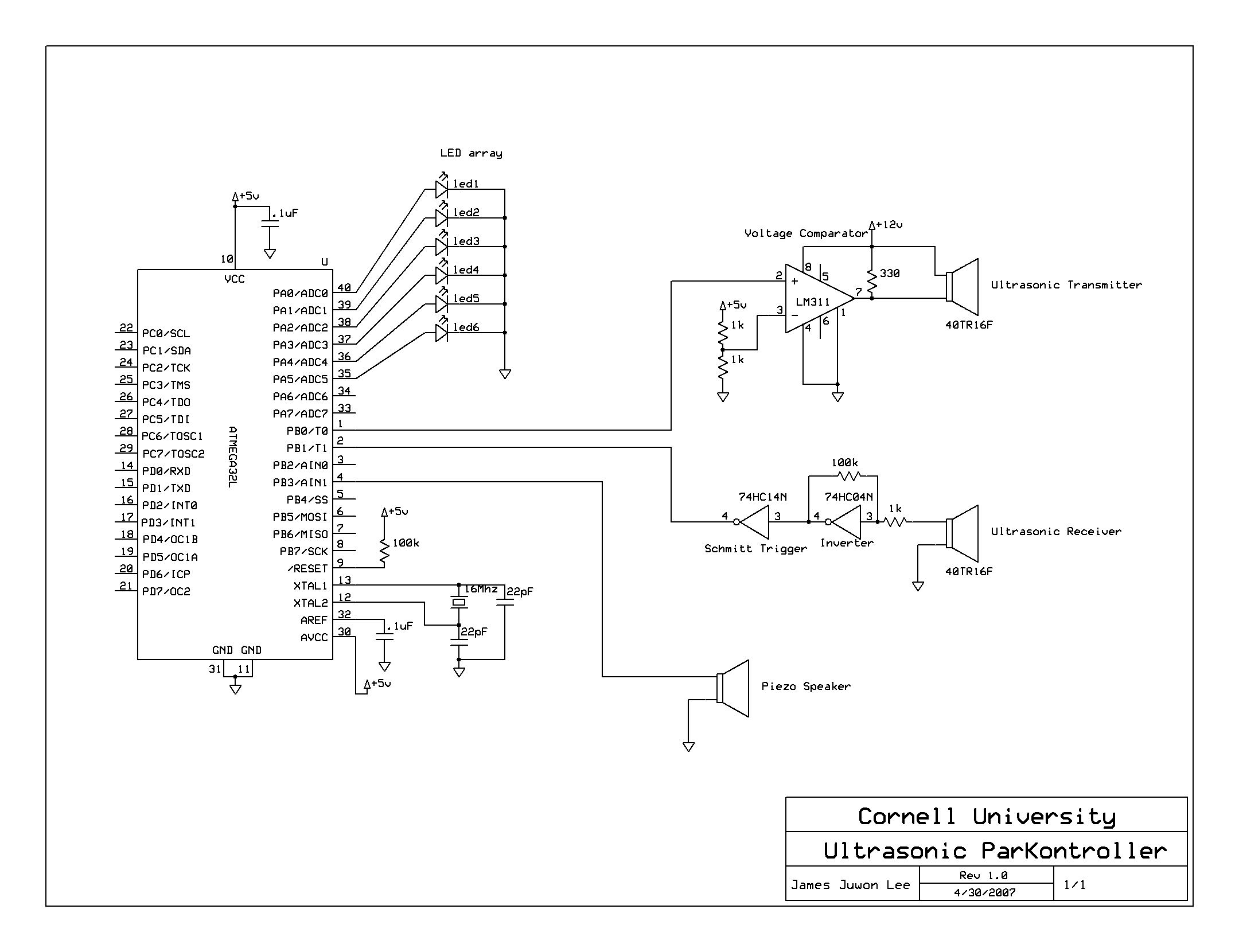
Ultrasonic Parking controller
A series of five short pulses blasted by the microcontroller only has 5V amplitude, which will be attenuated down to less than 20 mV when received by the receiver circuit. Hence, LM311 voltage comparator was used for signal amplification before...
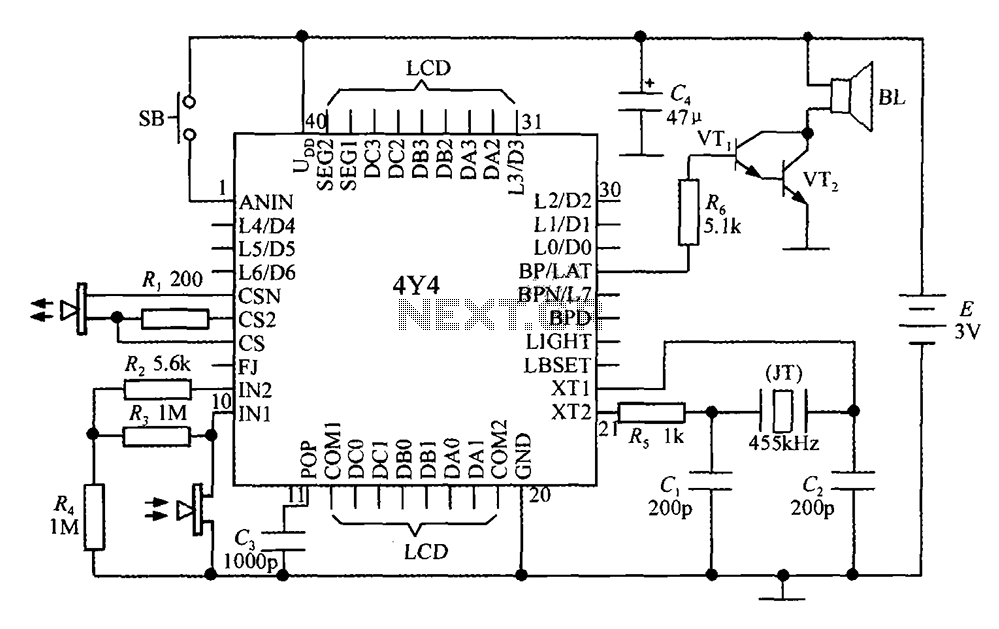
Intelligent Ultrasonic Ranging IC 4Y4 form a monolithic liquid crystal display rangefinder circuit diagram
The 4Y4 is a monolithic liquid crystal display rangefinder circuit. The instrument comprises an ultrasonic transmitter, a receiver, an LCD display, buttons, switches, and a buzzer (or speaker). To simplify wiring, the 4Y4 is directly welded to the back of...