


Wet/Dry Mix Knob - will this schematic work
#audio mixing
#parallel compression
#wet/dry control
#GSSL
#Chameleon Labs 7720
#audio circuit
#signal processing
#knob control
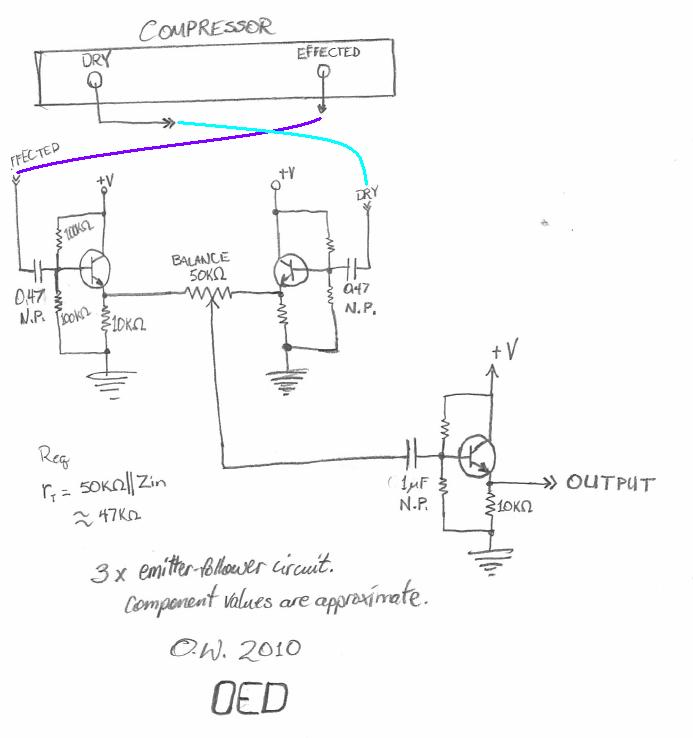
Description: A simple wet/dry knob is desired to be added to a GSSL (Chameleon Labs 7720) for parallel compression. A relevant schematic has been found.
To implement a wet/dry knob for parallel compression on a GSSL (Chameleon Labs 7720), the circuit can be designed using a potentiometer to blend the processed signal with the dry (unprocessed) signal. The wet/dry control allows for real-time adjustment of the ratio between the compressed and uncompressed signals, providing flexibility in the mixing process.
The typical configuration includes a dual-gang potentiometer, where one section controls the wet signal and the other controls the dry signal. The potentiometer's wiper connects to the output of the compressor, while the other end connects to the unprocessed signal path. The two signals are then fed into a summing amplifier or directly into the output stage of the circuit.
In the schematic, the wet signal path should include any necessary components such as capacitors for coupling and resistors for impedance matching. It is essential to ensure that the levels of both signals are balanced to avoid distortion or loss of fidelity. The output of the summing stage can then be routed to the main output of the unit.
Additionally, care should be taken to maintain the integrity of the original signal path, ensuring that the addition of the wet/dry knob does not introduce unwanted noise or interference. Proper grounding and shielding techniques should be employed to minimize these issues.
Overall, the implementation of a wet/dry knob in the GSSL for parallel compression enhances the versatility of the audio processing, allowing for creative control over the final sound output.Hi I am looking to add a simple wet/dry knob to a gssl (actually chameleon labs 7720) for parallel compression. Came across this schematic - it seems..
To implement a wet/dry knob for parallel compression on a GSSL (Chameleon Labs 7720), the circuit can be designed using a potentiometer to blend the processed signal with the dry (unprocessed) signal. The wet/dry control allows for real-time adjustment of the ratio between the compressed and uncompressed signals, providing flexibility in the mixing process.
The typical configuration includes a dual-gang potentiometer, where one section controls the wet signal and the other controls the dry signal. The potentiometer's wiper connects to the output of the compressor, while the other end connects to the unprocessed signal path. The two signals are then fed into a summing amplifier or directly into the output stage of the circuit.
In the schematic, the wet signal path should include any necessary components such as capacitors for coupling and resistors for impedance matching. It is essential to ensure that the levels of both signals are balanced to avoid distortion or loss of fidelity. The output of the summing stage can then be routed to the main output of the unit.
Additionally, care should be taken to maintain the integrity of the original signal path, ensuring that the addition of the wet/dry knob does not introduce unwanted noise or interference. Proper grounding and shielding techniques should be employed to minimize these issues.
Overall, the implementation of a wet/dry knob in the GSSL for parallel compression enhances the versatility of the audio processing, allowing for creative control over the final sound output.Hi I am looking to add a simple wet/dry knob to a gssl (actually chameleon labs 7720) for parallel compression. Came across this schematic - it seems..
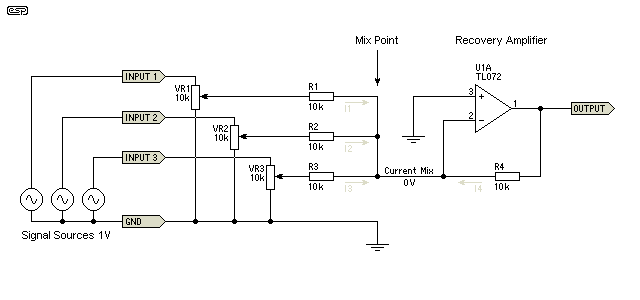
audio mixing
The fundamental principles of mixing audio signals are simple, yet they are often not clearly explained online. This article aims to address those gaps.
Mixing audio signals involves combining multiple sound sources to create a cohesive audio output. The process requires...
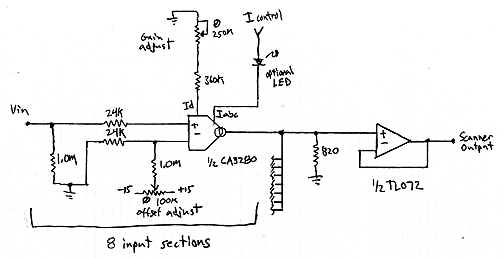
Interpolating Scanner Circuit
This design is for an interpolating scanner, a circuit featuring multiple signal inputs, a control voltage input, and a signal output. The output selectively transitions between inputs, smoothly fading from one to the next as the control voltage increases. A...