


Car Reversing Horn With Flasher
#car horn
#NE556
#timer
#flasher
#reversing sensor
#automotive safety
#dual timer
#vehicle electronics
#alarm
#sound generator
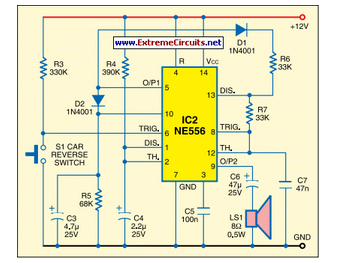
Description: This circuit activates the car horn when the vehicle is in reverse gear. It utilizes a dual timer NE556 to generate the necessary signals.
The described circuit employs a dual timer IC, specifically the NE556, which is a versatile component commonly used in timing applications. In this configuration, the NE556 is set up to detect the reverse gear activation of a vehicle. When the car is shifted into reverse, a signal is sent to the NE556, triggering it to generate a tone or beep through the car's horn.
The circuit typically includes a few additional components to ensure proper operation. A power supply, often sourced from the vehicle's battery, provides the necessary voltage to the NE556. Resistors and capacitors are used in conjunction with the timer to define the timing intervals and the frequency of the output signal, which can be adjusted to achieve the desired sound characteristics of the horn.
Input from the vehicle’s reverse light switch can be connected to the trigger pin of the NE556. This input ensures that the circuit is only activated when the vehicle is indeed in reverse, preventing accidental horn activation. The output from the NE556 can be connected to a relay, which in turn activates the car horn, allowing for higher current flow than the timer IC can handle directly.
In summary, this circuit provides a practical solution for alerting pedestrians and other drivers when a vehicle is in reverse, enhancing safety through audible warnings. The use of the NE556 timer makes the circuit reliable and efficient, suitable for automotive applications.Here is a simple circuit that starts playing the car horn whenever your car is in reverse gear. The circuit (1) employs dual timer NE556 to generate the s..
The described circuit employs a dual timer IC, specifically the NE556, which is a versatile component commonly used in timing applications. In this configuration, the NE556 is set up to detect the reverse gear activation of a vehicle. When the car is shifted into reverse, a signal is sent to the NE556, triggering it to generate a tone or beep through the car's horn.
The circuit typically includes a few additional components to ensure proper operation. A power supply, often sourced from the vehicle's battery, provides the necessary voltage to the NE556. Resistors and capacitors are used in conjunction with the timer to define the timing intervals and the frequency of the output signal, which can be adjusted to achieve the desired sound characteristics of the horn.
Input from the vehicle’s reverse light switch can be connected to the trigger pin of the NE556. This input ensures that the circuit is only activated when the vehicle is indeed in reverse, preventing accidental horn activation. The output from the NE556 can be connected to a relay, which in turn activates the car horn, allowing for higher current flow than the timer IC can handle directly.
In summary, this circuit provides a practical solution for alerting pedestrians and other drivers when a vehicle is in reverse, enhancing safety through audible warnings. The use of the NE556 timer makes the circuit reliable and efficient, suitable for automotive applications.Here is a simple circuit that starts playing the car horn whenever your car is in reverse gear. The circuit (1) employs dual timer NE556 to generate the s..
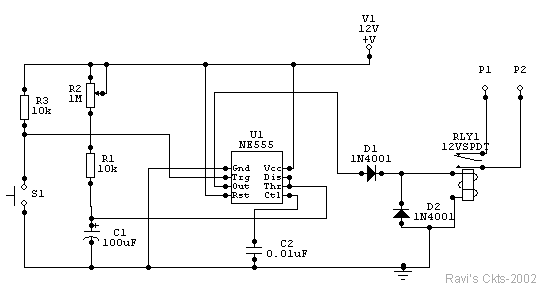
Photo Timer Circuit
The time is set by potentiometer R2, which provides a range from 1 second to 100 seconds, using a timing capacitor C1 of 100 µF. The output at pin 3 is normally low, keeping the relay in the off state.
The...
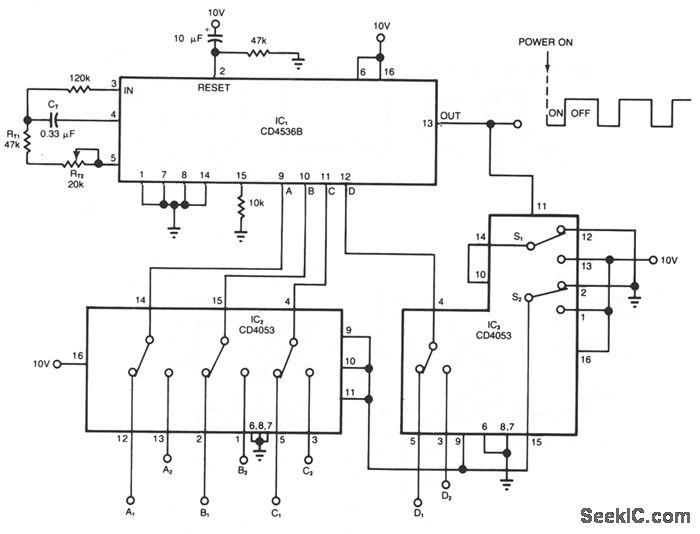
SEQUENTIAL TIMER
The timer circuit provides independent control of the output's on and off intervals, which can range from 0.055 seconds to 30 minutes, with minimal impact from power-line transients. IC1 is a CMOS programmable timer chip that features 24 ripple-binary counter...
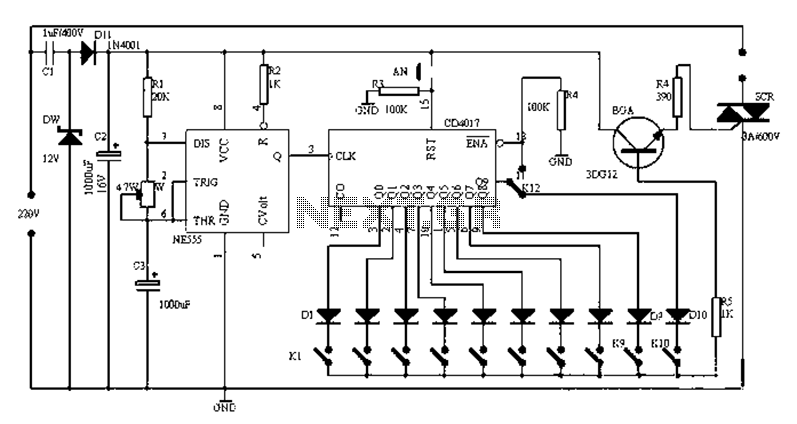
Universal electronic timer circuit diagram
Figure 1-1 illustrates a general-purpose timer capable of timing intervals ranging from 5 minutes to 18 hours. The timing cycle can be adjusted to span from 5 minutes to 20 hours, with a maximum control time of 18 hours. The...
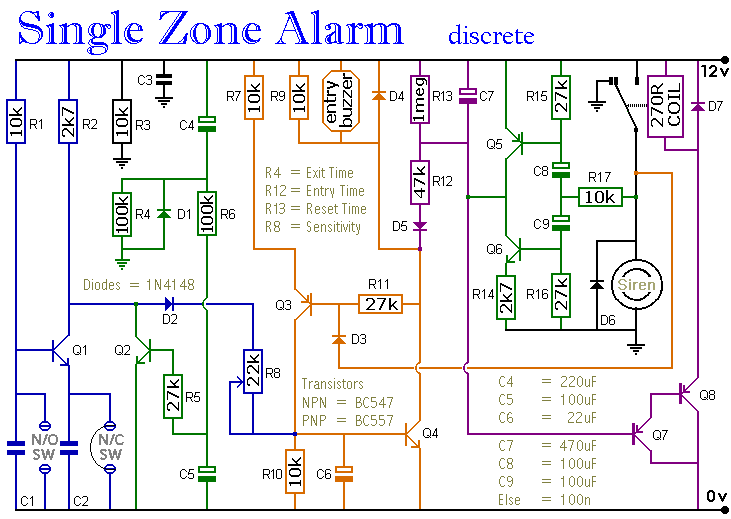
Single Zone Alarm
A single zone alarm circuit with entry and exit delay and other facilities. The circuit features automatic exit and entry delays, timed bell cut-off and system reset. It has provision for normally open and normally closed switches and will suit...
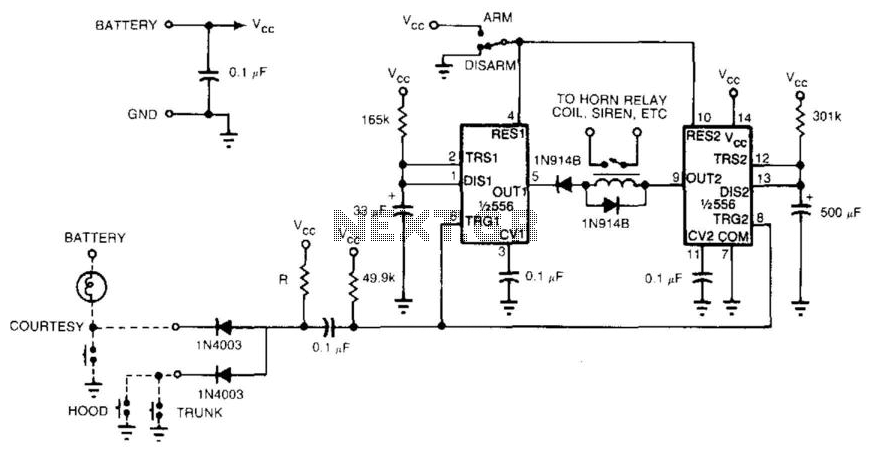
Single-Ic Alarm
With a single integrated circuit (IC), it is possible to construct a straightforward and dependable auto burglar alarm or a similar alarm system. Refer to (a) for the timing information related to the alarm circuit in (b). When leaving the...
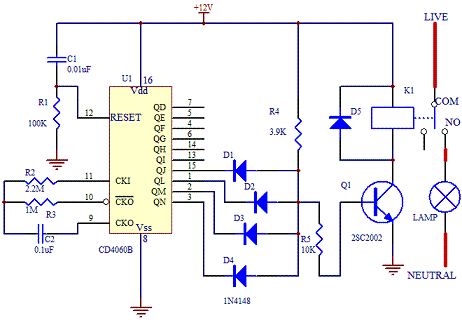
Electronic Timer Switch
This electronic timer switch will turn on a light for 100 seconds, turn it off for another 100 seconds, and then turn it on again for 100 seconds after an hour of powering up the circuit. It is a good...
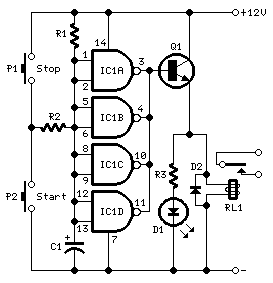
long delay timer circuit diagram
This timer was designed primarily to turn off a portable radio after a specific duration. This feature allows users to fall asleep on the beach or in a hammock, with the assurance that the radio will automatically shut off after...

Cuckoo-song Generator
Agreeable, very close sound imitation Suitable for sound effects, door-bells etc. This circuit generates a two-tone effect very much alike the cuckoo song. It can be used for door-bells or other purposes thanks to a built-in audio amplifier and loudspeaker....
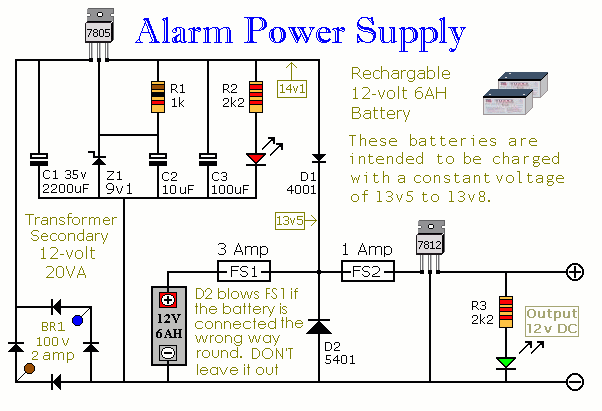
Alarm Power Supply
This power supply is suitable for a modular burglar alarm but can also serve other applications. It is designed to provide a 12-volt output with a current capacity of up to 1 amp. In case of mains failure, the backup...