


Directional-signals-monitor
#unijunction transistor
#audio oscillator
#speaker
#turn-signal
#resistor
#capacitor
#diode
#automotive
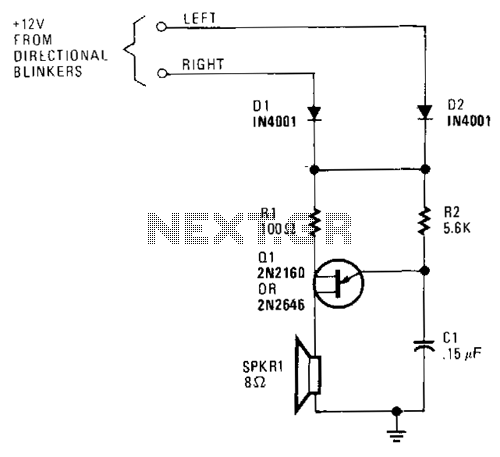
Description: A unijunction transistor audio oscillator drives a small speaker. The oscillator's frequency is determined by resistor R2 and capacitor C2. The operating voltage is supplied from the car's turn-signal circuit(s) through D1 and D2. The diodes conduct current from the blinker circuit that is energized and prevent stray current flow to the other blinker circuit.
The circuit utilizes a unijunction transistor (UJT) as the primary oscillating element. The UJT is characterized by its negative resistance region, which enables it to generate oscillations. In this configuration, the UJT is connected in such a way that it forms an oscillator circuit, with the frequency of oscillation being determined by the values of resistor R2 and capacitor C2. The choice of these components directly influences the charge and discharge time of capacitor C2, thereby establishing the output frequency that drives the connected speaker.
The power supply for this oscillator circuit is sourced from the vehicle's turn-signal circuit. Diodes D1 and D2 are employed to ensure that the circuit receives the appropriate voltage while preventing feedback or interference from other circuits within the vehicle. When one blinker circuit is activated, the corresponding diode conducts, allowing current to flow into the oscillator. This design effectively isolates the oscillator from the other blinker circuit, ensuring stable operation without unwanted cross-talk.
The small speaker connected to the output of the oscillator converts the electrical oscillations into audible sound. The frequency of the sound produced correlates with the design parameters of the oscillator, allowing for a range of audio outputs depending on the values of R2 and C2. This simple yet effective circuit design is commonly used in automotive applications to provide audible alerts or signals in conjunction with visual indicators.A unijunction transistor audio oscillator drives a small speaker. The oscillator"s frequency is determined by resistor R2 and capacitor C2. The ope rating voltage is supplied from the car"s turn-signal circuit(s) through Dl and D2. "The diodes conduct current from the blinker circuit that is energized, and prevent stray current flow to the other blinker circuit.
The circuit utilizes a unijunction transistor (UJT) as the primary oscillating element. The UJT is characterized by its negative resistance region, which enables it to generate oscillations. In this configuration, the UJT is connected in such a way that it forms an oscillator circuit, with the frequency of oscillation being determined by the values of resistor R2 and capacitor C2. The choice of these components directly influences the charge and discharge time of capacitor C2, thereby establishing the output frequency that drives the connected speaker.
The power supply for this oscillator circuit is sourced from the vehicle's turn-signal circuit. Diodes D1 and D2 are employed to ensure that the circuit receives the appropriate voltage while preventing feedback or interference from other circuits within the vehicle. When one blinker circuit is activated, the corresponding diode conducts, allowing current to flow into the oscillator. This design effectively isolates the oscillator from the other blinker circuit, ensuring stable operation without unwanted cross-talk.
The small speaker connected to the output of the oscillator converts the electrical oscillations into audible sound. The frequency of the sound produced correlates with the design parameters of the oscillator, allowing for a range of audio outputs depending on the values of R2 and C2. This simple yet effective circuit design is commonly used in automotive applications to provide audible alerts or signals in conjunction with visual indicators.A unijunction transistor audio oscillator drives a small speaker. The oscillator"s frequency is determined by resistor R2 and capacitor C2. The ope rating voltage is supplied from the car"s turn-signal circuit(s) through Dl and D2. "The diodes conduct current from the blinker circuit that is energized, and prevent stray current flow to the other blinker circuit.
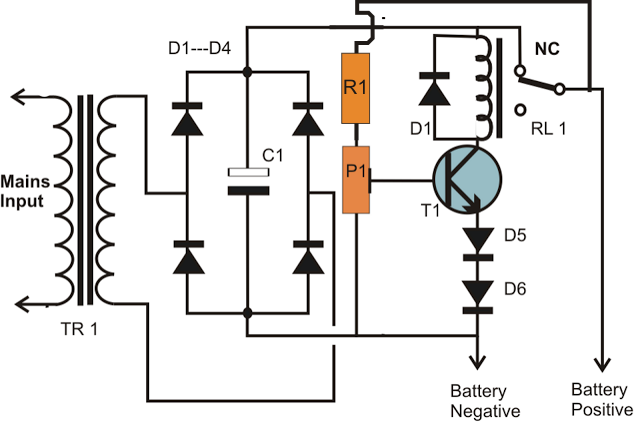
simplest smf automotive battery charger
A simple battery charger circuit is described, utilizing a single transistor for voltage detection and automatically disconnecting the battery from the supply when fully charged. The circuit's high voltage trip point is set to switch off the charging voltage when...
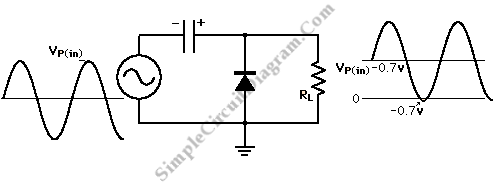
Signal Clamper Using Diode
A diode and capacitor can be utilized to clamp an AC signal, shifting the level into the positive region for all cycles. This condition is sometimes necessary to ensure a positive output.
In an electronic circuit, clamping is a technique used...
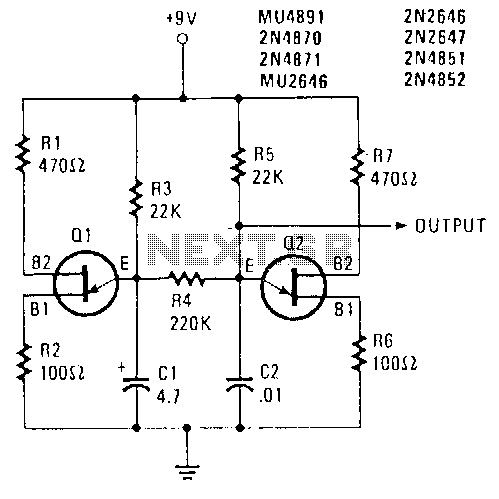
Yelping-siren
Unijunction transistors Q1 and Q2 are configured as relaxation-type sawtooth oscillators. Transistor Q1 serves as the low-frequency control oscillator, while Q2 functions as the tone generator. Sawtooth waveforms are generated at the emitter terminals. In the absence of resistor R4...
Diode Tube
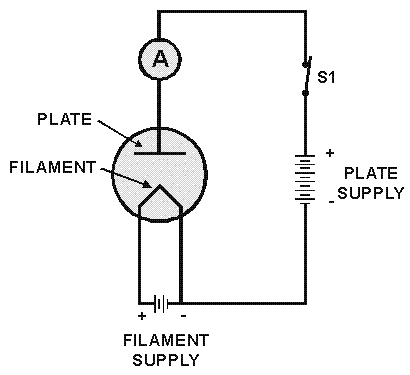
The diode tube under examination is essentially Edison’s early incandescent bulb containing a plate. The term "diode" refers to the two elements or electrodes within the glass container that constitute the tube. Shortly after the discovery of the Edison effect,...
Unijunction metronome
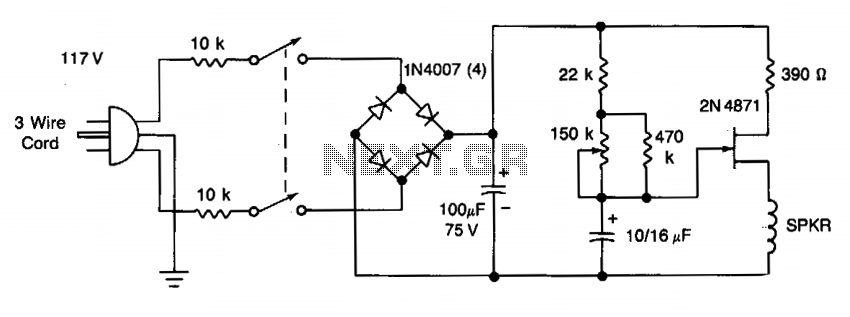
The frequency of the UJT oscillator is determined by the 100 µF capacitor and the effective resistance of the 22 Ω and 470 Ω resistors, along with a potentiometer. The rate can be varied from 42 to 208 beats per...
ELF MONITOR
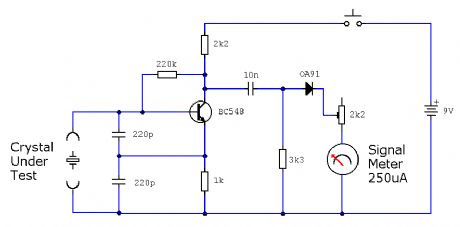
The capacitor instrument is not intended for measuring the capacitance of capacitors; rather, it is designed to identify whether a capacitor is functional or defective, as well as to detect short circuits or open circuits. This functionality provides reliable quality...
Audio Test Oscillator
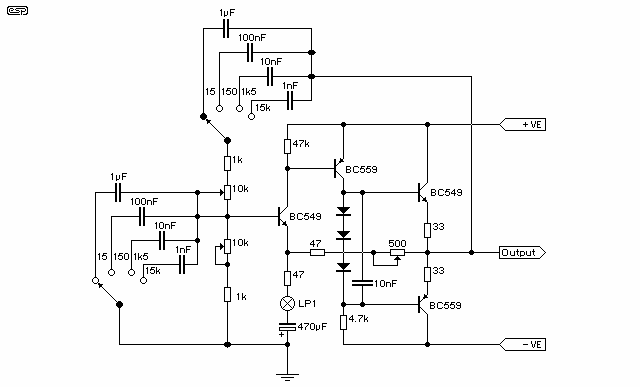
As a piece of test equipment, an audio oscillator has to be considered essential for anyone working in with hi-fi gear. Together with an audio millivoltmeter (as described in Project 16), and even better if you have access to an...
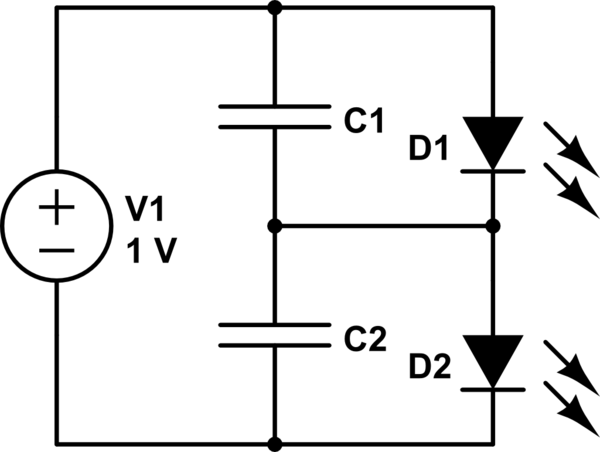
Charging a low-voltage high-C capacitor. Efficiently
The first option is a Zener diode. There are several 2.2V Zener diodes available that could adequately protect the capacitor. However, a significant drawback is that half the energy may be wasted across the diode short. The question arises whether...
FOUR STATION TWO WAYl
The timing interval is initiated by applying power and is determined by RT-CT. At the end of the interval, a unijunction transistor triggers a silicon-controlled rectifier to apply nearly the full supply voltage to the load. The delay range extends...