


Ice warning alarm 12V
#warning alarm
#temperature sensor
#op-amp
#12V
#ice detection
#filament lamp
#astable multivibrator
#voltage level sensor
#car safety

Description: The circuit alerts car drivers when the air temperature near the ground approaches 0°C, indicating a potential formation of ice on the road surface. Operational amplifier A1 is configured as a voltage level sensor, while operational amplifier A2 is set up as an astable multivibrator. This configuration, through the current buffer transistor Tr1, causes a filament lamp to flash at approximately 1 Hz. As the air temperature decreases, a threshold is reached when the voltage at pin 2 exceeds the voltage at pin 1.
The output from A1 is driven into positive saturation immediately, as it operates in an open-loop configuration. This positive output voltage supplies power to A2 via its V+ connection on pin 9, initiating the oscillator. The thermistor used is a glass bead type with a resistance of about 20 kΩ at 20°C. The variable resistor VR1 is adjusted so that the lamp begins to flash when the air temperature reaches 2°C.
The circuit design employs two operational amplifiers to effectively monitor and react to temperature changes. The first op-amp (A1) functions as a comparator, where it continuously compares the voltage generated by the thermistor with a reference voltage. The thermistor's resistance decreases with a drop in temperature, causing the voltage at pin 1 of A1 to change accordingly. When the ambient temperature approaches 0°C, the voltage at pin 2 of A1 rises above the reference voltage at pin 1, resulting in a high output signal.
This output signal is critical for the operation of the second op-amp (A2), which is configured as an astable multivibrator. The astable multivibrator continuously oscillates between its high and low states, producing a square wave output. The frequency of this oscillation is determined by the values of the resistors and capacitors in the circuit, specifically designed to create a flashing effect at approximately 1 Hz. The current buffer transistor Tr1 amplifies the output from A2, allowing it to drive the filament lamp effectively without overloading the op-amp.
The thermistor's characteristics are crucial for the circuit's functionality, providing a reliable means of detecting temperature changes. The adjustment of VR1 allows for calibration of the circuit, ensuring that the lamp activates at the desired temperature threshold. This feature is particularly important for applications in automotive safety, where timely warnings of icy conditions can prevent accidents. Overall, this circuit serves as an essential tool for enhancing driver awareness and safety in potentially hazardous weather conditions.The circuit warns car drivers when the air temperature close to the ground approaches 0°C, thereby indicating possible formation of ice on the road surface. Op amp A1 is wired as a voltage level sensor. Op amp A2 is wired as an astable multivibrator which, by means of current buffer Trl, flashes a filament lamp at about 1 Hz.
As air temperature falls, a point is reached when the voltage at pin 2 just rises above the voltage at pin 1. The output of A1 is immediately driven into positive saturation, since it is operated open loop. This positive output voltage powers A2 through its V + connection on pin 9, starting the oscillator. The thermistor is a glass bead type with a resistance of about 20 ?? at 20°C. VR1 is adjusted so that the lamp starts flashing when the air temperature is Tto 2°C.
The output from A1 is driven into positive saturation immediately, as it operates in an open-loop configuration. This positive output voltage supplies power to A2 via its V+ connection on pin 9, initiating the oscillator. The thermistor used is a glass bead type with a resistance of about 20 kΩ at 20°C. The variable resistor VR1 is adjusted so that the lamp begins to flash when the air temperature reaches 2°C.
The circuit design employs two operational amplifiers to effectively monitor and react to temperature changes. The first op-amp (A1) functions as a comparator, where it continuously compares the voltage generated by the thermistor with a reference voltage. The thermistor's resistance decreases with a drop in temperature, causing the voltage at pin 1 of A1 to change accordingly. When the ambient temperature approaches 0°C, the voltage at pin 2 of A1 rises above the reference voltage at pin 1, resulting in a high output signal.
This output signal is critical for the operation of the second op-amp (A2), which is configured as an astable multivibrator. The astable multivibrator continuously oscillates between its high and low states, producing a square wave output. The frequency of this oscillation is determined by the values of the resistors and capacitors in the circuit, specifically designed to create a flashing effect at approximately 1 Hz. The current buffer transistor Tr1 amplifies the output from A2, allowing it to drive the filament lamp effectively without overloading the op-amp.
The thermistor's characteristics are crucial for the circuit's functionality, providing a reliable means of detecting temperature changes. The adjustment of VR1 allows for calibration of the circuit, ensuring that the lamp activates at the desired temperature threshold. This feature is particularly important for applications in automotive safety, where timely warnings of icy conditions can prevent accidents. Overall, this circuit serves as an essential tool for enhancing driver awareness and safety in potentially hazardous weather conditions.The circuit warns car drivers when the air temperature close to the ground approaches 0°C, thereby indicating possible formation of ice on the road surface. Op amp A1 is wired as a voltage level sensor. Op amp A2 is wired as an astable multivibrator which, by means of current buffer Trl, flashes a filament lamp at about 1 Hz.
As air temperature falls, a point is reached when the voltage at pin 2 just rises above the voltage at pin 1. The output of A1 is immediately driven into positive saturation, since it is operated open loop. This positive output voltage powers A2 through its V + connection on pin 9, starting the oscillator. The thermistor is a glass bead type with a resistance of about 20 ?? at 20°C. VR1 is adjusted so that the lamp starts flashing when the air temperature is Tto 2°C.

8-channel temperature detection circuit
An 8-channel temperature detection circuit capable of monitoring eight different temperature sensors. The D581 serves as a 10.00V precision reference voltage source, providing a stable reference level for the detection circuit. Resistors RPi, RP2, and R4, along with the AD590L...

Single Input to Differential Input Adapter for Digital Voltmeter
In some cases, a differential input is needed for voltage measurement. By using a single operational amplifier, it is possible to construct an adapter that provides a floating voltage reference.
To achieve a differential input for voltage measurement using an operational...

op amp How does this OP-AMP offset voltage measuring circuit work
This circuit is constructed using two LT1001 operational amplifiers (OP-AMPs), with the output of the OP-AMP saturating at +5V. The power supplies used are +5V and ground. According to the documentation, applying +1V to the "Servo Input" results in an...
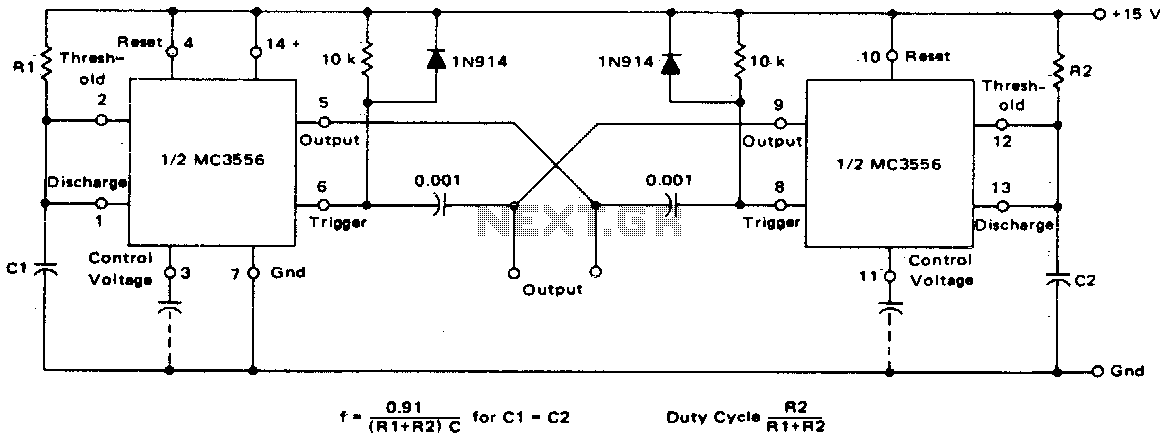
Dual astable multivibrator
This dual astable multivibrator offers versatility not found in single timer circuits. The duty cycle can be adjusted from 5% to 95%. The two outputs generate two-phase clock signals, which are frequently required in digital systems. Additionally, it can be...

Doppler Rdf
The power supply consists of a 7812 voltage regulator followed by an operational amplifier (op-amp) configured to output 6V, which serves as a midpoint supply voltage for the audio op-amp stages. A 12V regulator is deemed excessive for battery-powered applications....

Digital Remote Thermometer
This circuit is designed for precise centigrade temperature measurement. It features a transmitter section that converts the sensor's output voltage, which is proportional to the measured temperature, into frequency. The output frequency bursts are transmitted through the mains supply cables....

Digital Remote Thermometer
This circuit is designed for precise measurement of temperature in degrees Celsius. It features a transmitter section that converts the output voltage from a temperature sensor, which is proportional to the temperature being measured, into frequency. The resulting frequency bursts...

12V light dimmer
A portable 50W light operates using a 12V 7Ah battery. There are instances when the light output is excessively bright, prompting an inquiry into the necessary components to reduce the brightness.
To address the issue of excessive brightness in a portable...

Bidirectional Compound Op Amp
Using two transistors (Q1 and Q2), a bidirectional operational amplifier can source or sink up to 50 mA. Diodes D1 and D2 provide biasing for Q1 to eliminate "dead-zone" effects.
The described circuit utilizes two transistors, Q1 and Q2, configured to...