


Ignition Coil Wont Spark from Mosfet but DOES spark By Hand
#ignition coil
#MOSFET
#555 timer
#spark generation
#switching
#automotive electronics
#high voltage
#circuit troubleshooting
#pulse generation
#power electronics
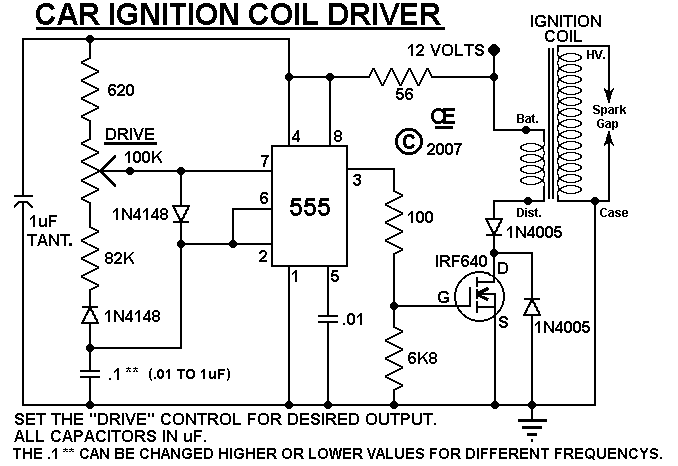
Description: An ignition coil is being used to generate sparks, controlled by a MOSFET powered by a 555 timer. The MOSFET is confirmed to be switching.
The circuit involves a 555 timer configured in astable mode to generate a pulse-width modulation (PWM) signal that drives the gate of a MOSFET. The output from the 555 timer is used to turn the MOSFET on and off at a frequency suitable for the ignition coil. The MOSFET acts as a switch, allowing current to flow through the ignition coil when activated.
In this setup, the ignition coil is connected to a power source, typically a battery. When the MOSFET is turned on, current flows through the ignition coil, generating a magnetic field. Upon turning off the MOSFET, the collapsing magnetic field induces a high voltage in the coil, creating a spark at the output terminal of the ignition coil.
To ensure proper operation, it is essential to select a MOSFET that can handle the required current and voltage levels. Additionally, protection components such as a flyback diode may be included across the ignition coil to prevent voltage spikes from damaging the MOSFET. Proper heat sinking for the MOSFET may also be necessary to manage thermal dissipation during operation.
The timing characteristics of the 555 timer should be adjusted to achieve the desired spark frequency, which can be fine-tuned by changing the resistor and capacitor values in the 555 timer circuit. Overall, this configuration provides a reliable method for generating sparks using an ignition coil and a MOSFET controlled by a 555 timer.I`m trying to get an ignition coil to create sparks running it with a Mosfet powered by a 555 timer. The Mosfet is definitely switching. I checked it..
The circuit involves a 555 timer configured in astable mode to generate a pulse-width modulation (PWM) signal that drives the gate of a MOSFET. The output from the 555 timer is used to turn the MOSFET on and off at a frequency suitable for the ignition coil. The MOSFET acts as a switch, allowing current to flow through the ignition coil when activated.
In this setup, the ignition coil is connected to a power source, typically a battery. When the MOSFET is turned on, current flows through the ignition coil, generating a magnetic field. Upon turning off the MOSFET, the collapsing magnetic field induces a high voltage in the coil, creating a spark at the output terminal of the ignition coil.
To ensure proper operation, it is essential to select a MOSFET that can handle the required current and voltage levels. Additionally, protection components such as a flyback diode may be included across the ignition coil to prevent voltage spikes from damaging the MOSFET. Proper heat sinking for the MOSFET may also be necessary to manage thermal dissipation during operation.
The timing characteristics of the 555 timer should be adjusted to achieve the desired spark frequency, which can be fine-tuned by changing the resistor and capacitor values in the 555 timer circuit. Overall, this configuration provides a reliable method for generating sparks using an ignition coil and a MOSFET controlled by a 555 timer.I`m trying to get an ignition coil to create sparks running it with a Mosfet powered by a 555 timer. The Mosfet is definitely switching. I checked it..
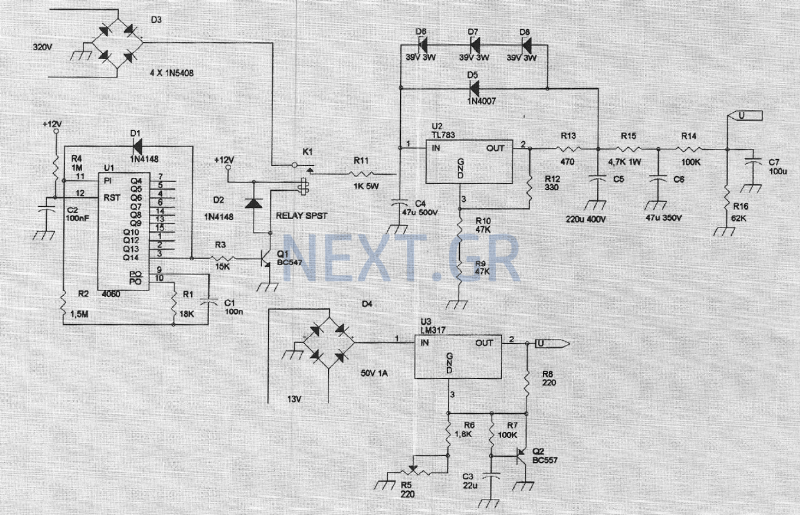
High Voltage Power Supply for Valve Preamplifiers
The amplifier feeding the final amplification stage operates with unstabilized voltage. The output stage, utilizing push-pull operation, exhibits significant rejection of the supply voltage. However, the earlier stages do not provide the same level of rejection, resulting in unwanted noise....
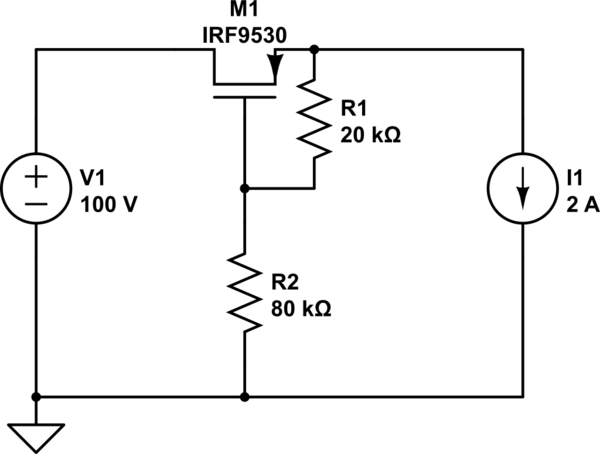
mosfet Reverse polarity protection
When a reverse voltage of 10V is applied to the source while the drain is grounded, the gate-source voltage (Vgs) becomes -10V. This voltage is significantly above the threshold, which allows the MOSFET to remain in the saturation region, enabling...
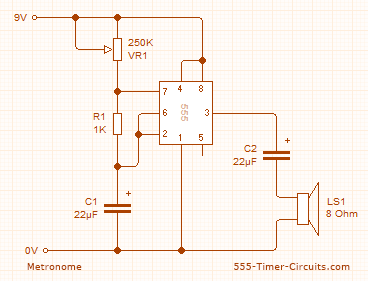
metronome
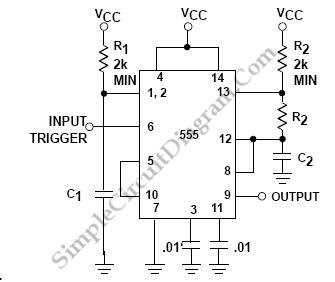
This circuit employs the 555 timer configured in astable mode to produce a continuous square wave output from Pin 3. The output is subsequently filtered through a 22.5 µF electrolytic capacitor to generate a smooth oscillation, resulting in a 'toc-toc'...
555 IC Tone Burst Generator
A high-quality tone burst generator can be constructed using a 556 Dual Timer. The first half of the timer can be configured as a one-shot, while the second half can function as an oscillator.
The 556 Dual Timer is an integrated...
555 tester circuit
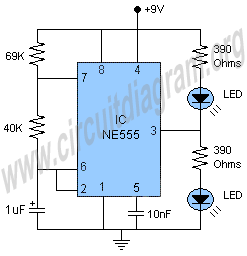
A project of a 555 tester circuit, the circuit will start blinking LEDs when power is applied, which will indicate that the IC is working correctly.
The 555 tester circuit is designed to verify the operational status of the 555 timer...
LED Light Sequencer using 555
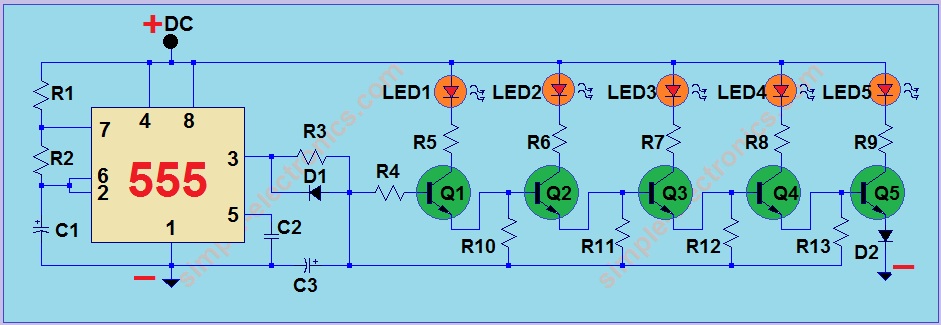
This project utilizes a 555 integrated circuit (IC) to create a sequential LED flashing effect. The configuration allows the LEDs to illuminate in a specific order, making it suitable for use as an indicator for vehicles and bicycles when turning...
10000Vdc Supply
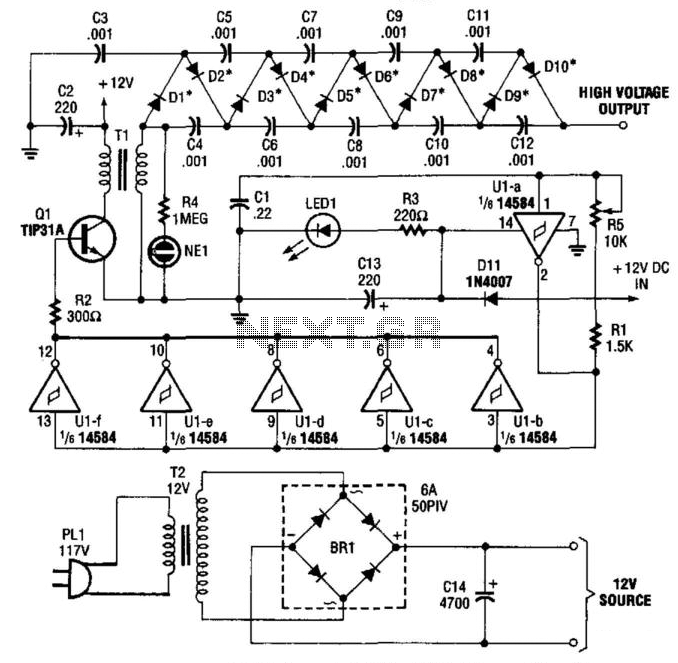
A CMOS oscillator (U1A) drives U1B through U1F, which in turn drives Q1, generating a 12-Vpp square wave across the primary of T1. This square wave is applied to a rectifier-multiplier circuit consisting of diodes D1 through D10 (each comprising...
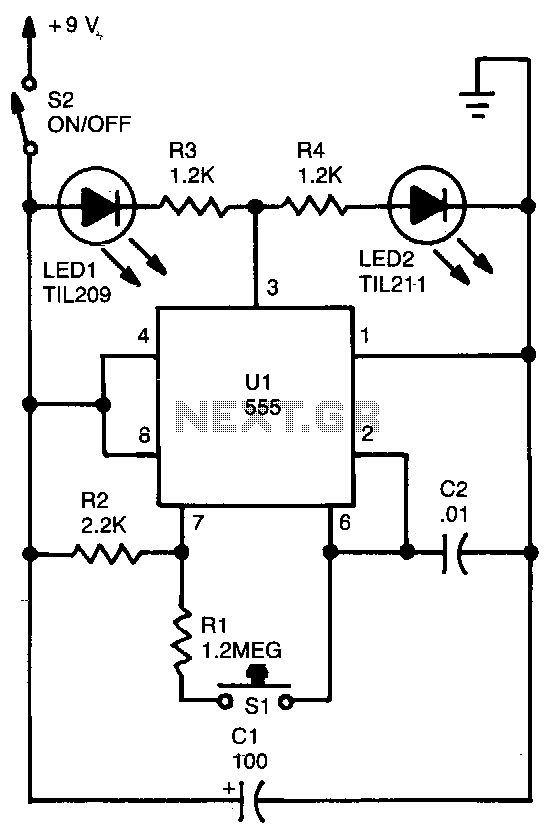
Coin-flipper
The circuit is a 555 astable circuit that controls two LEDs, LED1 and LED2. LED2 is activated when the output of U1 is high, while LED1 turns on when the output is low. As U1 oscillates, LED1 and LED2 alternate...
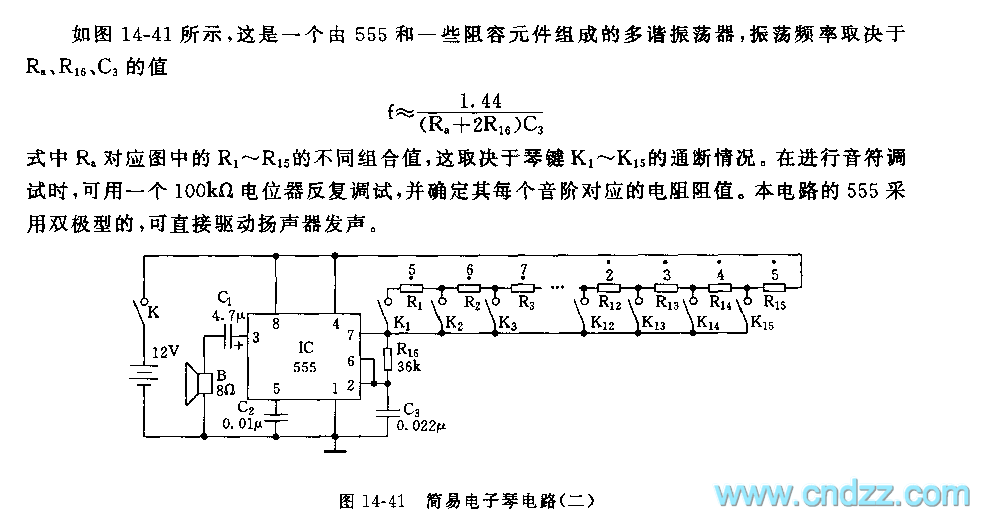
555 simple electronic keyboard circuit (2)
Figure 14-41 illustrates a multivibrator circuit utilizing a 555 timer alongside various capacitive and resistive components. The oscillation frequency is determined by the values of Ra, R16, and C3, following the formula f = 1.44 / ((Ra + 2R16) *...