


Lambda Probe Readout For Carburettor Tuning
#lambda probe
#oxygen sensor
#carburettor tuning
#exhaust system
#voltage measurement
#automotive diagnostics
#fuel efficiency
#sensor readout
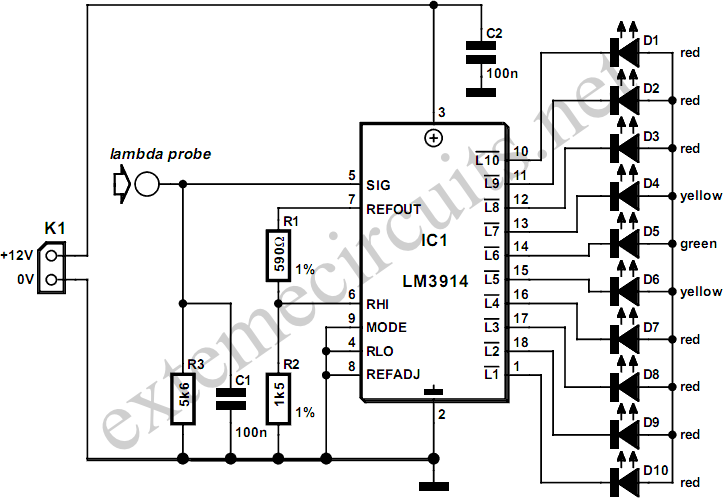
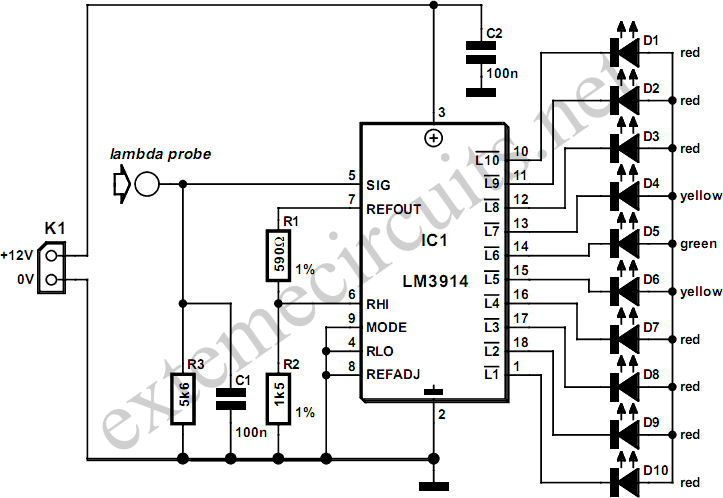
Description: A lambda probe, also known as an oxygen sensor, is commonly found on the exhaust systems of vehicles that operate on unleaded fuel. Once it reaches its normal operating temperature of approximately 600 degrees Celsius, the lambda probe generates an output voltage that is proportional to the residual oxygen levels detected in the exhaust gas. This data is crucial for assessing factors such as the air/fuel ratio provided by the carburetor(s) and overall combustion efficiency. In contemporary automotive and motorcycle engines, this information is utilized to electronically modify engine parameters, including ignition timing and fuel injection. The indicator discussed here is designed for permanent installation on a motorcycle to monitor the air/fuel ratio, facilitating engine power tuning when different carburetors are fitted. In addition to its technical purpose, the unit features bright LEDs that are likely to attract the interest of motorcyclists. A single-wire lambda probe can often be salvaged from a junked vehicle. After acquiring an appropriate nut, the probe can be installed into the motorcycle's exhaust pipe approximately 30 cm from the cylinders. Given the need for welding and drilling in a costly chrome-plated exhaust pipe, it may be advisable to have the installation performed by professionals. The design of the electronic indicator is based on the principle that an air/fuel ratio of 14.7 to 1 is generally optimal, with a range from 16.2 to 1 (lean) to 11.7 to 1 (rich). The ideal ratio corresponds to a probe output voltage of 0.45 V, which will illuminate 5 out of the 10 LEDs, including the green LED (D5). If any of the red LEDs light up, it indicates that the mixture is excessively rich. It is generally preferable to have a slightly rich mixture rather than a lean one, which is why a yellow LED lights up between the green LED and the first red one. It is important to note that the engine must be at its normal operating temperature for the readings to be meaningful.
The lambda probe operates by measuring the concentration of oxygen in the exhaust gases, providing critical feedback to the engine control unit (ECU) for optimizing the combustion process. The probe's output voltage varies with the oxygen levels; a higher voltage indicates a lean mixture (more oxygen), while a lower voltage indicates a rich mixture (less oxygen). The electronic indicator utilizes a series of LEDs to visually represent the air/fuel ratio in real time, allowing the user to make adjustments to the carburation as needed.
The circuit design for the indicator typically includes a voltage divider and a comparator to interpret the probe's output voltage. The voltage divider scales the lambda probe's output to a suitable level for the comparator, which then activates the appropriate LEDs based on the voltage range. For instance, the green LED lights up at the ideal voltage of 0.45 V, while the red LEDs indicate a rich mixture, and the yellow LED serves as a cautionary signal for a slightly rich condition.
Installation of the lambda probe requires careful consideration of the exhaust system's layout and may involve drilling and welding. Proper sealing and insulation must be ensured to prevent exhaust leaks and maintain the integrity of the exhaust system. The placement of the probe is crucial; it should be located far enough from the engine to avoid excessive heat but close enough to provide accurate readings of the exhaust gases.
In summary, the lambda probe and its associated electronic indicator serve as essential tools for tuning motorcycle engines, providing valuable insights into the air/fuel ratio and enabling adjustments to improve performance and efficiency.A lambda probe (or oxygen sensor) can be found on the exhaust system of most cars running on unleaded fuel. Having reached its normal operating temperature (of about 600 degrees Celsius!) the lambda probe supplies an output voltage proportional to the amount of residual oxygen measured in the exhaust gas.
This information is indicative of, among o thers, the air/fuel ratio supplied by the carburetor(s) and hence the combustion efficiency. In modern car (and motorcycle) engines, this information is used to (electronically) adjust engine parameters like ignition timing and fuel injection. The indicator described here is intended for permanent installation on a motorcycle of which the air/fuel ratio needed to be watched, with the obvious aim engine power tuning aftertting a different set of carburetors.
Apart from this obvious technical use the unit`s bright LEDs will no doubt attract the attention of curious motorcyclists. At the local junkyard a single-wire lambda probe may be salvaged from a wrecked car. Once a suitable nut has been found, the probe can screwed into the exhaust pipe of the motorcycle, at about 30 cm from the cylinders.
Since we`re talking of welding and drilling in an expensive (chrome-plated) exhaust pipe, you maynd that actuallytting the probe is best left to specialists! The starting point for the design of a suitable electronic indicator is that in the noble art of carburetor tuning an air/fuel ratio of 14.
7 to 1 is generally considered perfect`, the range covering 16. 2 to 1 (lean`) to 11. 7 to 1 (rich`). The perfect ratio typically corresponds to a probe output voltage of 0. 45 V. Referring to the circuit diagram, that is the input level at which 5 of the 10 LEDs will light, including the green one, D5. If one of the red LEDs lights, the mixture is definitely too rich. Note that in general it is better to have a mixture that is a little to rich than one that`s on the lean side, hence a yellow LED lights between the green LED and therst red one.
Also note that the engine needs to be at its normal operating temperature before a meaningful indication is obtained.
The lambda probe operates by measuring the concentration of oxygen in the exhaust gases, providing critical feedback to the engine control unit (ECU) for optimizing the combustion process. The probe's output voltage varies with the oxygen levels; a higher voltage indicates a lean mixture (more oxygen), while a lower voltage indicates a rich mixture (less oxygen). The electronic indicator utilizes a series of LEDs to visually represent the air/fuel ratio in real time, allowing the user to make adjustments to the carburation as needed.
The circuit design for the indicator typically includes a voltage divider and a comparator to interpret the probe's output voltage. The voltage divider scales the lambda probe's output to a suitable level for the comparator, which then activates the appropriate LEDs based on the voltage range. For instance, the green LED lights up at the ideal voltage of 0.45 V, while the red LEDs indicate a rich mixture, and the yellow LED serves as a cautionary signal for a slightly rich condition.
Installation of the lambda probe requires careful consideration of the exhaust system's layout and may involve drilling and welding. Proper sealing and insulation must be ensured to prevent exhaust leaks and maintain the integrity of the exhaust system. The placement of the probe is crucial; it should be located far enough from the engine to avoid excessive heat but close enough to provide accurate readings of the exhaust gases.
In summary, the lambda probe and its associated electronic indicator serve as essential tools for tuning motorcycle engines, providing valuable insights into the air/fuel ratio and enabling adjustments to improve performance and efficiency.A lambda probe (or oxygen sensor) can be found on the exhaust system of most cars running on unleaded fuel. Having reached its normal operating temperature (of about 600 degrees Celsius!) the lambda probe supplies an output voltage proportional to the amount of residual oxygen measured in the exhaust gas.
This information is indicative of, among o thers, the air/fuel ratio supplied by the carburetor(s) and hence the combustion efficiency. In modern car (and motorcycle) engines, this information is used to (electronically) adjust engine parameters like ignition timing and fuel injection. The indicator described here is intended for permanent installation on a motorcycle of which the air/fuel ratio needed to be watched, with the obvious aim engine power tuning aftertting a different set of carburetors.
Apart from this obvious technical use the unit`s bright LEDs will no doubt attract the attention of curious motorcyclists. At the local junkyard a single-wire lambda probe may be salvaged from a wrecked car. Once a suitable nut has been found, the probe can screwed into the exhaust pipe of the motorcycle, at about 30 cm from the cylinders.
Since we`re talking of welding and drilling in an expensive (chrome-plated) exhaust pipe, you maynd that actuallytting the probe is best left to specialists! The starting point for the design of a suitable electronic indicator is that in the noble art of carburetor tuning an air/fuel ratio of 14.
7 to 1 is generally considered perfect`, the range covering 16. 2 to 1 (lean`) to 11. 7 to 1 (rich`). The perfect ratio typically corresponds to a probe output voltage of 0. 45 V. Referring to the circuit diagram, that is the input level at which 5 of the 10 LEDs will light, including the green one, D5. If one of the red LEDs lights, the mixture is definitely too rich. Note that in general it is better to have a mixture that is a little to rich than one that`s on the lean side, hence a yellow LED lights between the green LED and therst red one.
Also note that the engine needs to be at its normal operating temperature before a meaningful indication is obtained.
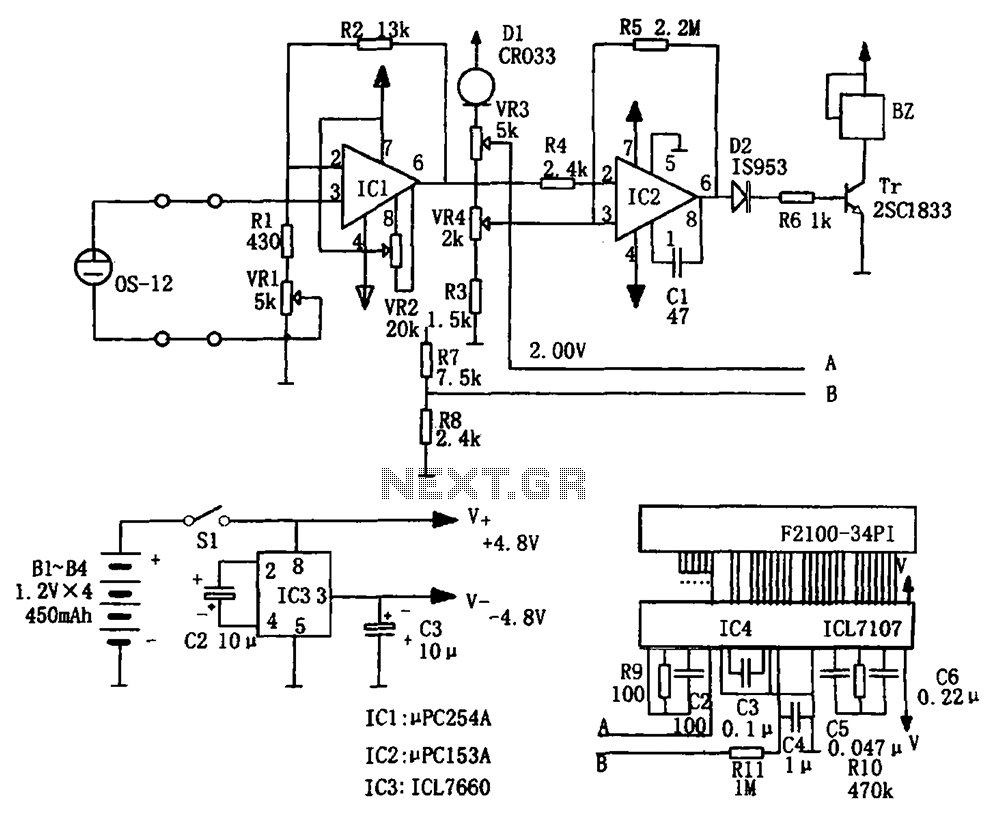
Portable hypoxia monitoring circuit ICL7660 PC254A PC153A
The portable hypoxia monitoring circuit comprises the oxygen sensor OS-12, a DC amplifier IC1, an A/D converter IC4, and a liquid crystal display F2100-34PI. Additionally, it includes a voltage comparator IC2 and a positive and negative power converter IC, along...
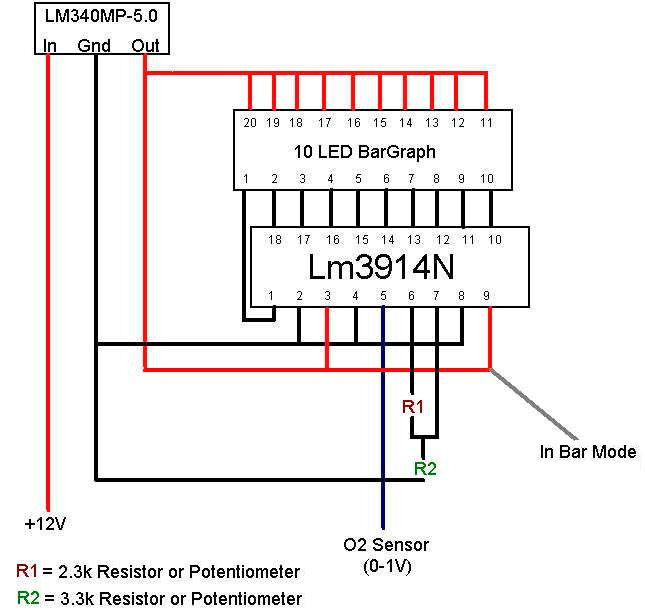
HOW TO make a cheap narrowband A/F gauge
The engine management system monitors its air-fuel ratio using an oxygen sensor (O2) located in the hot exhaust flow, typically positioned before the catalytic converter. All O2 sensors function similarly, with variations including heated sensors or those with multiple signal...
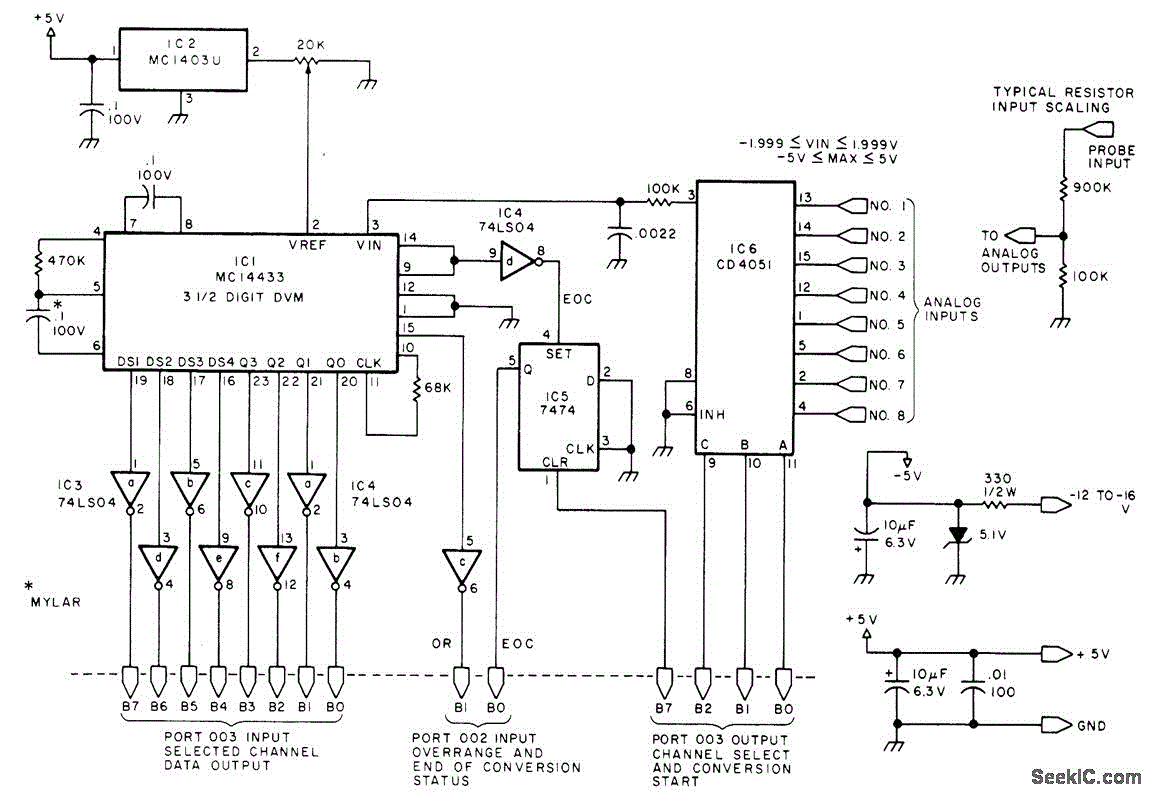
EIGHT CHANNEL COMPUTERIZED 3SUP1 SUP SUB2 SUB DIGIT_VM
Displays up to eight different DC voltages on a CRT terminal of a microprocessor under keyboard control, using BASIC commands and a BASIC routine provided in the article. Utilizes a modified Motorola MC14433 dual-lamp integrating analog-to-digital converter. An unknown voltage...
Lambda Probe Readout For Carburettor Tuning
A lambda probe, also known as an oxygen sensor, is typically located on the exhaust system of most vehicles that operate on unleaded fuel. It functions effectively once it has reached its normal operating temperature.
A lambda probe is a critical...
Test-Measurement 4
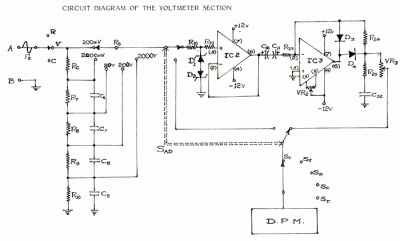
In circuit diagrams provided in equipment manuals, voltages at various points in the circuit are typically indicated. A deviation from these specified values suggests that a component has failed and can help in identifying faulty areas. Specifications include: D.C. Voltage...
Absolute-Value Meter With Polarity Detector
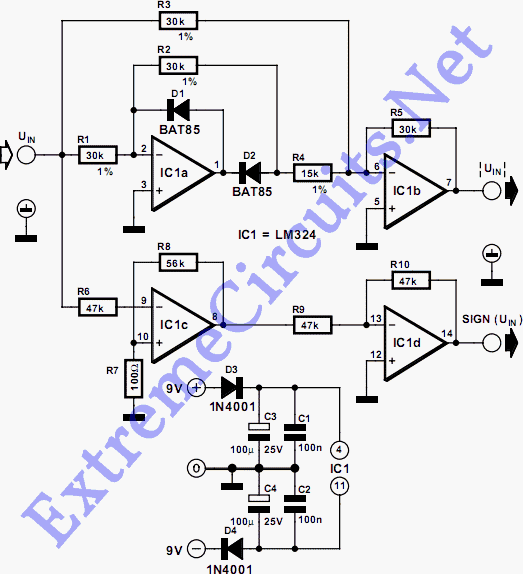
This circuit separates an input voltage signal into its components: (1) the absolute value and (2) the polarity or 'sign' (+ or -). It is designed to handle direct current (DC) signals.
The circuit operates by utilizing operational amplifiers (op-amps) to...

muffler valves dual-mode exhaust not opening at 3500rpm
A peculiar issue has arisen over the past few months regarding the stock muffler flaps and valves, which are not opening at any RPM, including above 3500 RPM. They do not appear to be stuck, as they operate correctly when...
o2 sensor
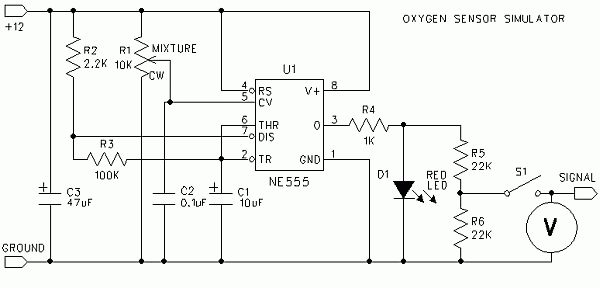
The oxygen sensor simulator is constructed on a protoboard. It utilizes a cigarette lighter plug as the power source. An adjustment knob is located on the left side, while a switch is positioned on the right. A red indicator LED...
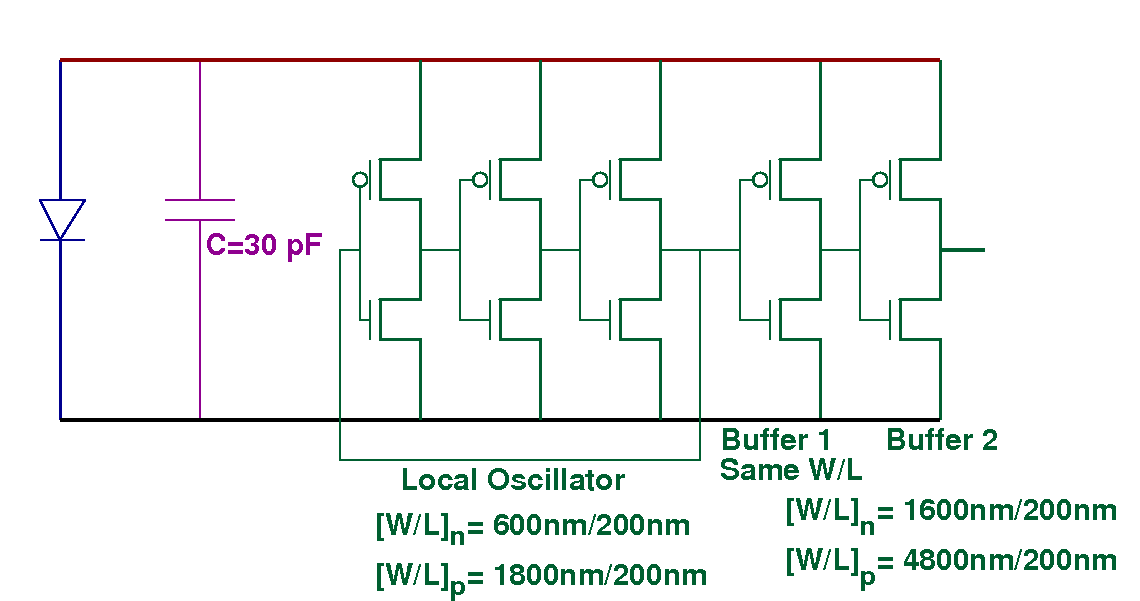
The Measurements for MIT 3DL1 Run
The chips that are classified as "working well" produce approximately 300 mV when exposed to a laser pointer and between 40 to 80 mV when illuminated by LED light. Voltages around 100 mV were recorded in a sunlit environment, while...