


RA-203
#battery drainage
#1989 Buick Electra
#park avenue
#compressor
#cooling fan
#engine off
#electrical issue
#component identification
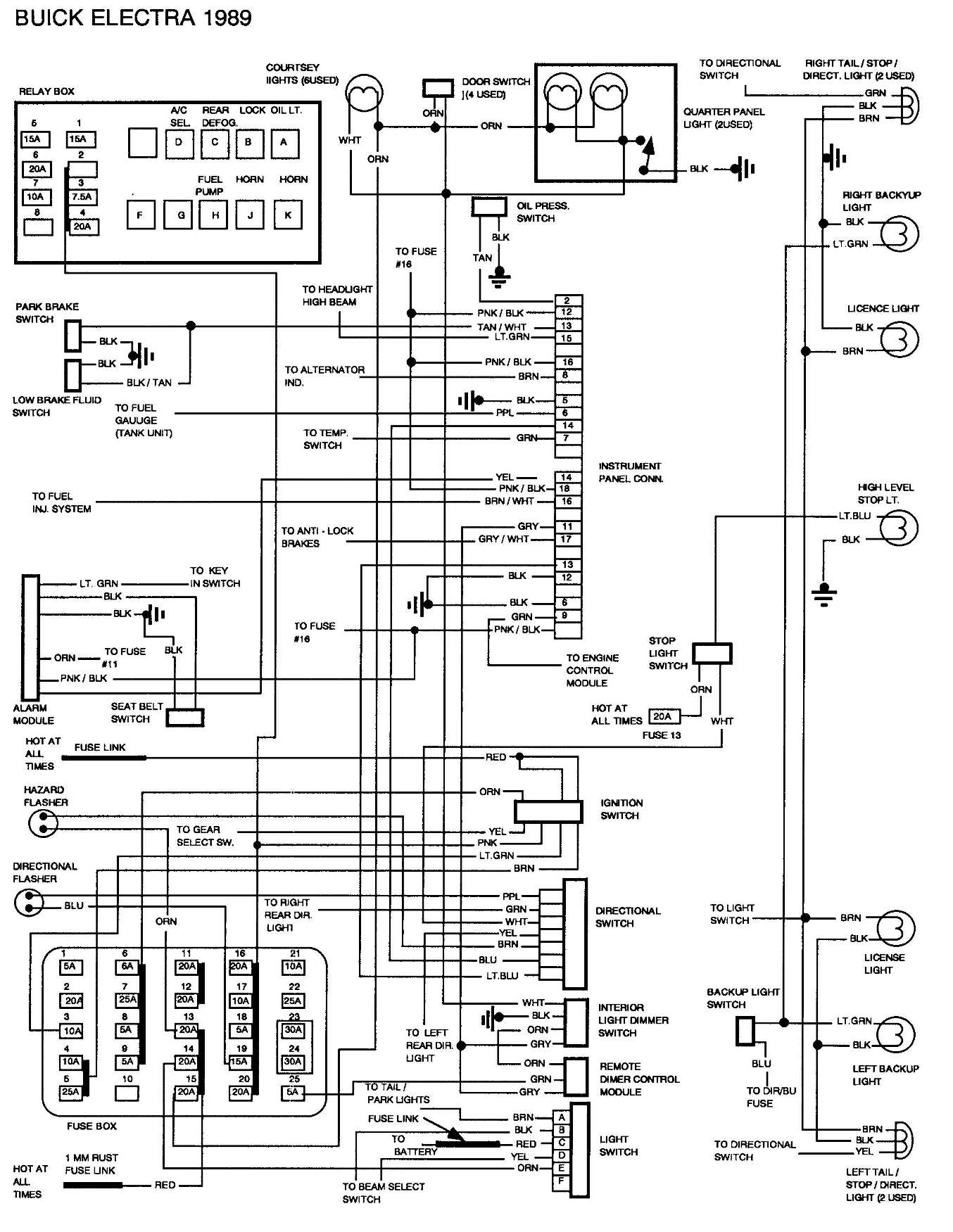
Description: A 1989 Buick Electra Park Avenue is experiencing a battery drainage issue. The suspected cause is an unidentified component that engages for 5 to 7 second intervals after the engine is turned off. Initially thought to be the cooling fan, the component is located behind the left headlight on the driver's side. There is speculation that it may be a compressor related to the fuel-air mixture for the injectors. Additionally, the heater system is not functioning properly in cold weather, only operating on a low setting, which suggests a possible resistor module issue. There is a concern that the engine control module (ECM) may be related to both problems. To troubleshoot the battery drainage, it is recommended to use a voltmeter to check for shorts by measuring the voltage drop while pulling fuses and relays. Common culprits include the cooling fan relay, ignition switch, and possibly the air ride system's compressor. The heater issue likely involves the blower relay or a faulty resistor module. The air intake may also be obstructed by debris, contributing to the problem. The air ride suspension system is identified as the compressor causing the battery drainage, with suspicions of a corroded switch arm or a leak in the suspension system. The owner has resorted to disconnecting the air compressor nightly to prevent further battery drainage. There is also confusion regarding electrical diagrams and their orientation, with a suggestion to obtain specific wiring diagrams for the vehicle.
To address the battery drainage issue in the 1989 Buick Electra Park Avenue, a systematic approach to diagnosing the electrical components is essential. The first step involves utilizing a voltmeter to measure current draw by connecting it between the negative battery cable and the battery post. This method allows for the identification of any parasitic draws on the battery. By sequentially removing fuses from the fuse box, both inside the vehicle and under the hood, it is possible to determine if any particular circuit is responsible for the increased current draw. A significant voltage drop below 0.3 volts indicates the presence of a fault in the corresponding circuit.
The component suspected of causing the battery drainage, located behind the left headlight, may be linked to the vehicle's air ride suspension system. This system utilizes a compressor to maintain proper air pressure in the suspension components. If the compressor is continuously engaging after the engine is turned off, it could indicate a malfunctioning relay or a failure in the pressure switch that regulates compressor operation. Inspecting the air ride system for leaks and ensuring that the switch arm is not corroded will be crucial in diagnosing this issue.
Regarding the heater problem, the blower relay, typically located under the dashboard on the passenger side near the heater box, should be checked. If the relay has been replaced without resolving the issue, further investigation into the resistor module is warranted. The resistor module controls the speed settings of the blower motor, and a failure here could explain the limited operation of the heater.
Furthermore, the air intake area should be regularly cleaned to prevent debris accumulation, which may obstruct airflow and contribute to overheating or other electrical issues. Ensuring that all connections in the wiring harness are secure and free of corrosion will also aid in maintaining the integrity of the electrical system.
In conclusion, a thorough inspection and methodical testing of the vehicle's electrical components, particularly focusing on the air ride system and heater controls, will be necessary to resolve the battery drainage issue and restore proper functionality to the heater.A 1989 buick electra park avenue with a battery drainage problem. I think i have located the culprit but not the exact source. When the engine is off after running awhile, what i think is a compressor of sorts is engaging. It runs for 5 to 7 second intervals. I thought it may be the cooling fan but im not sure what it is. I have looked fordiagrams to find the component name but have had no verifiable success. It is located behind the Left headlight (drivers side). I can only guess that it is a compressor for the fuel to air mixture for the injectors I also have a problem with the heater. it doesnt seem to want to operate in our North Dakota cold-it only operates (or whispers) on low. This seems to me a resistor module problem. but could it be ECM and could the two be related through a faulty ECM how can i figure it out Hi, Glad to be of help.
When looking for shorts or components with current draw, the best and quickest way to find the culprit is to hook up a volt meter between battery negative cable and battery post. Start pulling fuses inside and under hood one by one until voltage drops below. 3 volts. If no luck with fuses, pull relays and disconnect componets that have power at all times such as alternator.
Most of the time a cooling fan relay is the problem but could be ignition switch or something else. It`s not the ECM. Do you have an air ride system with air compressor If you have ABS brakes, this may be your problem. The only cheap thing to replace on these is the relay, otherwise may be looking at replacing the whole ABS unit. Hope this is not your problem. The heater problem is most likely the blower relay located on passenger side under dash near heater box.
I discovered it was not the relay by way of replacement. awaiting shipment of a resistor module for replacement. otherwise the motor will need replacing due to bad circuitry. My car is normally parked under a tree and i remember what i now recognize as the air intake collects leaves and debris from it. Its neglegence on my part for not knowing/cleaning it. So. that`s the cause (in addition to ice and snow) overloading the components i think. The air ride suspension system is the compressor i was referring to previously. No ABS in this model. I think i either have a corroded "switch arm" that regulates the air pressure (connected to rear axl) or the suspension itself is leaking a little.
I think i will have to be satisfied with unplugging the air compressor every night and reconnecting everyday to prevent battery drainage. I garaged my car for a period and within 3 to 4 hours doing maintance and cleaning it engaged everytime i got out of the vehicle (cleaning interior) and in stints of 5 seconds every 15 to 20 minutes while doing other things.
I`m certian this is my main culprit in battery drainage. If i could block it up i would spray the line and parts back to the struts with soapy water to look for leaks but again will have to compromise. Have to say tho that even with some technical education those electrical diagrams, or the format they are in are confusing.
where is the point of orientation Is it just the battery If that`s so then these are generic diagrams for a period of models I don`t know what you mean by point of orientation but these diagrams are specifically for your 1989 Electra. I do not have access to a specific wiring diagram for heater & AC controls but you may purchase a mitchel on demand subscription for specific wiring diagrams at Then check the connections through the wiring harness to the switch with key ON and someone moving the control switch to see if you get a 0 ohm on any of the knob settings.
Might be bad connections in the switch on the dashboard. (Or take the control out of the dashboard and check at the connector on the back. ) it may be a fault in the dash control or may be some other part. A blown resistor wire in the resistor pack would lose the lower 1 or
To address the battery drainage issue in the 1989 Buick Electra Park Avenue, a systematic approach to diagnosing the electrical components is essential. The first step involves utilizing a voltmeter to measure current draw by connecting it between the negative battery cable and the battery post. This method allows for the identification of any parasitic draws on the battery. By sequentially removing fuses from the fuse box, both inside the vehicle and under the hood, it is possible to determine if any particular circuit is responsible for the increased current draw. A significant voltage drop below 0.3 volts indicates the presence of a fault in the corresponding circuit.
The component suspected of causing the battery drainage, located behind the left headlight, may be linked to the vehicle's air ride suspension system. This system utilizes a compressor to maintain proper air pressure in the suspension components. If the compressor is continuously engaging after the engine is turned off, it could indicate a malfunctioning relay or a failure in the pressure switch that regulates compressor operation. Inspecting the air ride system for leaks and ensuring that the switch arm is not corroded will be crucial in diagnosing this issue.
Regarding the heater problem, the blower relay, typically located under the dashboard on the passenger side near the heater box, should be checked. If the relay has been replaced without resolving the issue, further investigation into the resistor module is warranted. The resistor module controls the speed settings of the blower motor, and a failure here could explain the limited operation of the heater.
Furthermore, the air intake area should be regularly cleaned to prevent debris accumulation, which may obstruct airflow and contribute to overheating or other electrical issues. Ensuring that all connections in the wiring harness are secure and free of corrosion will also aid in maintaining the integrity of the electrical system.
In conclusion, a thorough inspection and methodical testing of the vehicle's electrical components, particularly focusing on the air ride system and heater controls, will be necessary to resolve the battery drainage issue and restore proper functionality to the heater.A 1989 buick electra park avenue with a battery drainage problem. I think i have located the culprit but not the exact source. When the engine is off after running awhile, what i think is a compressor of sorts is engaging. It runs for 5 to 7 second intervals. I thought it may be the cooling fan but im not sure what it is. I have looked fordiagrams to find the component name but have had no verifiable success. It is located behind the Left headlight (drivers side). I can only guess that it is a compressor for the fuel to air mixture for the injectors I also have a problem with the heater. it doesnt seem to want to operate in our North Dakota cold-it only operates (or whispers) on low. This seems to me a resistor module problem. but could it be ECM and could the two be related through a faulty ECM how can i figure it out Hi, Glad to be of help.
When looking for shorts or components with current draw, the best and quickest way to find the culprit is to hook up a volt meter between battery negative cable and battery post. Start pulling fuses inside and under hood one by one until voltage drops below. 3 volts. If no luck with fuses, pull relays and disconnect componets that have power at all times such as alternator.
Most of the time a cooling fan relay is the problem but could be ignition switch or something else. It`s not the ECM. Do you have an air ride system with air compressor If you have ABS brakes, this may be your problem. The only cheap thing to replace on these is the relay, otherwise may be looking at replacing the whole ABS unit. Hope this is not your problem. The heater problem is most likely the blower relay located on passenger side under dash near heater box.
I discovered it was not the relay by way of replacement. awaiting shipment of a resistor module for replacement. otherwise the motor will need replacing due to bad circuitry. My car is normally parked under a tree and i remember what i now recognize as the air intake collects leaves and debris from it. Its neglegence on my part for not knowing/cleaning it. So. that`s the cause (in addition to ice and snow) overloading the components i think. The air ride suspension system is the compressor i was referring to previously. No ABS in this model. I think i either have a corroded "switch arm" that regulates the air pressure (connected to rear axl) or the suspension itself is leaking a little.
I think i will have to be satisfied with unplugging the air compressor every night and reconnecting everyday to prevent battery drainage. I garaged my car for a period and within 3 to 4 hours doing maintance and cleaning it engaged everytime i got out of the vehicle (cleaning interior) and in stints of 5 seconds every 15 to 20 minutes while doing other things.
I`m certian this is my main culprit in battery drainage. If i could block it up i would spray the line and parts back to the struts with soapy water to look for leaks but again will have to compromise. Have to say tho that even with some technical education those electrical diagrams, or the format they are in are confusing.
where is the point of orientation Is it just the battery If that`s so then these are generic diagrams for a period of models I don`t know what you mean by point of orientation but these diagrams are specifically for your 1989 Electra. I do not have access to a specific wiring diagram for heater & AC controls but you may purchase a mitchel on demand subscription for specific wiring diagrams at Then check the connections through the wiring harness to the switch with key ON and someone moving the control switch to see if you get a 0 ohm on any of the knob settings.
Might be bad connections in the switch on the dashboard. (Or take the control out of the dashboard and check at the connector on the back. ) it may be a fault in the dash control or may be some other part. A blown resistor wire in the resistor pack would lose the lower 1 or
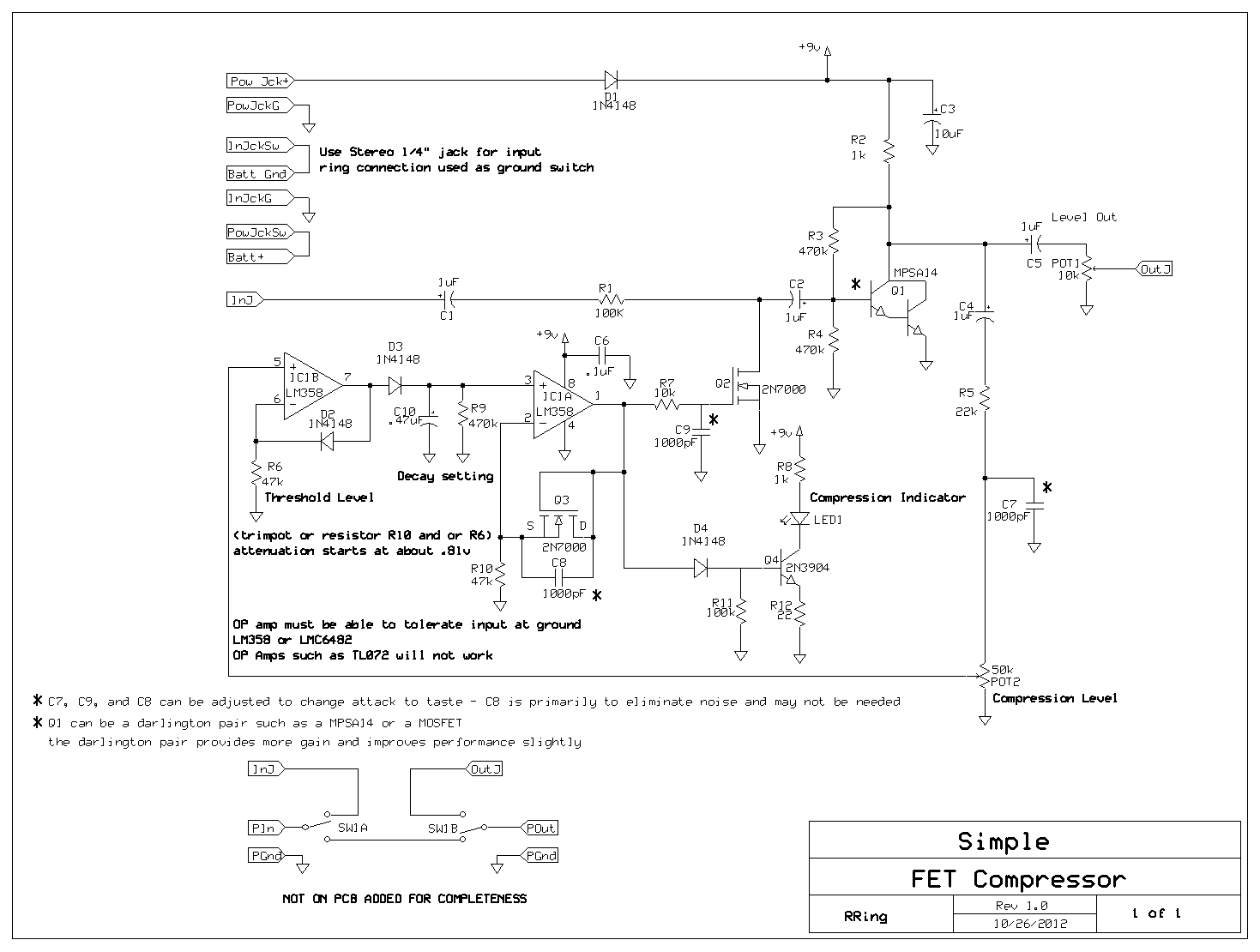
Board layout and final schematic for Mosfet Compressor
Here is a link to the ExpressPCB layout for this compressor. If you are not familiar with ExpressPCB, look it up. They provide a layout tool that is very easy to use, and you can have boards manufactured for $60.00...
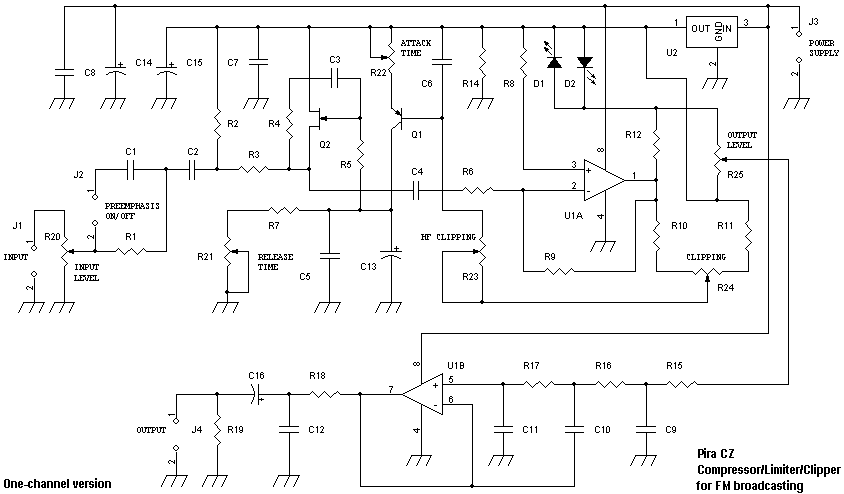
Compressor-Limiter-Clipper for FM transmitters
Audio signals as music or speech have big dynamic ranges. There are silent and loud sections. These audio signals aren't too good for a transmitter, which requires audio signal with constant level on the input. Limiter is a device, which...
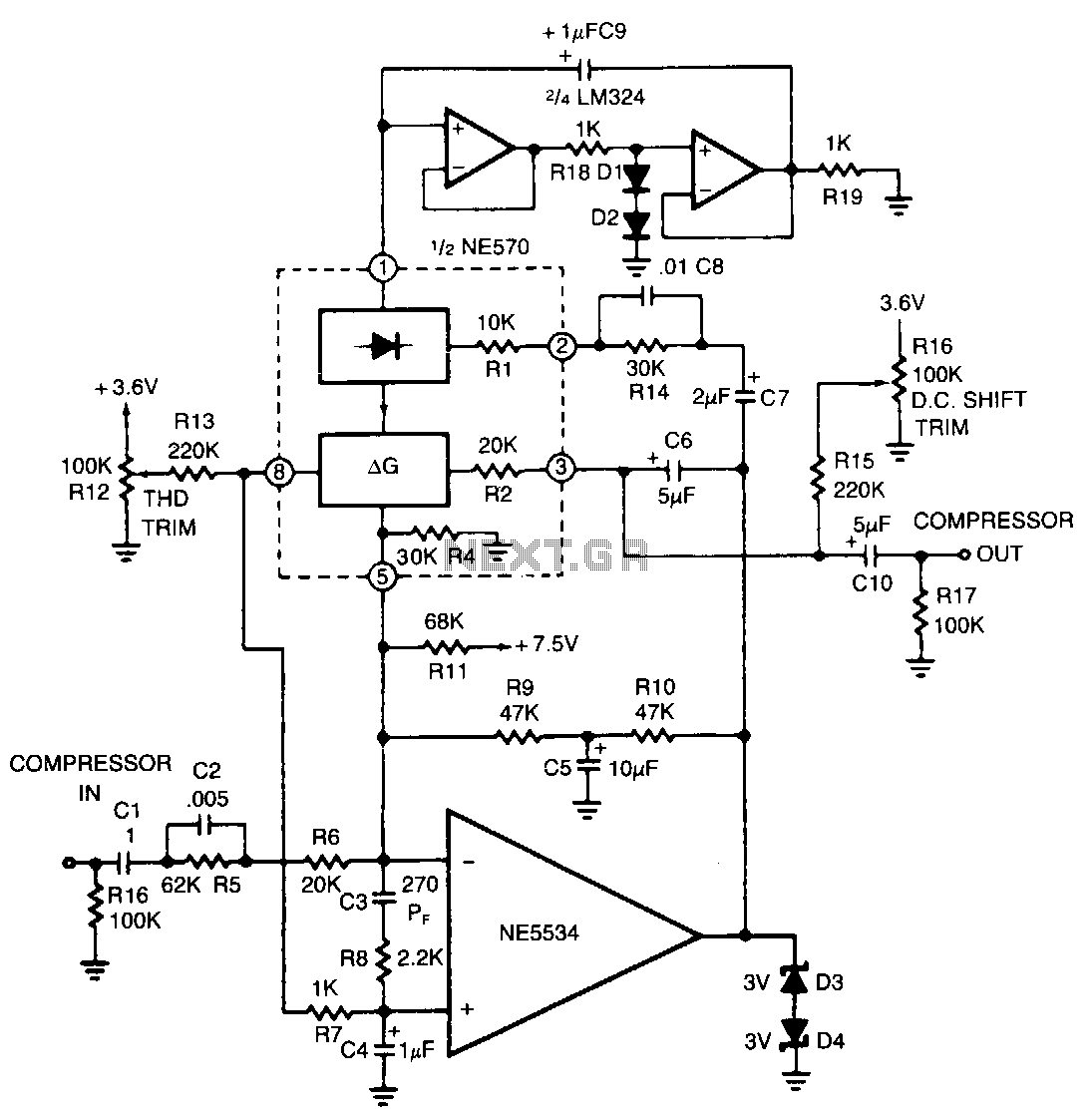
Hi-ficompressor-with-pre-emphasis
The compressor includes a high-frequency pre-emphasis circuit (C2, R5, CS, R14) that addresses this issue. A corresponding de-emphasis circuit on the expander is necessary. More sophisticated designs may allow for variable pre-emphasis.
The compressor's high-frequency pre-emphasis circuit is crucial for enhancing...
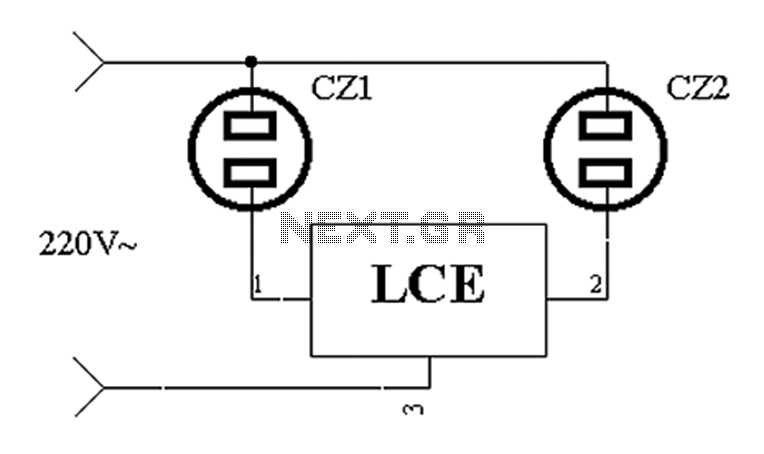
Cooling fan control socket synchronous circuit diagram
The application circuit operates the device as illustrated below. It is designed for cooling electrical equipment, typically utilizing a cooling fan to dissipate heat. The LCE employs a synchronous control socket on the device and its connections remain unchanged. As...
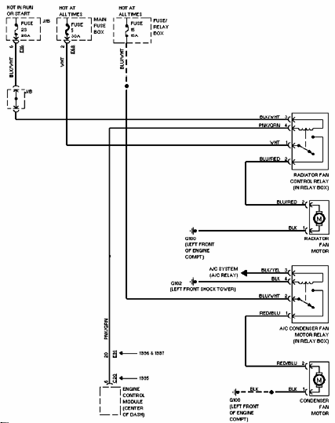
1996 Suzuki Esteem Cooling Fan Circuit Diagram
The 1996 Suzuki Esteem Cooling Fan system includes a control relay for the radiator fan (located in the relay box), air conditioning fan motor, radiator fan motor, condenser fan motor, junction box, fuse and relay box, and engine control module....
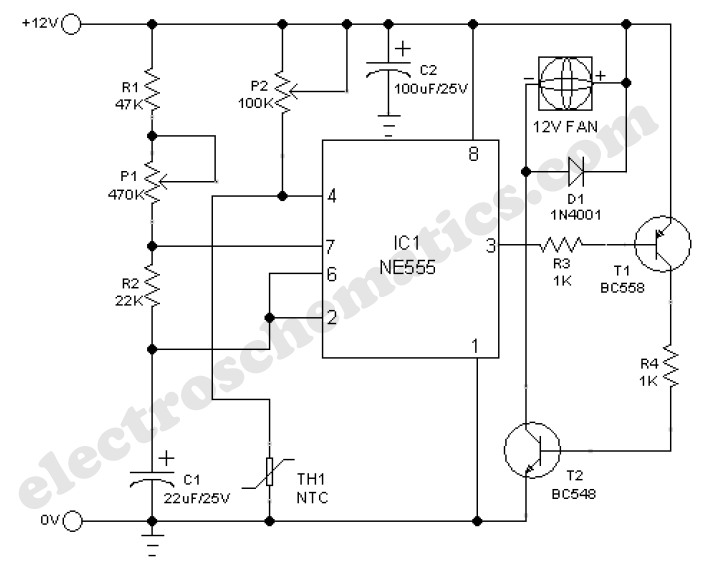
Smart Cooling Fan Circuit
A continuously running cooling fan can be a significant nuisance and is not essential for most instruments. The 12V smart fan control presented here allows the fan to operate only when necessary.
The 12V smart fan control circuit is designed to...
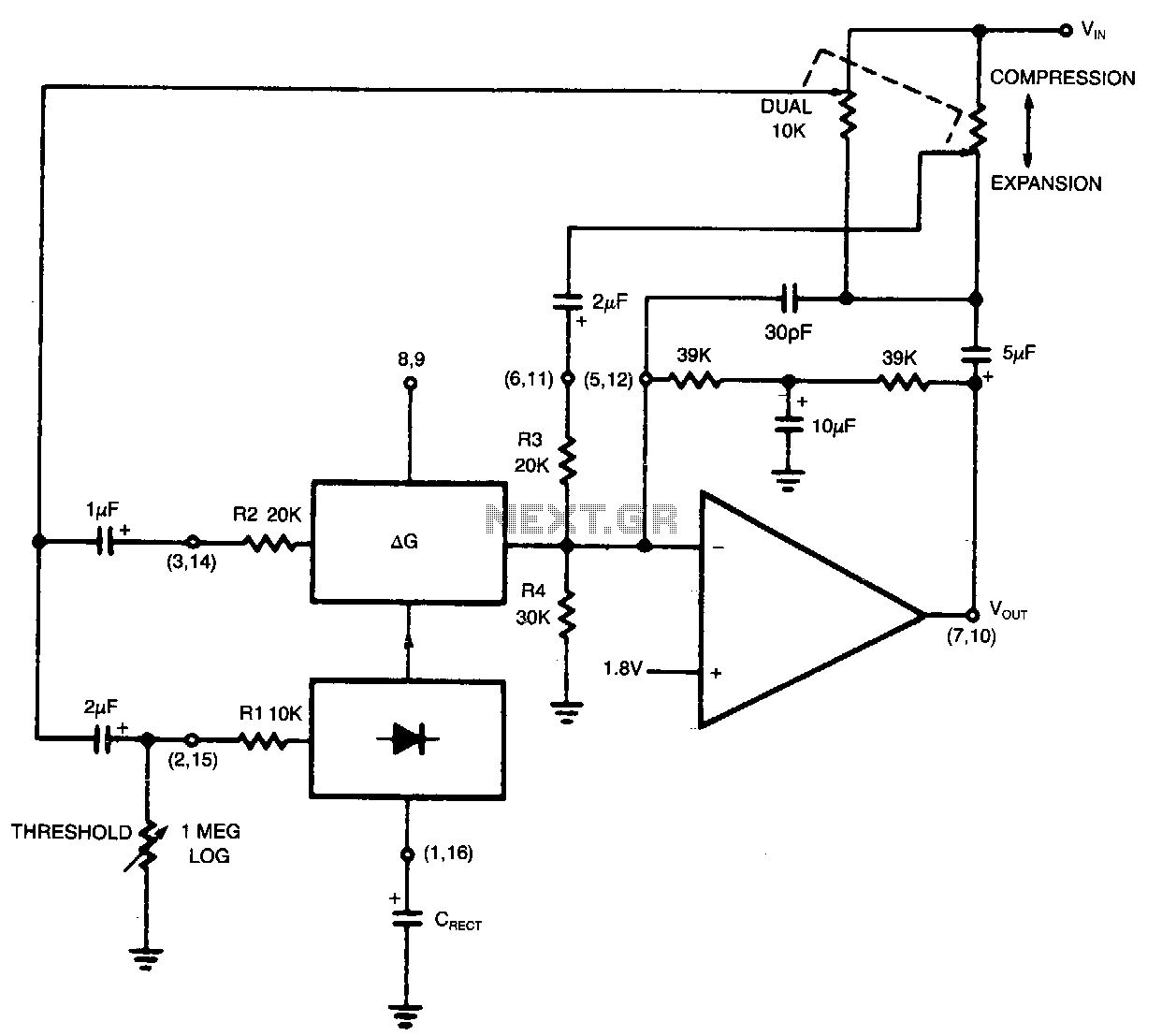
Variable-slope-compressor-expander
Compression and expansion ratios other than 2:1 can be achieved by the circuit shown. Rotation of the dual potentiometer causes the circuit connection to change from a basic compressor to a basic expander. At the center of rotation, the circuit...
compressor
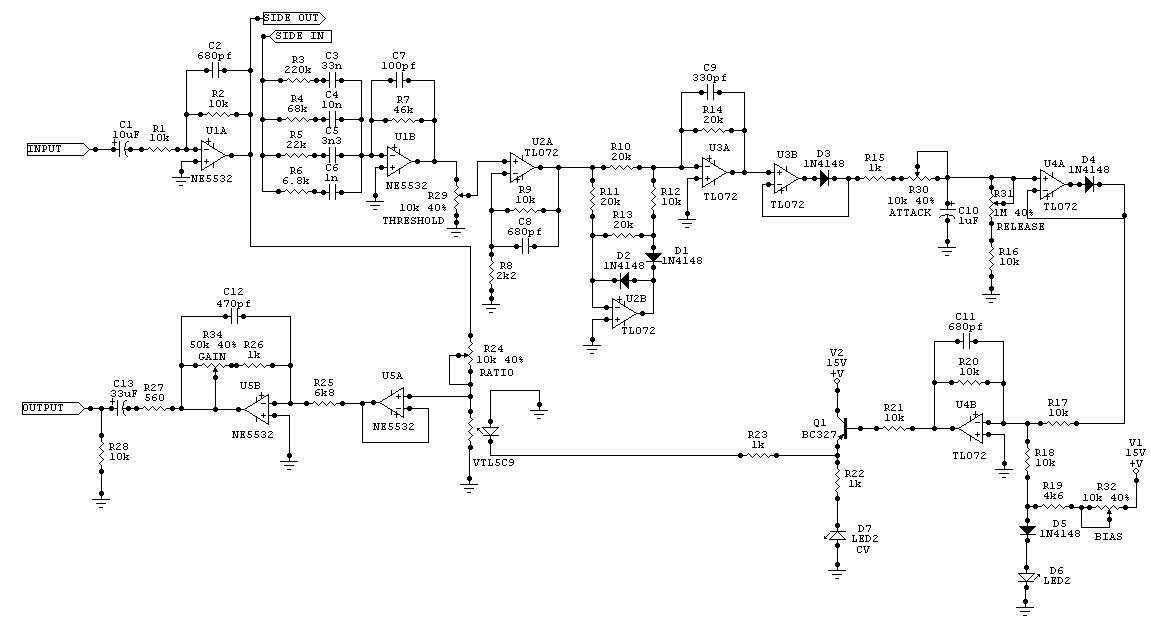
Many audio DIY enthusiasts are likely familiar with "What Compressor," a project that originated from one individual's dissatisfaction with the Alesis 3630 compressor and an admiration for a friend's Joe Meek device. The creator, known as DeeT, has shared his...
Compressor Protector
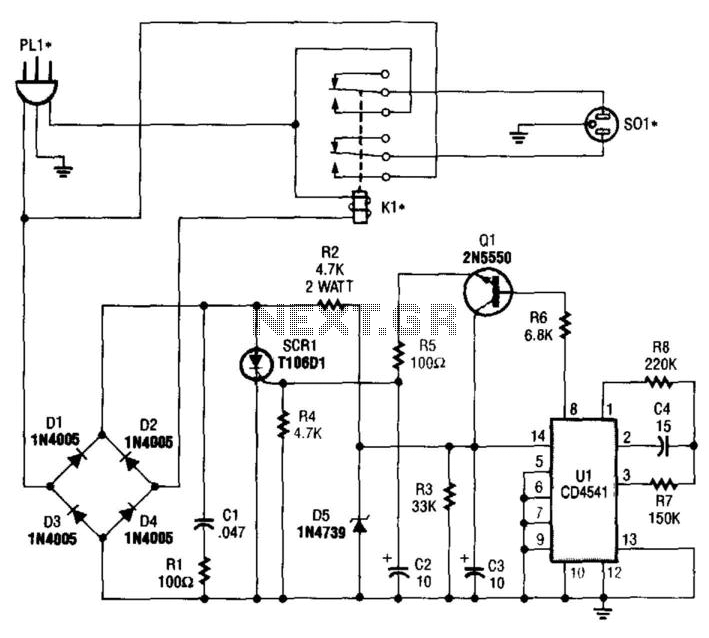
This circuit monitors the AC voltage of the power line. Upon a power failure, when power is restored, the circuit introduces a five-minute delay before energizing relay K1, which safeguards the compressor against low voltage conditions. U1 is a 16-stage...