


Battery Charger Display Using LT1639
#LT1639
#operational amplifier
#current sense
#battery management
#power electronics
#circuit design
#charging circuit
#over-the-top amplifier
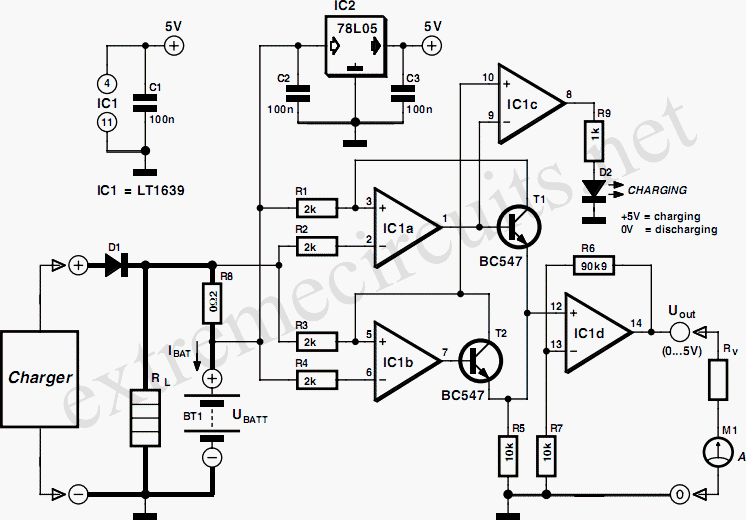
Description: The Over-the-Top type of operational amplifier is ideal for use as a current sense for battery charger applications. The design described here can be used.
The Over-the-Top operational amplifier (op-amp) is specifically designed for applications requiring precise current sensing, particularly in battery charger systems. This op-amp configuration allows for accurate monitoring of current flow, which is critical for optimizing charging efficiency and ensuring battery longevity.
In a typical implementation, the op-amp can be connected in a differential configuration to measure the voltage drop across a shunt resistor placed in series with the battery charging circuit. This setup provides a proportional voltage output that corresponds to the current flowing through the shunt resistor. The gain of the op-amp can be adjusted using external resistors to match the desired sensitivity and range of current measurement.
To enhance performance, the op-amp may include features such as low offset voltage, high common-mode rejection ratio (CMRR), and wide bandwidth, which are essential for accurate and stable operation in dynamic charging environments. Additionally, incorporating feedback mechanisms can help maintain linearity and reduce distortion in the output signal.
For practical applications, the op-amp circuit may be integrated with a microcontroller or analog-to-digital converter (ADC) to facilitate real-time monitoring and control of the charging process. This integration enables the implementation of sophisticated charging algorithms that can adapt to varying battery conditions, ensuring optimal charging profiles and enhancing overall system efficiency.
In summary, the Over-the-Top operational amplifier serves as a vital component in battery charger designs, providing accurate current sensing capabilities that are essential for effective battery management.The Over-the-Top type of operational amplifier is ideal for use as a current sense for battery charger applications. The design described here can be used..
The Over-the-Top operational amplifier (op-amp) is specifically designed for applications requiring precise current sensing, particularly in battery charger systems. This op-amp configuration allows for accurate monitoring of current flow, which is critical for optimizing charging efficiency and ensuring battery longevity.
In a typical implementation, the op-amp can be connected in a differential configuration to measure the voltage drop across a shunt resistor placed in series with the battery charging circuit. This setup provides a proportional voltage output that corresponds to the current flowing through the shunt resistor. The gain of the op-amp can be adjusted using external resistors to match the desired sensitivity and range of current measurement.
To enhance performance, the op-amp may include features such as low offset voltage, high common-mode rejection ratio (CMRR), and wide bandwidth, which are essential for accurate and stable operation in dynamic charging environments. Additionally, incorporating feedback mechanisms can help maintain linearity and reduce distortion in the output signal.
For practical applications, the op-amp circuit may be integrated with a microcontroller or analog-to-digital converter (ADC) to facilitate real-time monitoring and control of the charging process. This integration enables the implementation of sophisticated charging algorithms that can adapt to varying battery conditions, ensuring optimal charging profiles and enhancing overall system efficiency.
In summary, the Over-the-Top operational amplifier serves as a vital component in battery charger designs, providing accurate current sensing capabilities that are essential for effective battery management.The Over-the-Top type of operational amplifier is ideal for use as a current sense for battery charger applications. The design described here can be used..
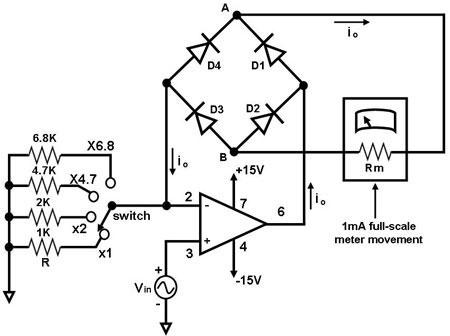
lowvoltage ac voltmeter
The primary component of this circuit is an operational amplifier (such as the 741 or 351), configured as an amplifier with a feedback circuit that consists of a diode bridge full-wave rectifier. An ammeter is connected to the rectifier circuit,...
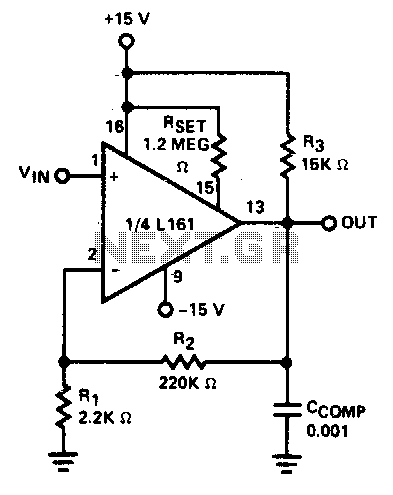
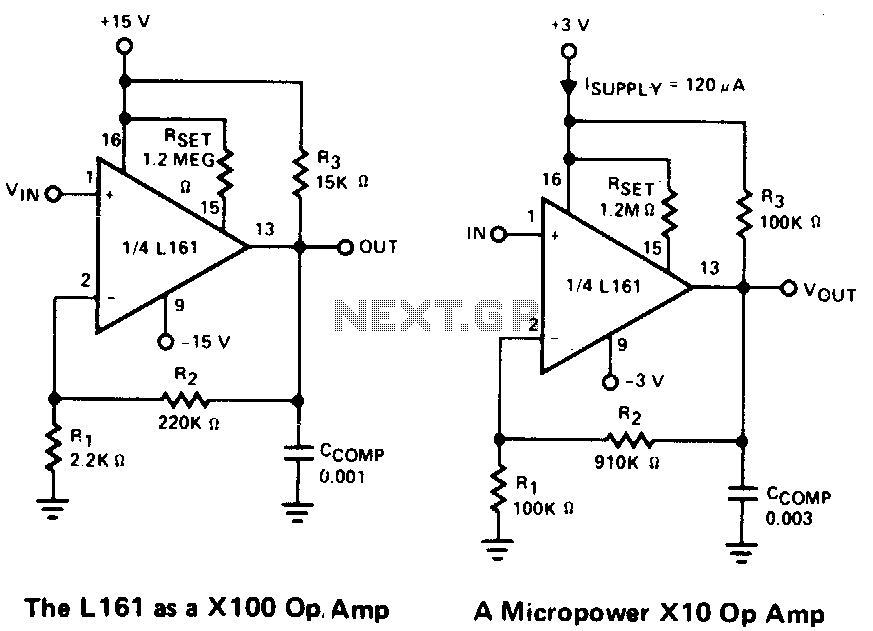
X100 operational amplifier
The amplifier has a gain-bandwidth product of 20 MHz, with a slew rate of 0.3 V/µs.
The amplifier's gain-bandwidth product (GBP) of 20 MHz indicates that the product of the amplifier's gain and the bandwidth at which that gain is applicable...
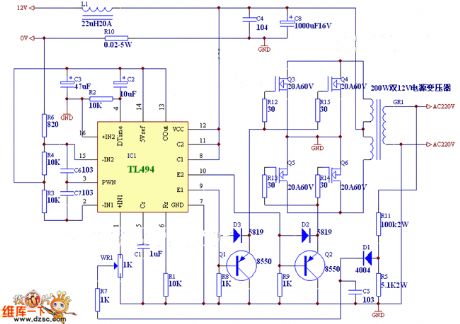
Precision current sink sourcel
An operational amplifier circuit can provide a constant voltage source with a high amplification factor and substantial load current. Even with significant variations in circuit parameters, the output voltage maintains high precision. The output current limit is managed by transistors...
Operational-amplifiers
This is a single gain-of-100 amplifier with a gain-bandwidth product of 20 MHz. The primary limitation in performance is the low slew rate of 0.3 V/μs imposed by the charging of Ccomp. The effects of slew rate and compensation are...
operational amplifier op amp oscillator
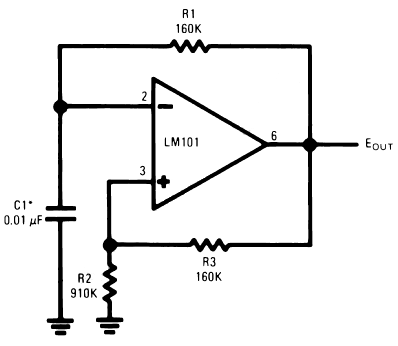
The timing capacitor (C1) generates multiple time constants, facilitating substantial voltage fluctuations at the input, attributable to the LM101's extensive input voltage range. It is advisable to decrease the value of resistor R2 and to increase the capacitance of C1...
TA-1500 fever amplifier circuit
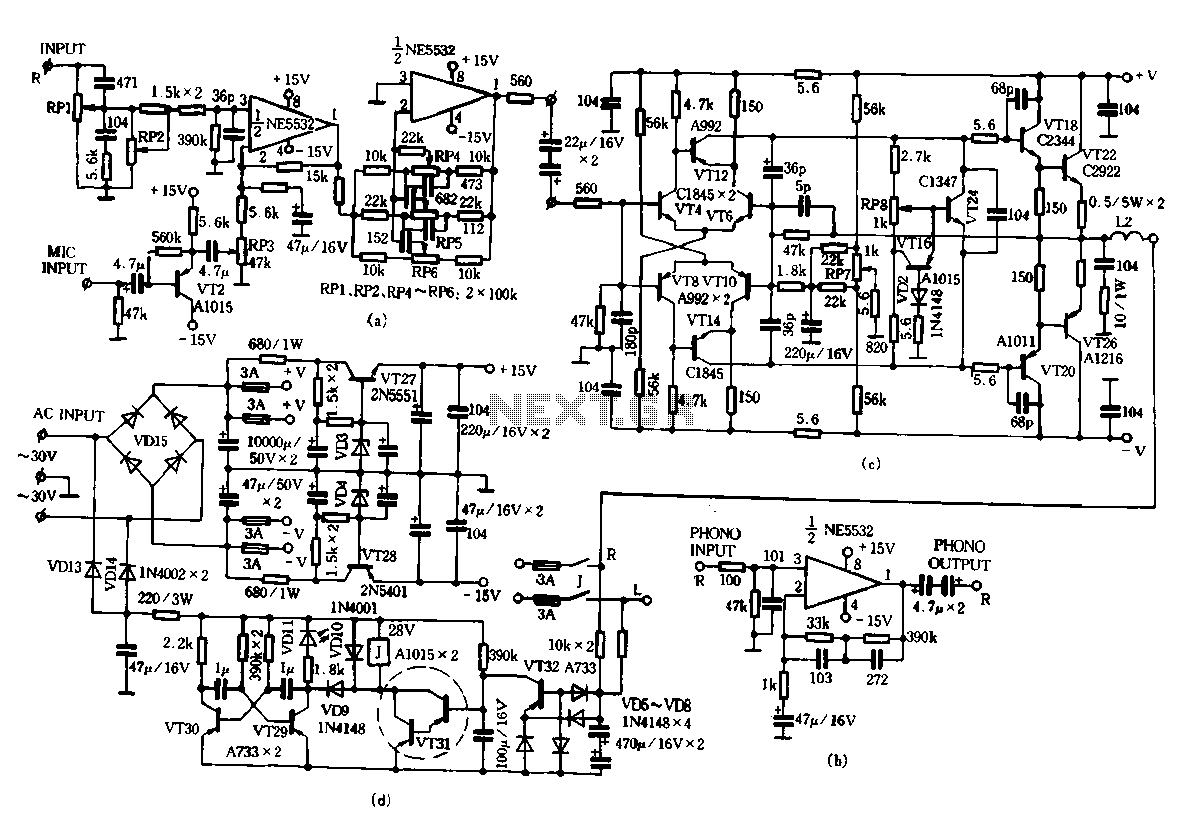
Only the R channel is shown, with the original reference PCB label. Figure (a) illustrates the front tone circuit, which consists of a common negative feedback operational amplifier in an RC circuit configuration. The microphone signal is amplified by VTz,...
OP AMP SINE WAVE GENERATOR CIRCUIT
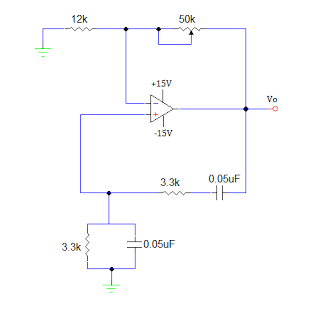
An operational amplifier-based sine wave generator circuit, commonly known as a Wien bridge oscillator, is recognized for its simplicity and stability. The Wien bridge oscillator connects the Wien bridge circuit between the amplifier's input and output terminals. The bridge features...
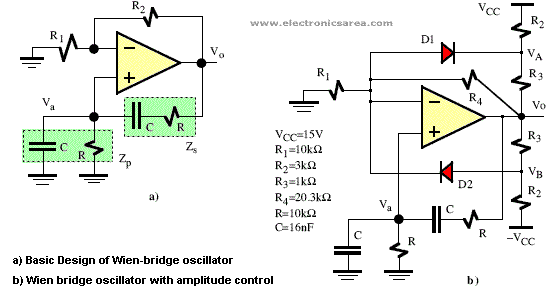
Opamp Wien-bridge oscillator
The Wien-bridge oscillator consists of an operational amplifier (OA) in a non-inverting configuration with a gain of 1 + R2/R1 and an RC feedback network.
The Wien-bridge oscillator is a type of electronic oscillator that generates sine waves. It employs a...
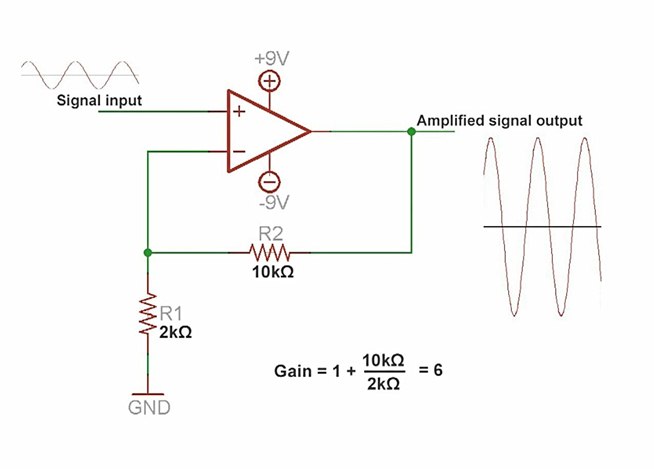
amplify voltage and build microphone circuit
An amplifier is a device that increases the voltage in a circuit. The simplest type is an operational amplifier, and this video will demonstrate how these devices function and how to implement them in electronic applications. As an example, you...