


BATTERY TRICKLE CHARGER
#LM317T
#voltage regulator
#adjustable voltage
#trickle charge
#resistor network
#diode
#current flow
#battery maintenance
#12V battery
#charging circuit
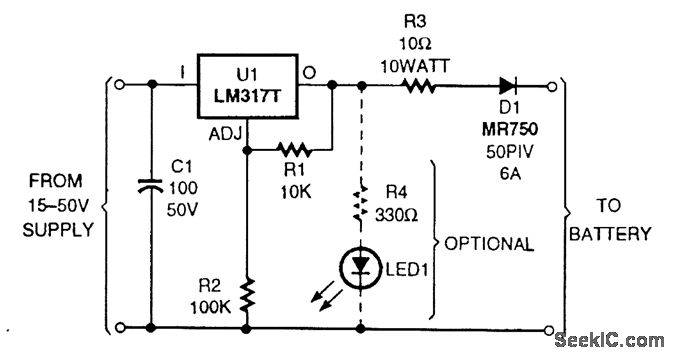
Description: The circuit is based on an LM317T adjustable voltage regulator. The output voltage (VOUT) is defined by the formula VOUT = 1.25 (1 + R2/R1). A 10-kΩ resistor is selected for R1 and a 100-kΩ resistor for R2, allowing for a small current flow of approximately 125 µA. This configuration results in an output voltage of 13.75 V between the output terminal and ground. Resistor R3 and a diode are included to prevent burnout in case of short-circuiting or reversing the terminals, as well as to avoid battery discharge if the regulator is disconnected from the main power supply. An optional capacitor can be added to enhance performance under extreme charging conditions. With adequate heat sinking, the IC can handle a current of up to 1.5 A to the battery. The circuit can remain connected to the battery continuously without the risk of overcharging.
The LM317T is a versatile adjustable voltage regulator commonly used in power supply applications. The adjustment of the output voltage is achieved by varying the resistor values R1 and R2 in the feedback network. The chosen values of 10 kΩ for R1 and 100 kΩ for R2 provide a stable output voltage of 13.75 V, calculated using the formula VOUT = 1.25 (1 + R2/R1). This configuration allows for a small quiescent current, which is beneficial for battery-operated devices.
Incorporating a diode in the circuit is crucial for protecting the LM317T from potential damage due to incorrect connections. The diode allows current to flow in the correct direction and blocks reverse current that could lead to component failure. Additionally, resistor R3 serves as a current limiting or protection component, ensuring that the circuit operates safely under various conditions.
The optional capacitor can be used to smooth out voltage fluctuations during rapid charging cycles, thereby enhancing the stability of the output voltage. This is particularly important in applications where the load may change quickly, as it helps to prevent voltage spikes that could affect sensitive components.
The LM317T is capable of delivering a maximum output current of 1.5 A with proper heat sinking, which is essential for maintaining the regulator's performance and preventing overheating during continuous operation. The design allows for the circuit to remain connected to the battery at all times without the risk of overcharging, making it suitable for applications where a constant voltage supply is required. Overall, this circuit design provides a reliable and efficient solution for adjustable voltage regulation in various electronic applications.The circuit is built around an LM317T adjustable voltage regulator. Its output voltage (VOUT) is determined by the formula VOUT= l. 25 (1+R2/R1). I chose a 10-k © resistor for R1 and a 100-k © resistor for R2 to allow for a little wasted current flow (around 125 A). This will develop 13. 75 V between the output terminal and ground. R3 and a diode prevent burnout if the terminals are shorted or reversed, and prevent battery discharge in the event that the regulator is disconnected from the main power supply. The capacitor is optional but will make life easier on the chip under an extreme charging cycle. With proper heat sinking, the IC is capable of carrying 1. 5 A to the battery. The circuit can be left hooked to the battery all of the time and will not overcharge it.
The LM317T is a versatile adjustable voltage regulator commonly used in power supply applications. The adjustment of the output voltage is achieved by varying the resistor values R1 and R2 in the feedback network. The chosen values of 10 kΩ for R1 and 100 kΩ for R2 provide a stable output voltage of 13.75 V, calculated using the formula VOUT = 1.25 (1 + R2/R1). This configuration allows for a small quiescent current, which is beneficial for battery-operated devices.
Incorporating a diode in the circuit is crucial for protecting the LM317T from potential damage due to incorrect connections. The diode allows current to flow in the correct direction and blocks reverse current that could lead to component failure. Additionally, resistor R3 serves as a current limiting or protection component, ensuring that the circuit operates safely under various conditions.
The optional capacitor can be used to smooth out voltage fluctuations during rapid charging cycles, thereby enhancing the stability of the output voltage. This is particularly important in applications where the load may change quickly, as it helps to prevent voltage spikes that could affect sensitive components.
The LM317T is capable of delivering a maximum output current of 1.5 A with proper heat sinking, which is essential for maintaining the regulator's performance and preventing overheating during continuous operation. The design allows for the circuit to remain connected to the battery at all times without the risk of overcharging, making it suitable for applications where a constant voltage supply is required. Overall, this circuit design provides a reliable and efficient solution for adjustable voltage regulation in various electronic applications.The circuit is built around an LM317T adjustable voltage regulator. Its output voltage (VOUT) is determined by the formula VOUT= l. 25 (1+R2/R1). I chose a 10-k © resistor for R1 and a 100-k © resistor for R2 to allow for a little wasted current flow (around 125 A). This will develop 13. 75 V between the output terminal and ground. R3 and a diode prevent burnout if the terminals are shorted or reversed, and prevent battery discharge in the event that the regulator is disconnected from the main power supply. The capacitor is optional but will make life easier on the chip under an extreme charging cycle. With proper heat sinking, the IC is capable of carrying 1. 5 A to the battery. The circuit can be left hooked to the battery all of the time and will not overcharge it.
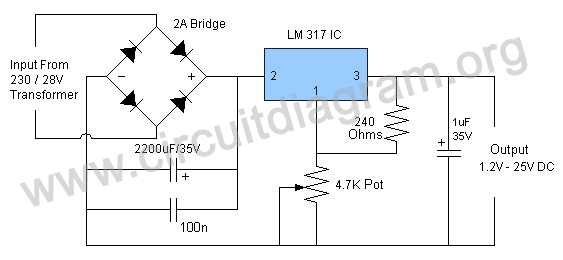
lm317t power supply
The LM317T power supply circuit is a straightforward and enduring design that consists of a minimal number of components. It provides a stable, regulated, adjustable, or variable output.
The LM317T is a versatile linear voltage regulator that can output a voltage...
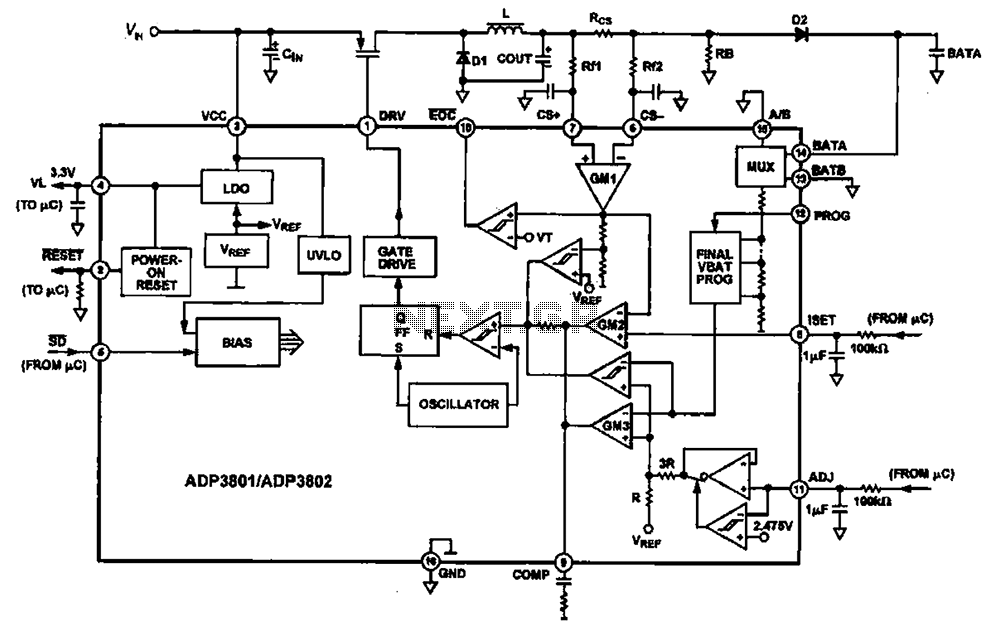
Charging circuit diagram personal work
Charging circuit diagram for personal work based on the operating principle of ADP3801/3802 charging circuit.
The ADP3801/3802 is a highly integrated battery charger controller designed for Li-ion and Li-polymer batteries. The charging circuit typically consists of several key components including the...
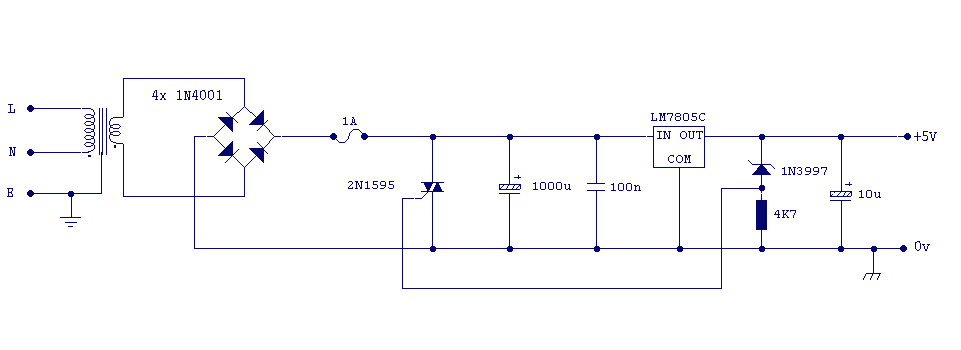
Logic PSU with Overvoltage Protection
The 5 volt regulated power supply for TTL and 74LS series integrated circuits has to be very precise and tolerant of voltage transients. These ICs are easily damaged by short voltage spikes. A fuse will blow when its current rating...
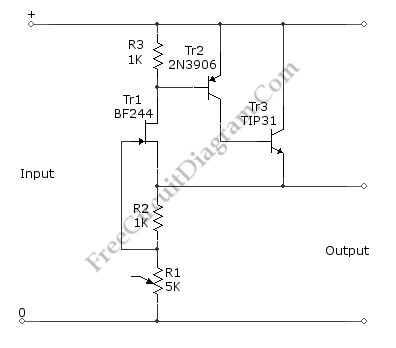
5V FET Voltage Regulator
This voltage regulator circuit provides a stable 5V output from unregulated inputs that are greater than 5V. The output voltage stability is satisfactory, with minimal variations.
The voltage regulator circuit utilizes a linear voltage regulator, such as the LM7805, which is...
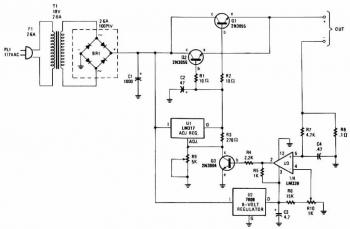
universal battery charger
The charger's output voltage is adjustable and regulated, featuring an adjustable constant-current charging circuit that is compatible with most NiCad batteries. It is capable of charging a single cell or multiple series-connected cells with a maximum voltage of 18V. Power...
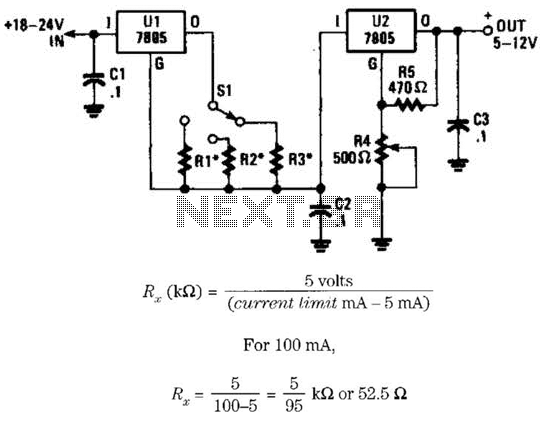
Combination Voltage And Current Regulator Circuit
This voltage regulator and current limiter combination can be constructed using two 7805 regulators as illustrated. Resistors R1, R2, and R3 should be chosen to achieve a 5-V drop at the maximum allowable current limit. Switch S1 selects one of...
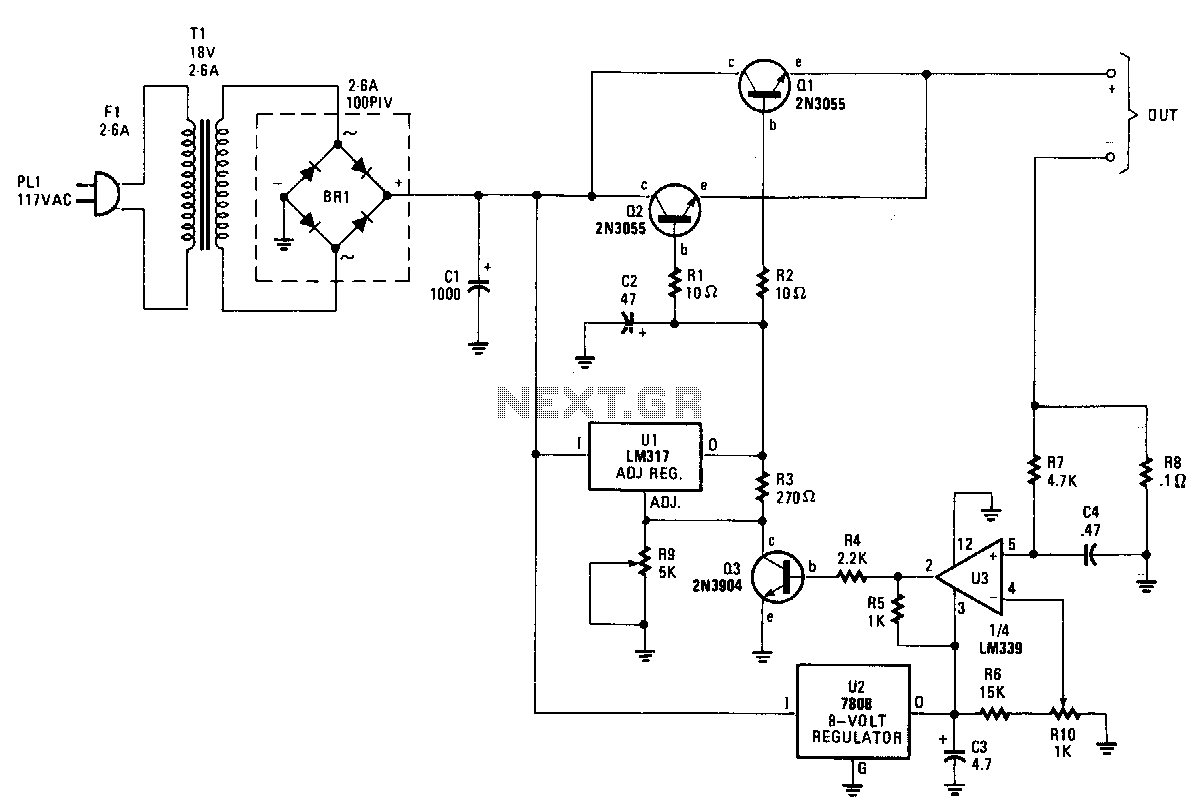
Universal-battery-charger
The charger's output voltage is adjustable and regulated, featuring an adjustable constant-current charging circuit that facilitates compatibility with most NiCad batteries. It is capable of charging a single cell or multiple series-connected cells, with a maximum voltage of 18 V....
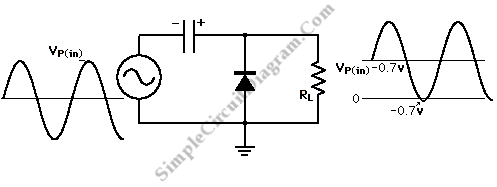
Signal Clamper Using Diode
A diode and capacitor can be utilized to clamp an AC signal, shifting the level into the positive region for all cycles. This condition is sometimes necessary to ensure a positive output.
In an electronic circuit, clamping is a technique used...
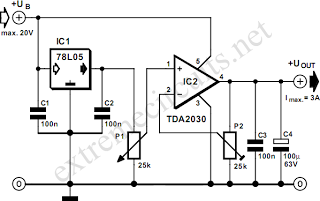
Adjustable 3 Ampere Regulator
By combining a standard 78L05 voltage regulator with an integrated audio amplifier, specifically the TDA2030, it is possible to construct a simple yet effective adjustable voltage regulator. This regulator can output a voltage adjustable up to 20 V and handle...