


car battery 6v or 12v charger
#6V battery
#12V battery
#automatic charger
#transformer
#short circuit resistance
#fast charging
#battery maintenance
#power electronics
#energy management
#DIY charger
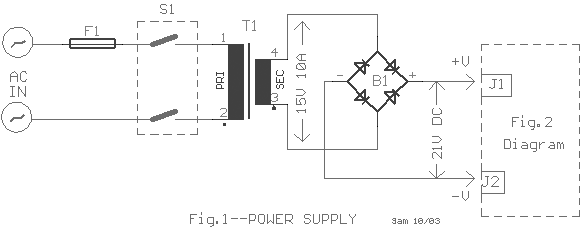
Description: This circuit can automatically and efficiently charge 6V and 12V batteries. A key factor in the successful operation of the circuit is the use of a high-quality transformer [T1] that has excellent insulation and resistance to short circuits.
The circuit functions as a battery charger, designed to handle both 6V and 12V lead-acid batteries. The primary component, the transformer (T1), steps down the AC voltage from the mains supply to a suitable level for charging the batteries. The choice of a high-quality transformer is critical, as it ensures proper voltage regulation and minimizes the risk of overheating or failure due to short circuits.
The circuit typically includes a rectifier, which converts the AC voltage output from the transformer into DC voltage. This is essential since batteries require direct current for charging. The rectifier may consist of a bridge rectifier configuration using diodes rated for the expected current load.
Following the rectification stage, a filtering capacitor is employed to smooth out the pulsating DC voltage, providing a more stable voltage output to the batteries. The capacitor's value must be selected based on the charging current and the desired ripple voltage.
Additionally, a voltage regulator may be incorporated to maintain a constant output voltage, ensuring that the batteries are charged safely and efficiently without overcharging. A current limiting resistor or a more sophisticated current control circuit can also be included to prevent excessive current flow, which could damage the batteries.
To enhance safety and reliability, the circuit may feature protection mechanisms such as fuses or circuit breakers to guard against short circuits and overcurrent conditions. Proper heat dissipation measures, like heat sinks for the diodes and voltage regulators, should also be considered to maintain optimal operating temperatures.
Overall, the successful operation of this battery charging circuit relies on the careful selection of components, particularly the transformer, as well as the implementation of protective features to ensure safe and efficient charging of 6V and 12V batteries.This circuit can charge automatically, fast and rightly, batteries 6V and 12V. A basic factor in the success in the circuit operation is the use of transformer [T1] of good quality with very good insulation and resistance in the short circuits..
The circuit functions as a battery charger, designed to handle both 6V and 12V lead-acid batteries. The primary component, the transformer (T1), steps down the AC voltage from the mains supply to a suitable level for charging the batteries. The choice of a high-quality transformer is critical, as it ensures proper voltage regulation and minimizes the risk of overheating or failure due to short circuits.
The circuit typically includes a rectifier, which converts the AC voltage output from the transformer into DC voltage. This is essential since batteries require direct current for charging. The rectifier may consist of a bridge rectifier configuration using diodes rated for the expected current load.
Following the rectification stage, a filtering capacitor is employed to smooth out the pulsating DC voltage, providing a more stable voltage output to the batteries. The capacitor's value must be selected based on the charging current and the desired ripple voltage.
Additionally, a voltage regulator may be incorporated to maintain a constant output voltage, ensuring that the batteries are charged safely and efficiently without overcharging. A current limiting resistor or a more sophisticated current control circuit can also be included to prevent excessive current flow, which could damage the batteries.
To enhance safety and reliability, the circuit may feature protection mechanisms such as fuses or circuit breakers to guard against short circuits and overcurrent conditions. Proper heat dissipation measures, like heat sinks for the diodes and voltage regulators, should also be considered to maintain optimal operating temperatures.
Overall, the successful operation of this battery charging circuit relies on the careful selection of components, particularly the transformer, as well as the implementation of protective features to ensure safe and efficient charging of 6V and 12V batteries.This circuit can charge automatically, fast and rightly, batteries 6V and 12V. A basic factor in the success in the circuit operation is the use of transformer [T1] of good quality with very good insulation and resistance in the short circuits..
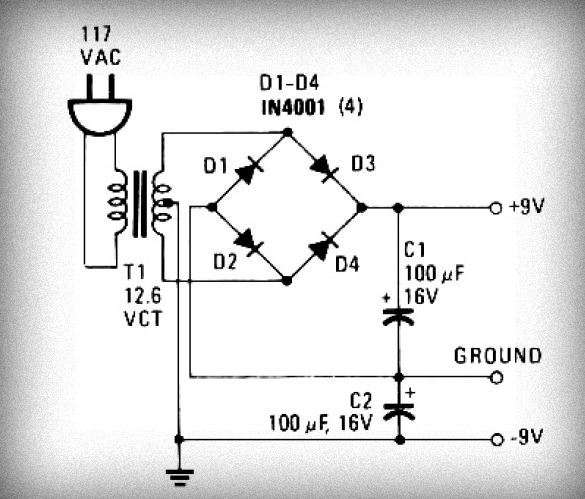
Simple Power Supply Circuit easy to make Schematic Diagram
Initially, voltage from AC 220V or 110V enters the transformer, which reduces it to 12V AC. This AC voltage is then rectified using either four diodes or a bridge rectifier to convert it to DC voltage. The resulting DC voltage...
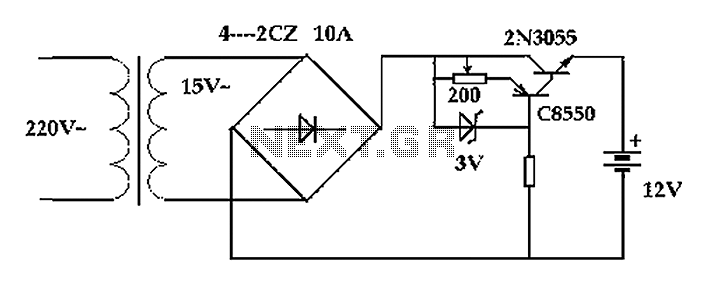
Classic car battery charging circuit diagram
The circuit operates after a transformer, utilizing a bridge rectifier and conditioning for battery charging. The charging current transformer can be easily adjusted to provide approximately 12V at 100Ah battery charging. The required charging current is 10A, and a 150VA...
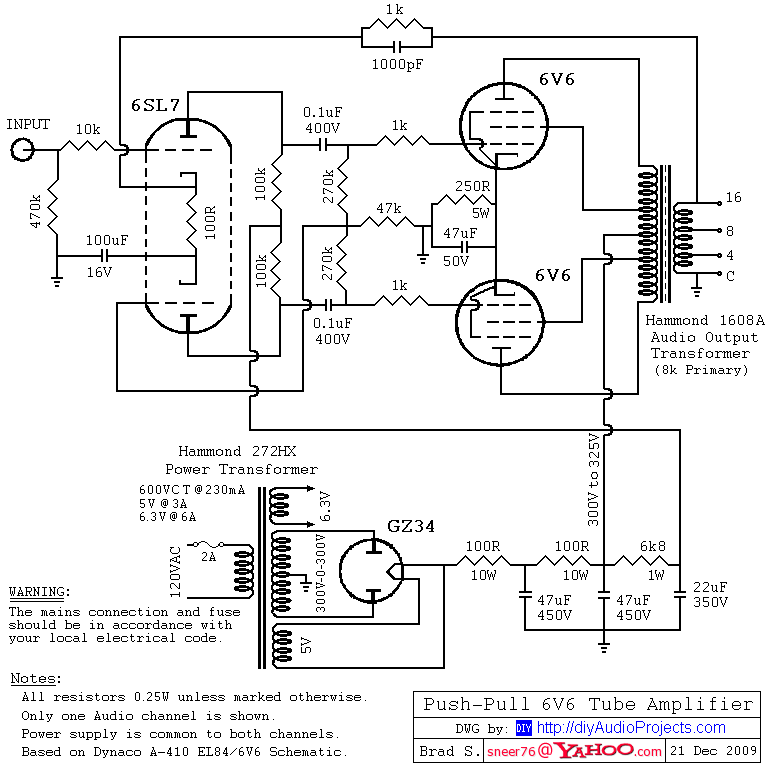
how to select transformers
The Edcor model that appears to be the most suitable is the GXPP15-8-8K from EDCOR Electronics Corporation. The GXPP15-8-8K is a cost-effective option.
The GXPP15-8-8K is a high-performance audio output transformer designed for use in tube amplifier applications. It features an...
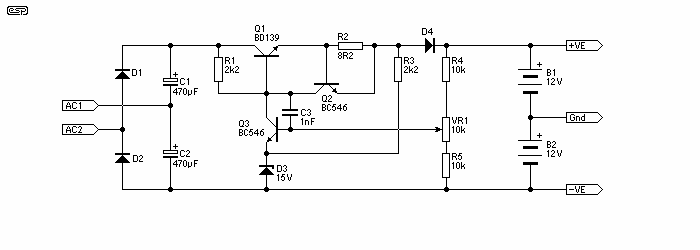
Automatic Charger for Battery Hi-Fi Preamps
This project is one for the experimenter, but as shown will work extremely well. The sensing circuit can be made so sensitive that a load of only 2.5mA is enough for the circuit to detect, and disconnect the charger. The...
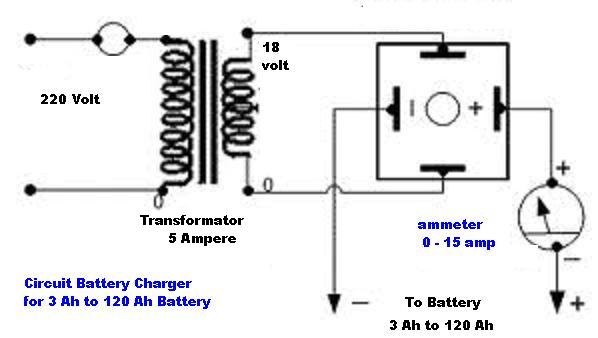
how to make car battery charger
The circuit diagram of a simple and straightforward 12 V battery charger is presented here. This circuit can be utilized to charge various types of 12V rechargeable batteries, including car batteries and motorcycle batteries.
The 12 V battery charger circuit typically...

Battery Charge Nominal Discharge Indicator Circuit
12V Battery Charge Nominal Discharge (Low) Indicator Circuit. This circuit monitors car battery voltage and provides an indication of nominal supply voltage, as well as low or high voltage.
The 12V Battery Charge Nominal Discharge Indicator Circuit is designed to continuously...
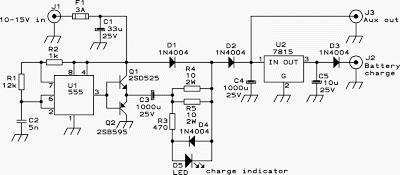
12V Powered 12V Lead Acid Battery Charger with Indicator
A charger is essential for charging a 12 Volt battery from a 12 Volt source due to the typical voltage variation between 11 Volt and 15 Volt. A battery requires a controlled charge current and voltage, which cannot be achieved...
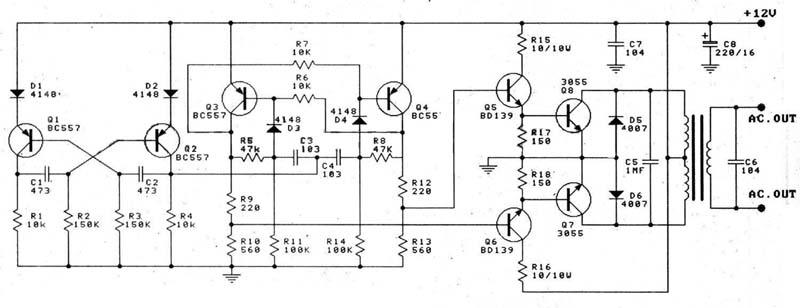
100w dc inverter circuit with pcb design
A 12V car battery is recommended as the input for this circuit, utilizing the 2N3055 transistor as the amplifier. This configuration can deliver a power output of up to 100W, making it suitable for use in battery chargers, emergency lights,...

transformer circuit
A static device that couples two circuits to transfer alternating current (AC) from one circuit to another through electromagnetic induction. The current maintains the same frequency but may vary in voltage, phase, or impedance values. A transformer consists of two...