


Current-Limited 6-V Charger
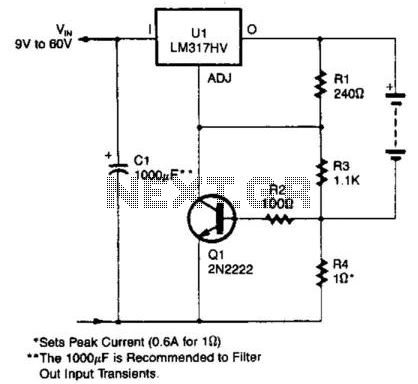
Description: An LM317HV regulator is utilized as a current-limited charger. If the current through R4 exceeds 0.6 A, Q1 is activated, which pulls the ADJ terminal of the LM317HV to ground and reduces the battery charging current.
The LM317HV is a versatile adjustable linear voltage regulator capable of providing a stable output voltage while allowing for current limiting features. In this configuration, the regulator is employed to maintain a safe charging current for a connected battery. The resistor R4 is strategically placed to monitor the charging current; when this current surpasses a predefined threshold of 0.6 A, it triggers the transistor Q1.
When Q1 is activated, it effectively connects the ADJ terminal of the LM317HV to ground. This action alters the feedback loop of the regulator, causing the output voltage to decrease. As a result, the charging current supplied to the battery is reduced, preventing potential damage from overcurrent conditions. This current limiting mechanism is essential in battery charging applications where maintaining a safe charge level is critical to the longevity and safety of the battery.
In practical applications, careful selection of R4 is necessary to ensure accurate current sensing. The value of R4 can be calculated based on the desired current limit and the voltage drop across it at the threshold current. Additionally, Q1 must be chosen based on its current handling capabilities and voltage ratings to ensure reliable operation under the defined conditions.
Overall, this configuration provides an effective solution for current-limited battery charging, enhancing the reliability and safety of the charging process. An LM317HV regulator is used as a current-limited charger. If current through R4 exceeds 0.6 A, Ql is biased on , which pulls the ADJ terminal of the LM317 HV to ground and reduces the battery-charging current.
The LM317HV is a versatile adjustable linear voltage regulator capable of providing a stable output voltage while allowing for current limiting features. In this configuration, the regulator is employed to maintain a safe charging current for a connected battery. The resistor R4 is strategically placed to monitor the charging current; when this current surpasses a predefined threshold of 0.6 A, it triggers the transistor Q1.
When Q1 is activated, it effectively connects the ADJ terminal of the LM317HV to ground. This action alters the feedback loop of the regulator, causing the output voltage to decrease. As a result, the charging current supplied to the battery is reduced, preventing potential damage from overcurrent conditions. This current limiting mechanism is essential in battery charging applications where maintaining a safe charge level is critical to the longevity and safety of the battery.
In practical applications, careful selection of R4 is necessary to ensure accurate current sensing. The value of R4 can be calculated based on the desired current limit and the voltage drop across it at the threshold current. Additionally, Q1 must be chosen based on its current handling capabilities and voltage ratings to ensure reliable operation under the defined conditions.
Overall, this configuration provides an effective solution for current-limited battery charging, enhancing the reliability and safety of the charging process. An LM317HV regulator is used as a current-limited charger. If current through R4 exceeds 0.6 A, Ql is biased on , which pulls the ADJ terminal of the LM317 HV to ground and reduces the battery-charging current.
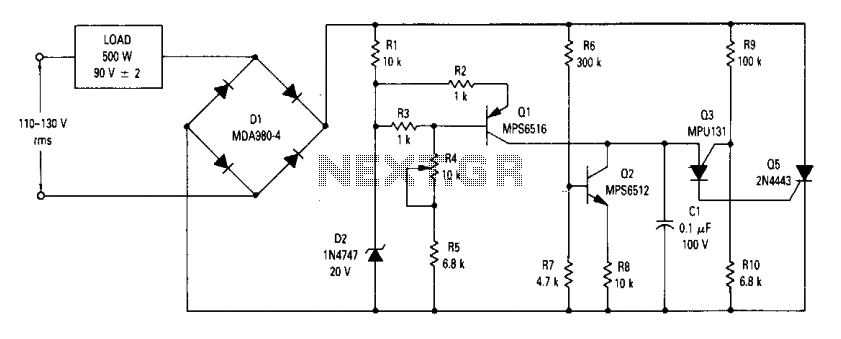
90Vrms voltage regulator
The circuit is an open-loop RMS voltage regulator designed to deliver 500 watts of power at 90 V RMS, maintaining good regulation within an input voltage range of 110-130 V RMS. When the input voltage is applied, capacitor C1 charges...
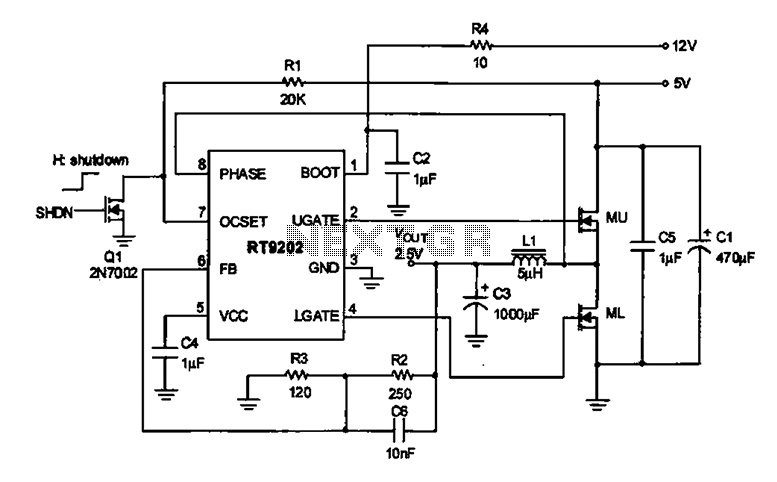
2.5V voltage regulator circuit
A 2.5V voltage regulator circuit is illustrated, which is part of a computer's motherboard. The circuit employs an oscillation circuit with the RT9202 control core chip, converting a 5V input supply into a regulated +2.5V output voltage, with the chip's...
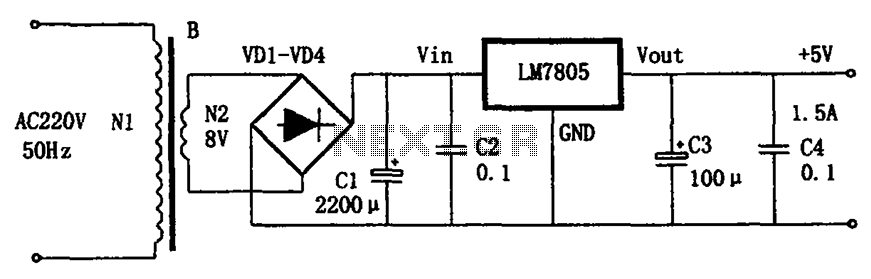
LM7805 + 5V power supply configuration
The circuit illustrated in the figure provides an output voltage of +5V and an output current of 1.5A. It comprises a power transformer, a bridge rectifier circuit consisting of diodes D1 to D4, and filter capacitor C1. Additionally, capacitors C2...
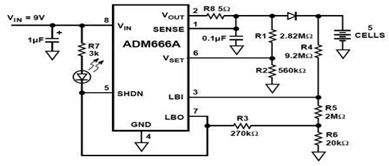
Micropower Linear Voltage Regulator in the Battery Charger Circuit
The ADM666A application note provides a detailed explanation of a low-cost battery charger circuit, including maximum output voltage, charge termination voltage calculation, battery voltage level monitoring, and circuit efficiency optimization. The ADM666A utilizes an NPN transistor and a P-channel FET....
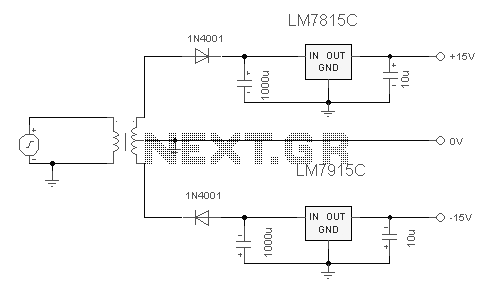
Dual Regulated Power Supply
The 7815 regulates the positive supply, while the 7915 regulates the negative supply. The transformer should have a primary rating of 240/220 volts for Europe or 120 volts for North America. The center-tapped secondary coil should be rated approximately 18...
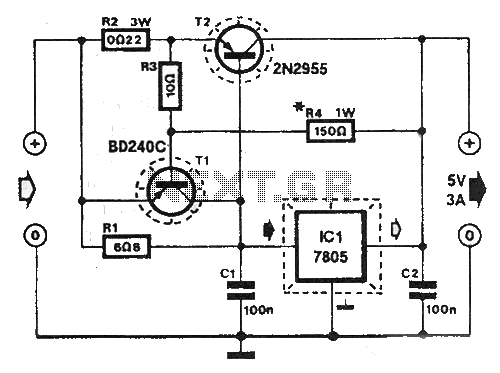
Shortcircuit protected voltage regulator
At this voltage regulator prototype the maximum current, with output shortcircuited it was only 0.5 A, so no overheating occurred. In this DC voltage regulator circuit, T1 is for current limitation. As soon as the voltage on the R2 +...
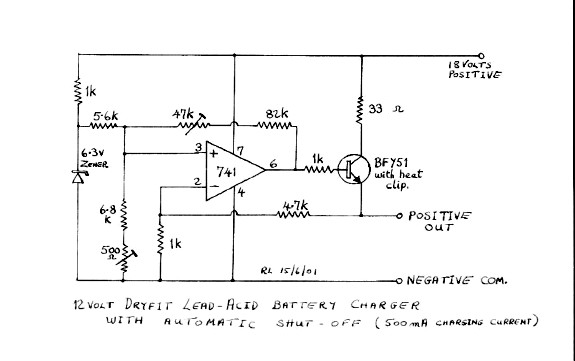
charger
The circuit was constructed on a Vero board and tested with a large electrolytic capacitor in place of a battery. A 500-ohm preset resistor determines the output voltage, while a 47k preset resistor regulates the hysteresis and establishes the voltage...
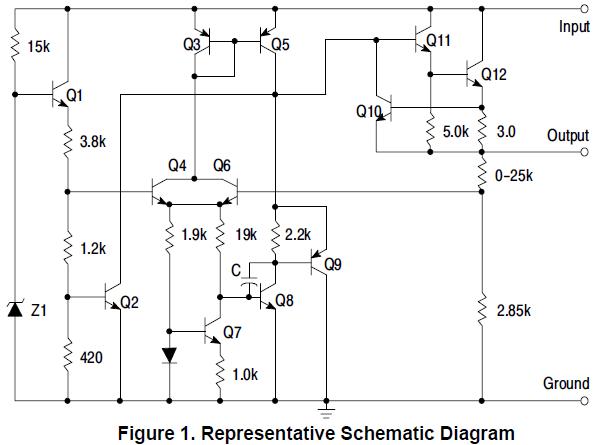
MC78L15ABPG Original supply
MC78L15ABPG positive voltage regulator, 100mA, TO-92
The MC78L15ABPG is a low-dropout (LDO) voltage regulator designed to provide a stable output voltage of 15V with a maximum output current of 100mA. This device is packaged in a TO-92 form factor, which is...

12V DC Dual Power Supply Circuit with IC 7812&7912
The 78W series voltage regulators are designed to handle an input voltage of approximately 35V, while the 24V type can withstand up to 40V. It should be noted that these regulators will not operate effectively with a significant input-output voltage...