


phone charger using a 7805 voltage regualtor
#7805
#voltage regulator
#phone charger
#USB charging
#power supply
#smartphone
#Minty Boost
#DC-DC
#portable charger
#5V
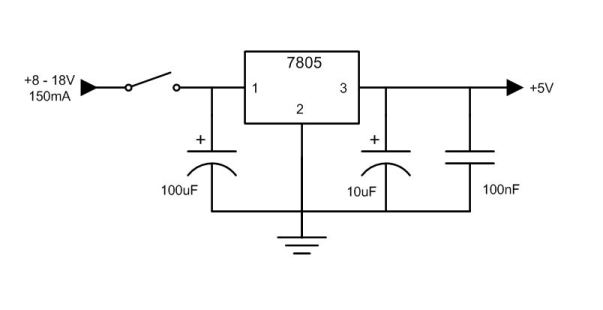
Description: A simple 7805 charging circuit designed to recharge smartphones, such as the Incredible model. The circuit design is similar to that of the Minty Boost.
The 7805 voltage regulator is a popular component used in various electronic circuits to provide a stable output voltage of 5V. In this charging circuit, the 7805 is employed to convert a higher input voltage, typically from a power source like a USB charger or a battery, to the required 5V output suitable for charging smartphones.
The circuit typically includes the following components:
1. **Input Power Source**: This can be a USB power supply or a battery that provides a voltage higher than 5V, usually in the range of 7V to 12V.
2. **7805 Voltage Regulator**: This three-terminal device regulates the input voltage down to a stable 5V output. It has an input terminal, an output terminal, and a ground terminal.
3. **Capacitors**: To ensure stability and reduce noise in the output voltage, input and output capacitors are often added. A common configuration uses a 0.33µF capacitor at the input and a 0.1µF capacitor at the output.
4. **Diode (optional)**: A diode may be placed in parallel with the input to protect against reverse polarity connections, which can damage the circuit.
5. **Charging Circuitry**: Depending on the smartphone's charging requirements, additional components such as a microcontroller or charging IC may be included to manage the charging process, monitor battery status, and ensure safe charging rates.
The layout of the circuit should be designed to minimize noise and interference, with careful attention to the placement of components to avoid inductive coupling. The heat dissipation of the 7805 should also be considered, as it can generate heat during operation, especially when the input voltage is significantly higher than the output voltage. A heat sink may be necessary to prevent overheating and ensure reliable operation.
Overall, this simple 7805 charging circuit is effective for recharging smartphones and can be implemented in various portable electronic projects.Simple 7805 charging circuit to recharge smart phones like the Incredible. Similar in design to the Minty Boost..
The 7805 voltage regulator is a popular component used in various electronic circuits to provide a stable output voltage of 5V. In this charging circuit, the 7805 is employed to convert a higher input voltage, typically from a power source like a USB charger or a battery, to the required 5V output suitable for charging smartphones.
The circuit typically includes the following components:
1. **Input Power Source**: This can be a USB power supply or a battery that provides a voltage higher than 5V, usually in the range of 7V to 12V.
2. **7805 Voltage Regulator**: This three-terminal device regulates the input voltage down to a stable 5V output. It has an input terminal, an output terminal, and a ground terminal.
3. **Capacitors**: To ensure stability and reduce noise in the output voltage, input and output capacitors are often added. A common configuration uses a 0.33µF capacitor at the input and a 0.1µF capacitor at the output.
4. **Diode (optional)**: A diode may be placed in parallel with the input to protect against reverse polarity connections, which can damage the circuit.
5. **Charging Circuitry**: Depending on the smartphone's charging requirements, additional components such as a microcontroller or charging IC may be included to manage the charging process, monitor battery status, and ensure safe charging rates.
The layout of the circuit should be designed to minimize noise and interference, with careful attention to the placement of components to avoid inductive coupling. The heat dissipation of the 7805 should also be considered, as it can generate heat during operation, especially when the input voltage is significantly higher than the output voltage. A heat sink may be necessary to prevent overheating and ensure reliable operation.
Overall, this simple 7805 charging circuit is effective for recharging smartphones and can be implemented in various portable electronic projects.Simple 7805 charging circuit to recharge smart phones like the Incredible. Similar in design to the Minty Boost..
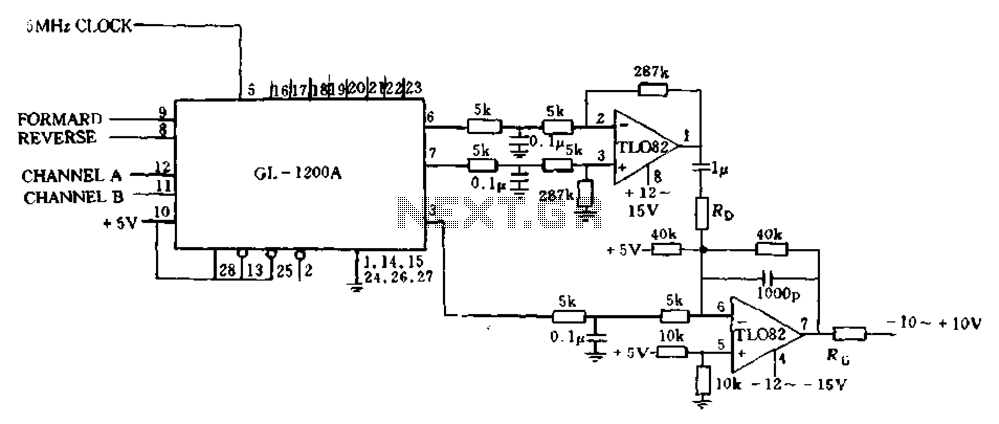
Which only uses the 5V power supply connection circuit
The error processing segment is converted into a pulse width modulated (PWM) signal output from 3 feet (MC signal). Additionally, the differential position error is calculated, which represents the small velocity, from 6 to 7 feet, selected as a system...
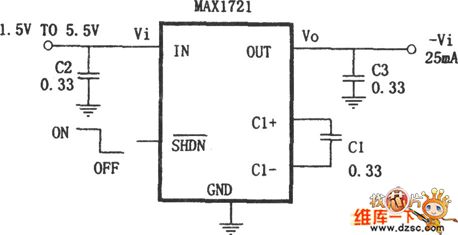
Index 2 - Power-Supply Circuits-DC to DC - power supply circuit - SeekIC.com
The MAX732/733 is a DC-DC current PWM step-up regulator. The MAX732 has an output voltage of +12V with a maximum output current of 200mA and an output voltage range of +4.0V to +9.3V. The MAX733 features an output voltage of...
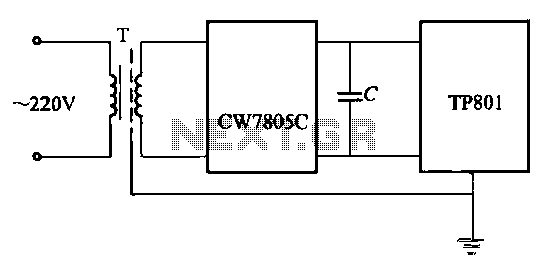
MCU power supply wiring portion
High-precision voltage regulator, isolation transformer with the correct wiring, and low-pass filter to enhance the electrical noise immunity of the source portion. The wiring in Figures 20-48 and 20-49 is illustrated in the figures. Chokes (L1, L2) should have an...

DC-DC Convertor
This circuit will generate a smaller DC output voltage from a larger DC input voltage. It is quick and simple to make and by changing the value of the zener diode, the circuit can be universally adapted to provide other...
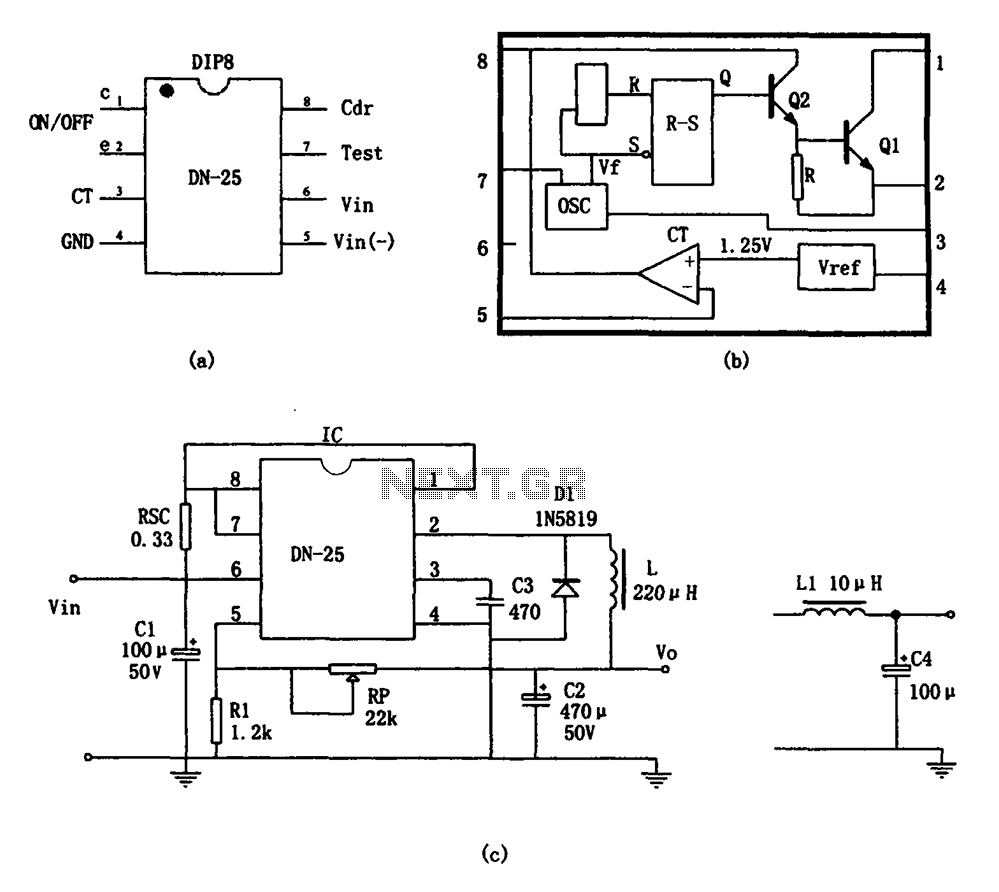
Switching power supply monolithic switching regulator DN-25 configuration
As shown in the figure, the DN-25 IC is a switching power supply. The DN-25 is a monolithic switching power supply device suitable for medium output current applications and a wide voltage range. Its main performance indicators include an input...
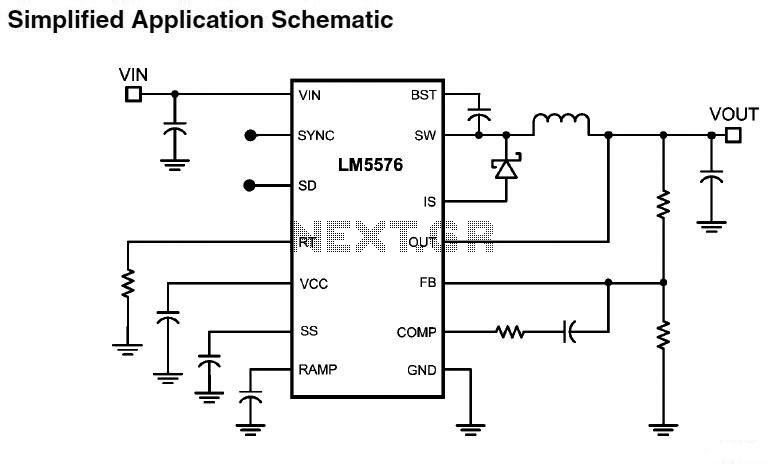
LM567CM Integrated Circuits
LM5576MHX absolute maximum ratings: (1) VIN to GND: 76V; (2) BST to GND: 90V; (3) PRE to GND: 76V; (4) SW to GND (Steady State): -1.5V; (5) BST to VCC: 76V; (6) SD, VCC to GND: 14V; (7) BST to...
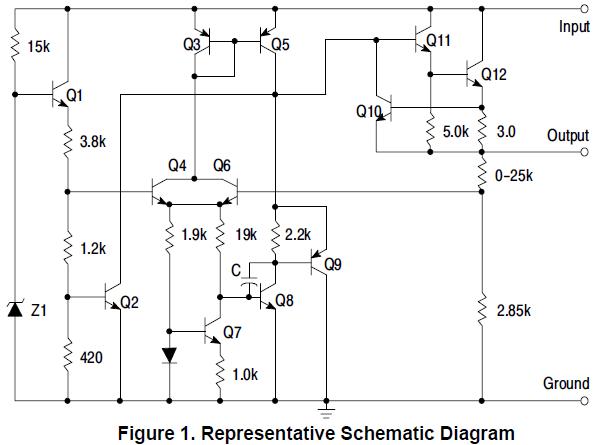
MC78L15ABPG Original supply
MC78L15ABPG positive voltage regulator, 100mA, TO-92
The MC78L15ABPG is a low-dropout (LDO) voltage regulator designed to provide a stable output voltage of 15V with a maximum output current of 100mA. This device is packaged in a TO-92 form factor, which is...
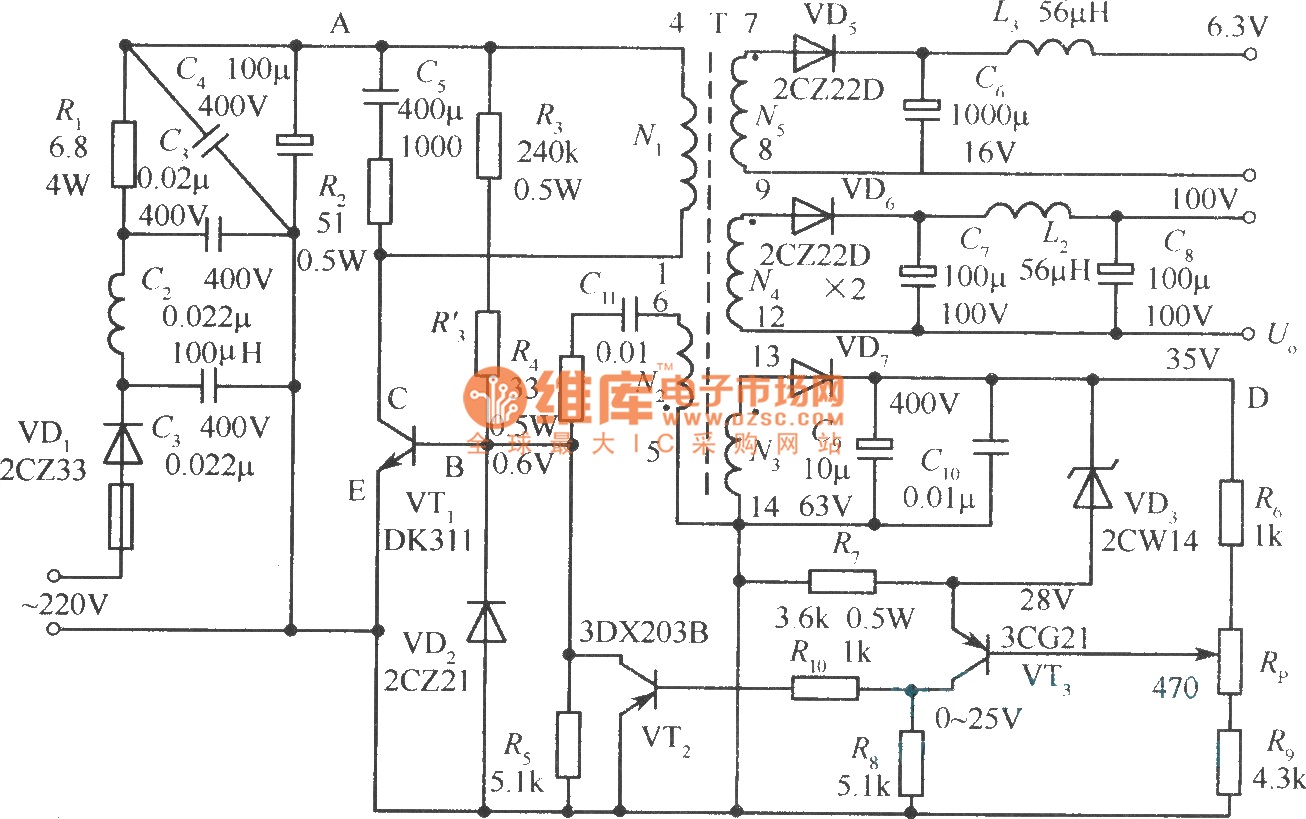
Output sampling winding isolated switching power supply
The diagram illustrates the output sampling winding of an isolated switching power supply. In the diagram, T represents a high-frequency transformer; N2 denotes the self-oscillation positive feedback winding; N3 is the error amplifier; VTS is the winding that provides the...
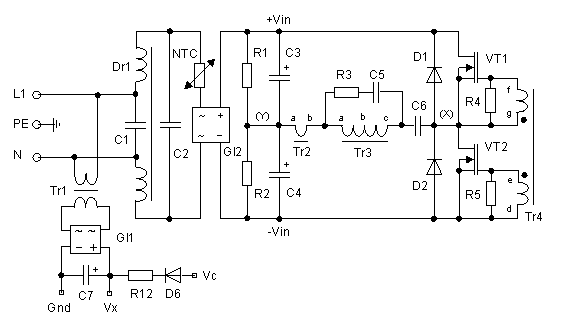
250 Watt PC power Supply
Up to 10 A continuous output current, or operation with 50 % ESD and 18 A peak current are possible without a fan if sufficient natural air flow is present and the ambient temperature does not exceed 30 °C. A...